Home Blog Page 471

Climate Smart Agric: How Aquaculture is greening a ‘desolate’ countryside


The Njovo Community Garden is fed by water from the nearby Njovo Weir

Moses
Ziyambi

With climate change
increasingly becoming mankind’s greatest existential threat, climate smart
agriculture has become a buzzword but effective responses to the crisis remain dispersed
and far between.

In Zimbabwe, as in
every other developing country indeed, sustainable responses to climate change
and the grave threat it poses to livelihoods in general and food security in
particular are even less convincing.

It is in light of this
gap between problems encountered and solutions offered that Aquaculture
Zimbabwe, a Non-Governmental Organisation (NGO) based in Masvingo, is making a
notable difference in the most vulnerable communities through a multi-pronged approach.

Through its Integrated
Agriculture, Aquaculture Production System, the organisation is implementing
diverse projects in three districts namely Bikita, Gutu and Masvingo Rural.

The programme encompasses
assisting communities to set-up combined projects comprising the raising small
livestock, building of gardens and planting of orchards at the same piece of
land.

In Masvingo Rural Ward
18, Aquaculture has assisted the Njovo community to build a dam which supports
over 500 villagers through a scheme called the Food Assistance for Assets
Programme.

With either direct or
indirect support from the World Food Program (WFP), the United States Aid for
International Development (WFP) and other partners, Aquaculture has facilitated
natural resource reclamation and conservation in a manner which supports livelihoods
for the Njovo community under Chief Shumba.

The project begins in
Zezai Village with a water harvesting exercise involving the building of a 186
metre-long trench along the Mashate-Veza-Jerera gravel road.

The trench will harness
water which perennially gushes down the adjacent Mashate Mountain and floods
the road every rainy season thereby eroding all the gravel downstream and
making movement harder for children attending the nearby Njovo Primary School.

By reducing the erosion
of gravel and other top soils from the road, the trench will significantly
contribute to broader efforts to reduce siltation of the nearby small river
thereby protecting a massive weir that has been constructed a short distance
downstream.

When this writer
visited the site, many villagers were busy at work, putting final touches to
the trench which channels the water to a wetland further down the road.

“We will be done with
this section of the project by September. I am glad that we have received so
much buy-in from community members who appreciate the project’s worth,” says
Food Assistance for Assets field officer John Shumba.

At Njovo Primary
School, a few metres away, an even bigger project to harvest run-off water is being
implemented by another contingent of enthusiastic villagers with Aquaculture
technical support.

A massive water tank
with a holding capacity of 8 000 litres is being built at the base of a hillock
which overlooks the school to the north. The tank will receive water channeled
into it by a network of strategically-built stone kerbs that will offload into
a funnel which runs into the tank.

The stored water will
be accessible to the school for gardening and sanitary purposes thus ending
decades of water poverty.

An 8000-litre tank is being built at Njovo Primary School


What is more striking
about all this work is perhaps the fact that much of it is being done using
locally-available resources; both human and materials – stones uprooted from
the hillock and quarry obtained by hand-crushing the same.

The school has all
along operated a garden on the wetland, on which makeshift structures of poles
and wire had served to protect vegetables from roving village livestock every
dry season.

At the edges of the
school beyond the road sits the wetland, itself another flagship section of the
project where some 20 beehives stand secluded in verdant thickets of wild bush
and grass.

The places has since
been neatly-fenced as part of the reclamation process and to ensure that
livestock and humans do not pound its sodden ground with hooves and feet at will,
and neither will they be able to trample on its delicate vegetation again.

The contrast between
the overgrown protected area and its heavily trodden, overgrazed immediate environs
cannot be starker, with the fenced area’s vibrant vegetation providing cover
for delicate soils beneath.

“This dekete (wetland) had traditionally been
considered sacred and the myths associated with it helped keep it a bit safe
for some time. However, as times began to change, people started to have little
regard for it.

“Trees were cut down
randomly, with pollutants from the school and the greater community finding their
way here. It is heartening to know that all that defilement is now being
reversed. We are now conserving this wetland and we are adding value into it
through the bee-keeping project which will soon give us enormous rewards,” said
Modrick Taruvinga, the wetland conservation committee vice chairperson.

Sitting on a 2.5
hectare piece of land, the wetland’s vegetation is thriving once again. School authorities
will no longer run a garden on the wetland as they will soon be doing it right
in their yard using water from the new tank.

The wetland’s new
custodians say it is becoming a budding haven for diverse flora and fauna; such
herbs as moringa/marenge which have medicinal properties, as well as the feared and
almost mystical python which itself is an endangered species.

It is onto this wetland
that runoff water from Mashate Mountain, as channeled by the new trench, will
be seamless released to aid infiltration and help feed into its ecological
balance.

The committee, which hopes
to increase the beehives to 500 in the year 2021, has already prepared an
adjacent piece of land which has been earmarked for a banana and citrus grove.

Members of the
committee say the grove will provide abundant flowers from which the bees will
extract ingredients for their cryptic yet sweet recipes.

More importantly, the
wetland thicket and the envisaged banana-citrus grove are part of the watershed
management upstream, which involves reducing soil erosion which leads to siltation
of the water body.

The wetland is bound by
Masvora River at its southern edge down which Aquaculture has facilitated the
construction of the giant Njovo Weir which has already spurned new agricultural
activities by hundreds of villagers.

This is a place which
clearly captures the Integrated Agriculture, Aquaculture Production System
which combines market gardening, tree planting, poultry farming and fisheries.

The combined projects,
which are dominated by women, have incarnated the kind of hope that all people
need to get by.

Use of waters in the Njovo Weir is regulated by an Asset Regulatory Committee 


Irrigation water is
released from the weir and travels by gradient into an underground storage tank
downstream, from where it is hoisted by a solar-powered submersible pump into
huge overhead tanks (colloquially known as Jojo tanks).

A labyrinth of piping  delivers the water to the length and breadth
of the garden which boasts a variety of vegetables including beans, sweet
potatoes, king onions and covo. The vegetable beds are interspersed with fruit
trees which get watered the very moment that the vegetables are watered.

A borehole was also
drilled to supply potable water to the poultry project which raises the Sasso
chicken breed.

“Sasso chickens are a
duo-purpose breed which can be used for both eggs and meat. It grows faster
than the traditional chicken breed and is less expensive to feed than the broiler.
The manure generated here is used on the vegetable beds,” said project
secretary Angeline Kamheni.

A fisheries
industry is also taking off after Aquaculture invested 30 000 fingerlings into
the dam, with the Zimababwe National Parks and Wildlife Authority (Zimparks)
adding a further 15 000.

For US$1, one
earns some four hours of fishing rights on condition that only two fishing rods
are used at a time. Profits realised are kept by the Asset Regulatory Committee
for use in maintenance and sustainability work around the dam.

The weir, which has a
capacity of 40m3 at a full supply level of 1.5m
,
has a masonry spillway wall bound by earthen embankments on each side, all
built by villagers who receive food incentives in return for their labour.

On the
embankments, vetiver and sisal grass nurseries are being prepared as part of
measures to forestall erosion and siltation. These measures are complemented by
an over 1.5km fencing around the dam which provides an orderly restriction of
access to the dam by livestock.

The barbed wire
fencing has already helped to spare some healthy undergrowth from the pounding
hooves of livestock thereby complementing efforts to preserve the pristine
state of the water body.

More interesting
is that the set up at Njovo has its lookalike a few kilometres away in the
Tadzembwa community of Ward 17 where the Chebvute Weir, Community Garden and
Fish Ponds project – which now sustains over 500 households – has also taken
shape.

The Chebvute
Weir, which appears to be a replica of the Njovo Weir, was built along Nyamangure
River which flows south-westwards through several villages.

From its depths
flows the precious liquid running through a piping system which branches onto
the 3.5 hectare plot which in turn hosts a vegetable garden, a fowl run and a
goat pen housing 24 goats.

People from such
villages as Sumbayaonda, Maregere, Murambwi and Tadzembwa have found succor in
this project which has given rise to hope that it is possible to mitigate the
worst of climate change.

“I feel we have
survived a desperate situation as a community, thanks to the intervention by
Aquaculture. This is not a haphazard project as it took a lot of planning and
consultations to implement.

“We realised
that the rains we received per year were no longer enough to support our
agricultural potential and sustain our livelihoods so we proposed this kind of
a project. The support from Aquaculture has been overwhelming and I am glad
that barely three years after construction work began, we have realised a
profit from this work,” said project chairperson Julius Swadi.

Aquaculture’s
support for the project begun with the provision of funding and technical
support for the construction of the dam, laying down the piping network,
installing the solar-powered system, building the infield canals, setting-up
the water tanks and supporting the project’s production systems.

A solar-powered
borehole also provides potable water for dozens of households that had hitherto
relied on unprotected water wells dotted along the river bank.

The goats, which
were bought using profits realised from the other projects being undertaken on
the piece of land, produce manure which helps to fertilize the vegetables
growing on this otherwise barren piece of land.

Project members
are also indulging thoughts of a lucerne grass nursery which would not only
help reduce soil erosion and siltation of Nyamangure River, but will provide
nutritious feed for their goats as well.

In between the
Chebvute and Njovo projects exists many households that are making use of new
climate-change mitigation agricultural knowledge acquired from Aquaculture’s
training programme which began a few years ago.

One beneficiary
of this knowledge is Elimon Mawire who is practicing a dry-planting method
known locally as pfumvudza. The
practice involves making composite heaps from which manure is obtained to fill
small, dry holes prepared in the fields.

At the onset of
the rains, maize seeds are planted in those holes and covered with a mixture of
top soil and the manure.

Mawire says this
method helps to conserve both manure and whatever little moisture that the soil
could retain with every rain drop.

“By filling manure
directly into the hole, little of that manure is wasted and this also helps to
improve moisture retention when rainfall is erratic. This is a more
conservatory method of farming than the traditional practice of spreading
manure all over the place,” said Mawire.

He said he would
also be eager to participate in Aquaculture’s envisaged plans to promote the
farming of small grains which are more drought-tolerant.

“People are not
very much receptive to small grains owing to the labour-intensive nature of the
processing which is required. But with the new technology that is coming, I
would very much be willing to invest my energies more on millet and sorghum
because unlike in the past, we no longer have reliable rainfall,” said Mawire
whose homestead which stands a few metres from the Mashate-Renco Mine road.

The Pfumvudza dry-planting method is now being practiced by hundreds of households under Masvingo Rural District Council


Several other
villagers in both wards 17 and 18 have embraced another relatively novel
initiative known as the key-hole garden which is a brilliant method of growing
vegetables right on the homestead using little water.

Keyhole gardens provide
for water recycling since even waste water that is normally thrown away in a
rural household can be ‘dumped’ onto them, with remarkable blossoming effect on
the plants.

On average, a
keyhole garden can last up to four years without having to re-dig it, and their
plants last longer with little water than plants in a more conventional garden
set-up.

Getting an
opportunity to see these initiatives give one an opportunity to appreciate how
ordinary people, with capacitation from capable partners, are working to make
Sustainable Development Goals (SDGs) Number 1 ‘Ending Poverty’ and Number 2
‘Climate Action’ a reality.


NSSA moves to mitigate Covid-19 impact

0


Noah
Kupeta

The
National Social Security Authority (NSSA) has embarked on comprehensive and
robust social security and protection mechanisms against the Covid-19 pandemic
on employees and organisations as part of efforts to contain the rapid spread
of the disease.

NSSA,
a State-administered insurance and pension entity, was created by an Act of
Parliament of Zimbabwe, through the NSSA Act (Chapter 17:04) of 1989, to
enhance social security and protection
against the economic and social distress.

NSSA
marketing and communications executive Tendai Mutseyekwa told this publication
that they had embarked on serious and comprehensive training of nurses and
employees pertaining to organisational healthy safety in the context of Covid-19.

“In
line with our mandate to promote health and safety at work, we are conducting
joint operations with the Ministry of Public Service, Labour and Social Welfare
to inspect whether or not companies are complying with Covid-19 guidelines as
set by the Ministry of Health and Child Care.

“We
also provide training for occupational health nurses and safety and health
professionals, as well raise awareness on issues to do with health and safety
at work through various media channels,” said Mutseyekwa.

NSSA
currently covers four branches of social security and is yet to cover the
remaining five branches.

This
has also been affected by continuous expansion of a huge informal sector, which
is not covered by social security.

Mutseyekwa
said organisational health remains a priority in NSSA’s endeavour to cover the inevitable
nonetheless.

“As
an entity responsible for social security and occupational safety and health,
we have put in place measures to prevent the spread of the coronavirus by
making most of our services available online and reducing the number of
employees coming to work at any given time

“We
have also designed a health monitoring questionnaire that employees fill each
time they come to work. We have set up a Covid-19 response team comprising
nurses and doctors to check on our staff by testing those found with the
symptoms as well as following up on those infected to ensure that they receive
adequate treatment and eventually be able to return to work healthy,”
Mutseyekwa said.

Organisational
health safety in Zimbabwe came under more intense spotlight in recent months
following the spread of coronavirus.

Some
analysts are convinced that the initiative by NSSA will go a long way in
complimenting the African Union Sustainable Development Goal number three which
focuses on good health and wellbeing through health insurance, medical aid
schemes and workmanship compensation, accidents and injuries, disability, and
high cost of medication.

Zimbabwe
Nurses Association (Zina) president Dr Enock Dongo said social security
protection mechanisms in face of pandemics should be holistic, comprehensive
and goal-oriented.

He
implored medical aid insurance companies to enhance their response to
organisational health safety against Covid-19 by appreciating loss of incomes
to employees and organisations.

“Medical
aid societies play a vital role in enhancing public and organisational health.
They are therefore expected to be innovative enough to prepare on how to fight
pandemics.

“The
monthly premiums from policy holders naturally increase, with those of
individual policy holders sometimes doubling up. This further strains them yet
that individual has been contributing so much over a course of time,” said
Dongo.

Some
policy holders said they too were worried by the erosion of the value of their
policies in light of the highly inflationary economic environment compounded by
the pandemic.

“Our
organisations are failing to give us the service we expect in the event of a
risk because of this hyperinflationary environment. I have worked for this
organisation for many years contributing my premiums, but most employees are
carrying the burden of topping up to service providers in case of need,” said
one policy holder.

Dr
Grace Muradzikwa, who is a commissioner with the Insurance and Pension
Commission (IPEC) said Covid-19 was indeed impacting on the performance of the
sector.

“The
circumstances have impacted on the ability of organisations to effectively
manage social security and protection of employees from work related risks. Reduced
disposable income owing to company closures, retrenchments and lack of formal
employment opportunities have seen organisations accumulating arrears of $887
million in premium arrears,” said Muradzikwa.


Tafadzwa Jabangwe successfully operated

0


Exsto Makunzva

ZVISHAVANE – Ten-year-old Tafadzwa Jabangwe, who had massive lumps on his back, was successfully operated at Karanda Hospital on August 06 2020.
Tafadzwa’s story was published by TellZim back in July, leading to many donations pouring in from as far as overseas countries.
The boy is now recuperating at home in Chetura village under Chief Mapanzure in Zvishavane district.
Shekinah Glory Organization spearheaded the fund-raising effort to cater for the boy’s medical expenses.
Juliet Bvekwa, who is director for the Zvishavane-based Non-Governmental Organization (NGO), thanked everyone who made a contribution towards Tafadzwa’s medical operation.
She told TellZim that after reading his story, many companies and private individuals swiftly responded to pleas to help Tafadzwa undergo surgery.
“I am humbled by the way people responded and gave a hand to Tafadzwa. Today I want to inform the world that Tafadzwa is now at home and is doing very well. The lumps were removed and the doctor said the infection was in his blood and he also said there were two more lumps in his stomach.
“The total amount of money donated to Tafadzwa was US$4 130, R500, ZWL$16 330 in EcoCash and ZWL$70 in cash. I also want to thank TellZim for the publicity. We have worked together very well with TellZim and part of the donated money came through their Masvingo office.
“The story they published went a very long way in publicizing Tafadzwa’s predicament. The story was read all over the world. We didn’t even know that their stories are even read overseas,” said Bvekwa. 
Tafadzwa’s father, John Jabangwe said prior to his son’s condition getting publicised, he had not known that there was so much compassion in the world.
“I had lost hope. I want to thank Shekinah Glory for everything they did for my son. I also want thank everyone who put hand in order for my son to be operated on,” said Jabangwe.
To read the first story on this matter, use this link https://tellzim.com/2020/07/zvishavane-boy-pleads-assistance-to.html

Anglicans side with Catholics in row with Govt

0
Arch Bishop Mutamiri of Harare


Upenyu
Chaota

The Anglican Council of
Zimbabwe (ACZ) has sprung to the defence of the Zimbabwe Catholic Bishops
Conference (ZCBC) saying government could not continue pretending that
everything was alright when the country was in a crisis.

This is contained in a
letter dated August 24, 2020 and signed by Ignatios Makumbe the Anglican Church
in Zimbabwe chairperson (Diocese of Central Zimbabwe), Godfrey Tawonezvi
(Diocese of Masvingo), Cleophas Lunga (Diocese of Matebeleland), Erick Ruwona
(Diocese of Manicaland) and Farai Mutamiri (Diocese of Harare).

In the letter, the
Anglicans urge the government to address the issues raised by the catholic
bishops instead of attacking them.

Riding on the Bible
book of Ezekiel 3:7 which reads, “Son of man, I have made you the watchman to
the house of Israel; therefore, hear the word at my mouth and give them warning
from me”, ACZ says that as a church could not ignore the torment that the
people were being subjected.

“The Anglican Council
of Zimbabwe (ACZ) writes in solidarity with the pastoral letter issued on 14
August 2020 by the Catholic Bishops Conference entitled “The March is Not
Ended”.

“ACZ notes with concern
the several responses by the government of Zimbabwe to the Catholic Bishops
Conference which seems to dismiss the fact that the church is called to
exercise its prophetic role, which can mean challenging our political leaders
on their conduct of affairs, particularly if this affects the people of God.

“We write this message
to highlight our concerns and emphasis that ‘Indeed the March has not ended’
unless and until the issues raised by the people of Zimbabwe and also echoed by
the bishops are attended to and resolved holistically,” reads the letter.

ACZ says that the
government has decided to take a defensive position and attack the church
instead of interrogating and addressing the issues and concerns raised by the
church on behalf of the people.

“We wish to register
our concerns to the several responses of the government which we feel were
counterproductive to the efforts being made by many stakeholders including the
church to unite the nation.

“We make it abundantly
clear that since time immemorial, the church in Zimbabwe has spoken against
injustice and has been consistent in that regard. Any view or postulation to
the contrary would be an attempt to rewrite that narrative in order to promote
a negative picture of what the church stands for.

“The church has the
biblical mandate to speak without fear or favour, particularly to a government
which believes that ‘The voice of the people is the voice of God’. The
prophetic ministry of the church mandates it to speak for God and for his
people as it is the ambassador of Christ and God in appealing through it (2
Cor.5:20).

“As Anglican bishops,
we desire to see an engagement of all stakeholders as respected by the Zimbabwe
Heads of Christian Denominations (ZHOCD) and respect of the constitution of the
land and institutions thereof for the good of the nation and (Proverbs 11:14)
victory for the nation as we, together, overcome all our challenges,” reads the
letter.

The Anglican Church
called on all progressive religious leaders and religions to pray for peace in
the country as the situation has reached a tipping point.

“We also call upon the
citizens of this our beautiful nation to remain calm, pray for peace and to
work towards all that promotes peace and the common good.

“We also call upon all
Christians and other religions to pray for our leaders and the nation at large
for peace, stability and prosperity.

“To our brothers and
Roman Catholic in particular, we say we are holding you in our prayers and may
the blessing of the Almighty God strengthen you and be with you now and
forever,” reads the letter.

After ZCBC wrote the
pastoral letter, the government raged and attacked them bishops as evil, but
several other faith and non-faith organisations published statements in support
of the bishops.

During a recent Zanu PF
politburo meeting, President Emmerson Mnangagwa challenged churches that were
critical of his rule to form their own political parties and contest in
elections.

Duped Ghanaian players get justice

0


Energy Zava

…as
Zifa suspends two officials, orders them pay back US$5 000

Clayton
Shereni

MASVINGO— Local
football mother body Zimbabwe Football Association (Zifa) has ordered two of
its suspended officials to pay back over US$5 000 to four Ghanaian players whom
they duped into travelling to the country and sign-up for a non-existent club.

Masvingo provincial
vice chairperson Energy Zava and finance member-in-charge Tinashe Gomba were
recently each slapped with a five-year ban from all football-related activities
and were ordered to reimburse the players whom they swindled.

TellZim reported a few
weeks ago how the two corruption-accused officials were digging in their heels
when made to account for their actions.

The accused duo did not
turn up for the hearing, with Zava having earlier requested for a rescheduling
but still failed to turn up when his request was granted.

Gomba is said to have
refused to turn up for the hearing, claiming his lawyer was busy with something
else.

The two, who deny the
charges, had their disciplinary hearing conducted at the Masvingo Zifa office
on August 07, 2020.

In passing the ruling,
the disciplinary committee noted that the two had committed a heinous crime
which was tantamount to human trafficking.

“The deeds of the
accused persons are no different from the criminal contact of human
traffickers. Young and innocent footballers between the age of 23 to 24 years
of age were plucked from their families and homes and further swindled of money
through elements of misrepresentation, fraud and forgery and dumped in a
foreign land without proper accommodation, medical aid or care and turned into
beggers in a foreign land,” reads part of the judgment which TellZim had the
privilege to see.

The two officials were
ordered to pay US$1 300 to each of the four Ghanaians in cash.

“The first and second
accused persons are ordered to contribute equally in restituting US$1 300 to
each of the following Ghanaian players; Nelson Atsu Adenyo, Peter Tibilla, Francis
Adjetey and John Adu Poku. A total of US$5 200 to be given in cash within 30
days of the issuing of this order,” reads the judgment.

The four Ghanaians were
prejudiced by Gomba and Zava through a fake letter signed by Wellington
Muchemwa, the former provincial football boss, inviting the players to a
non-existent club called Khaya Africa FC supposedly based in Chiredzi.

The players were dumped
in Chiredzi where they were offered petty deals by the duo and three of them
are reportedly still stuck in the sugar-producing town while one has returned
to Ghana.

Hungry Zaka villagers get food from LOBDA

0


Venancio Kurauone 

Brighton
Chiseva

ZAKA – Lowveld Business
Development Association (LOBDA) recently donated food hampers to the Minister of
State Masvingo for Provincial Affairs Ezra Chadzamira in a move the
organisation said was a way of assisting to reduce hunger during the lockdown

Minister Chadzamira, who is also
chairperson of the Covid-19 Provincial Taskforce which is composed of several
subcommittees, received the donation at a ground-breaking ceremony to mark the
beginning of construction of Mudzara Secondary School in Mudzara Village.

Chadzamira in turn handed over the
donation to Zaka District Covid-19 Taskforce which then distributed to the food
to the disabled and other needy people who were present.

LOBDA chairperson Venancio Kurauone
donated a total of 100x10kg bags of mealie-meal which they said were meant to
contribute to the welfare of people in need.

“Our thrust as an organisation is the
development of Masvingo province so we can achieve that through many ways including
helping families that are most vulnerable during this lockdown period. The Minister
of State is the local face of government so we will continue to work with him
and other relevant authorities,” said Kurauone.

Kurauone, who hails from Zaka West, was
in the company of Chiredzi West Member of Parliament Farai Musikavanhu and
LOBDA member who himself donated 200kg of sugar.

Zaka Ward 13 Councillor Manfred Mada
donated 100kg of mealie-meal before urging other people to lend a hand to the
needy.

“It is our duty as the community leaders
to make sure that people have food in times of a crisis. We should not confine
ourselves only to areas we lead but have to unite and develop our district and
the whole province,” said Mada.

After receiving the donations, Chadzamira
thanked LOBDA and others saying their contributions were important to the
welfare of vulnerable people.

Recently, LOBDA donated some face masks,
sanitizers to Chiredzi General Hospital.


The best dining experience at Pagomo Pub n Grill

0


A braai treat at Pagomo Pub n Grill


Staff Reporter

MASVINGO –
Outdoor food lovers in and out of Masvingo now have an exciting place to dine
and sit back following the opening of Pagomo Pub n Grill in Clipsham Views just
behind Puma Service Station at Wimpy.

Pagomo
Pub and Grill could not have come at a more opportune moment since the Covid-19
induced national lockdown and the subsequent extensions have thrown many places
out of business, leaving people with no comfortable out-door place to have
descent meals and drinks.

The
location of the outlet, along a major highway but on the outskirts of town,
gives customers both the convenience of reach and the serenity of fresh air.

Pagomo
Pub and Grill is not only a new joint in town – having opened its doors to the
public on July 27 – but is also a place where succulent dishes and chilled
drinks are served in a clean atmosphere.

Traditional
and Western dishes are available at reasonable cost; braaied and stewed beef,
chicken, turkey and other meats served with salads, vegetables and a one’s
choice of starch.

Sadza
rerviyo, traditional ‘road-runner’ chicken and peanut-buttered rice are part of
the treats awaiting those who prefer healthier dishes.

Pagomo
Pub and Grill operations director, Talent Chivange said the place was working
to further improve customer experience through additional services.

“We
want to a be a one-stop shop for all customer’s basic requirement so we are
setting up a butchery which will stock the choices grades of steaks, sausages
and mince at the most affordable prices.

“Sit
down pub and grill customers will soon have access to Wi-Fi, and this tells you
that we want to make this place the ultimate place to be for both ordinary people
with time to spare and executives who want some time to relax but without
losing their connectivity,” said Chivange.

He
said a wide open-air set up was deliberately chosen to allow for social
distancing in accordance with regulations governing the national lockdown.

“Besides
the obligation to comply with the requirements of national laws and
regulations, we also feel obliged to protect the health of our customers and
staff by maintaining the best hygiene practices. We therefore keep this place
clean and everybody gets hand-sanitized,” said Chivange.

He
said the place was testimony that young people can use their entrepreneurial
skills to create employment for themselves and others in order to contribute to
the economy.

“We
are also handing out face masks to members of the police at roadblocks as well
as to any other citizens who are in need,” said Chivange.


We have no authority to prosecute Kurauone: State

0


Martin Mureri expressed disappointment that the court had consented to the State’s request that the case be postponed by a further full month

…MDC Alliance organising
secretary remanded for further one month

Mark Chavhunduka

MDC Alliance national youth
organiser and Masvingo Urban Ward 4 Councillor Godfrey Kurauone will spend another
full month in remand prison after the State yesterday, August 25, argued in
court that it needed 30 days to seek prosecutorial authority from the
Prosecutor General’s office.

Kurauone will therefore be back in
court on September 24 after Magistrate Patience Madondo sided with the State
for postponement of the case.

Kurauone, who was arrested on July 31 and has two other separate charges pending, faces charges of undermining
the authority of President Emmerson Mnangagwa.

Human Rights lawyer Martin Mureri
said he was very disappointed by the decision as he had expected full trial
since the State had a very long time to put its house in order.

Kurauone arrived for the court proceedings
under heavy guard and in leg irons.

The court room was filled with
supporters and the case had to be delayed while the police made concerted
efforts to remove everyone from the gallery ostensibly on the basis on maintinaing social distancing.

Kurauone’s case has put Zimbabwe
under the spotlight with the US Senate Foreign Relations Committee castigating
the President Mnangagwa’s government for human rights violations.

“The credibility of Zimbabwe’s
judiciary was eroded more this week after bias shown by courts against
citizens- denying bail and choice of counsel. All political prisoners including
Hopewell Chin’ono and Godfrey Kurauone deserve impartial justice and due
process,” noted the Committee in a recent statement.

Former US secretary of state
Hillary Clinton also tweeted urging government to release Kurauone and other
political prisoners whom she said represented Zimbabwe’s future.

People to People: 15-year-old paraplegic gets wheelchair

0


Ratidzo Munembi

A 15-year-old disabled boy from
Mucheke in Masvingo was last week given a new lease of life by the People to
People Organisation Zimbabwe which bought for him a brand new wheelchair.

Anesu Nyasha Zvinake, who was
born paralysed on his lower body and has speech difficulties, beamed with
delight when City of Masvingo Town Clerk Edward Mukaratirwa presented him with the
wheelchair.

Mukaratirwa also serves as patron
of People to People Organisation which has of late been involved in a number of
charitable activities.

Anesu’s mother Mary Tungamirai
said her son had never missed a chance to remind her that he needed a wheelchair
so that he too could move around more freely like other children of his age.

“Anesu wanted a wheelchair so
much that he would try saving a few coins he got from well-wishers towards the
cause. He wants to be free and adventurous but he faces serious limitations
since he could only do that when I carried him out of the house and walk around
with him,” said Tungamirai, who got widowed a few years ago when her husband
died in a vehicle traffic accident.

In his remarks, Mukaratirwa said it
was through acts of kindness and compassion towards others that people could become
really free.

“These are the kind of cases that
should jolt all of us into action. As People to People Organisation Zimbabwe, we
could not simply sit back after learning about the condition of Anesu. Many people
and organisations put their heads together and made contributions that made the
purchase of this wheelchair possible,” said Mukaratirwa.

He thanked Profmed, a company
which specialises in the sourcing and distribution of medical consumables and equipment
as well as rehabilitation and physiotherapy equipment, for taking a lead in the
initiative.

Meanwhile experts have
recommended that Anesu be sent to St Giles School for the Disabled in Harare but
he has remained in Masvingo because his mother cannot afford the costs


Mwenezi School gets 1st classrooms after 17 years

0


Turf Primary School

Cephas
Shava

MWENEZI
Turf
Primary School, which is located in Ward 15 Mwenezi West, now has its first
classroom block after 17 years, thanks to an intervention by the United Nations
Children Emergency Fund (Unicef).

The satellite school
began offering classes in the open back in 2003 at the height of the Land
Reform Programme and has constantly registered zero percent pass rate in grade
seven exams.

Many pupils had been
sitting on the ground under makeshift structures built of wooden poles and
dagga with thatched roofs while several others conducted lessons under trees.

TellZim first reported
about the dire state of affairs at the school on February 10 this year, much to
the embarrassment of provincial education authorities, and to the dismay of
children’s rights groups.

The community then
mobilised itself and began molding bricks that are being used to construct a
single block with two classrooms.

Turf Primary School
Teacher-in-Charge (TIC) Benard Chauke confirmed the developments in a phone
interview with TellZim.

“Community members
mobilised themselves to build the classroom block which is now nearing
completion at roof level. This is a milestone for us because we had not expected
it. The development shows what can be achieved if ordinary community members
work together,” said Chauke.

He also said the school
still faced many infrastructural deficits as the block will not be enough to
accommodate all pupils.

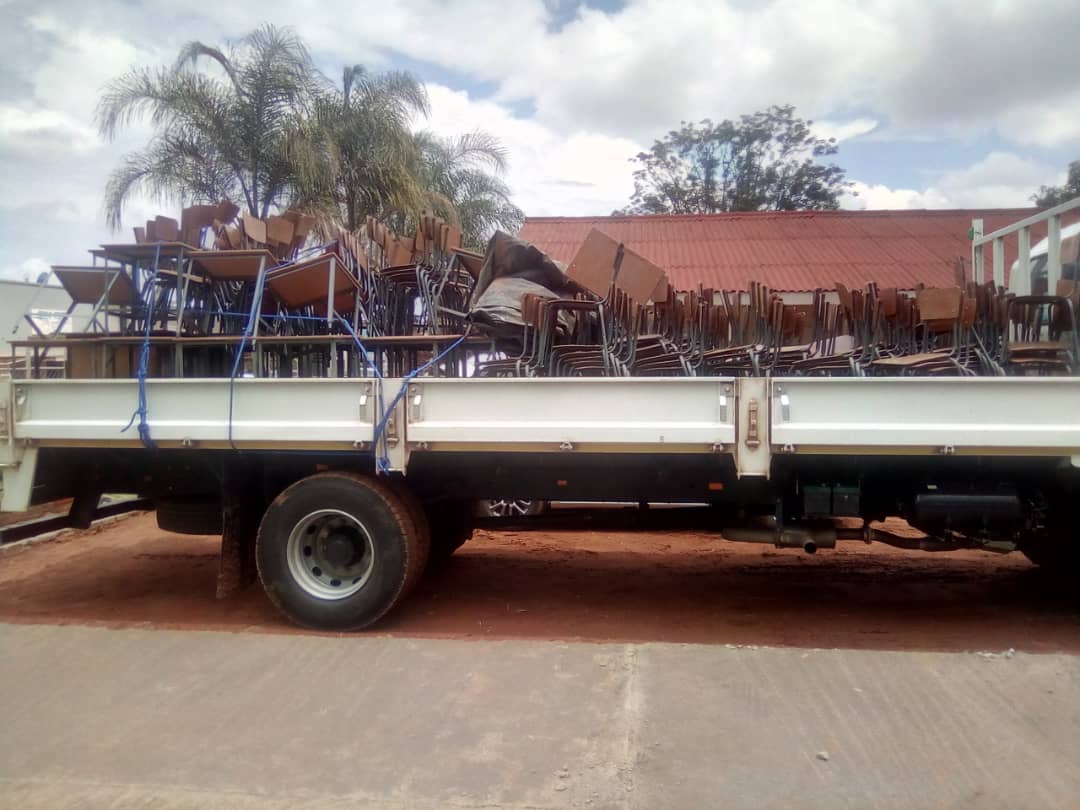
He said some new pieces
of furniture were bought by money availed through the Ministry of Primary and
Secondary Education by Unicef under its School Improvement Grant (Sig) programme.

“We have been the
receiving money under the programme for some years and this time we used our
share to buy 42 chairs and 43 desks that will be used in the new classroom
block,” said Chauke.

Mwenezi Ward 25 Cllr
Samuel Kwinika praised the local community for coming together in the name of
development, but called for more assistance from those capable of intervening.

“The level of
commitment displayed by locals towards this project is awesome. We are also
grateful for the funds donated by Unicef,” said Kwinika.

The school has only
five teachers for its 385 pupils with shortage of facilities meaning that many
classes are combined. Mwenezi has 102 satellite schools that are
poorly-equipped and severely understaffed.

The original story that
TellZim wrote on Turf primary School can be accessed on;

https://tellzim.com/2020/02/17-years-of-waiting-for-classroom-block.html