Home Blog Page 660

A case for people with disabilities

People who are blind seen begging on the streets and on buses would tempt one to believe that it is a testimony of low levels of employment opportunities in the labour market of Zimbabwe. School to work transition often helps individuals who are blind with valuable workplace exposure. It is not known whether those individuals who are blind, who are beggars on streets and on buses have received proper school to work transition or whether they were prepared for employment through skills training.                     

In 2014, the World Health Organisation (WHO) estimated that 45 million people are blind in the world. Poverty and blindness are believed to be intimately linked, with poverty predisposing to blindness, and blindness exacerbating poverty by limiting employment opportunities (Kuper, et al,2011).
The blind are heavily affected economically, as 90 percent of them cannot work (WHO, 2014). It is known that as a disability, blindness often leads to unemployment, which in turn leads to loss of income, higher levels of poverty and hunger and low standards of living (Khupe, 2010).
It is recognised that inclusion in the workplace is critical to full participation in society and to financial independence but people who are blind have historically been under-represented in the labour market (Bell & Mino, 2013). People who are blind are confronted with barriers that limit their social participation, especially as regards access to the labour market (Bell, 2010).
The employment rate for individuals who are blind remains far below that of the general population, despite the fact that their education level is comparable (Shaw, Gold & Wolffe, 2007).
The employment rate of people who are bind is also lower than the population with other types of disabilities, as noticed by Shaw et al. (2007). Many people who are blind face barriers to their participation in work (Shaw et al.2007). In the La Grow & Daye New Zealand study (2005), individuals who had blindness reported that their condition limited the amount and type of work they could do (Brennan & Sleightholm, 2009).
Heber (1978) in McDonnall and Crudden (2009) demonstrated that figures obtained from a United States (1970) census indicated that 85%of the employable PWD were not working. Silape (1994) argues that most employers shun employing people who are blind because they claim that they could not perform well on the job. Some claim that it is costly to modify the work place to suit the needs of the people who are blind. She further indicated that some employers believe that people who are blind do not give a good image of the company since they are not “presentable” by virtue of their appearances.

 It is clear that stereotyped attitudes of employers in engaging blind persons for work remain a major barrier. Capella-McDonnall (2005) argues that a tradition has grown concerning the limited forms of work that can be done by people who are blind. This assumption has probably been based on the erroneous belief that almost every type of employment initially appears to be wholly or largely dependent on the ability to see.

There are several factors that predict employment for individuals who are blind. Among them, educational level, age, training in blindness skills, and visual status remain consistent across the research studies. Leonard, D’Allura and Horowitz (1999) found that both achieving a higher educational level and attending an integrated school setting for most of one’s schooling was associated with being employed.
 In addition, employment related skills (computer, typing, and use of public transportation), psychosocial variables (overall satisfaction with social contact and receipt of encouragement from family and friends), vision rehabilitation service, and technology training were associated with being employed. In relation to those factors that predicted employment in higher level positions, they identified higher level of education, technology training, orientation and mobility (O&M) training, and fewer hours of rehabilitation teaching.
Africa has the highest prevalence of blindness in the world, with an estimated 6 million people who are blind. The sub-Saharan region is estimated to have about 2 million people who are blind and it is estimated that 125000 people in Zimbabwe are blind (Zimbabwe Council for the blind(ZCfB),2017).

Compiled by Ishmael Danirayi Tabe

Trevor Dongo’s ‘secret family’ uncovered in Chiredzi


Trevor Dongo with his ‘secret family’


Beatific Gumbwanda

CHIREDZI – Popular Urban Grooves artist and ‘Ndashamisika’ hit maker, Trevor Dongo is said to have a previously unknown child with a Chiredzi woman, TellZim News has learnt.
It is said Dongo loves the child, named Tarel, but is no longer with his mother who has been identified as Talent Nhliziyo and he wants to keep the matter out of the public domain.
Dongo married Ashley Maumbe in 2016 but the couple separated the following year before reconciling in 2017.
Before that, it had been reported that a dancer named Rumbidzai Scaniso was claiming to be pregnant with Dongo’s child and was accusing the singer of refusing to take responsibility.
Nothing, however, seems to have been reported about Nhliziyo and her son Tarel who was reportedly born in January 2010.
“Contrary to public knowledge, Trevor’s eldest son is eight-year-old Tarel who has been hidden in Chiredzi since 2010. Trevor wants the matter out of the public eye though he tries his best to provide for the child,” said a close source.
When contacted for comment, Nhliziyo refused to comment and Dongo did not pick calls.
TellZim News, however, saw a photograph of Dongo with the woman purported to be Nhliziyo and the child said to be Tarel.
The photograph was reportedly taken when Dongo visited Chiredzi to perform at Labamba Sports Bar recently.local

Mwenezana Estate employee jailed for assault

Cephas Shava

MWENEZI – Bernard Makado (35) an employee of  Mwenezana Estate  who was hired by Kudzai Rufugokuda (30) to transport his scotch cart to Chingwizi but assaulted him along the way and left him unconscious after a misunderstanding, has been convicted of assault.
Makado’s co-accused, Energy Nyamakonde (22) was acquitted due to lack of evidence to link him to the offence.
Makado pleaded not guilty to all the two charges but was still was convicted of assault though he was acquitted on the charge of theft of a scotch cart.
He was sentenced to 20 months imprisonment with eight months conditionally suspended. The remaining 12 months were set aside on condition that he performed 420 hours of community service at Mwenezana Clinic. Since Makado is currently employed, he was ordered to execute the sentence over the weekends.
The State case was that sometime in September last year, Rufugokuda hired Makado’s truck to carry his scotch cart to Chingwizi intending to deliver it to Dumela village head.
Makado then engaged his workmate, Nyamakonde and the two accompanied Rufugokuda to Chingwizi but on the way they got lost as Rufugokuda was not well-conversant with the route.
This led to a misunderstanding that forced Makado to stop the vehicle and began to severely assault Rufugokuda with open hands and booted feet before leaving him unconscious in the bush.
The two suspects drove the vehicle and later left Rufugokuda’s scotch cart at another homestead under Chief Maranda.
The unconscious Rufugokuda was later picked by passer-by who alerted the police leading to the arrest of the two suspects.
As a result of the assault, the complainant sustained a fractured jaw and severe head injuries. He was referred to Neshuro District Hospital from where he was further transferred to Masvingo Provincial Hospital and later on to Parerenyatwa Group of Hospitals.
Angelinah Makonya prosecuted.crime

Gweru artists in anti-HIV & Aids stigma campaign


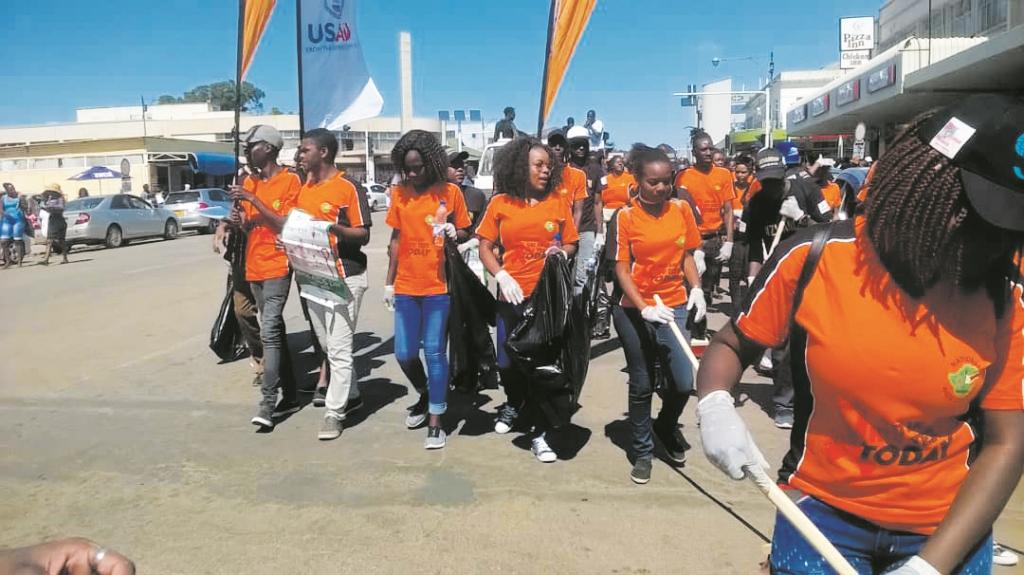
Gweru Artists Against HIV and Aids on a march and clean-up campaign

Tinaani Nyabereka

GWERU – The National Aids Council (Nac) recently partnered some concerned local artists for a concerted campaign against the stigma associated with HIV and Aids.
Running under the theme ‘Addressing Stigma and Discrimination Through Sports and Arts’, the programme sought to increase understanding of HIV and Aids, as well as debunking the myths that still persist in society despite some progress being made.
Gweru Artists Against HIV and Aids coordinator, Elias Maginya, who is also known as DJ Vas, said there was need to continue raising awareness on HIV and Aids as well as on other infectious diseases through music, poems and drama.
“Art is a powerful medium through which the message can better reach such critical targets as bars and night clubs as well as transport operators and the general public. We have come together as DJs, MCs, gospel artists and singers of other music genres in our common recognition of the important role that we can play in influencing positive change.
“We are encouraging each other to go and compose songs to fight new HIV infections while promoting zero tolerance to stigmatisation of people living with HIV and Aids. This is our own small way of contributing to this big struggle,” said Maginya.
He said although being possible agents of change, artists themselves were not immune to the virus but could, in fact, be at a higher risk of infection due to the nature of their work which involves travel and meeting many different people.
“Matters of sexual and reproduction health are also of great concern to us because we meet a lot of people at clubs, shows and galas. We are therefore pleased to be in partnership with Nac which is encouraging us to be good ambassadors,” he said.
Midlands Nac coordinator, Muraru Hwingwiri praised the joint sensitisation programme, saying his organisation was working to bring more stakeholders on board.
Some common stigma associated with HIV and Aids is the false belief that the virus can only be contracted through promiscuous sexual intercourse and that being HIV positive is the end of one’s life.
People living with HIV and Aids also face discrimination from family members and friends, out of the mistaken belief that, for example, sharing utensils with them is risky.health

Super refined foods a danger to health


Beatific Gumbwanda

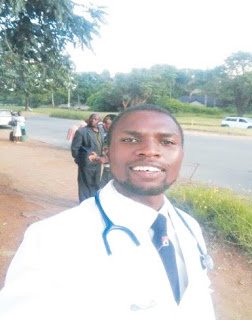
BIKITA – A junior medical doctor at Harare Hospital who is also a member of the Zimbabwe Diabetes Association (ZDA), Dr Nyasha Mupangabuwe has warned people to reduce consumption of super refined foods that he said posed a hazard to health.
Dr Mupangabuwe was part of a team of nine doctors from the hospital who recently visited Mashoko in Bikita South for some voluntary medical work.
Their visit was facilitated by the Masvingo chapter of the ZDA in partnership with Triangle Lions Club.
They brought a mobile clinic where more than 150 people were freely tested for diabetes high blood pressure.
Dr Mupangabuwe told TellZim News that people were being encouraged to lose weight and eat healthier meals.
“Diabetes is growing at an exponential rate due to super refined foods that have become the order of the day in most urban and rural homes.
“People should desist from taking super-refined foods and get back to their traditional meals that have been proven to be much healthier. Many people in urban areas are becoming diabetic due to daily access to super-refined foods,” said Mupangabuwe.
Super-refined foods include polony, tinned meat, all kinds of sausages, white bread, biscuits, pies, muffins, cheese and most cereals.
ZDA provincial chairperson, Edmore Veterai said there were many misconceptions about diabetes for example, that diabetes is only limited to older, overweight people.
“We need to impart more knowledge to our people on diabetes as it seems many people are being misinformed,” said Veterai.
Lions Club regional chairperson, Cosmas Chisare said rural communities lacked knowledge on how to better manage diabetes.
“Awareness in rural areas is lacking so as Lions Club, we have seen it necessary to chip in by working with important stakeholders like the Zimbabwe Diabetic Association. We don’t do it alone but with service providers,” said Chisare.health

The beast behind the binge…


Taona Tivafire

Alcohol’s impact on your body starts from the moment you take your first sip. While an occasional glass of wine with dinner is not a cause for concern, the cumulative effects of drinking wine, beer, or spirits can take its toll on your body.
Alcohol is like a sheet of cloth that most people use to cover themselves from reality. It is the way most enjoy their lives and use to bond with other people. We really cannot say that we had a party when there was no booze. In all its beauty and fun, there is the other side of the coin, a beast behind the smiling face. This week we will discuss the adverse effects of alcohol abuse.
Alcohol is one of the few substances that can be easily and readily absorbed by the body. It can reach and damage any part of the body. Starting in the digestive system, drinking too much alcohol can cause abnormal activation of digestive enzymes produced by the pancreas.  Build up of these enzymes can lead to inflammation known as pancreatitis. Pancreatitis can become a long-term condition and cause serious complications.
Most of the detoxification in the body occurs in the liver. Excessive alcohol consumption interferes with the normal detoxification process and increases the risk for chronic liver inflammation and liver disease. The scarring that results is called cirrhosis, hence liver cirrhosis. This decreases the ability of the liver to perform its various functions including making proteins essential for normal blood viscosity and condition, detoxification and glucose production.
                                        
The pancreas helps regulate the body`s use of insulin in response to glucose in the blood. When both the pancreas and the liver are not functioning well, there is a high risk of developing low blood sugar, also known as hypoglycaemia. Due to the damaged pancreas, there is no longer control of the blood glucose after meals and this results in increased sugar levels in the blood, hyperglycaemia. This is why most people who excessively take in alcohol later develop diabetes mellitus. People who are already diabetic should not take in alcohol.
Slurred speech is a classical sign that a person has had too much to drink. This is due to the alcohol`s effect on the Central Nervous System (CNS) that disrupts the communication between the brain and the body. This makes coordination more difficult and usually these individuals have a hard time with their balance. The damage to the CNS may also result in some numbness and tingling sensation in the hands and the feet. Drinking makes it difficult for the brain to create long-term memories. Over time the part that is responsible for emotional control, short-term memory and judgement, called the frontal lobe, becomes damaged. This can be the beginning of a permanent brain damage and leads to a condition called Wernicke-Korsakoff syndrome, a brain disorder that affects memory. The brain of an alcoholic is usually shrunken compared to that of a non-alcoholic.
Some heavy drinkers may develop a physical and emotional dependency on alcohol. Alcohol withdrawal can be difficult and sometimes life-threatening. Breaking alcohol addiction may require professional help. Some of the alcohol withdrawal symptoms include anxiety, nervousness, nausea, irregular heartbeats, heavy sweating. In severe cases seizures, hallucinations and delirium may occur.
Alcohol consumption can damage tissues in the digestive tract and prevents the intestines from digesting food and absorbing nutrients and vitamins. This may lead to malnutrition. Heavy drinking can also lead to bloating, gassiness or diarrhoea or painful stools. Ulcers and haemorrhoids, which may result from dehydration and constipation, may occur. In addition to this, alcohol consumers are at risk of developing cancer in the mouth, throat, oesophagus, colon or liver.
Alcohol can affect the heart and the lungs. Alcohol can interfere with the normal metabolism of fats, and may lead to cardiovascular complications which include hypertension, irregular heartbeats, stroke, heart failure, heart attack and heart disease. Decreased vitamins and mineral absorption from food can cause severe anaemia since these are vital in the formation of blood cells.
On the sexual and reproductive system, alcohol has some adverse effects. Men who drink too much are more likely to experience erectile dysfunction. Heavy drinking can also prevent sex hormone production and lower your libido. Women who drink too much may stop menstruating. That puts them at a greater risk for infertility. Women who drink heavily during pregnancy have a higher risk of premature delivery, miscarriage, or stillbirth. Pregnant women are strongly discouraged to consume alcohol as they will be putting the unborn child at risk of Foetal Alcohol Syndrome Disorders (FASD). This condition comes tagged with learning difficulties, long term health issues like heart disorders, physical developmental abnormalities and increased emotional problems.
Drinking heavily reduces the body`s natural immune system making it difficult for the body to fight off invading bacteria and viruses. People who drink heavily over a long period of time are also more likely to develop pneumonia or tuberculosis than the general population. About 10 percent of all tuberculosis cases worldwide can be tied to alcohol consumption.
Though there are some therapeutic advantages of alcohol, when taken in the correct amounts, which is about one normal glass per day, when taken in excess, it will unveil its beast face and things may get absolutely ugly. So, make a wise choice, decrease the amount of alcohol you take in, or completely stop. Until we meet again next time, stay healthy-live healthy.
Taona is a third year medical student from the Midlands State University (MSU). He is a member of the Zimbabwe Medical Students` Association (ZiMSA).education

Elderly Mwenezi man convicted for stealing stray cattle

Cephas Shava

MWENEZI – Obert Johane (61) of village one Sosonye under Chief Maranda was recently convicted for stock theft after he sold an unregistered stray heifer which he had been looking after at his homestead.
Johane pleaded not guilty to the charge but was convicted and was sentenced to nine years behind bars by magistrate Honest Musiiwa who strongly warned the public against stock theft, saying the offence carried a mandatory nine year jail sentence.
Despite the evidence of two key State witnesses Johane insisted that he was absent when Thulani Siziba, the buyer of the heifer, came to drive it away.
He claimed that Siziba had driven the wrong heifer which he had registered with the police as stolen cattle.
Siziba, however, pointed out that the very day he collected the said stray heifer, Johane was present and he was the one who helped him to tie it up.
The investigating officer Nonsikelelo Ndlovu presented evidence that in 2016, Johane registered a stray cow to the police but did not register its calf which he later sold to Siziba.
Prosecutor Willard Chasi said some time is 2016, a cow and its calf strayed into Johane’s homestead but he only registered the cow with the police, leaving the calf.
Sometime in October 2017 when the unregistered calf had grown into a heifer, Johane sold it to Siziba for US$300.
A few days after collecting the heifer, Siziba was tipped that he had bought a stray cattle. He then decided to return the heifer, with the village head witnessing the transaction.
A police report was later made leading to Johane’s arrest.crime

ZRP Zvishavane launches Foot Patrol Unit


ZRP Zvishavane patrol unit launch

Exsto Makunzva /
Caroline Gumbo

ZVISHAVANE – Zimbabwe Republic Police (ZRP) officer commanding Zvishavane-Mberengwa policing district, Chief Superintendent Edward Ncube has challenged police officers to be good at their work, saying society looked up to them for safety and security.
Speaking during the launch of a new Foot Patrol Unit at Mandava Bus Terminus recently, Ncube said police officers should do their duties in a way that inspires confidence in the people they serve.
“Ladies and gentleman, patrolling and doing beats is part of everyday police work. We should not be ashamed of our work. All over the world, police officers do beats and they patrol communities to ensure better observation and greater interaction with the people.
“When taking the oath on appointment, one swears to be faithful and to bear true allegiance to Zimbabwe and observe the laws of Zimbabwe. Therefore, a member who leaves his or her point of duty without permission or reasonable excuse is wayward. He or she is neither faithful, loyal, dependable nor trustworthy,” said Ncube.   
Members of the police were warned against selecting duties since the very nature of police work demands a lot of discipline, making it impossible for one to be selective.
Ncube said some members of the police despise patrols, considering them to be menial work for the less educated and unsophisticated.
“I get worried when police officers desert their responsibilities when they are supposed to be out protecting the people and fighting crime in communities,” said Ncube, urging members of the public to cooperate with the police for a safer society.
He also encouraged the media to promote accountability by exposing police officers who spend their time doing what is not expected of them.local

Another victim of 2008 political violence dies in Mberengwa


The late Trynos Shava MDC T secretary for defence

Tinaani Nyabereka

MBERENGWA – The Movement for Democratic Change (MDC-T), Midlands South secretary for defence, Trynos Shava, who died on May 04, has been described as a gallant fighter for freedom.
The 44-year-old Shava passed on after a long battle with an undisclosed illness which many people, however, have said was not unrelated to the injuries he suffered in the run-up to the violent 2008 presidential election runoff as well as in the early 2000s.
Shava rose through the ranks from the youth wing of the opposition party up to the position of Midlands South secretary for defence, a position he held for two consecutive terms until the time of his death.
MDC-T Midlands South spokesperson, Munyaradzi Mutandavari said the party and the wider society had lost a gallant fighter who suffered heavily for the sake of democracy and freedom.
“We have been robbed of one of our gallant fighters, Trynos Shava, from Mberengwa South. He was one of our dedicated sons of the struggle who fought well for the rights of the people and for the achievement of a democratic nation.
“He stood against many of Big Chitoro’s atrocities in Mberengwa and suffered heavily for it. He was instrumental in building our structures in parts of Zvishavane and Mberengwa districts,” said Mutandavari.
Wilson Kufa ‘Biggie’ Chitoro, who died in 20014 and was declared a liberation war hero and buried at Midlands Provincial Heroes Acre, masterminded a reign of terror in Mberengwa in the early 2000s, torturing many opposition supporters resulting in the death of the likes of Fainos Kufazvinei Zhou.
In 2008, Chitoro denounced Robert Mugabe for using him to commit acts of terror against opposition members, and regretted having committed many atrocities.
Shava’s long-time workmate and colleague, Lewlyn Sibanda described the fallen opposition member as a dedicated and courageous cadre who stood for the principles of freedom.
“Shava was a freedom fighter who was courageous, principled and was a no-retreat-no-surrender type of person and he will always be remembered for that,” said Sibanda.
Shava was laid to rest on the May 07 at his family homestead in Mberengwa. 
Present at his burial was many people including MDC-T Zvishavane senator Lilian Timveos, national council member Denias Mudzingwa, Midlands provincial secretary general Zenzo Hove, Midlands South spokesperson Munyaradzi Mutandavari, traditional leaders and several community members.politics

‘Sango Border Post misnamed’


Herbert Hasani Pikhela

Beatific Gumbwanda

CHIREDZI – People living in the Sengwe communal lands have welcomed plans for a possible rebranding of the Sango Border Post, saying the current name was inappropriate and was doing a disservice to efforts to market the place.
Sango is a Shona name for ‘bush’ or ‘forest’, a name which surrounding communities feel is not only negative but does not represent the area’s Tsonga/Shangani heritage.
Some of the local names that have been suggested include Justin Chauke (a late local Zanla commander), Xilotlela and Xikwalakwala.
Gaza Trust director, Herbert Hasani Pikhela said rebranding should be comprehensive, taking into consideration the Tsonga heritage as well as the divisions of their community by colonialism.
"The government of Zimbabwe' rebranding programme is a noble initiative. Surely we have a tainted past as a republic and wearing a new face is justified. In the name of rebranding Zimbabwe, I suggest that the name Sango for our dear south-east border with Mozambique be rebranded.
"Surely, how can we say our border is a bush? Why did we choose to go against the local Tsonga names? With all our contributions to the liberation of our dear Zimbabwe, the idle ruins of Gonakujingwa restriction camp bearing good evidence to that, can we be rewarded with such a name?
"I heard Tokwe-Mukosi Dam is being given its proper name. As we celebrate 38 years of independence let's relieve our dear border of this curse. Surely we can't attract any meaningful investment in the shadows of such a name," said Phikela.
Government has renamed Tokwe-Mukosi to Tugwi Mukosi to better resemble the correct pronunciation of the two rivers that feed into the dam.
Phikela said locals should be given space to define their places by naming them. He also said locals were better placed to explain why certain places should be given particular names. 
“Locals should be given space to define their places. When people visit us as the locals, they ask us the meaning of Sango and it's so embarrassing to tell them it's a bush according to our knowledge,” Phikela said.local