Home Blog Page 550

Granny past cow over witchcraft allegations

Brighton Chiseva

Zaka – An elderly woman from Mharadza village, Headman Nyamutaki
under Chief Bota was recently fined a cow for accusing her village head of
bewitching her.
Ketsia Zuva appeared in the Zaka
Magistrates; Court at Jerera where she was convicted but spared jail.
Efforts to get a comment from the
village head were futile as his phone was not reachable but Headman Nyamutaki, real
name Maxwell Chaminuka, confirmed the incident.
“She was reported to the police and was taken to court but due to her advanced age, she was spared jail time. However, the village
head demanded that he be paid a cow and culturally that is the norm. She had to pay the fine,” said Nyamutaki.
Nyamutaki said the whole issue
started when the village head found human faeces in his house and called a meeting where he warned the culprit to come forward or risk
unspecified action.
“The next day, Zuva came forward
and said her grandchild was the responsible. The matter was brought to my court so I sought audience with both of them and the matter was resolved amicably.
After a few months’ time, Zuva had some problems with her leg and she accused the village head of bewitching her over the
previous incident and that is how the issue ended up in the higher court,” said Nyamutaki.

Madzibaba flees shrine after raping minor

Cephas Shava
MWENEZI – A
self-styled prophet of Madzibaba Enguvo Tsvuku church has disappeared after
allegedly raping a 16-year-old girl who had been consulting fo healing, TellZim
News has learnt.
The
prophet, popularly known as Madzibaba Joshua, could not be found at his shrine
at the growth point when people went there looking for him last week.
Ward
18 Councillor Albert Mashiri said women and children must be wary of dubious
churches sprouting everywhere and their so-called prophets.
“There
is a case of rape involving Madzibaba Joshua which is currently being
investigated by the police. When we heard about the matter, we visited the
victim’s place of residence together with a team from the department of social
welfare and the Justice for Children (JCT) and we compiled our own reports,”
said Mashiri.
The
victim, who is from Nyajena, is said to be a form three school dropout who was
employed as a housemaid at Rutenga.
“When
the girl first visited the prophet, she was told that she possessed some mermaid
spirits that required continuous exorcism. When she returned for the second
time, the rape ordeal began and lasted for a long time. The culprit would
always threaten her against divulging the abuse, warning that she would go mad
if she ever did,” said a source.
Other
sources said the matter came to light when prophets at the girl’s own church
asked her to confess the sin of adultery which they accused her of committing.
That is when the minor opened up about the rape ordeal, leading to a police
report being made.
TellZim
News managed to visit the shrine where the self-styled prophet used to conduct
his services and the place was completely deserted.
  

Citizens want resolution of Gukurahundi massacres, says NPRC

Munyaradzi
Goche
MUTARE – Zimbabweans are
united in their call for the resolution of Gukurahundi atrocities to give
grieving victims and their families’ closure, the National Peace and Reconciliation
Commission (NPRC) heard during a meeting held in Mutare recently.
Speaking at a strategic and policy framework meeting
recently, NPRC commissioner Choice Ndoro said people in areas that they had
visited had demanded that the matter be resolved once and for all.
“People in Kitsiyatota (in Bindura) demanded that we deal with the
Gukurahundi issues in the name of Ubuntu. They said some fellow Zimbabweans in
Midlands and Matebeleland were grieving and wanted closure,” Ndoro said.
She said her commission was going to ensure that the
issue was handled with the guidance of the victims.
“The victims will need to guide us in tackling this
issue because each person was affected differently and would have their own
preferences in dealing with this,” Ndoro said.
She said they were preparing to consult widely in
order to deal with the issue that claimed over 20 000 lives and continues to
divide the nation close to four decades after independence. “We want to learn
from across the content; from the people of Sierra Leone, Rwanda and South
Africa as well as read about how Cambodia handled similar issues,” Ndoro said.
She noted that while the signing of the Unity Accord
in 1987 and the stability-inducing government of national unity in 2008 laid
some foundation for national healing and reconciliation, more still needed to
be done as that alone was not enough.
“Unity Accord and GNU did not resolve these issues….Yes,
something was done but was not enough. Part of the mandate of the commission is
to deal with the root problem which previous efforts did not deal with,” Ndoro
said.
She said there was need for people to always be
cautious of their actions as the country was still grappling with issues that
happened long before colonization.
“Before you think of doing anything remember you are
leaving a legacy for your children,” she said.

Body language story telling: An exploration of the intangible

Elizabeth
Duve Dziva
                           
Agnes
De Mille once said bodies never lie, the truest expression of a people is in
dance.  Dance symbolises elementary values
to our culture, our nation, tradition, spirituality, history and children. It
is one of the most authentic and reliable source of history for with it comes
an undistorted story. Dance is a strong magic, its telling a story without a
voice. Each movement sums up moments and experiences. Cultural dancers are
story tellers, they tell a story in every movement and sequence of their dance.
Every cultural dance has a story that needs to match the theme of the dance. Literally,
there is no cultural dance without a story.
The
beauty of dance is that even if you want to know what the dancers are trying to
express, you do not need to know a particular spoken language, it is merely
body language. It tells us something about people’s beliefs, feelings and
ancestry.  Dance is not simply body
language but has many theoretical definitions. As a matter of fact it is an
emotional movement with a strong meaningful moment and signifies a people’s uniqueness.
Cultural
dances are so valuable to various societies as they often carry pieces of their
history and livelihood that would otherwise be lost. A dance is a common language
that unites people at the same level. There are various dances in Zimbabwe
which vary according to ethnic diversity; some may have slightly changed due to
the dynamics of time. Among them are vast traditional dances which are very
powerful and meaningful. These include the Mbira dance which is accompanied by
a thumb piano (mbira instrument).
It
is religious in nature and is meant to summon ancestral spirits to come through
mediums. There is the Dinhe dance which carries a lot of war movements and also
has to do with inviting ancestors and agricultural fertility. Mbakumba dance is
performed after harvest and Muchongoyo was performed by the Ndebele men in preparation
for war or after war.
Jerusarema
(mbende) dance which goes along with drums and rattles was traditionally a
symbol of fertility, sexuality and family but today can be performed at various
gatherings. Mhande dance is usually performed at kurova guva ceremony bringing back a deceased person’s sprit and is
usually done by the Shona people. Isitshikitsha is a Ndebele dance which was
traditionally performed for the king’s pleasure and was also performed at
Njelele for rainmaking ceremonies during droughts. Among the vast dances are shangara,
jiti-chinungu, zihwere, chimutare, ingwenyama, mmabhiza, ingquza, chinyobera, ngungu
among many traditional dances which vary according to ethnic groups.
Today,
there are new dances like museve, bum jive, gwara gwara, house dance and break
dancing among many contemporary dances which are emanating. Apparently, they
carry no known connotative meaning than mere entertainment. Nonetheless our
generation should do nothing but to embrace them and try to pass them over generations.
Societal growth is inevitable and with growth comes change and such aspects
like new dances are unavoidable.
There
is need to preserve cultural dances for they connect us directly from the present
to the past.  The onus is upon us to
preserve the joyful body movements we have inherited from our ancestors and
those that we are inventing and pass them to our successors as they were passed
to us.
Elizabeth Duve
Dziva is an Archaeological and cultural heritage practitioner,
the views and opinions expressed
in this article are purely the author’s in her own capacity unless stated otherwise
. They do not
necessarily represent the views of any organization. Email:
duveelizabeth@gmail.com
.

Mwenezi imbiber murdered for ‘disrespecting’ bar owner

Tendai Mange
There
was shock at a drinking spot in Mwenezi district recently when a man was
murdered by his drinking mate for disrespecting the bar owner.
Masvingo
provincial police spokesperson Chief Inspector Charity Mazula confirmed the
incident and urged people to solve their difference amicably.
“We
can confirm that we received the murder case and a suspect is in our custody. We
urge people to try and solve their problems when they are sober,” said Mazula.
Sources
said Wilson Ngungwana of Village 10 Chipimbi, Mukwasine, was drinking beer with
his friend Charles Chauke of Village 8 Chimpimbi at Chagara’s bar.
A
serious misunderstanding emerged between Ngungwana and bar owner Funny Chagara,
leading Chauke to intervene against the former whom he accused of disrespecting
Chagara.
Chauke
then went outside the bar and brought a log which he used to hit Ngungwane on the
head. The victim instantly fell unconscious and was then taken to Chiredzi
Hospital from where he was referred to Hippo Valley and finally to Parirenyatwa
in Harare.
He
died at Parirenyatwa six days later.

MDC infighting persists in Mwenezi

                                             Chihwakwa-Sithole
Cephas Shava
MWENEZI –
The fight between two hostile MDC factions for the control of the district
seems to be far from over, with the both camps still claiming legitimacy after
the party’s national congress held in Gweru recently.
Prior
to the congress, a team from the national headquarters visited the district and
called a meeting at Neshuro where Alfred Chihwakwa-Sithole’s executive was
recognised.
At
the meeting, Chihwakwa-Sithole’s rival Timitia Dziva was allocated the position of
secretary for elections in an attempt to foster unity though he did not turn up
for the gathering.
At
the congress, however, the Chihwakwa-Sithole’s executive was shocked when they
were not allowed to vote while Dziva, who is Masvingo provincial chairperson James
Gumbi’s blue-eyed boy, and his team were allowed to cast votes in their stead.
When
contacted for comment, Chihwakwa-Sithole confirmed the problems but was quick
to say he was confident they will soon be solved.
“I
am the district chairperson but when we went to Gweru for the congress, it was
Dziva’s team that voted on behalf of the district at the expense of my team. We
raised the issue there at the congress and I have just briefed the provincial
leadership. They have pledged to resolve the issue,” said Chihwakwa-Sithole.
Repeated
efforts to get Dziva’s side of the story were fruitless as his mobile phone was
not reachable.
Prior
to the congress and soon after the national team visited the district to try
and resolve the dispute, Dziva refused to entertain questions from TellZim
News.
Several
senior MDC members said if the dispute in Mwenezi is allowed to continue, the
party was headed for yet another poor performance in the next election.
The
party won only one council seat in the district during the 2018 harmonised
elections.
   

‘A’ level Family & Religious Studies question and answer

Question:  Assess
the contribution of African traditional religion to the conservation of the
environment.


Mhuri Muneni

Africans
view themselves as part of the environment. This web of relation is what makes
Africans view the earth as their mother and themselves as her children. This
means that, though God, humanity and nature are distinct concepts they are
ontological categories that are interrelated and interdependent hence J. Mbiti’s
position that Africans are notoriously religious. This means that they believe
in everything being religious. Their environment is a sacred one that should be
guarded jealously. Therefore plants, animals and other non-living beings are
part of nature, which is the product of God’s creation deserving to be
respected as much as human beings who are also part of nature.
 The relationships between persons and nature
are rooted in God as the creator of all. God’s creation is a single family.
This is what makes Africans regard themselves as being in a close relationship
with the entire cosmos. Idowu et al posit that “Africans, especially in the
traditional setting were nature-oriented.” 
African traditional religion is a religion that comprises belief in the human
world, the natural world and the spiritual world. These three worlds are
linked. The natural world provides the habitat for the spirits and sends
message from the spiritual world to the human world (as hierophanies)
Haverkort, et al. For the Africans every plant, animal and natural phenomena are
sacred. In order to appease the spiritual world, people performed rituals and
made sacrifices. The human world has to relate to both the natural and the spiritual
world. It is, therefore, along this general world view that this essay will categorically
examine the attitude of African traditional religion towards the environment.
Land
is important in African traditional religion; it is sacred. That is why the
Shona used soil in swearing rituals. Some traditional sacrifices were
administered by the practice of people biting some soil and swearing. Besides
land, most African ethnic groups regarded water as a symbol of life. Watering
places were approached with respect. Most of the water sources belonged to the
whole community. Nobody was allowed to cultivate around these places. Trees
were not cut and vegetation was kept to ensure that water was not disturbed. To
protect the places and the water from being polluted, many myths, taboos,
proverbs, and riddles were formulated to educate or to make people aware that
those places had to be preserved. One taboo is not to fetch water from the
source using dirt pots (Hari). This would cause the source to dry up. More so,
people should not urinate into water because they might face serious
catastrophes. These taboos were formulated to make sure that people do no
pollute the water.
As
a practical religion, African Traditional Religion involves many beliefs and
practices, traditions and customs, which are the ways by which people express
their religion. Religious values beneath these beliefs customs and traditions
helped people to have a good relationship with their environment. Animals were
viewed as sacred creatures of God. That is why many myths and stories used
animals as main characters. They were respected as part of the whole creation.
Some ethnic groups believed that fierce wild animals such as lions and
elephants were just manifestations of the great power of God. The totemic
beliefs and taboos helped in the preservation of some animal species. For example,
the Remba people of Mberengwa use the Zhou totem. They are not allowed to kill
or eat meat from this animal. They respected these animals. All this consequently
helped in protecting and preserving many animals’ species and therefore the
environment in general.
Many
if not all ethnic groups in Africa, believed that God was the sole owner of the
universe. He created it and so He automatically owns it and does what He wants
with it. Awolalu (1979) posits that God owns the universe, He is immanent in
it. He dwells in the universe in special places, like mountains, rocks,
valleys, or trees. That is why traditionally Africans considered the universe
sacred. Therefore, nobody had the right to destroy it. They believed that the
power to create and destroy the universe belonged to God alone. Therefore, man
had no right to abuse, spoil, destroy or squander what God has made to manifest
His glory.
 In conclusion, Africans have to revert back to
their environmental conservation approaches that have been affected by
contemporary changes, and draw from them what is proper and blend it with
contemporary ways of environmental preservation. Traditional religious
education is important in environmental preservation. Traditional African
education has to be focused on preserving the sacredness of life and whatever
enhanced it. The African system of education traditionally emphasized respect
and reverence of nature which enhanced life. Contemporary Africa should borrow
a drop from traditional education systems as far as environmental conservation
is concerned.

The writer is a teacher at Errymaple High School in Zvishavane

B.A Degree in Philosophy and Religious Studies.


Post Graduate Diploma in Education,
Shona and Religious Studies.

Midlands loses thousands of hectares of vegetation to veld fires

Tinaani Nyabereka
GWERU – Midlands
province has seen massive destruction of vegetation last year due to veld fires
most of which were caused by human activities.
Most
cases of wild fires happen in resettlement areas where people were given A1 and
A2 pieces of land during the Land Reform Programme.
Most
of the land belongs to absentee landlords who hold it simply for speculative
purposes, while those who live there have little means to fight the fires.
Environmental
Management Agency (Ema) Midlands provincial education and publicity officer,
Oswald Ndlovu said most of the fires could be attributed to human activities.
“Most
veld fires are caused by human activities such as opening up new arable land
using fire, deliberate lighting of fires for hunting purposes, gold panning,
careless throwing away of cigarette stubs and improper ash disposal.
“Of
late, veld fires have resulted in severe environmental degradation which also
translates to diminished livelihoods. In Midlands province, a total of 114 035.04
hectares of land were burnt in 2018. 
This, however, translates to a 0.26 percent reduction from the 2017 record
of 126 652.68 hectares,” said Ndlovu.
He
encouraged people to make fire guards in their areas in order to avoid large scale
destruction of vegetation and land.
Fire guards are belts of land measuring at least nine metres
in width on either side of a boundary that are cleared of all combustible
material such as grass, shrubs and leaf litter. These can be made using
ox-drawn ploughs or using tractors.
“Engaging
in projects such as beekeeping, hay-baling and thatch grass-harvesting not only
helps in income generation, but in reducing fires as well. Hay-baling and
grass-combing projects help to reduce biomass. In 2018, a total of 368 001
bales were made countrywide with an estimated value of $552 001.
“In
Midlands, a total of 67 770 bales with an estimated value of $101 550 were
produced.  In 2018, thatch grass-harvesting
was done throughout the country at community level as a way of biomass
reduction and improving livelihoods,” he said.
Statutory
Instrument (SI) 7 of 2007 (Environmental Impact Assessment and Ecosystems Protection
Regulations) criminalises the deliberate starting of open fires between 31 July
and 31 October, failure to put in place a standard fireguard of at least 9m and
passing or driving past a fire and failure to report a fire to Ema, police or fire
brigade
.

USAID launches farmer-to-farmer program in Zimbabwe

      Farmers
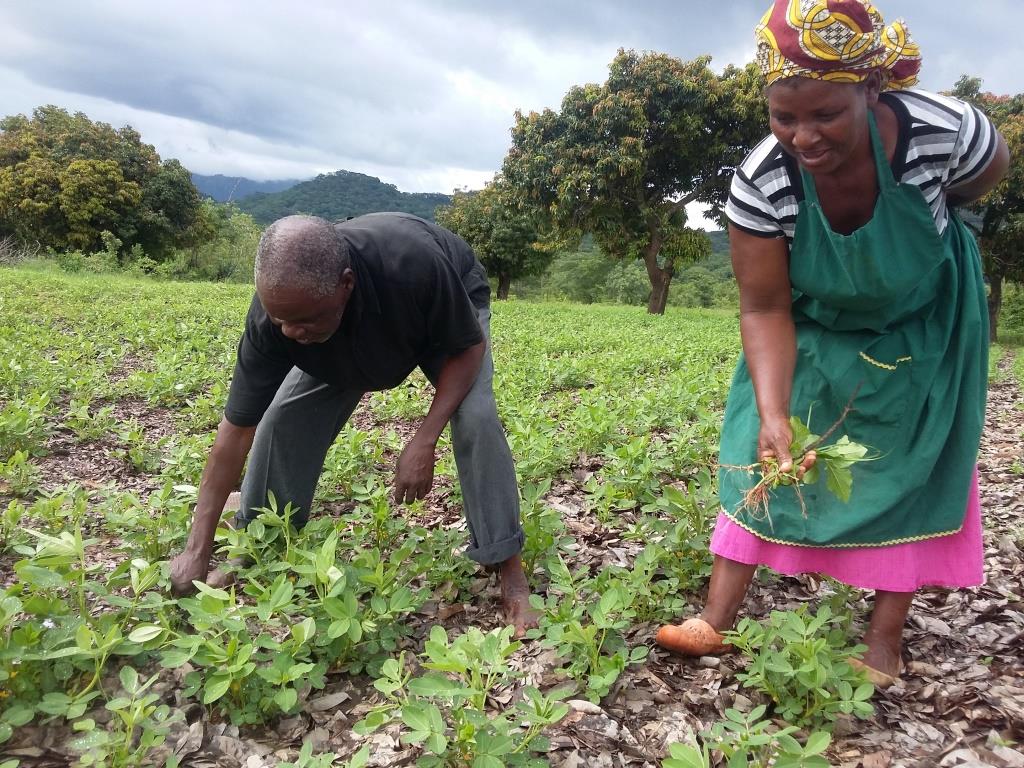
weed their groundnut field in Chivi. Photo credit: David Nyoni, ENSURE


TellZim
Reporter
HARARE – The United States Agency for
International Development (USAID) yesterday, May 30, launched the five-year
USAID-funded Farmer-to-Farmer Program for the years 2018-2023 at Africa Synod
House in Harare.
There were representatives
from the), the Government of Zimbabwe, a Farmer-to-Farmer volunteer, and
implementing organization Cultivating New Frontiers in Agriculture (CNFA).
The representatives
reaffirmed their shared commitment to strengthening agriculture and resilience
in Zimbabwe.
The USAID-funded John
Ogonowski and Doug Bereuter Farmer-to-Farmer Program provides technical
assistance by highly qualified American volunteers to farmers, farmer groups,
agribusinesses, and other agriculture sector institutions in developing and
transitional countries. 
The program aims to
generate sustainable, broad-based economic growth in the agricultural sector
and increase understanding of international development issues and U.S.
development programs through people-to-people diplomacy.
In Zimbabwe, the program
will focus on horticulture, legumes and livestock/dairy value chains due to
their potential to benefit many farmers and earn high returns on investment.
Through 84 volunteer
assignments, the program will catalyze the development of commercially viable
and sustainable businesses along these value chains.
The volunteers will support
the efforts of current US government-funded agricultural programs working with
farmers, aggregators, processors, and marketers. 
The training and support
provided through Farmer-to-Farmer will focus on improved production and
processing technologies, strengthening organizational and marketing capacity of
agribusinesses, and promoting the use of conservation agriculture.
Over the course of the
five-year program, volunteers will train thousands of small-holder farmers to
increase sales and learn how to do farming as a business in order to increase
household incomes, strengthen livelihoods, and build community resilience.
 USAID,
have contributed over $3 billion in assistance to Zimbabwe for a period of over
30 years. 
Current
projects include initiatives to increase food security, support economic
resilience, improve health systems and services, and promote a more democratic
system of governance.

By-election for Bikita East Ward 31

                                               Zex Pudurai
Moses Ziyambi

BIKITA – There will soon be a by-election for the Bikita Rural
District Council (RDC) Ward 31 to fill the council seat left vacant following
the death of Zanu PF Councillor Patrick Marozhe on April 15 this year.
The nomination court sits at
Bikita RDC boardroom tomorrow, May 31, with a number of parties including Zanu
PF and MDC expected to participate.
Zimbabwe Election Commission
(Zec) Masvingo provincial head, Zex Pudurai said it was all systems go for the
by-election which will be held on July 13.
“We are happy with our state of
preparedness. We are ready for the nomination court and any other subsequent
processes that need to be followed. We are also pleased with the peaceful
environment that we are seeing ahead of the by-election,” said Pudurai.
The opposition MDC held their
primary elections at Mandadzaka Primary School yesterday, May 29.
Presided over by a national organising team led by Tamsanqa Dangazela and Farai Chinobva, the primary elections were won by Moses
Maposa, who is the party’s district chairperson.
“We are already working hard to
market our candidate to the electorate because he is the best person to
represent the interests of Ward 31 residents in council. We are a party of
excellence so the people of Ward 31 have the best candidate in Maphosa,” said
MDC provincial youth leader Kudakwashe Bhadharai, who is a resident of Bikita
East himself.
Maphosa served as MDC councillor
in the same ward between 2008 and 2013.
Zanu PF is expected to be
represented by Thomas Mataga who last year contested in the party’s
primary elections for Bikita East and lost to current Member of Parliament (MP)
Johnson Madhuku.
“We are ready for the challenge. As
Zanu PF, we will launch our campaign on 09 June at Mandadzaka Primary School
and we will then be hard at work from that day onwards. We are confident that
we will retain our council seat because we are doing many developmental
projects in the communities,” said Madhuku.
Peter Mavenga is expected to
represent the Professor Lovemore Madhuku-led National Constitutional (NCA).
“The people now know that only
the NCA is capable of delivering on their needs because it is a party founded
on constitutionalism and good governance. We take this by-election seriously
because local governance is key to good service delivery,” said Ernest Rambe,
an NCA leader in the district.