Home Blog Page 346

Bikita RDC embarks on roads rehabilitation project

Innocent Muraiwa

Duma– Bikita Rural District Council (RDC) has embarked on a roads construction project through some State devolution funds within the location of Duma in a way to boost safe trafficking as well as getting rid of potholes.
Speaking to TellZim News, Bikita RDC Chief Executive Officer, Peter Chibhi said that they embarked on road rehabilitation projects within Duma location so as to improve safe trafficking. He further said the state of the roads was just an eyesore and that made them to quickly take some responsible actions in revamping the roads.
“I mobilised the team work to quickly work on roads rehabilitation processes within the location of Duma which I spied as of under an urgent attendance. Fortunately, we had sufficient equipment for the facilitation and spearheading of the roads rehabilitation process and the project was quickly done and that showed thriving development,” said Chibhi.
Duma resident Tatenda Munetsi applauded council over the new developments to upgrade roads.
“We are very pleased with such developments within our area. Now we have access to different places which have been brought up through the roads rehabilitation project by the council,” said Musengi.
Mirriam Mabhegedhe said the improved road infrastructure would help children, who had been struggling to access their learning centres due to dilapidated roads.
“The education sector has also been improved because during the past days, our children have been facing a challenge of better ways to get to their learning centres,” said Mabhegedhe.
Chibhi also stated that they are also targeting to rehabilitate roads in other Bikita communities.

Suspected hit and run incident kills one in Mashava

0

Rutendo Chirume

Police in Mashava on Monday February 7 discovered a human body at the 41km peg along Masvingo-Mbalabala road in a suspected hit and run incident.
Masvingo provincial police spokesperson Kudakwashe Dhewa confirmed the incident.
It is suspected that the accident occurred around 0300hours on February 7.
The police who were on duty at Mashava police station went on a night patrol and saw the body of a man believed to be around 25 years of age lying in the middle of the road.
He was wearing a yellow jacket, black trouser, black cap and black shoes and had severe head injuries with deep cuts and several injuries all over the body.
The body was taken to Chivi District Hospital.
The vehicle was not identified and investigations are still in progress.

Is Zimbabwe on course to build back better on girls education?

…as the number of girls dropping out of school rises rapidly

Theresa Takafuma/Rutendo Chirume

In 2019, Zimbabwe amended the Education Act, adding Section 68C, that allows pregnant girls to be unconditionally readmitted in schools, a move that gave the country a big leap towards ratification of international instruments in education.
In 2020 Zimbabwe recorded over 6 000 girls who fell pregnant during the first wave of the Covid-19 which saw closure of schools for over a period of three months, directly jeopardizing these girls’ chances to continue with education.
In 2021, the country continued to record a major increase in teenage pregnancies with nearly 5 000 girls falling pregnant in January alone and in February about 1 800 entered into early marriages.
As the world commemorated the International Day of Education (IDE) on January 24 2022, which is celebrated annually to showcase the most important transformations that have been made to realize everyone’s fundamental right to education to build a sustainable and inclusive future, a lot of girls’ future looked bleak.
In a world recovering from a global pandemic, where all hands are on the deck to ‘build back better’, a mantra that has been adopted by all stakeholders in a bid to channel all effort towards a return not only to normalcy but to even better circumstances, policy change seems to be racing against time for implementation.
United Nations Secretary General Antonio Guterres on IDE emphasized that education should strive to bridge gender inequalities and give significance to the girl child being more at risk of dropping out of school.
“We need education to reduce inequalities and improve health. We need education to achieve gender equality and eliminate child marriages. Yet at least 262 million children, adolescents and youths are out of school, most of them girls,” Guterres said in a statement.
During the recent United Nations Universal Periodic Review, Zimbabwe was urged to increase efforts in the protection of children and to criminalize child marriages.
Situations of girls dropping out of school especially after falling pregnant, are far too common across Zimbabwe and yet often go unnoticed and unaddressed.
In a recent report Amnesty International noted that these girls are then forced to find work, frequently as housemaids, to support their children or their families force them to go live with the men who impregnated them regardless of the circumstances in which they got pregnant.
Patience Mukaro (20) of Masvingo said she could not imagine that she will end up being a mother and housewife at such young age because like any other girl, she hoped to complete her education up to university before settling down.
Mukaro narrated how she saw her world crumbling before her eyes when she found out she was pregnant while waiting for her ordinary level results and lost hope for going back to school because of the responsibilities accompanied with being a mother and housewife as she was already carrying her second pregnancy at the time of the interview.
“I was shuttered when I found that I was pregnant and when my parents found out, they chased me away. That is how I got married and as you can see, I am expecting my second child. It happened unexpectedly but my dream was over,” said Mukaro.
Mercy Ncube, who also became a mother at 16 narrated how she was forced to drop out of school and came to the city to look for a job after finding out she was pregnant.
“I find out that I was pregnant when I was in Form three. When the man responsible for the pregnancy denied it, I tried to conceal it for some time but it was not long until my mother discovered it. Because she had heard that pregnant girls are not allowed at school, she transferred me to a private school, but it was not easy being a pregnant girl in school uniform.
“I was talk of the school. It was too much for me, therefore I dropped out. After giving birth in 2019, I left my child with my mother and came to the city to become a house help so that I could take care of my child. Also, I needed to get away because I had brought shame to my family and in the village people talked about me where ever I went,” said Ncube.
Mukaro and Ncube’s stories are just a drop in the sea compared to the actual number of girls who either turn to domestic work to eke a living for their children or who are then forced into marriage and child bearing at a tender age, which may even cost them their lives.
In 2021, 15-year-old Anna Machaya of Manicaland died while giving birth at a Johane Marange shrine, a religious sect that has been rapped for preying on girls who they deny the opportunity to go further than grade seven in school.
The patriarchal beliefs and perceptions of the marriage institution in Zimbabwe is again a major contributor to the gender divide which has seen more girls dropping out of school after falling pregnant, rendering the Education Act amendment that makes it illegal for schools to expel pregnant girls from school difficult to implement.
According to United Nations Educational Scientific and Cultural Organisation (UNESCO), due to coronavirus pandemic, 11 million girls and young women are at risk of not returning to school with over five million being in primary and secondary school levels.
According to United Nations Population Fund (UNFPA) Zimbabwe is among countries in sub-Saharan Africa with high rate of teenage pregnancies which has resulted in high adolescent fertility rate of 108 per 1,000 among young women aged 15 to 19 which is above average fertility rate of 101 births per 1,000 young women between 15 and 19.
The Research and Advocacy Unit also revealed that 31percent of girls in Zimbabwe are married before the age of 18 and four percent are married before their 15th birthday, despite the fact that Zimbabwe has criminalized all marriages below the age of 18.
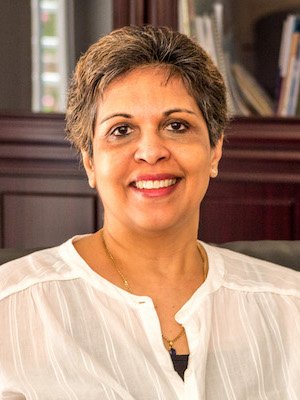
In an interview with TellZim News, African Union Centre for Girls and Women’s Education in Africa (AU/CIEFFA) Head of Mission Dr Rita Bissoonauth said although the pace of progress in implementing policies that enable pregnant school girls to return to school in Africa has generally been slow, Zimbabwe was however worth noting for revising the Education Act to allow pregnant girls to return to school.
“Zimbabwe is noted among Member States to have impressively revised its Education Act in 2019 including resourcing for the return of the girls to school, given the speed and swift actions undertaken in 2021. Also, key is Zimbabwe’s actions in the insistence on non-discriminatory and victimization of these girls, as they return to school.
“The pace of progress towards developing and implementing policies that enable pregnant school girls return back to school in Africa has been slow. As part of its Strategic Plan priorities for the period 2021 to 2025, AU/CIEFFA is committed to collecting data and undertaking research to inform African policy-makers and stakeholders on the pertinence of realizing the rights of ALL African girls and young women to quality education and training. With Sub-Saharan Africa region having high numbers of pregnant school girls, approximated at 13 million girls expected not to return to school, urgent action is required,” said Dr Bissoonauth.
She also said AU/CIEFFA has initiated two key interventions; to track legislative and policy progress on the rights of African girls and women in education, through documenting, with a focus on those out of school and the #AfricaEducatesHer campaign.
The campaign is an AU/CIEFFA communication strategy innovation in calling for Member States to allow girls to return to school after Covid-19 and other humanitarian challenges affecting participation of girls in schools.
To ensure effective implementation of laws and policies that enable readmission of survivors like pregnant girls in schools, Dr Bissoonauth said AU/CIEFFA has implemented about six activities to which Member States are meant to learn and replicate, given their contexts.
Other challenges faced when trying to implement the Zimbabwean policy, good as it may be, are lack of policy practices, fear of stigmatization by other school pupils, increased responsibility as the teenage mother has to balance between school and motherhood within the unsupportive school environment due to the state of schools in the country.
Women Action Group director Medina Masiiwa bemoaned the state of many schools in Zimbabwe saying despite the education amendment act, many schools do not have facilities to achieve that goal.
“There is a lot which needs to be done. Currently in Zimbabwe it can be difficult because schools have no proper facilities considering financial and economic hardships in the country. Also, that girl would need counseling in order to stigmatization from other pupils even the teachers,” said Masiiwa.
Communications Director in Ministry of Primary and Secondary Education (MoPSE) Taungana Ndoro said the ministry has been doing outreach programmes, encouraging pregnant girls’ readmission in schools, as the numbers increased due to the Covid-19 induced lockdowns.
“We have had quite a number of girls who fell pregnant because of the COVID-19-induced lockdowns. But still because of the policy that we have, this Education Amendment Act, which allows them to come back to school, we have been having community outreach programmes throughout the whole nation to encourage these learners to come back to school to continue with their education because it is not the end of the world,” said Ndoro.
As schools recently opened their doors for the 2022 academic year, the Zimbabwean government is constantly clashing with teachers over poor salaries, and the continuous absence of children in classroom spells more problems especially for the girl child.

Govt approves Chipinge Town Council 2022 budget

Melinda Kusemachibi

As the battle for council budgets approval from the Ministry of Local Government, Public Works and National Housing continues, Chipinge Town Council 2022 budget was finally approved last week.
Chipinge Town Council Chair Lovemore Mukwapati confirmed that the 2022 budget was finally approved by the Ministry.
“Our budget was last week approved by the Minister of Local Government, Public Works and National Housing,” said Mukwapati.
He went on to say part of the funds will be allocated for devolution and Emergency Road Rehabilitations Projects (ERRP), further highlighting that no funds this year have been allocated for the Public Sector Investment Fund.
“Our total budget for this year is ZWL $940 722 410. An amount of ZWL$196 924 000 was allocated for devolution projects and ZWL$42 038 167 50 was allocated on ERRP for the 2022. This year there is no public sector programme fund allocated,” said Mukwapati.
Mukwapati added that under devolution they intended to do many projects.
“Under devolution projects we are going to purchase a refuse tractor and dumper trailer at a cost of ZWL$14 000 000, also purchase an ambulance for our clinic at ZWL$10 800, 000 construction of a communal septic tank in Gaza at a cost of ZW$425 000. In Usanga C we are going to do a water reticulation at the cost of 6 00 000.
“Again, we are going to construct three water filters at the Bangazani treatment water plant, construction of two classroom blocks at St Kelvin Secondary School at a cost of ZWL10 000 000. We are also going to surface 1km Dombera road in the medium density at a cost of 39 384 800,” said Mukwapati.

Redcliff Council Chairperson assures better service delivery

Branton Matondo

Redcliff town which has for decades suffered sheer economic and structural meltdown will soon start developmental work meant to target service delivery and infrastructure revamp in the first quarter of the year, Council Chairperson has said.
Redcliff which has for long been tainted for its extending water tariff debt amounting to over ZWL$35 million to Kwekwe City Council, ailing services delivery, closure of Ziscosteel and the surge in crime rate is currently experiencing some developments that are meant to ensure standard service delivery and proper infrastructure development.
In an interview with TellZim News Redcliff Council Chairperson Clayton Masiyatsva initially lamented on the worsening state of key sectors of service delivery like health in past decades.
He added that such troubles have for long hindered meaningful progress but confirmed that a number of projects are currently in shape to improve key service delivery sectors, also promising that residents will witness robust transformation in waste management soon.
“For the past decades we have been performing badly under health services but to improve in that area we procured an ambulance, fire tender, skip bin loader and a refuse compactor. The rehabilitation of S block which is part of Bell Medical Center has also assisted. We are finalizing electrification of S block which will be completed soon. Very soon residents will see improvements under that department,” Masiyatsva said.
He added that the former ‘little London’ is implementing projects targeted at improving the status of the town in the long run.
“We have moved our town close to Gweru – Harare highway, a move to improve geographic location and enhance chances of luring investors. We have started a Smart Cities concept which all things being equal by end of this year’s first quarter, we must would have completed the concept plan.
“A committee program comprising of Redcliff business people and Ministry representatives will back up the Smart Cities initiative,” Masiyatsva said.
CMED has commenced road revamp programme in Redcliff a move that has been welcomed by residents.
On the issue of road works Masiyatsva said much of the roads have been done though CMED is currently refurbishing some of the major ones.
“Townsend and Sally Mugabe roads were resurfaced by road trackers but Linksway Drive and Orpheas Roads are still outstanding,” he said.

Pote hardware workers up for stealing 332 bags of cement

Russell Mapuvire

ZVISHAVANE – Three men employed by Pote Hardware as general workers recently appeared in court on allegations of stealing 332 (50) kgs of PPC cement.
Prince Muroyi (22), Trinity Ndukwana (29) and Only Shumba (29) appeared before Zvishavane magistrate Archie Wochiunga on the February 8 2022 to answer to the theft charges and were remanded in custody to February 22 2022
It is the state case that the three accused people unlawfully took the cement from the hardware during period extending from December 2021 to February 2022 when Muroyi was then caught red handed.
The trio took the advantage of the absence of the supervisor at their workplace and stole 332 bags of cement on different occasions
Their luck ran out when Muroyi was caught with three bags of cement which he had stolen and was arrested.
Further investigations unearthed that the accused had been stealing cement together with his two accomplices.
The stolen cement was valued at US$3320 and only US$30 was recovered.
Isheanesu Mashayanye represented the state.

Gokomere pupils’ parents blame Mazhunga for riot

0

…as court date gets postponed

Rutendo Chirume

Parents of 23 Gokomere Secondary School pupils who are facing charges of inciting public violence following a violent incident that took place at the institution on November 7 2021 blamed the school head Aquanos Mazhunga for the incident as well as ruining the school reputation and standards.
Some of the disgruntled parents shared their sentiments with this publication as they submitted their children’s summon letters to Zimbabwe Lawyers for Human Rights (ZLHR) Advocate Martin Mureri to represent the kids.
Guide Mandizha who is a parish chairperson at Gokomere Parish center said the school head is incompetent and will ruin the school’s reputation if other stakeholders fail to do something about it.
“I blame the school headmaster for all this. I have been in constant touch with Gokomere for some time now and we never had such issues until the current head. The school used to have a good reputation and was recommendable all over Zimbabwe, but now look at what is happening, even the school standards including the pass rates are down to shambles,” said Mandizha.
Another parent who spoke on condition of anonymity said the school head lacks administrative skills considering that he was transferred from Mukaro Girls College under similar circumstances.
“It looks like Mazhunga has no idea on how to run a school because when he was at Mukaro College the same maladministration happened, school children had to resort to demonstrations. It cannot be coincidence that the same is happening at Gokomere, it says a lot about him. Prior to the incident, my child told me that they were served rotten food at the dining hall but when they complained to the kitchen cooks they were told that, the headmaster is aware but has instructed us to serve it like that. The school has a lot of things which need to be addressed and I am very bitter that at 17 my child is already arraigned before courts,” said the parent.
Another parent who identified himself as Pheneas Potera blamed Gokomere head of not having learners at heart considering that he already has a pending case of corruption.
“What can we expect from someone who steals from school funds? Already it shows that he has no children’s interests at heart. Our children were preparing for exams, instead of concentrating on that they were brutalised by police and this will obviously affect their performance. We have since filed a petition to the Ministry of Education to relieve him off his duties and we will not rest until we see the end of this,” said Potera.
The 23 pupils were supposed to appear in court on February 7 at Masvingo magistrates court but the matter was postponed to April 26.
Advocate Martin Mureri confirmed the new development and said the case requires more time to prepare considering the number of pupils involved.
“I have managed to secure a new date because the case needs enough preparation time. Besides that, some of the parents were still collecting summon letters, so we would not have managed to stand in court today. There will be 23 pupils and their parents. There will be a lot of commotion that is why we opted for when we will be not be too busy at the court,” he said.
Aquanos Mazhunga, his deputy Cephas Vhurumuku, Gokomere Central Primary School (CPS) acting head Mhangarai Masakadza, acting deputy head Alex Mawaya and Priest In Charge James Magadzire have a pending case at the Anti-corruption court at Masvingo magistrates court where they are accused of allegedly stealing school funds which amounts to ZW$ 1 941 553.
The parents and guardians of children at Gokomere Schools once wrote a letter to the Minister of Primary and Secondary Education petitioning immediate expulsion of the accused school administrators from office.

Bureaucratic devolution agenda and local authorities’ incapacitation

…does implementation need revisit?

Emmanuel Chitsika

The principle of devolution adopted by the Zimbabwean government in 2013 with the aim of decentralising power from central to lower tiers of government with the major aim to promote sustainable, representative, accountable, inclusive and socio-economic development among other issues seem to be hitting a nail on a hard wall as far as some operations of local authorities are concerned.
In the past, local authorities used to collect vehicle taxes, the revenue which would be channeled towards various projects like road maintenance and such other issues within their locality, but with the introduction of Zimbabwe National Roads Administration (Zinara) taking over the reins, things have arguably taken another twist.
Incapacitation of local authorities to finance the devolution agenda has been cited as a major undoing, detrimental to the development aim.
Socio-economic activist Abel Sibanda said the audit report on Zinara for the period 2017 and 2019 presented before parliament by the Public Accounts Committee (PAC) concluded that the establishment deviates from its key functions altogether.
“The report presented to PAC on October 27, 2020 following the committee’s analysis of Zinara’s 2017 and 2019 audit reports together with the 2017 forensic audit concluded that the organisation has deviated from its key functions as defined in the enabling Roads Act.
“It also failed its mandate under the same Act hence government was urged to re-examine Zinara’s mandate on whether or not they are fulfilling their obligations and its policy expectations and aspirations from its formation and consider whether the issue of roads and road maintenance still best served by the establishment. Given this background, it is evident that Zinara is failing to adequately execute its mandate as a centralised entity to collect and use the funds collected for the road fund,” said Sibanda.
He went on to say if the principle of devolution was to be followed, local authorities are better positioned to drive the agenda of development.
“Local authorities can do better given that they are the ones with direct knowledge of areas of need in their locales. Corruption noted in several audits at Zinara is a result of centralised funds, where money is managed by a central authority which evidently does not seem to have systems to manage it, corruption is inevitable.
“Decentralising the collection and use of vehicle licence money and other related moneys will help reduce corruption for each local authority will be directly accountable to people and by nature, they would act competitively in trying to effectively use the money and thus generally benefit citizens and motorists in particular,” he added.
Sibanda argued that devolution is rather key when it comes to collection and use of road funds where the collection would be effective, given that local authorities have manpower to enforce payment of licences.
Economist Caleb Gwaindepi said the centralization of revenue collection which used to be the role of councils is negatively impacting on their budgets as they face shortfalls to provide services.
“Government is preaching devolution in terms of service provision but they want to continue holding the revenue flows and determining how the funds are used. So it will be difficult for devolution to be a success as the regions lack adequate budgets and control over their budgets and source of funds,” said Gwaindepi.
Youth economic activist with ActionAid Receive Nyamutamba said the aspect of devolution is still in its infancy as most if not all issues are decided at national level.
“I think devolution in Zimbabwe is still at its infant stage. Most of the things are decided at national level. If you look at the manner in which road projects are handled, one can see that it takes long to implement such projects as even the issues of tenders to prospective constructors are decided at national level.
“Payments are also done at national level meaning devolution is not at play at all. The local authority just oversee the progress but with little or no control over such projects,” said Nyamutamba.
The fact that devolution theoretically seeks to be a policy championing decentralisation as one of its core values sounds to be noble but the practical aspect cease to exist as bureaucracy takes centre stage as the very national-sub entities supposed to be taking control of implementing programmes, are denied the opportunity to do so.
There seem to be a deviation from the chorus of empowering the local people through enhanced participation in such programmes that affect their lives and at the end of the day, the whole essence of empowering the general citizenry is eclipsed after all. The transfer of local fiscal policy responsibilities and resources from central government to lower tiers ceases to exist.

Councils in Masvingo account for 2021 devolution funds

….Zaka, Gutu and Masvingo RDCs refuse to release figures

Kimberly Kusauka

Access to information on public funds management, specifically the disbursed devolution funds has been critical, with six local authorities out of nine approached by TellZim News releasing clear breakdowns of how they utilised 2021 funds.
Bikita, Chivi, Chiredzi and Mwenezi Rural District Councils (RDCs) as well as Masvingo City and Chiredzi Town Councils made public the figures they received in 2021 and gave clear breakdowns of how they used the funds.
However, Gutu, Zaka and Masvingo RDCs declined to avail the information raising suspicion of likely underhand dealings and corruption after refusal to even disclose the amounts disbursed.
Chivi CEO Tariro Matavire cooperated and referred the reporter to Engineer Ronald Mashapa to answer all questions.
“Our engineer will send the information tomorrow,” said Matavire.
Chivi Council Engineer Ronald Mashapa gave the amount they received and projects earmarked as well as the balance as at December 31, 2021.
“We received ZW$49,450,000 for devolution and we constructed Bwanya clinic, classroom blocks at Nyahombe and Rubweruchena secondary schools and installed piped water scheme at Chombwe.
“We spent ZW$25,039,897 by December 2021 and we received another ZW$15,000,000 in December last year, so we had a high closing balance. We have more than ZW$23 million as our balance,” said Eng Mashapa.
Bikita CEO Peter Chibhi revealed all the information on their devolution expenditure.
“We received ZW$56,287,000 and utilized ZW$45,225,988.23 by December 2021. We completed Mupamaonde, Budzi and Chibvure clinics.
“We repaired Tafara secondary school block roof, sunk 25 boreholes, constructed classroom blocks at Musiya primary and Tamuka secondary schools.
“We constructed a semi-detached house at Manunure secondary school and procured a back whole loader, Grader and Tipper,” said Chibhi.
Masvingo city Town Clerk Engineer Edward Mukaratirwa divulged their devolution expenditure.
“We received ZW$97,846,720 for devolution disbursement and spent ZW$86,516,084.71 as at December 31, 2021.
“We worked on two projects, Mucheke Trunk sewer and Runyararo North West Clinic,” said Eng Mukaratirwa.
However, Runyararo clinic is yet to open its doors to the general public as the facility is yet to be furnished with the relevant equipment that will enable it to offer services.
Mwenezi CEO, Albert Chivanga gave the reporter information and explained in detail how they spent their devolution funds in the year 2021.
“We received ZW$59, 100, 000 and used ZW$48,815,955.14, as at December 31, we had a balance of ZW$10,284,440.86.
“We constructed one by two classroom blocks at Bubi, Mufula, Valley, Rushangarumwe and Turf Nyangambi primary schools. We constructed a structure at Petronella clinic and all these projects are now at roof level using 2021 disbursements,” said Chivanga.
He said they worked with Mushagashe Training Centre and other local people.
“We engaged Mushagashe Training centre trainees and local people. Mushagashe trainees did the brick work and we are only left with roofing and tiling, which we expect to be complete soon.
“The community benefited in that they were also trained. We are using the leaving no one behind notion,” said Chivanga.
Chiredzi Council CEO Ailes Baloyi took his time to go through their devolution expenditure as he revealed their projects and monetary values.
“In 2021, we received ZW$65,461,100 and we managed to spend ZW$48,731,613 by December. We focused on health, infrastructure, roads equipment, water and sanitation.
“We constructed clinics; Turkey Heart in ward 28, Gwaseche ward 7, Rusununguko ward 32 and Masivamele in ward 8. Of these four clinics two are 100 percent complete and the remaining will be completed during the first quarter of 2022,” said Baloyi.
On water and sanitation he said they drilled 28 boreholes across the district using their own rig.
“We drilled 28 boreholes and they are to be equipped this year with a minimum of 10 being equipped with solar or electricity powered system especially the ones at business centres,” said Baloyi.
He said they purchased a new motorized grader which awaits delivery.
Some local authorities were however not interested in divulging information.
Gutu RDC CEO Alexander Mutembwa did not give any information when the reporter contacted him.
“That’s social media journalism,” said Mutembwa.
Masvingo RDC CEO Martin Mubviro did not cooperate as usual and when the reporter sent him a message on WhatsApp, he replied with a single ‘okay’ on WhatsApp.
Zaka RDC Chief Executive Officer (CEO), David Majaura seemed agitated when the reporter called him.
“You can send your questions on WhatsApp,” said Majaura.
Two hours later when the reporter reminded him of the messages sent on his WhatsApp, he responded in a hostile manner.
“Not yet, I am busy at the moment. You are doing your work right so am I. So do not say you are being delayed (iwe uri kuita basa rako izvezvi handiti, iniwo ndinenge ndichiita basa, saka do not say you are delayed),” said Majaura.
With such high levels of information concealment, one wonders if ever the principle of devolution, its agenda to serve the interests of the population will be served and thus enhancing participation of communities will not be catered for hence exclusion reign supreme.


ZETDC losing US$4 million annually from theft and vandalism

Fredrick Moyo

The Zimbabwe Electricity Transmission and Distribution Company (ZETDC) said the power subsidiary loses US$4 million annually in potential revenue through vandalism of transformers, theft of copper conductors, iron angles, illegal connections and corruption in the organisation.
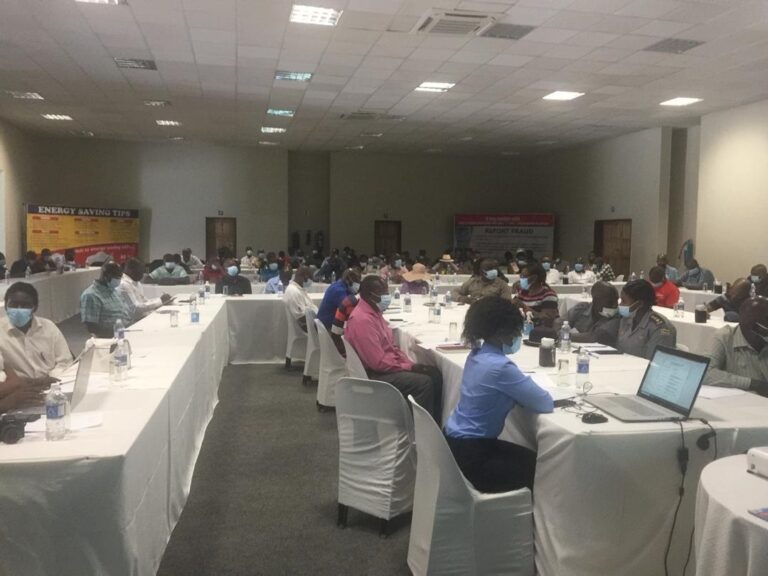
Speaking at a stakeholders meeting held on February 04 2022 at Flamboyant Hotel in Masvingo, Head of Loss Control Festo Madembo said ZETDC is losing huge amounts of money due to various illegal activities as well as corruption.
“In 2020 we received a total number of 947 cases of stolen property which translated to the value of USD $ 4 390 000 and in 2021 we had 1 267 cases that were valued at USD $ 4 460 000, within two years ZETDC has lost infrastructure valued to USD $ 8.8 million which is a huge amount of money,” said Madembo.
“ZETDC is facing many challenges which include theft of transformers and iron angles, illegal connections and ramped corruption of ZETDC workers. Last year 281 transformers were manufactured and were supposed to be distributed to the community but the whole of last year ZETDC lost 288 transformers.
“We also have a challenge of theft of electricity whereby people are doing illegal connections, bypassing metres to use free electricity. Stealing copper conductors and iron angle bolts and nuts and corruption of ZETDC workers affecting service delivery,” added Madembo.
The power utility company has been struggling to generate enough electricity as there has been massive load shedding countrywide.

… As power utility launches Call Centre

Fredrick Moyo

The Zimbabwe Electricity Transmission and Distribution Company (ZETDC) is expecting to launch a call centre by mid-2022 as part of efforts to improve service delivery.
Speaking during a stakeholders meeting held on February 04 2022 at Flamboyant Hotel in Masvingo, ZETDC Acting Managing Director Engineer Howard Choga said they are setting up a call centre in Harare before mid-year like other organisations have done in order to improve service delivery in the country.
“We are setting up a contact centre in Harare. We would have a contact centre where by you call from across the country to the same place they will dispatch your problems to the people that resolve them.
“Before mid-year 2022, we would have launched this contact centre because all the hardware and software have all been commissioned and we are in the process of recruiting agents and people that will be manning the contact centre,” said Choga.
He also added that the call centre is meant to improve service delivery in the country and for the good of the customers as they can use many platforms to say the challenges they are facing or encountering.
“All these things are meant to ensure that service delivery for the best of our clients is improved and also through the same channel you can Email, WhatsApp, Web-chat, Facebook and many other social media platforms. This is the most important thing and we are going to use it to measure how we are performing, so once it happens it means that we would be able to focus on certain areas,” he added.
Speaking at the same event ZETDC Commercial Services Manager Engineer Gift Ndlovu said they have enhanced their credit control measures and are in the process of dispatching prepaid metres targeting that each and every house will have a prepaid metre by 2023.
“We have enhanced our credit control measures and we are running disconnection blitz to those who are not paid up. Clients should be paid up or on a payment plan and out team is out there disconnecting those who are not paid up and those who are not on payment plans.
“We also look forward that everyone should be on pre-paid platforms and we are installing pre-paid metres. We still have a long way to go but I am glad to let you know that 712 000 clients are now on pre-paid metres and we still have about 100 000 that are on fixed paid metres. We are working to make sure that by the end of year everyone would be on pre-paid metres,” he said.
ZETDC has been pleading with its clients to pay up their bills as this would improve service delivery.