Home Blog Page 712

FC Mutonhori Troppers aim to elevate Zaka football

0

FC Mutonhori Troopers squad

Bothwell Chabarika

ZAKA – In the deepest corners of the district lies a community with a promising team which is determined to take local football to great heights.
FC Mutonhori Troopers, a team made up of a number of youths brought together by passion, talent and determination, was formed last year in Mutonhori area under Chief Nyakunhuwa.
The team, which is jointly coached by Tungamirai Tivafukidze and Stanly Masara, is managed by Chief Kuzourava and Munyaradzi Chagweda, with A. Munodzana as its chairperson.
Tivafukidze told TellZim News that the team aimed to give young people something to put their minds on as a way of fighting social vice.
He added that the team was put together to instil discipline among the youth as well as to bring an active sporting community by identifying and nurturing young talent.
“Our motive is to create an enabling environment for youths to be morally and culturally upright. We would also like to see the Mutonhori/Harava community coming together through sport. We know that we have so much talent to grow here,” said Tivafukidze.
He added that the team was looking forward to take part in big games and the Premier Soccer League (PSL).
The team so far has participated in a number of competitions such as the Pinda muSmart tournament, Chief Nyakunhuwa Trophy, and Zaka Division 3 league where they found themselves playing well to a point of taking some first prizes.
Masara applauded the performance of the team saying they had started on a high note and promised that only the sky will be the limit for FC Mutonhori Troopers.
The team does not have a sponsor at the moment and has appealed to those with the means to partner them. Members of the team are using their own meagre resources to transport themselves and buy the necessities of the game.
Class Kuzourava, Chagweda Munyaradzi, Mazivazvose Nyasha and team captain Guffi Makufa are some of the FC Mutonhori Troopers players.sport

Know more about butterflies

0

Arthur Harmsworth


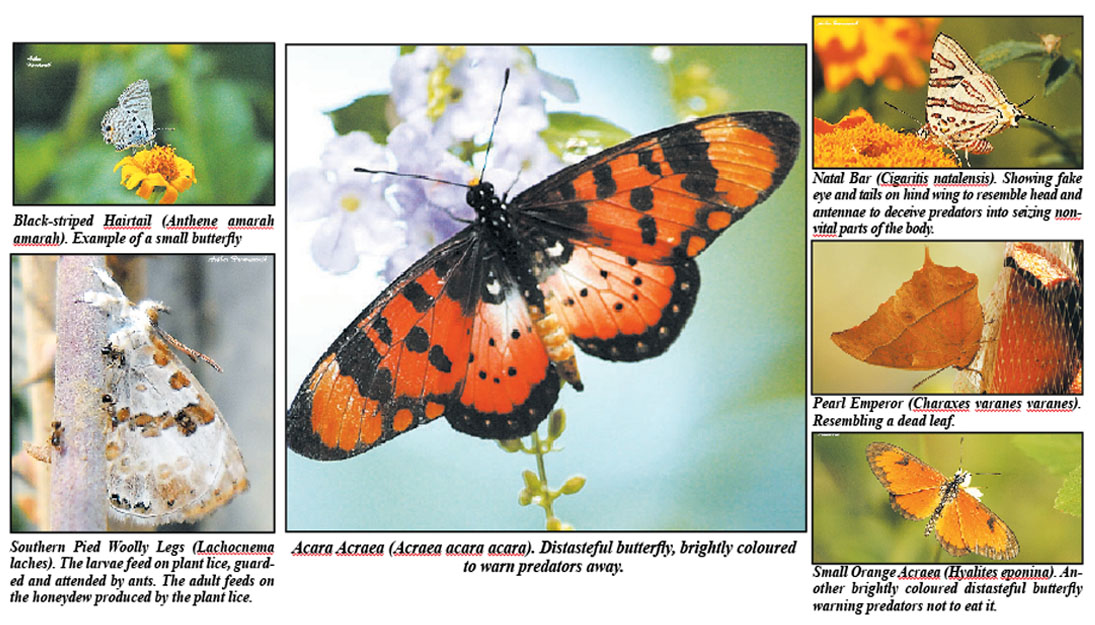
There are over 20 000 species of butterfly worldwide and Zimbabwe is blessed with over 570 species of butterfly, ranging from small (thumbnail size) to some nearly hand size.
Butterflies are insects, of the Order Lepidoptera stemming from the Greek for ‘wing scales’ which give each species their distinctive colours and wing patterns.
They are very sensitive to environmental change and are therefore recognised as important indicators of terrestrial environmental health. The declining numbers and variety are real reasons for concern. Urban sprawl, habitat loss, widespread and indiscriminate use of pesticides, farming practices and global warming have all contributed to this decline.
Essentially, the butterfly’s life cycle is divided into several stages: egg, larvae (caterpillar), chrysalis (metamorphosis) and finally the winged adult (imago) whose prime purpose is to reproduce. The adult stage of the cycle is brief, usually only a few weeks. Butterflies can often delay emergence from the chrysalis (cocoon) if climatic conditions are not favourable for the emergence of host food plants for the adult and later the larvae (caterpillar).
While most species lay their eggs on suitable host plants for the caterpillars to feed on, some species have unique symbiotic/commensal relationships with ant species which raise or protect the larvae.
Butterflies are attractive prey for many predators including chameleons, lizards, birds and small mammals. Survival techniques vary from species to species. Some butterflies such as the Charaxes species are large and extremely fast flying. Others rely on cryptic colouration, deception or camouflage to avoid being preyed upon. Some resemble dead leaves or the preferred substrate that they frequent. Some have false eyespots and hind-wing ‘tails’ resembling the head and antennae of the butterfly. Others have prominent eye spots on the wings that again can deceive or startle a predator giving the butterfly a chance to escape.
Yet other species such as the Acraea and Monarch families utilize naturally occurring chemicals such as cyanide and other plant alkaloids to make them distasteful or even toxic to predators. The caterpillars usually feed on cyanide-containing plants and store the poisons in their bodies as bitter tasting chemicals. These poisonous substances are transferred to the adult during metamorphosis. However, in some species, there is evidence that the adults can manufacture poisons within their own bodies or absorb toxins from certain plants. These toxic/distasteful butterflies are often conspicuously coloured to warn predators to leave them alone.
Some species employ Batesian Mimicry to imitate distasteful species as a successful ploy to avoid predation.
Some species are migratory in a regional sense, notably the Brown-veined White (Belenois aurota aurota) and the African Migrant (Catopsilia florella) following new sources of food plants for an exploding population following seasons of good rainfall. These migrating populations can sometimes number in their thousands!local

Jah Stonny releases third album

0
Jah Stonny

Lawrence Mandava

Jah Stonny, real name Clive Chivakire, a promising reggae and dancehall artist, released his third love album titled Babilan Touch over the festive holidays, with hopes that it is going to be a change maker in his career.
Babilan Touch is Jah Stonny’s third album, following the release of Mavambo in 2015 and Dai Mandiona in 2016.
The new album is largely conscious, is about love but partly gospel too. It also touches on improving the lives of the ghetto youths in Masvingo,” Jah Stonny said.
He expressed gratitude to Mankind, Skyfall Records and Oudin studios as well as his management team (Ricky Boss, Fire Master and Net King) for sponsoring and assisting in the successful production of his album.
“I would like to greatly appreciate the support I got from my management team including Ricky Boss, Fire Master, Net King and the three studios (Mankind, Skyfall Records, Oudin) for helping me in my journey to my third album which is now out,” he said.
The 23-year-old artist, who said he was looking forward to improving his musical skills, encouraged his fans to continue supporting his music. He said he was also looking forward to collaborations with big names in the dancehall music industry
“This is a great year for me. I am looking forward to improving my music, buy more instruments and collaborate with other big dancehall artists in the country. To my fans, continue to support us, you help us going and we are promising you more tunes,” said Jah Stonny.entertainment

Chipinge, Chimanimani receive digital TV signal

0
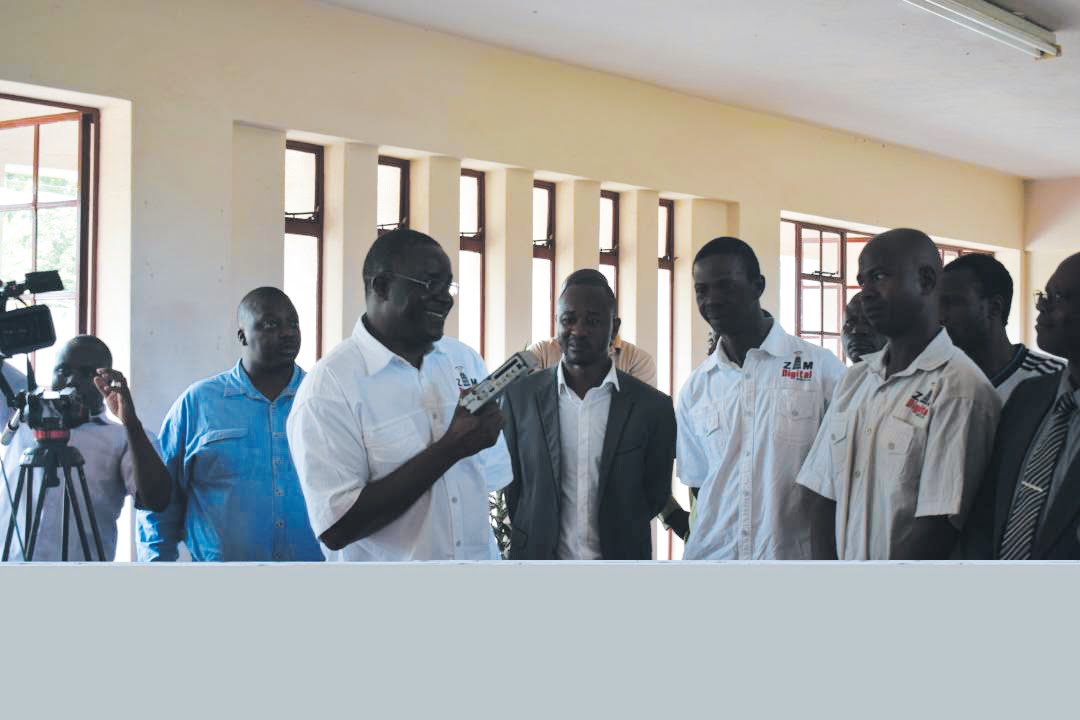
Charamba (2nd from left) shows a set top box to districts heads of departments at Chipinge Gvt Complex last week

TellZim Reporter

CHIPINGE – The two districts of Chipinge and Chimanimani this week joined parts of the country that have been connected to digital television signals under the country’s national digitisation programme.
The move will see television users migrate from analogue broadcasting to digital terrestrial services.
Last week Thursday, a high-powered delegation comprising the permanent secretary in Ministry of Information and Broadcasting services George Charamba, Broadcasting Authority of Zimbabwe (BAZ) CEO Engineer Obert Muganyura and Transmedia engineers were in Manicaland province where they installed the Gwindingwi transmitter in Chimanimani district.
The transmitter will provide digital services to Chipinge, Chimanimani and parts of the Bikita districts.
Speaking during the tour, Charamba said the TV digital signals was now ready in Chipinge, Chimanimani and parts of Masvingo province.
“The Chipinge and Chimanimani districts are now connected to digital TV signals after the Gwindingwi transmitter in Chimanimani was connected end December.
“The people in these districts can tune to digital services once we disburse the set boxes which we are going to distribute soon.
“We will tender for set boxes and suppliers have already told us they need only a period not less than 3 months to finish connecting these set boxes to our digital services.
“The people should not worry about the prices of the set boxes because we probably will give them free of charge. The real money emanate from selling the content not selling set top boxes.
“We are targeting 100 000 set boxes in the first phase,” Charamba said.
He said the digitisation programme was good news for Chipinge and Chimanimani people as they were not receiving good transmission since independence.
“The beauty of Chipinge and Chimanimani districts was always a curse on TV transmission due to its terrain and mountainous scenes. Now we can promise that we will make sure that transmission in this area will not be interrupted as we will provide good equipment that reach every corner.
“The transmitter is being boosted by a 3 000 litre generator on standby for use if power outages may occur.
“The installation of transmitters means the quality of TV has improved and more content should be provided which can also create employment for locals. After finishing TV digitalisation we will shift our attention to radio. We are always wanted to prioritise radio because it is the medium for Africa,” said Charamba.
Muganyura said those with morden digital televisions sets should not bother buying set top boxes.
Presenting 2018 budget Minister of Finance and Economic development Mr Patrick Chinamasa allocated US$26,6m for digitalisation programmes.local

Elderly Mwenezi man jailed for planting mbanje

0


Cephas Shava

MWENEZI – A 52-year-old man was last week convicted at the Magistrates’ Court for growing dagga in his field.
Mutema Makombe of village 6A Mufula Ranch under Chief Chitanga was convicted on his own plea of guilty for contravening section 156 (1)(b) of the Criminal Law Codification and Reform Act Chapter  9:23 “Unlawful dealing in dangerous drugs”.
He told the court that dagga gave him a livelihood.
Magistrate Honest Musiiwa sentenced him to 12 months imprisonment of which four months were conditionally suspended.
The court heard that sometime last year during the start of the rainy season, Makombe planted some mbanje but on December 28 last year, police detectives received a tip on Makombe’s dealings.
Upon conducting a search at Makombe’s homestead, police detectives found ten mbanje plants that were planted in the nearby field. 
The plants were measured in Makombe’s presence and they measured between 49 cm and one metre long.
Willard Chasi prosecuted.local

Angry Mwenezi woman pulls husband’s privates

0


Cephas Shava

MWENEZI – Reason Hlabani (36) of Chavani village under Chief Neshuro nearly died after his manhood was pulled by his 41-year old wife during a domestic violence incident, the Mwenezi Magistrates’ Court heard last week.
Hlabani pleaded guilty to the charges of contravening Section 4 (1) of the Domestic Violence Act Chapter 05:16 “Physical abuse”.
He told the court that he was left without any other choice except to assault his wife after she tightly grabbed his manhood.
“I stay with my wife and the four children whom she sired from her previous marriage. At times, those children assault me. So at some point, I told my wife that the children should vacate my homestead. While I was busy arguing with her, she firmly grabbed my manhood.
“Realising she would not let go, I bashed her to set me free. I was left is severe agony and I still feel the pain. Had I not beaten her, she could have killed me,” said Hlabani.
State facts as argued by prosecutor Willard Chasi were that on December 30 last year, at around 10:00 hrs, Hlabani told his wife Serina Hahlani that her children from a previous marriage should vacate his homestead.
Hahlani did not respond and this annoyed Hlabani who began to assault his wife with fists all over her face. A police report was made leading to Hlabani’s arrest.
After full trial magistrate Honest Musiiwa sentenced Hlabani to six months behind bars of which two months were conditionally suspended. The remaining four months were set aside on condition that he performed 140 hours of community service at Mushava Clinic.local

Mbanje-growing Rujeko man lands whole family in court

0


Nyasha Marumbi

MASVINGO – A man from Rujeko, residing at House Number 3788 Makonde Close, was last week brought to court together with his family members after the police had found two dagga plants measuring 188 centimetres and 95 centimetres in their garden.
Four family members; Qetway Dadirari (40), Landnos Musvovi (49), Johanne Dube (21) and Matthew Dube(21) appeared before magistrate Takawira Mugabe facing unlawful possession of drugs charges as defined in Section 157 (1) of the Criminal Law (Codification and Reform) Act Chapter 9.33.
Musvovi and Dadirari escaped the charges after convincing the court that they left the house in possession of their two sons Matthew and Johanne for another house and they had simply returned to facilitate water reconnection to the house.
However Matthew pleaded not guilty after his brother Johanne admitted that the plants were his. Johanne was remanded in custody to January 12 for further trial.
It was the State’s case that on December 28, 2017 the police heard rumours that Johanne and Matthew were growing dagga in their garden. Investigations led to the discovery of two plants, leading to the arrest of the four.
Edmond Mapope prosecuted.local

Gutu man in trouble for attempted rape of minor

0

TellZim Reporter

MPANDAWANA – Alouis Kufandikamwe (21) of Noorhood village 4 Chatsworth was recently sentenced to 12 months in prison for attempting to rape his 14-year-old girlfriend.
Six months were suspended on condition that it was the first crime committed and the other six were set aside on condition he performed community service at Chiwore Clinic in Chatsworth.
It was the State’s case that on November 24, 2017, the complainant was with her younger sister in the bush looking for firewood when they met Kufandikamwe.
The two love birds then sat on the log where Kufandikwamwe started fondling the toddlers’ breasts, grabbing her by the waist and removing her panties to knee level to solicit for sex.
The complainant realised what was about to happen and left to go home where she disclosed the matter to her grandmother who then accompanied her to the police to report the case leading to the arrest of the suspect.
Addressing this issue, magistrate Edwin Marecha warned against the habit of forcing underage girls into sex.
 “You can date a girl of your age or even date those who are older than you. No one will ask a question but it is another thing altogether to destroy a minor’s future,” said Marecha.
Samuel Magobeya appeared for the State.local

Dedicated educationist, reformer Chigumo goes to rest

0
Ishmael Chigumo and his wife Florance

Ishmael Chigumo, the head of Ratidzo School in Masvingo, has retired from his long career as a teacher, special needs educator and very committed Reformed Church in Zimbabwe (RCZ) parishioner.
Born of Mangisi and Ronia Chigumo in Gosho Village in Buhera on 6 January 1953, Chigumo went to Gosho and Mukondomoi Primary schools for his early education from 1961 to 1968 before enrolling for his secondary education at Makumbe Mission (1969-1972). He was born in in very humble conditions but it was the Dutch Reformed Church became part of his life.
After completing his form 4 at Makumbe High School, Chigumo went to Morgenster Mission for the then T3 teachers’ training from 1973 to 1975. He then joined the Henry Murray School for the Deaf when he taught for most of his prime time as a primary specialist teacher beginning 1976.
It was at Henry Murray School for the Deaf that his passion for teaching the deaf became apparent. It was because of this passion for special needs education that he enrolled for the special Education Certificate at Montfort College in Malawi between 1980 and 1981.
In Malawi, the young Chigumo then met and married Florence Chigumo. Between 1984 and 1985, he furthered his education, again in special needs education at Newcastle Upon-Tyne University in the United Kingdom, where he graduated with the Diploma in Advanced Education Studies in Special Needs Education.
He then completed his Bachelor of Education in Educational Administration with the Zimbabwe Open University (ZOU) in 1997.
He then began to study for the Master of Education Degree in Educational Administration with the same institution.
In 1985, Mr Chigumo was appointed headmaster of the Henry Murray School for the Deaf after 9 years as a teacher. He became head of the special school for 23 years, during which time he helped to initiate monumental educational development programmes for the school of the deaf. He was instrumental in the shaping of the physical and structional developments of the Henry Murray School for the Deaf. Before that, all the pupils at his school did not write the grade 7 examinations. Between 1986 and 1987, Chigumo oversaw the building of two blocks of buildings with four classrooms each at the same school.
In 1989, he engaged the Netherlands Friends of the School who then donated a truck which became the school’s first vehicle. He helped to build a lot respect for the deaf at this school in Masvingo.
Between 1990 and 1996, Chigumo initiated several income-generating projects that also gave learners a chance to do practical work.
He oversaw the building of the Henry Murray School Kitchen and Dining Hall. He also helped to build the audio logical laboratory centre, the girls’ hostel and new administration block currently being used by the Reformed Church University (RCU). At the same time, he started the poultry and piggery projects for the school plot. All these projects became important income-generating projects while training learners in practical life skills.
Christian engagements at the RCZ
He became the secretary to the Education Secretary between 1996 and 2008 and the Synodical Administrative Board Secretary between 1998 and 2008.
Chigumo was the Morgenster Mission Station Council Treasure, while also being the secretary of the Reformed Church University Trust which saw the introduction of the RCU between 2004 and 2008.
In 2008, Chigumo joined Ratidzo School for the Mentally Challenged as headmaster. He has been there up to this time of his retirement. While at Ratidzo, he became instrumental in the development of the school.
To date he has contributed to the building of the security wall around the school, acquiring two vehicles for the school and building the computer laboratory in 2012. Indeed, education and the church has been central to Chigumo’s life. He has now retired after more than 42 years of committed and dedicated work in education and in the church.
Chigumo has had a glamorous educational and Christian career. He deserves a good rest, knowing that his contribution can never go unnoticed for the people of Masvingo and Zimbabwe
  Kutsiriyi Timothy Gondo
Great Zimbabwe University (GZU).education

Pote Drilling – you do not pay for dry holes

0


TellZim Reporter

With most rural areas in the country heavily reliant on underground water for all their household needs, Pote Drilling continues to deliver the ultimate services by harnessing the potential of that critical natural resource to improve living conditions. 
With Pote Drilling, water is guaranteed and there is no payment for dry holes.
Pote Drilling marketing manager Kudzai Nyika said the company was pleased that it remains the most reliable and affordable in the industry.
The company has also gained dalliance with the public due to its vast social responsibility work characterised by the donation of boreholes to schools and other amenities in such districts as Zvishavane and dry Chivi.
“As you may know, the underground underpins rural lives as it is the only reliable source of safe water for domestic use. Moreover, many rural women do gardening as one of their primary income-generating activity. This requires a good water supply system and the same applies to other ventures like piggery and poultry.
“Livestock also drink from boreholes as the changing climatic conditions are causing rivers to dry up quicker than ever before. As Pote Drilling, that is where we come in and we are proud of our untainted record. We have never failed on that; we have drilled boreholes and we continue drilling more,” said Nyika.
To improve the ease of doing business between Pote Drilling and its clients, a new payment system that allows the customer to settle costs using even livestock and grain has been put in place.
“We know cash is hard to come by these days and that is why we introduced a convenient payment method for our clients. We accept various payment methods from cash to livestock. A farmer may not have cash but has grain as payment, we accept that,” said Nyika.business