Home Blog Page 114

Mother, daughter arrested for murder

0

By Beverly Bizeki

A Chiredzi woman and her 18-year-old daughter are in police custody after she allegedly murdered her husband with the help of their daughter during a fight.
Masvingo Provincial Police Spokesperson Inspector Kudakwashe Dhewa confirmed the arrest of Obey Bere (18) together with her mother Nyaradzo Mawadze on August 7 and warned people against using violence to settle disputes.
“I confirm a case of murder where a mother and daughter teamed up and assaulted the former’s husband who is also the latter’s father. We urge members of the public avoid using violence to settle disputes and to value the sanctity of life,” said Dhewa.
Circumstances are that on August 6 and at Village 5 Masimbaevanhu, Chief Neromwe, Chiredzi, Mawadze and Chivhenge had a dispute which ended up violent, Obey joined in the scuffle in support of her mother who was being overpowered by the deceased.
Mawadze and Obey tripped over Chivhenge to the ground before assaulting him all over the body with logs.
Obey’s 14-year-old brother then went to seek help from a neighbor, who came and found Obey exchanging harsh words with her father who was telling her to leave the house as she was disobedient and her mother was defending her.
Obey picked up a stone and hit her father on the forehead once which made him to fall to the ground, unconscious. The neighbor helped him gain consciousness and he was taken to Neromwe Clinic where he was referred to Chiredzi General Hospital.
Chivhenge died on August 7 at the hospital where he was admitted leading to the arrest of the two.

Prof Zvobgo officially launches AI & Robotics bootcamp

By Tatiana Mhararira

Great Zimbabwe University Vice Chancellor Professor Rungano Jonas Zvobgo officially launched the Artificial Intelligence (AI) and Robotics boot camp that was hosted by GZU at its Mashava Campus on August 04, 2024.
The boot camp was organized by GZU in collaboration with Girls in Stem Trust.
In his welcome speech, Prof. Zvobgo said the boot camp was important as it empowers educators and learners equipping them with skills necessary for a world full of technology.
“The boot camp is important as it seeks to empower educators, students, and learners by equipping them with technological skills that will help them to tackle real-world challenges.
“The bootcamp will help in providing networking and collaboration through connecting industry professionals, peers and learners and forging lasting relationships scheduling ideas and inviting innovations. We want you to create a platform to produce commercially viable products by focusing on practical aspects of AI & Robotics,” said Prof Zvobgo.
Prof Zvobgo said the bootcamp is not there to deepen the understanding of the attendees but rather introduce exposure to them.
“The camp is designed not to just deepen your understanding of AI & Robotics but to provide tools and insights needed to inspire and engage students in these cut-edging themes. Our goal is to offer you practical knowledge that you will take to your classrooms after this training,” said Prof Zvobgo.
Masvingo Christian College Head Dr Edson Muresherwa who was among the guests said the event fulfilled education 5.0 where students and learners from different levels of learning gathered to acquire skills from professional experts to move with what is happening in the digital age.
“When we talk about education 5.0, this is the personification of education 5.0 and community engagement where primary and high schools will be interacting with universities and technical colleges at such a stage,” said Dr Muresherwa.
Addressing the bootcamp participants Ministry Of Primary and Secondary Provincial Director of Education Services Petronella Nyangwe said AI was now embedded in people’s lives so the younger generation was supposed to be exposed to it to promote the well-being of people in the society.
“Artificial Intelligence and data processing is now embedded in our lives so it is only logical to expose our young generations to all these areas that is what education 5.0 is all about and we are promoting this in all our education sectors in Zimbabwe.
“This week of learning will assist the participants to link the digital technological world to human social and emotional skills to promote the well-being of all the people in our communities,” said Nyangwe.
Girls in Stem Trust representative Victoria Nxumalo said the five-day training session will look at five different aspects with each day focusing on a different aspect.
“The practical week of training will focus on the ethical use of AI, machine learning, natural language processing, computer vision and image recognition as well as fundamentals of robotics before having our award ceremony on Friday.
In an interview with TellZim News one of the participants from Helen Mghie Primary School Mazvita Machengere said she was eager to learn and by the end of the week she expected to have acquired several skills in the robotics field.
“I am looking forward to learning a lot and by the end of the week I expect to have acquired knowledge and skills in the AI & Robotics field,” said Machengere.
The AI & Robotics bootcamp is a follow-up of the World Robot Olympiad held in Bulawayo early July where Zimuto High emerged victorious and is set to represent the country at international level in Turkey.

NSSA trains nurses on occupational safety

0

By Tatiana Mhararira

National Social Security Authority (NSSA) recently took 43 occupational nurses on a five day training workshop on occupational safety health at Clevers’ Hotel in Masvingo.
The training was done under the theme ‘enriched upon promoting a physically acceptable culture through vision zero’ where nurses working for various organisations across the country underwent a rigourous training to promote safety and health at workplaces.
Addressing trainees during the closing session of the workshop, NSSA acting General Manager Dr Charles Shava said it was possible to achieve vision zero which is aimed at reducing accidents at workplaces.
“Vision zero in the workplace is possible. The vision states that we will have zero accidents at workplaces. We should make sure workers are not injured or do not contract work place-related diseases.
“Let us brace our minds and efforts to move towards promoting an onset camera through vision zero harmful and a sustainable workforce. It is important from a point of view that we know where we are going, what we are using and what gaps exist in our various Occupational Safety Health initiatives,” said Dr Shava.
He said combined efforts of occupational nurses was key in combating injuries in workplaces.
The training course looked at some topics such as Factories and Works Act, understanding climate risks and opportunities for OSH professionals, lung inhalation injuries, occupational eye injuries and drug and substance abuse.
Speaking to one of the trainees, Evans Hove from Inscor’s Providence Clinic said the course equipped them with new skills to deal with occupational hazards.
“During the occupational health nurses training l learnt a lot about workers compensation and insurance fund, a fund which is executed by NSSA to support workers injured at work and retired employees,” said Hove.
“I would like to teach our company employees about work related stress, how to deal with mental health issues both at work and at home,” he added.
Among other measures to ensure safety in work places, NSSA says any workplace with a minimum of 70 workers should have a clinic and a doctor.

Tourist breaks down in court after being denied bail

By Perpetua Murungweni

Lucas Slavik, a citizen of the Czech Republic, broke down in tears in court after he was denied bail by Masvingo Magistrate Franklin Mukwananzi on August 6, 2024.
Slavik was arrested on August 1, 2024, on charges of spreading falsehoods after he was allegedly seen by police detail recording a video on his cellphone at a local lodge.
Through his lawyer Knowledge Mabvuure, Slavik applied for bail, which was denied by the court, saying he was a flight risk and was ordered to come back for trial on August 16, 2024.
Despite efforts by his defense to convince the court that his client was ready to surrender his passport and all his traveling documents, citing efforts by Czech Republic Embassy to secure bail for their citizen to ensure that he attends trial until its conclusion, the state, led by Prosecutor Tarisai Muvengi blocked the bail application arguing that the tourist was a flight risk.
“The state is opposing granting the accused bail because we fear that if he is granted bail he is going to abscond trial. The accused person is also a foreigner with no permanent interest in the country therefore he is likely going to run away,” said Muvengi in court.
Muvengi also argued that the Czech Republic was not present in the court to confirm the support they were going to give to their citizens and even if they were going to render that support, he said the state was afraid that the accused was going to interfere with the state’s outstanding witnesses.
“The state cannot grant the accused person bail because the Czech Republic is not present here in this court to confirm the support to their citizen, and if they are going to render that support the accused will be staying at Backpackers Lodge and we fear that the accused is going to interfere with our outstanding witnesses who are workers at Backpackers,” said Muvengi.
It is the state’s case that Slavik was arrested outside the Backpackers Lodge, where he was found recording a video claiming there was no water or electricity, and that he could not even shave.
Another Ugandan national Tom Ssekamwa was arrested alongside Slavik for possession of sex toys and appeared before Mukwananzi for bail, which was also denied under the same circumstances. He was also ordered to return to court on August 16, 2024 for trial.
Masvingo Police confirmed that they seized Slavik and Ssekamwa’s gadgets which include laptops, cameras, and cellphones, for further investigation.

Manunure High hosts 2024 career guidance

By Decide Nhendo

It was a hive of activity at this year’s career guidance exhibition held at Manunure High School in Masvingo Central Constituency on Friday, July 26 2024.
The event which was organized by Masvingo Central ward 13 councilor Sarah Munemo and organizing Secretary Eliot Vhimisai was attended by six schools, Machitenda primary school, Manunure, Chikarudzo, Mapakomere, Mapanzure and Chekai Secondary schools. There were various exhibitors who attended and gave guidance to the learners.
Speaking to TellZim News, Ward 13 councilor Sarah Munemo said the career guidance was important to learners as it gave them exposure to different career paths that they may choose to pursue after school.
She said financial and network issues were affecting learners especially from rural areas and the career guidance programme brought them closer to the corporate world.
“We organized this career guidance for learners in ward 13 and 17 so that they get exposed to the job market in the world. The learners face major constraints like network barriers which hinter them from accessing essential information compared to those in urban areas, so through this initiative, they are acquainted with the information they need before they join the professional world,” said Munemo.
The hosting school head Svondo Chiwawa said the event was running under the theme,’ Fight against drug and substance abuse, heads taking the lead’.
He said the career guidance was relevant especially during a time when learners were indulging in drug and substance abuse saying they took advantage of the programme to teach leaners about the dangers of drug abuse.
Svondo also said they were implementing strategies to curb the surging and disturbing menace saying war against drug and substance abuse was for every person’s responsibility.
“This year’s theme is relevant because we are having serious trouble with learners who are taking drugs, some of the learners are now drug peddlers and they supplying to schools.
“We are making a lot of effort to stop this ill destroying our children’s futures, but to do so effectively the whole community must work together so that no gap will be spared in as much as drug and substance abuse is concerned.
“At Manunure we are planning to erect a precast wall so that we will be able to control and monitor all leaners, so I am sure if we combine effort we can make it,” said Chiwawa.
Local Junior councilor Catherine Muzinda said the career guidance was important because it equipped them with essential tools to meet the corporate world at the same time making them aware of the harm drugs can exert on their lives.
“The career guidance was important because we learnt more on careers that we can pursue, so now we are going to work knowing clearly what we want to do. We also learnt the physical and health harm caused by drug and substance abuse, so it’s up to us to shun drugs,” said Muzinda.
Four organisations namely Zimbabwe Republic Police (ZRP), Zimbabwe National Army (ZNA) and Traffic Safety Council of Zimbabwe (TSCZ) interacted with the leaners.
Munemo praised the collaboration between the community, schools and Masvingo Central Member of Parliament which she said resulted in the organisation of such a brilliant programme.
“What made it easy for the event to be a success is the unity between the community and local leaders. Our MP offered transport and refreshments, while locals provided food and also the hosting school offered the space,” said Munemo.
She said the event will be bigger and better next year as they target all the school in the constituency to participate.

Economies of affection and vertical trust deficit

By Nicholas Aribino

Economies of affection and vertical trust deficit When countries enjoy growth with development, leaders of such countries naturally earn the respect of their followers without necessarily muscling it up. Growth with development is growth that comes with hybrid dynamics that straddles both quantitative and qualitative aspects of development. As opposed to quantitative growth that is aligned to International Financial Institutions like the IMF and WB, growth with development is sensitive to human security because it embraces the happiness index of a nation, which is the qualitative domain of development. Many African countries are failing to realise growth with development because of political patronage, economies of affection, tender-preneurship, selective application of the law, corruption and pernicious polarization. Arguably, where economies are belaboured with the above factors, they become disarticulated and, in the process, vertical trust deficit sets in, thereby complicating governance. It is the object of this opinion piece, to ventilate the extent to which economies of affection have wrought vertical trust deficit in Zimbabwe.
Vertical trust deficit is a situation whereby citizens no longer trust their leaders. This mistrust emanates from citizens’ observations of how decision-making, policy making, production and distribution of resources, appointments, procurement of goods and services and dissemination of information are done. Since independence, there have been a disturbing trend of economies and politics of affection where government tenders, land distribution and appointments of personnel to key institutions like commissions, parastatals, judiciary, government boards, ministries and departments are concerned. For example, land distribution has largely benefitted the political elite, with some of them having multiple farms at the cost of everyday people of Zimbabwe. Furthermore, findings of most land audits have not been released for public consumption because they contain names of BIG people. During the time of Gono (2003-2013) as the governor of Zimbabwe there were agricultural implements and loans that were given to a beneficiary population defined according to politics of affection, and these loans were later written off. At the time of Kumbirai Kangai as the Minister of Land and Agriculture (1994-2000), the Grain Marketing Board (GMB) was prejudiced of millions of dollars when he flouted tendering procedures. In 2015 the Auditor General’s report revealed that the Basic Education Assistance Module (BEAM), which is a safety net for orphans and vulnerable children, was at some stage ring-fenced (US$500 000) for food hampers for some officials in the Ministry of Public Service, Labour and Social Welfare, leaving multiply minoritized students without anything to cater for their scholastic needs. The Auditor General has on several occasions revealed deep dyed corruption within parastatals, government departments, parliament and commissions. Specifically, in 2016 a report by the Auditor General revealed that US$15 billion in diamond revenue had just dissipated due to lack of oversight and corrupt tendencies in the state-owned diamond company.
In the light of the above revelations of leakages within different public structures, the citizens naturally lose faith in the entire fabric of governance. When there is loss of faith in the system, citizens develop what is called vertical trust deficit. In an environment where there is vertical trust deficit as a result of economies of affection, institutions become dysfunctional because appointments to such institutions may be according to homophilic tendencies as compared to meritocracy. Filter bubbles and echo chambers are common in token economies because they characterize side taking rather than perspective taking. Economies of affection split nations into camps and these camps make it difficult for countries to be guided by issues when critical decisions are being made. Economies of affection identify with home or identity politics that can never help nations to converge on a common ground of building their nations. Where there are binary divisions, citizens will suffer as the distribution of resources will be done along political persuasions, key institutions like the judiciary and parliament will be guided by the strategic interests of people who wield social, political and economic power. The court judges in such nations become the spirit mediums of the political elites when they hand down judgements in court, and the parliament becomes an institution for settling scores and making laws that align to an incentive economy. As all these things happen, citizens will be observing and as they observe, their cognitive structures are coloured in a manner that creates a fertile ground for thinking that nothing good will come out of Nazareth. When such perceptions hold sway, citizens lose faith in the whole system of the nation and may fail to rally around the flag of their own country. Some of the citizens may even consider to migrate to other countries where they can build their careers and others may decide to remain in the country by riding on an unbanked informal economy where they get by through survivalist approaches of street smartness (kiya kiya, kungwavha-kungwavha).
Economies of affection do not come with any beneficiation, because they create the US vs THEM mentality which is toxic to growth with development. As we live in Zimbabwe let us realise that Zimbabwe is bigger than anyone of us and that social, political and economic circumstances change. In the event of shifting circumstances, we should be able to find one another as Zimbabweans. We only have one country, thence we need to develop it with an attitude of a singleness of purpose and fixity of focus. Economies of affection are not sustainable because circumstances change. Who ever thought that the late President of Zimbabwe R.G Mugabe would be buried in Zvimba, and not at the hero’s acre?

I am writing in my own capacity

UWPCG donates sanitary wear to Ndarama High girls

By Decide Nhendo

Masvingo Urban Women in Progress Community Group (UWPCG), a savings club that is donating sanitary wear to schools in Masvingo town recently took the charity initiative to Ndarama High School where they donated 139 packs of sanitary wear on July 26.
The donation is in fulfillment of the organization’s objective to mobilise resources to end period poverty in the province and it has so far donated 110 and 142 packs to Mucheke High and Masvingo Christian College respectively.
Speaking to TellZim News, UWPCG chairperson Regina Chabhanga said they realized that the girl child is more vulnerable hence they are trying to help, though in a small way.
“We do not have enough resources but we are going to do the little we can for our school-going children. Our wish is to extend to the communities and address other challenges affecting the girl-child,” said Chabhanga.
“We take heed to the advice we got from Masvingo Christian head Dr Edson Muresherwa to extend our hand to the boys also; so we are planning to come up with something for the boys soon,” Chabhanga added.
Ndarama High school head Oddy Matongo applauded the donation and UWPCG saying the donation would go a long way in serving girl leaners who are often absent themselves from school during their menstrual cycles due to lack of sanitary wear.
Matongo urged UWPCG and other players to take the initiative to rural schools as well.
“We are grateful because of what UWPCG has done, they have remembered the girl child by providing the essentials, and I pray that if resources permit, they should increase the numbers because we have a lot of girls who do not afford sanitary wear.
“I understand that we have economic challenges, but the effort by this group of women shows that they are determined to help the girl the child. This same initiative must be taken to rural areas because I am sure that most children there lack these essentials,” said Matongo.
UWPCG started in 2019 as a savings club and they contributed money which will then be lent to members who would return it with interest. They then started charity work where they help communities that are in need.

Rutenga woman dumps baby in blair toilet

0

By Rangarirai Shanyurai

In a distressing and shocking incident, a 20 year old woman from Rutenga was recently arrested for allegedly dumping her newly born baby boy in a blair toilet.
Zimbabwe Republic Police (ZRP) confirmed the arrest of Privilege Moyo over case of infanticide which occurred on July 15 at Village 9, Limbigia on their official X handle.
“The suspect dumped a newly born baby boy in a blair toilet immediately after giving birth to the child. The lifeless body of the infant was retrieved from the toilet on July 24 and was taken to Mwenezi District Hospital mortuary for post mortem,” reads the post.
Police in Harare are also investigating two other cases of infanticide whereby remains of a human baby where found under ZESA pillars while the other one was found wrapped in a plastic bag at a dumping site in Chitungwiza.
“The remains of a human foetus were found at an open space, under ZESA pylons in Kuwadzana 7, Harare on July 25 whilst another foetus was found in a black plastic bag at a dumbing site in Unit, Seke , Chitungwiza on July 25 at around 1000 hours,” reads part of the post.
The police are urging anyone with the information regarding these incidents report to any nearest police station.

Villagers in crisis as bridge damaged by cyclone in 2000 yet to be repaired

By Tatiana Mhararira

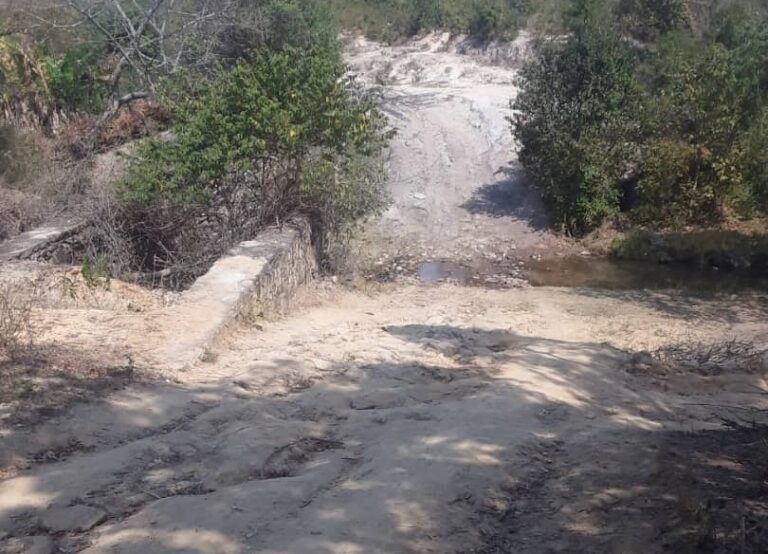
Since 2000, Madzive River Bridge that connects villagers from Hari, Mbeva and Mutonhodzi areas in Masvingo North has not been repaired and villagers are appealing to authorities to intervene.
The bridge, which connects roads network in Mbeva, Hari and Mutonhodzi villages, has an economic value since it links the community to Masvingo town where they access a number of services as well as selling their fresh farm produce.
Speaking to TellZim News, Ward 14 Councillor Misheck Nzvinginya whose ward the bridge is located said it is a vital economic resource that connects communities for different programmes.
“Most villagers from Mbeva travel daily to Masvingo to sell sugarcane and vegetables, and the damaged bridge has disrupted their economic activities because low lying vehicles struggle to cross through the temporary crossing point and it is worse during rainy season when the river gets flooded,” said Nzvinginya.
“Transporters who ferry villagers to and from Masvingo also face challenges, as the poor condition of the bridge has led to increased vehicle repairs, and the burden is felt by villagers as transporters transfer this cost to the villagers by increasing the fares,” Nzvinginya added.
During the rainy season, villagers on the other side of the bridge struggled to access essential services such as the grinding mill which is on the other side of the river.
A local villager Noah Machote said the situation was also affecting learners who cannot cross the river to school when there are floods.
“Most vehicles do not cross the bridge, and we are often forced to carry the sick on our backs to Zano Clinic, we have lost patients on their way to the clinic.
“The poor road network has also limited the movement of leaners to Makwavo and Zano schools, leading to increased absenteeism during the rainy season,” said Machote.
The prolonged abandonment of the bridge has had a significant impact on the economic and social well-being of the surrounding communities, highlighting the need for urgent intervention to repair the critical infrastructure.

Herbalist acquitted for culpable homicide

0

By Meditation Mposi

A 36 year old herbalist from Masvingo was lucky to escape imprisonment after Masvingo Magistrate Bishard Chineka acquitted him of attempted murder charges on July 31.
Innocent Tiringindi was dragged to court charged with culpable homicide as defined in section 49(1) of the Criminal Law Codification and Reform Act (Chapter 09:23).
It was the State case that on November 13, 2023, Tiringindi from ZBS, Masvingo was called by the now deceased Catherine Dube who wanted to buy Babado seed herbs to treat her stomach problem.
Tiringindi then went to Dube’s place of residence and delivered two Babado seeds at US$5.
Dube consumed the herbs on the same day at around 0500hrs as was prescribed by the herbalist and that’s when she started vomiting as well as sweating.
Tichaona Kubiku who is Dube’s husband then realized that the now deceased’s health was further deteriorating and rushed her to Masvingo General Hospital to seek medical attention.
Upon arrival at the hospital, Dube was pronounced dead after being attended to by the nurse on duty. The matter was reported to the police and a postmortem was conducted to establish the cause of death.
The postmortem report revealed that she died due to chemical toxicity and the abdomen, kidneys, liver and bowels were all injured. The report further noted that the damages could have been caused by consumption of poison, the body failing to accept a certain drug or the person may have been suffering from acids for a long time.
In acquitting, Tiringindi, Magistrate Chineka said the fact that the postmortem did not mention that the damages in the deceased’s body were linked to the Babado seed, means there was no enough incriminating evidence.
The Babado seed is used to treat people in Western countries and that Tiringindi was a registered herbalist who had treated a number of people including the deceased’s relative. The relative did not die.