
Cdes, have you noticed that there are two people that are really missing in action? Kudakwashe Tagwireyi and Prof Mthuli Ncube – where are they? Prof Mutuvi – I mean Prof Mthuli Ncube, the Finance Minister has been too quiet of late, could it be that he is yet to recover from the election baptism he experienced in Cowdry Park Constituency against the little known CCC’s Pashor Sibanda kkkkkk. Akaita kunonzi kusvasvangwa. Or could it be because of the new appointments made after elections – Kuda Mnangagwa as his deputy and the new RBZ Governor Dr John Mushavayavanhu aka John the Second.
Mapombi doubts if Mthuli is still the one calling the shots at the ministry of finance because kunyarara kwacho ummm zvinenge zvisisina kurongeka! It seems Kuda Mnangagwa and John Mushayazano ndivo vachibata kuti dzviii. Aaaah sorry I meant John Mushayavanhu, notwithstanding the fact that he has no ideas of course. What kind of strategy is that to only circulate 30% ZiG in the market and then one brags that our local currency is gaining value? The truth is there is critical shortage of the ZiG, and as such it is difficult to claim the currency is gaining value – we all know the truth kana muine nharo itaika mari yacho iwanike tione. It’s a silly strategy because it defeats the Government’s easy of doing business mantra. How can we do business when there is no money in circulation? Heee-ee? Ndipindure nhaiwe Mushayavanhu, Mushayazano, Mushayazivo? iEconomics dzipi idzodzo? Muchatiuraya neBP isu vana Mapombi – chete I don’t care because I survive on rotten bananas and maputi kutotyira zvangu vanhu kwavo kkkkkk.
As for Tagwirei, I think he has mastered the table manners very well because you don’t need to talk while eating – pataikura isu vana Mapombi kungotaura chete uchidya mbuya vangu vaitora ndiro vovhara zvavo iwe wosara wakati vavava. Im sure he is enjoying Government tenders chinyararire zvake achiita mari. Ko Mbudzi yava papi? Mapombi heard the prices are keeping on reviewed upwards ichasvika mubhirioni takavarairwa zvedu, or yakatosvika nhai? I wish Tagwirei would teach Wicknell ‘My Son’ Chivhayo some table manners. There is no need to brag and show off because we know muri kudya zvevapfupi nekureba.
But on Chivhayo issue, Mapombi now believes in toto that akachibata kuti dzvii. The way tables turned against Chimombe and Mpofu is clear evidence that Chivhayo akachibata kuti dzvii. Instead of Chivhayo being arrested for the ZEC tender scam, we are now seeing Chimombe and Mpofu being arrested. Hanzi maunza Chimombe Chisina Chivharo asi Fadzika. Kkkkkk its quite clear for Mapombi that this arrest has nothing to do with corruption but clear persecution for allegedly leaking the audios of Chivhayo in which he allegedly claimed kuti akachibata kuti dzvii. Mapombi thinks the arrest is more of punishment kuti dzidzai kuvhara tumuromo twenyu. To confirm this, very soon the case will be under carpet and we will never hear about it again because they would have achieved to silence Chimombe and Mpofu. In fact hamuchavanzwi futi vachiti bufu! Kana vane nharo mark my words. Chivhayo akachibata kuti dzviii chinhu ichi zvekuti Chimombe and Mpofu are probably busy kukumbira ruregero izvozvi.
Anyway, Mapombi is happy that the Government is making strides with its ‘Call to Action’ approach especially local authorities are doing quite well in terms of improving service delivery. Of course the majority of government departments are still struggling when it comes to implementation of Call to Action – haaa vanongowanza kutaura but action yacho dololo. We want action, we want to see positive results.
But Cdes, isn’t it the right time for our army to also to call and deal with the criminals around the President. It’s now clear that we have more criminals surrounding ED compared to the time of Uncle Bob. Pakuda action apa Cdes! Or maybe its actually ED who is surrounding the criminals kkk. Mapombi don’t want to delve much into this because we all know what happened in November 2017 so let me not say much otherwise ndinoswera zvangu ndapfekedzwa Apolo jersey as they did to Kudzai Chipanga gore riya. Kkkkkk but politics so, ma1. Mapombi heard Chipanga is now back zvine power and ari kumhanya neSlogan 2030 vaMnangagwa vanenge vachipo, vachitonga kkkkkk uchenjere uchapfekedzwa Apolo jersey futi Chipanga ndotokuudza ndopika namai vangu kudai. Vamwe vakaudzwa hondo nemurwere wepfungwa vakamuseka hanzi anorwara as chati homu chareva.
Mapombi will never remain silent because maCriminals achibata kuti dzviiii now and zvava kubhowa. Chokwadi kuita nyika inongovane Currency yatisiri kuona chokwadi? And millions are being spent on silly projects like the goat scheme. Haaa musadaro imi tinyareiwo. This is taxpayers’ money that you are abusing and, trust me, kumagumo kune nyaya! ZEC, ZESA, Starlink, Mbudzi traffic circle kuRound About uko and the goat scheme among many others – muchidya zvenyu isu vana Mapombi takangoti vava tichiswerera maputi and some rotten bananas. Kkkkkk bva itai tione ndimi makangwara but those who care to remember Uncle Bob ndakambovaudza and where is he today? May his soul rest in eternal peace.
But don’t you think this is the right time for our army to intervene and capture these criminals around the President and return things to normalcy? Zvamuri imi ndigonzwa kuti muri kufamba muchiti Mapombi ati Army ngaibvise mukuru. Let me put it categorically clear that I said the army should intervene and deal with the criminals surrounding the President as they did in November 2017 when Mugabe had been surrounded by criminals. The criminals that had surrounded Mugabe are still out of the country I’m sure. They ran for their dear lives. Kkkkkk but Mapombi thinks Mzembi is a case study – we heard akarwara neCancer ka if you remember when he was being dragged to court for corruption and abuse of office soon after the coup. Aaaaah not coup, I mean military assisted takeover. But I heard Mzembi is now as fit as a fiddle hanzi kuita chigwindiri chaiko. I think doctors and journalists should do research and stories respectively, pamwe vamwe varwere veCancer vangabatsirikana hama dzangu because Mzembi chava chigwindiri chaicho kupora kuti poo chaiko. Chasara kuuya kumusha kwaRupike kwaakadero kuzendemura ziimba kwaakuisa makuva ababa namai pamukova zvino hapana achada kugarapo. Rangova zuru rakapinda nyoka kana kutengeseka haiite kkk.
Anyway, Mzembi’s case aside, Mapombi thinks we need army intervention now than ever before. Dai Gogo Mahofa varipo zvavo she could have said it better. Corruption is increasing everyday – ZEC, Goats Scam, Solar Project, Presidential inputs, Command Agriculture, the list is endless.
It’s almost lunch time guys let me go ndindokanga zvangu maputi angu ndizvidyire. But before I go, let me emphasise the idea of Call to Action – let’s liberate our dear President from the criminals who surround him. They are making him not breathe properly. Ooooh shit, Mapombi had forgotten that our great Army General Sibusiso Moyo (SB) is now late (May his soul rest in peace) so there might be no other Shefu vaka chimaster chiGame chacho as he was. I miss SB too bad! By the way, Mr I can’t, I can’t vava sei mazuva ano? I mean Kembo Mohadi? Mapombi heard that he said he is not sick but old age is now catching up with him, really? Ko kuzorora zvinodii moswera zvenyu muchitamba nemukadzi nevazukuru kumba? Oooh chete mukadzi vakadzingirira and is now a senior bachelor who drinks two cups of Viagra each time he visits other towns. Mukaita overdose muchenjere kufa vana Mudhenge vakatisiya nazvo izvi kkkkkkk. Guys let me end here otherwise I will be accused of too much yep yepping.
Call to Action as ED now surrounded by more criminals than Mugabe was

Mhandamabwe traffic accident claims four
By Decide Nhendo
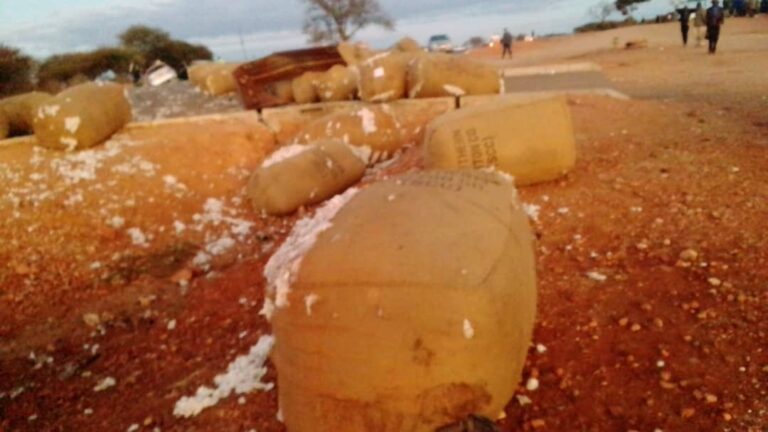
CHIVI – A traffic accident that took place along Masvingo-Mbalalabala Road on June 25 claimed four lives while and left two nursing injuries when a car they were travelling in hit a truck that had failed to observe road regulations at the intersection.
National police spokesperson Commissioner Paul Nyathi confirmed the accident in a post on the Zimbabwe Republic Police official X handle.
“The ZRP confirms a fatal road traffic accident which occurred at the 55 kilometre along Masvingo-Mbalalabala Road on June 25, 2024 at around 3:30 pm.
“Four people were killed while two others were injured when a Nissan Note carrying five passengers rammed into a Freightliner after the truck driver failed to obey a stop sign at the intersection of Masvingo-Mbalabala Road and Tokwe-Mhandamhambwe Road.
“The bodies of the of the victims were taken to Chivi District Hospital mortuary for post mortem while the injured are admitted at the same hospital,” read the post
The intersection has reportedly become a hotspot and locals have called for responsible authorities to intervene and put some measures that reduce accidents in place.
DEMONSTRATIONS IN KENYA-LISTEN AND LEARN FROM THE CITIZENS
By Dr Aribino Nicholas
Leaders in Africa tend to take their people for granted by not consulting with the people in the entire process of public policy formulation. People should be approached with a sense of respect and dignity because they are not subjects but citizens. Citizenship is not just defined in terms of status but also in terms of duty. Citizenship in terms of status implies that everyone should have documents that speak to being a constituent part of the country in which he or she is domiciled and citizenship in the light of duty implies that citizens have political, civil, economic, social and cultural rights. These rights are indeed lucidly covered in both the International Covenant on Civil and Political Rights (ICCPR) 1966 and the international Covenant on the Economic, Social and Cultural Rights (ICESCR) 1966. It is the object of this opinion piece to look at what is happening in Kenya with both an open mind and an open mouth.
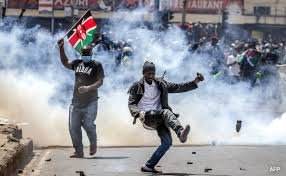
When one examines a phenomenon with an open mind and an open mouth, one adopts the attitude of a judge who is under obligation to look through the window to appreciate surrounding political, material, social, cultural and environmental circumstances before handing down a judgement. To that effect, one adopts a mind with a window and not a mind with a mirror. What is happening in Kenya has been accelerated by the intention of the government of Kenya to introduce a Finance Bill 2024. This Finance Bill 2024, among other things intended to introduce new levies on basic commodities like bread, vegetable oil, sugar and also an eco-levy on manufactured goods, including sanitary towels and diapers and an increase in existing taxes on financial transactions. The proposed tax measures did trigger the demonstrations, and these demonstrations were led largely by youths. In terms of demographics, 80% of the Kenyan population speaks to a youth bulge (aged 35 years and below) and 70% of Kenyans are wallowing in a deep dyed sea of poverty.
The proposed Finance Bill 2024 is coming against a background of internal resource mobilization in order to have 2.7 billion additional taxes to reduce the budget deficit and state borrowing. At the time of writing this opinion piece Kenya’s public debt is pegged at 68% higher than the 55% of GDP which is recommended by the International Financial Institutions (IFIs) (IMF and WB). Arguably, the Finance Bill 2024 can be seen as a move to align fiscal and monetary policies to the dictates of the IFIs so that Kenya can access credit lines for economic growth. This is where most African States have to engage in critical self-talk in terms of their direction of accountability. The direction of accountability by African leaders is upwards, that is towards the IFIs as compared to being downwards (grassroots). Quantitative growth or economic growth without growth with development is a faulty-line for most African countries. The quantitative growth that is often associated with an economic face without a qualitative aspect that improves the happiness index of citizens will always motivate citizens to grumble and protest in the long run. When African countries go for economic growth, they tick the IMF and WB boxes for good governance, because for them it means gaining more economic stamina for their institutions that rely on ancient wealth. Historically, ancient wealth constitutes economic resources that were looted from Africa during the era of colonialism and slavery and that are now being loaned out to Africa. African countries get embedded in a roundabout of debt through their continued association with the IFIs. The whole idea behind the IFIs is to strengthen the global North through dependency thinking by African leaders. When the youths in Kenya protested, they shouted, “Willian Ruto-US puppet.” The youths in Africa constitute 65%, Africa is therefore a youthful continent. The youths have collective power and can use that power to unseat any government. The majority of these youths in Africa are out of employment, they have all the time in the world to pool their knowledge and physical energies to either move or remove any government from power.
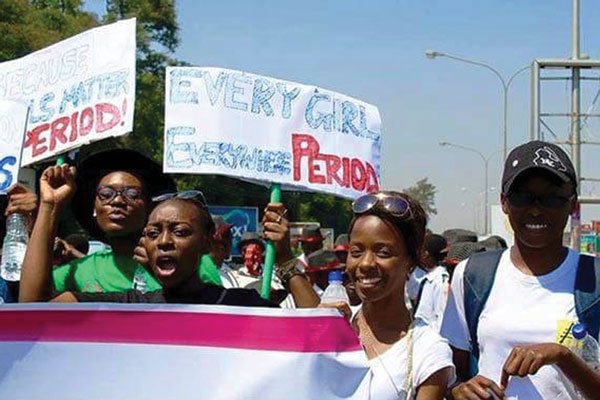
African governments should consult with their citizens first before they make decisions that have adverse ramifications on the well-being of their citizens. For example, the idea of the eco-levy would imply that the menstrual hygiene of Kenyan women would be compromised as that move could witness a hike in the cost of sanitary wear. Period poverty would continue to characterize the lives of girls and women. In-toto the Finance Bill 2024 is not coming as an elixir to the every day people of Kenya, as it will be there for international economic relations between Kenya and the IFIs. Economic diplomacy should not come at the cost of citizens’ livelihoods. African governments have an opportunity to pool their economic resources through the African Development Bank for the purpose of financing their development plans. To deny citizens space for demonstrations is only inviting more problems for African countries as the youths may resort to risky copying strategies of living like joining terrorist groups for survival purposes. When one door is closed to the youths, many more will open, for example a door to the underground space will be opened where youths can be involved in planning to use and abuse substances, spending time on sites of pornography and joining terrorist movements. It is important for African governments to involve youths in decision making in matters that affect their lives. Before tear-gassing youths, the Kenyan government should introspect and ask itself, “What are the structural determinants of the youths’ protestations.” What is happening in Kenya today should be an early warning sign for all African leaders.
WOMEN ARE BLEEDING
By Nicholas Aribino (Gender and Policy Studies Student-GZU), Mavis Mbiriri (Gender and Policy Studies Student-GZU) and Mrs Jenneth Musiyiwa (Early Childhood Education Coordinator-Women’s University in Africa (WUA)) writing in their own capacities.
Mao Tse-tung once remarked, “The Chinese men are under the burden of three mountains- imperialism, feudalism and backwardness and the Chinese women are under the burden of four mountains -imperialism, feudalism, backwardness and Chinese men.” According to Mao Tse-tung, the factors that accounted for women’s oppression in China during his time seemed to be parallel and yet coterminous when it came to the welfare, well-being and independence of women. Mao Tse-tung did not tell the entire story in his analysis about the tribulations of women, how come he elided nature as another variable working in intimate cahoots with the above variables to complexify the biological grammar of women? Women bleed (menstruate) every month due to physiological processes. This natural biological process comes with limited individual liberties for women due to hormonal changes. For example, some women may become horny towards their menstruation and cannot take the initiative to reach out to men for sex (lula lula) because of gendered socialization, others experience severe cramps and modal changes. During their menstruation women need sanitary towels and sanitary pads to feel comfortable and to go about their daily businesses with a sense of confidence. It is the intention of this opinion piece to highlight that when women bleed it is the duty of the State to respect, protect and fulfil their diverse needs and rights during this ephemeral period of carrying the mountainous burden of nature.
Women bleed as a result of nature, they do not bleed out of choice. It is indeed worrisome that sexual intercourse that is done out of choice has its concerns for protection covered through the provision of free condoms in both public and private spaces like colleges, toilets, hospitals, food courts, hotels and beerhalls. Women and girls experience menstruation at different times of the month, and this natural process comes with varied changes in behavioral and biological patterns. For example, a young girl experiencing menstruation would need to attend classes, go about every chore that needs to be done in the private arena and participate in sporting activities with all the confidence she can muster. The capacity for a woman to go about her sex and gender roles during menstruation is highly depended on a sense of security regarding the extent to which the bleeding is being managed. Most women and girls experience period poverty, that is they have no money to buy sanitary wear or pads, even those ones with the capacity to buy pads, they may not buy enough pads to follow the rigorous regime of changing the pads, that is at least three times a day. For school going girls, the absence or inadequacy of sanitary wear may lead to loss of confidence and absenteeism from school and this may disrupt enrolment, retention and completion of studies. The bleeding of women and girls does not define and rule women and girls as a homogeneous group with shared interests, as it comes with differential impacts and to that effect those with the responsibility to look after the welfare of women should understand and appreciate that women’s practical and strategic needs as a result of this biological process may differ but one point of convergence for all of them is the need to manage the bleeding through sanitary wear. Women and girls that cannot afford sanitary wear in most cases end up resorting to unhygienic means of managing the menstrual flow like using pieces of cloth (rags) that may cause infections, cow dung that may even cause further discomfort and irritations and leaves that may irritate and take away their sense of womanhood. Needles should just be put in their right places, why would rags, leaves, cow-dung be used instead of sanitary pads?
It is important for the readership to understand that when women bleed, the bleeding needs management so that their other daily activities are not compromised. A woman who is bleeding needs the support of his brother, husband, uncle and the State. A girl who is bleeding needs the social and economic support of his brother, siblings, father, class mates, peers, teachers and State. The bottom line here is that women and girls should not feel out of place because nature has called on them. It is the collective thinking of the writers of this opinion piece that the State, above all as guided by the directional and living document of the land, the Constitution of 2013 under Section 3g which talks about Gender Equality should ensure that sanitary ware is made available for all women and girls. Gender equality which is the ultimate goal of gender mainstreaming cannot be fully realized if women and girls’ practical and strategic needs are not considered in terms of programming. One does not need to be a rocket scientist to appreciate that sanitary ware for women and girls is as necessary as water is to fish, and that water also is as necessary to women and girls at all times just as sovereignty is to any country under the sun. Women and girls need their confidence during this natural cyclone of menstruation, and the State should ensure that nothing takes away their sense of womanhood during this period by even fencing off votes from the fiscus for free sanitary wear for our mothers, wives, daughters and sisters. The individuality of women per se cannot be complete when they know that they are bleeding yet no one is giving attention to that bleeding.
Women are already under the burden of the mountain of toxic masculinity, and this toxic masculinity has defined and ruled them according to essentialism if not vaginalism, something that already has further eroded their active participation in matters that affect them. To that effect, the State is under obligation to respect, protect and fulfil the natural right of women and girls to bleeding by providing free sanitary wear for them.
UWPCG takes charity to Masvingo Christian College
By Decide Nhendo
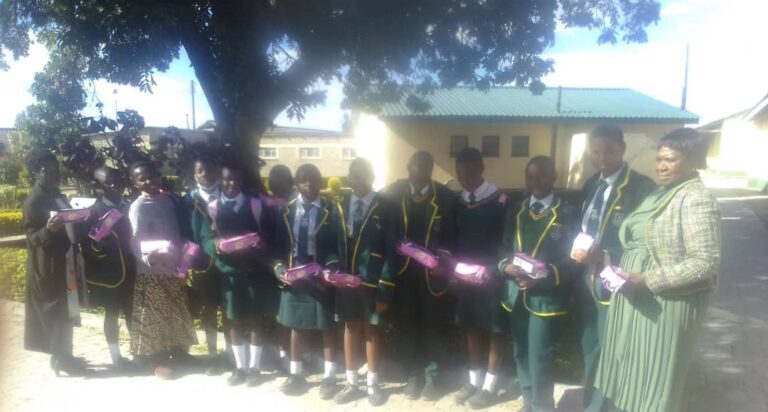
Masvingo Urban Women in Progress Community Group (UWPCG), a savings club that recently donated 110 packs of sanitary wear to Mucheke High is going on with the good work this time taking the charity to Masvingo Christian College.
Earlier, when they handed over the sanitary wear to Mucheke, UWPCG promised to mobilize for more to give to other schools, and true to their word, on June 18, they handed over 142 packs to Masvingo Christian College.
Speaking to TellZim News, UWPCG chairperson Regina Chabhanga said despite facing financial challenges, they were going to continue with the little they afford to make a difference in the communities.
“We do not have enough resources but we are going to do the little we can for our school-going children. Our wish is to extend to the community and address other challenges affecting people,” said Chabhanga.
Masvingo Christian College deputy head Getrude Chengeta said they were happy with the donation especially coming from a community group and urged UWPCG to consider the boy child in their next programmes.
“We are grateful because of what UCWPCG has done, they have remembered the girl child with essentials which will go a long way in enhancing learning and boosting confidence in learners. We, however, advise them not to focus on girls alone as they can include boys in their programming,” said Chengeta.
Chengeta said the donation comes as a lesson to the girl child who is going to be a mother in the future to remember that they have to support others in their communities.
“Another important lesson from the donations is that they are a good example to the girl child in making them realize that when they grow up they need to take responsibilities and fill in gaps within their communities,” said Chengeta.
UWPCG started in 2019 as a savings club and they contributed money which will then be lent to members who would return it with interest. They then started charity work where they help communities in need.
Ratidzo Zimcare School to conduct awareness campaign

By Staff Reporter
MASVINGO – Catholic-run Ratidzo Zimcare Trust School will on June 27 conduct an awareness campaign in Mucheke to increase the school and organization’s visibility.
School head Bernadette Chihava said the campaign was meant to raise awareness in the area that people with intellectual disability could still go to school and learn to become independent people.
She said the campaign was necessitated by the fact that there were members of the community with children with intellectual disabilities who were keeping them away from the public not knowing that they were just human beings like everyone else and deserved the right to education.
“We are going to do an awareness campaign to market the school as well as conscientize people that persons with intellectual disability can still come to school and learn so that they become independent rather than depending on others.
“There are many children with intellectual disabilities yet parents or guardians shy away from exposing them to school. As a result, they remain dependent on caregiving throughout their lives. Our school provides daily living skills as well as survival skills to children with intellectual disabilities,” said Chihava.
She went on to say as a school they were capable of capacitating intellectually disabled people on basic social issues for them to be able to do basics like brushing teeth and wearing clothes properly among other things.
She said they also train them on hands-on skills like gardening, poultry production and other agricultural skills which they can use after leaving the school at the age of 18.
She said after graduating those who afford would advance to adult centers where they would learn more but many were facing financial challenges as they were expected to pay fees.
“We teach them a lot of activities like basic social skills. They have to be able to wash their bodies alone, brush teeth, and do laundry among other things. We also teach them agriculture among others skills and we wean them at the age of 18.
“After that they can advance to adult centers but many fail to proceed because there they will be expected to pay fees unlike here where they do not pay fees as we rely on BEAM,” she said.
The school relies on donations from different organizations and individuals as well since the government is failing to release BEAM funds on time.
Masvingo BSPZ centre the best in province
By Perpetua Murungweni
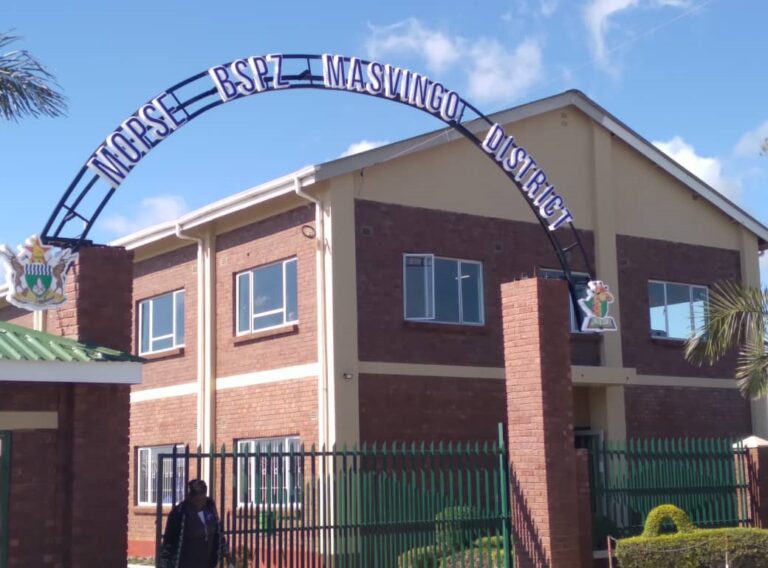
Masvingo District Better Schools Programme Zimbabwe Centre (BSPZ) in Mucheke which houses the district’s education offices has been described as the best in terms of architectural design.
Speaking at the official opening of the centre on June 14, 2024 Ministry of Primary and Secondary Education Permanent Secretary Moses Mhike said the centre was beautiful and said others should have copied from it.
“We were in Zaka on Tuesday and Chivi on Thursday before we came here and we have witnessed excellent work in the two districts but Masvingo District has proven to be exceptional, we are very proud,” said Mhike.
Mhike said the BSPZ complex was a cornerstone of the National Development Strategy 1 and 2 and is poised to redefine the education landscape.
“BSPZ centres represent a strategic investment in human capital development which is a cornerstone of National Development Strategy 1 and 2. As a ministry, we envision this space to be a hub of creativity, with its state-of-the-art structure, the designed BSPZ centre embodies excellence in every facet from its innovative architectural design to its cutting edge facilities. This complex is poised to redefine the education landscape of the district,” said Mhike.
He said if the complex was effectively used, it would greatly impact Masvingo Province.
“The complex has the potential to impact on people’s outcomes across Masvingo Province especially when we effectively use it for teacher capacity development,” said Mhike.
Masvingo Provincial Education Director (PED) Shyllate Mhike applauded the District for its work and said the province was proud.
“I applaud teachers, district personnel and school heads who worked together in achieving this goal and as the province, we are proud of you Masvingo District,” she said.
The complex comprises a wellness centre, library, computer laboratory, a lecture room and kitchens, facets that represent the ministry strategic priorities.
The Ministry commissioned similar projects in Chivi and Zaka Districts and is set to commission another one in Gutu.
Livestock farmers urged to form cooperatives as drought bites
By Decide Nhendo
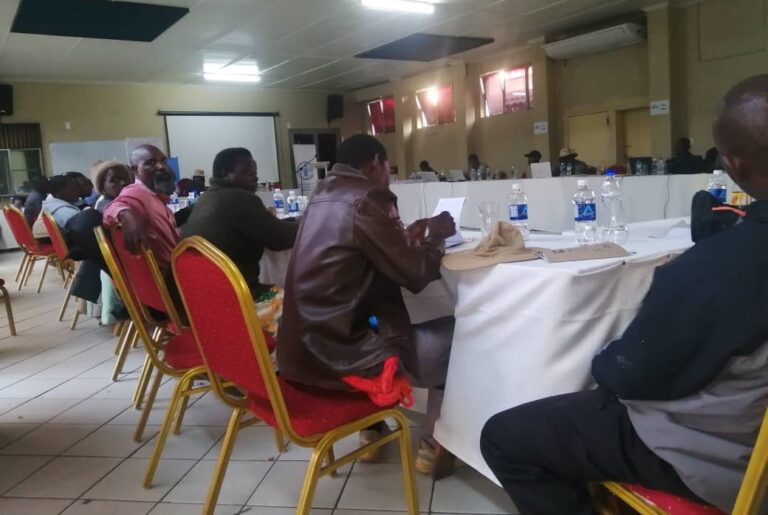
Ministry of Lands, Agriculture, Fisheries, Water and Rural Development (MoLAFWRD) in partnership with various private livestock players has encouraged livestock farmers to form cooperatives for sustenance as the impact of the El Nino-induced drought hits hard on livestock.
The ministry organized a dialogue meeting for farmers, private sector and stock feed providers at Chevron Hotel on June 20 to discuss solutions on reducing drought effects imposed on livestock.
Speaking at the meeting, MoLAFWRD Livestock Production Deputy Director Rutendo Nyahunda said farmers were supposed to form cooperatives and register them, as working in groups was less expensive than as individuals.
“Because of poor rains received this year, there is little feed for livestock, of which the little available feed is of poor quality.
“Farmers are encouraged to form farmer associations within the small-scale producers as they can achieve more with collective action, as it will be less expensive for them,” said Nyahunda.
Bikita Livestock Business Association chairperson Alex Makaye from Bikita South, Ward 3 said the effects of the drought were dire and were making it difficult for them to find feeds for their livestock.
He applauded the move by the ministry and stakeholders on drought mitigation measures, promising that farmers would form cooperatives and legalize them to get access to stock feed providers at a lesser cost.
“Drought has imposed a great threat to our animals because there is shortage of feed. We are grateful to the ministry for the dialogue meeting between various livestock production stakeholders. We have learnt that if we work in cooperatives it will be less costly. A truck can deliver feed in large quantities to our various destinations at a lesser cost,” said Makaye.
Makaye said the number of livestock farmers in Bikita was decreasing because of low prices of livestock as they were not able to produce quality livestock for competitive markets.
“In Bikita we have around 60 farmers who do commercial livestock farming. The number of farmers is decreasing because of the quality of cattle which fails to meet standards at abattoirs hence the low prices,” said Makaye.
Nonagenarian dies from witch craft-related arson
By Staff Reporter
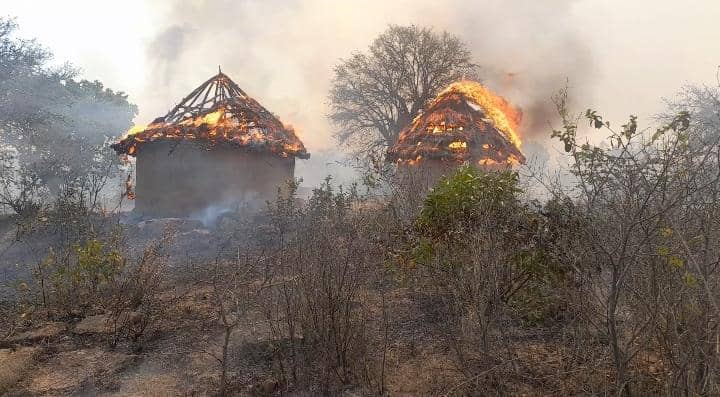
ZAKA – A 96-year-old Zaka granny died at Masvingo Provincial Hospital recently from burns sustained after the house she was sharing with her 68-year-old daughter was set ablaze by a male relative who accused the two of witchcraft.
Police sources said the suspect was arrested after the community apprehended and handed him over to the police.
Circumstances are that on June 6, the accused Assel Mukurungi from Maoneke Village under Chief Nyakunhuwa area went to Laiza Mukawu’s homestead around 10pm and found her asleep with the now deceased.
The accused is Mukawu’s nephew.
He asked Mukawu to open the door and threatened to break in accusing the two of witchcraft of which he went on to force open the door after the two refused to open.
He got into the house holding a small axe and threatened to kill both before setting property including a bed, fridge, wardrobe, a solar battery and some clothes on fire.
He struck Mukawu three times on the buttocks and once on the left arm with the axe handle as the fire spread inside the house, but Mukawu managed to escape calling for help from neighbors.
One villager came to their rescue but the accused managed to escaped and they managed to rescue Mapendere who had failed to escape from the raging fire, getting severely burnt in the process.
The villagers tracked down the accused whom they apprehended and handed over to the police while his two victims were rushed to hospital and were transferred to Masvingo where Mapendere later died.
Are Trade Unions doing good or harm the efficient running of business in Zimbabwe?
By Shadreck Zangairai
In one of my previous publications, I mentioned about decline in strike activity in Zimbabwe and the disjointment/fragmentation of trade unions. One of the avid followers of the column, after reading the presentation posed a question to me; if what I explained was the position, so can we say that trade unions are doing good or are harming the efficient running of business in Zimbabwe. Despite the fact that I answered him, but I promised to put the response on this platform for the sake of others who might be having the same question. The presence and rise of trade unions in Zimbabwe has had drastic effects on organisations’ relationships with employees, thereby affecting the effectiveness of business in Zimbabwe. While some say labour unions have many positive effects on work life and employment others maintain distinctly negative effects caused by unions that hinder the progress and effective running of business in Zimbabwe. From my analysis, it will be up to the reader to conclude whether the advantages outweigh the disadvantages, or vice versa.
Trade unions are one of the most important social movements underpinning democracy. They advocate for workers’ right to freedom of association and also creates the means by which all other rights are asserted and defended. Historically, trade unions have fought for the right to decent pay and conditions employment for both men and women at the workplace and for improved social welfare through, for example, health care, education and social security. The world in which we and our members work is rapidly changing. Competition is global and intensifying, bringing a new level of insecurity to workers. And we must never forget that many of the world’s citizens are still oppressed by dictatorial and authoritarian regimes that continue to deny, often by violent means, freedom of association and other basic human and workers’ rights. It is now the mandate and determination of trade unionism to fight again to defend the principles that have won so much for working people. These principles are as relevant in today’s world of global competition as they were at any stage of our history. Trade unions were founded to fight injustice and to ensure basic human and economic rights of working men and women and their families.
Labour unions in Zimbabwe have not always been met with a warm welcome from the government or from development economists. The reason being that they are viewed as a threat to both rapid economic growth and political stability. Unions pressure for higher real wages and more advanced social services than the economy can afford, even at a time when investment is the critical need. At worst, they may be led by political radicals dissatisfied with the existing system of governments. So trade unions benefit their members in the short run and harm the organisations in the long run and later the economy itself. There is also a possibility of a decline in the value of merit. In many union settings, workers cannot advance much at all on their merits but must generally progress within the limits defined by the unions. In theory, at least, unionised workers might become so comfortable and protected that they lose the incentive to work hard for the employer. This may lead outstanding employees to lose their hearts if there is no incentive to excel or worse, if they are pressured by the union not to go an extra mile.
On the other hand, too much power vested in on trade unions scares away investors to other countries with less powerful trade unions. For example, in the Zimbabwean context, the initiation of union formation by the government gave more power to unions in anticipation of their leadership’s compliance to the government demands. This however turned political and backfired the government. This impacted negatively the running of businesses in Zimbabwe which led to national strikes, stay away and go-slows which was taking place in almost every three month. In addition, trade unions such as the Zimbabwe Federation of Trade Unions (ZFTU), would impose their demands on companies. At one point ZFTU invaded factories which forced many companies to close. At the same time, there was vandalism of property as people took advantage of the disorders due to the demonstrations. Thus instead of addressing issues on the ground, the unions would fight for members and popularity while crippling the economy.
Disclaimer: The information contained herein does not serve as alternative to legal advice. The author do not accept any liability for any damages or losses suffered as a result of actions taken based on information contained herein.
Shadreck Zangairai is a Human Resources Practitioner and for feedback, email: shadreckzanga@gmail.com
To be continued..