Home Blog Page 186

Chiredzi District records 35 cholera cases

Beatific Gumbwanda

CHIREDZI Chiredzi District has been hit by cholera with 35 cases having been been confirmed in Chiredzi Rural District Council’s ward 1 in Save area where people mainly rely on unsafe water from the nearby river as well as in ward 24, which borders with Bikita District which had an outbreak, TellZim News can report.

Chiredzi District Medical Officer (DMO), Doctor Brian Dhlandhlara today (September 28, 2023) confirmed the thirty five cases and said they had acted quickly to stop the spread by setting up cholera treatment centers and are already doing health awareness campaigns.

“We have cases in ward 1, along Save River where villagers are using unsafe water from Save River and in ward 24 which borders with Bikita District where cases of cholera have also been recorded.

“We are responding with the help of other government departments and development partners by setting up cholera treatment centers in the affected wards and doing health education in the community,” said Dr Dhlandhlara

He also urged people to take extra care to minimize the spread of the disease by ensuring proper hygiene.

“I encourage people to ensure proper hygiene and regularly wash hands with soap and clean running water from safe sources and ensure proper disposal of human waste (in toilets),” said Dr Dhlandhlara.

Cholera is an acute diarrheal illness caused by infection of the intestine with a bacteria called Vibrio cholerae.

People can get sick after swallowing food or water contaminated with cholera bacteria and its signs and symptoms include severe diarrhea, vomiting and dehydration.

Severe Cholera cases in Chiredzi were last reported in 2015 at Chizvirizvi Rural Health Center

Masvingo Mayor promises to tame corruption in council

Beverly Bizeki

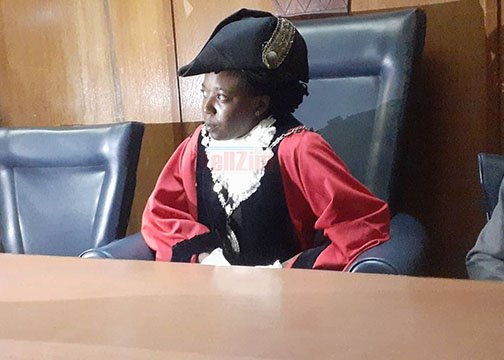
The newly elected Masvingo City Mayor Shantiel Chiwara has promised to arrest corruption in council as one of her major goals during her term following her election as top leader of the house.
25 year old Chiwara who is the councilor for ward 2 in Masvingo West was appointed mayor on September 19, 2023 after shrugging off competition from Zanu PF’s candidate Sharon Marombedze with 11 votes while the latter got only two votes.
“We are going to work towards a zero tolerance to corruption council as we move during our term in office so that we achieve things for a greater town and a greater city of Masvingo,” said Chiwara.
She also said she was going to look into other issues affecting the youth such as drug and substance abuse and rope in everyone in the fight to win the war.
“As a youthful leader, I am also going to look into things concerning drug abuse and early child marriages, we are going to stand together as this requires collective efforts from us.
“We will also look into the welfare of our workers to see that policies and rights to do with them are protected,” said Chiwara.
Chiwara also promised to work towards improving service delivery issues and lobby for equal opportunities for women and youth.
“We are going to look into issues concerning service delivery, to the youth and women, we say, we have a number of women in council so expect a vibrant voice from us, we are going to work towards getting the same opportunities for all,” she said.
Chiwara who is replacing Collen Maboke becomes the first female mayor for Masvingo City while at the same time she is believed to be among one of the youngest mayors in the country.
Ward 5 councilor Daniel Mberikunashe will be replacing Wellington Mawende as deputy mayor after he was kicked out in the parliamentary race for Masvingo urban constituency.
Chiwara is an investment banker by profession with a Bachelor’s Degree in Banking Investment from National University of Science and Technology (NUST) and is currently studying towards a Strategic Management Master’s Degree with Great Zimbabwe University (GZU)
She is the daughter of former deputy mayor James Chiwara, and won the chance to represent ward 2 in Masvingo West after the disqualification of Roki Kamuzonda and Frank Chirairo among others.

Quota system saves women representation in Mwenezi

Perpetua Murungweni

The woman’s local authority quota system that was introduced this year came to the rescue of women in terms of representation in Mwenezi District after only men won in the district’s 18 wards through ballot.
The election proved that a lot has to be done to ensure gender balance is improved in local authorities and parliament as two women who were on the ballot on August 23 election lost dismally to their male counterparts.
Philisiwe Moyo and Tirivaviri Manyorowedze were the only female candidates who contested for Mwenezi RDC, and both were on Citizens Coalition for Change (CCC) tickets and lost with bigger margins showing how greater the gender inequality gap is in politics.
The quota system went on to usher in five women narrowly bridging the gap of gender inequality at Mwenezi RDC chambers.
The quota system has however increased the number of seats that are available for women but it has failed to enhance the quality participation of women in competitive politics as fewer women are seen competing in competitive politics.
Member of Parliament (MP) for Mwenezi West Priscilla Moyo said she is grateful for the quota system because it is important for Mwenezi women to be represented and said she will play a role in aiding the women to represent fellow women in the district
“It is very important for Mwenezi women to be represented in the council. As the Member of Parliament I am going to help these women councilors to fully represent women in our district,”said Moyo
She went on to say though they were few, they were still councilors equal to their male counterparts and were supposed to play an equal role.
“They should also know that they are councilors just like their male counterparts and they need to play an equal role. I am also going to ensure that these councilors get the proper training so that they are able to fully execute their duties,” said Moyo.
Moyo’s counterpart and Mwenezi North MP Shiella Chikomo said she was going to work with the women councilors towards women representation through spearheading projects that benefits women.
“Women representation is one of the areas that is important considering that Mwenezi is an under developed area. One of our mandates is to show the difference between electing a man and a woman. We are going to make sure that our representation for women is not only on paper but it is also a lived reality where we get to see us live within the projects that benefits women.
“It is high time we initiate and spearhead projects that benefit women such as providing a medical center for screening breast and cervical cancer and other feminine related diseases,” said Chikomo
One female resident of Mwenezi Selina Mandebvu said she is happy that women’s quota came to their rescue by giving women a chance to represent them in the council.
“We are happy that the government has managed to promote women representation in Mwenezi through the quota system. We are hopeful that these women are going to work towards women empowerment through various projects like baking, poultry, farming and sewing. We are happy and hopeful that these women are going to implement policies that reduce domestic violence in our community,” said Mandebvu.
The province has only two female MPs, Moyo and Chikomo who won through ballot and also the quota system came to the rescue of women.

IS INTELLECTUAL DISABILITY THE SAME AS MENTAL ILLNESS?

0

By Dr. Nicholas Aribino

It is indeed true that wisdom begins with the realization that one doesn’t know. Failure to acknowledge that one doesn’t know is the beginning of arrogance and arrogance is deleterious to growth and development. In Zimbabwe the ignorance wave seems to be everywhere like a spirit, especially when it comes to the characterization of people who are assumed to be mentally ill as being ZIMCARE. People who seem to have lost touch with reality in Zimbabwe are unfortunately labelled as ZIMCARE, but the 64-million-dollar question is; Does ZIMCARE mean mental illness or psychosis? The panacea to the ignorance disease is education and it is the purpose of this opinion piece to tell apart the concepts -intellectual disability and mental illness and in the process walk through my Zimbabwean counterparts about the ABC of ZIMCARE.
ZIMCARE is an abbreviation for Zimbabwe Cares. It is an organization that educates and cares for children and adults with intellectual disabilities or challenges in Zimbabwe and in terms of institutional representation at national and subnational levels has 14 centres across Zimbabwe. Of those 14 centres, 11 are for learners with intellectual disabilities and three are adult workshops for persons with intellectual disabilities who are taught daily living skills, practical and vocational skills like gardening, carpentry (e.g coffin making), pottery and weaving. The 11 centres for learners with intellectual disabilities just focus on imparting basic literacy and numeracy skills, social skills and skills in different areas of gifting in the sporting arena. Both children and adults in ZIMCARE centres are not presented for any formal examinations because they will never be book-smart because of their condition of intellectual disability that will be unpacked anon. These children and adults in ZIMCARE are taught to be street-smart, their street-smartness should stand out in their communities when they can embark on livelihoods projects. The history of ZIMCARE is identified with the merging of four organisations in 1981and these organisations were SASCAM (Salisbury Association for the Care of African Mentally Handicapped), MAMSAC (Midlands Association for the Mentally Sub-Normal Children), Hopelands Trust and Sibantubanye Day Care. These four organisations’ common denominator was that of educating and caring for the most vulnerable children and adults with intellectual disabilities in different geographical locations. However, what may need fleshing out is that the Hopelands Trust solely dealt with whites with intellectual disabilities. SASCAM again is another erroneous classification for people who are assumed to be mentally ill in Zimbabwe, which is again wrong if we take into account the historization of ZIMCARE and its constituent parts. The focus now will be on distinguishing intellectual disability from mental illness.
Intellectual disability by definition is what was traditionally referred to as mental retardation. Intellectual disability describes a person whose intellectual and adaptive skills are significantly below the average for a typical person of his or her chronological age. People with intellectual disabilities are not homogeneous but heterogeneous in outlook because the condition of intellectual disability exists in a continuum, that is from mild to profound. This type of disability may be due to pre-natal, peri-natal or post -natal factors. Maternal and paternal factors are also said to have a hand in causing intellectual disability as scientific inquiry claims that women below the age of 20 and those ones above the age of 35 are at risk of giving birth to children with intellectual disabilities. Males whose ages are upward of age 55 are also at risk of contributing to the birth of children with intellectual disabilities. Children and adults with intellectual disabilities may show some the following physical and behavioural traits; sluggish physical and cognitive growth, difficult retaining information, inability to follow simple routines, changes in routine and coping with novel situations are usually confusing and upsetting, short attention span, inability to stay focused on an activity, limited communication skills, delayed development of vocabulary and syntax, lack of age-appropriate self-help skills, unawareness of surroundings or failing to tell a public space from a private space leading to engaging in activities that may be inappropriate for the public space like masturbation, rubbing their genitalia, developmental progress may be up one day and down the next and showing delayed social-emotional behaviours. Intellectual disability usually comes with co-diagnosis, that is one primary condition co-existing with another condition. For example, a person with an intellectual disability may also have cerebral palsy or a health-related condition like epilepsy. The case for comorbidity (co-diagnosis) is also supported by wide scale research which reveals that 35% of persons with intellectual disabilities also have mental illness.
From the foregoing, it is necessary to split hairs now between intellectual disability and mental illness. Both intellectual disability and mental illness are neither ZIMCARE nor SASCAM. Mental illness is not the same as intellectual disability, because the former is a disease of the brain that disrupts the emotional, psychological and social domains of a person and in the process disrupts how a person feels, thinks and acts. The words mental illness are often misunderstood. Sometimes people misuse the word mental to describe someone they think is stupid, bad or evil. For the record, mentally ill people are neither bad, evil nor stupid; they have a disease and are in pain. Essentially, mental illness speaks to mental health challenges that are often caused by personality disorders, stress, use and abuse of substances, anxiety, depression leading to visual, auditory and olfactory hallucinations. Mental illness can be episodic, that is irregular in terms of its occurrence and its prognosis is favourable when a combination of intervention measures such medication, counselling and social support are considered. Whilst mental illness disrupts the way a person feels, thinks, behaves and acts, it has nothing to do with diminished intellectual functioning that is constant as is evidenced in people with intellectual disabilities. Despite the fact that people with intellectual disabilities may have attention deficit hyperactive disorder, that may require medication to tone down their super-charged personalities, they have no disease of the brain. The fact that people with intellectual disabilities may not understand private and public spaces and activities attendant to such spaces lead people to stigmatize and label as being mentally ill. The most important thing about people with mental illness that sets them apart form people with intellectual disability is that they are not mentally challenged (retarded); many of them are very intelligent.
In summation, this opinion piece has indicated that putting people with intellectual disabilities and mental illness in the same basket is like comparing apples with computers. It is hoped that this article will help to change the attitudes of the so called typical (normal) Zimbabweans towards people with intellectual disabilities and mental illness, as both these categories of people are human beings that are equal to every Zimbabwean in terms of human dignity and rights.

Dr. Nicholas Aribino : ZIMCARE Trust Country
Director and is writing in his own capacity.
Contact : +263715617095


Equality in elections: So near yet so far

0

… As PWDs ask for percentage in proportional representation

Beverly Bizeki

As the country is drifting towards obtaining equal representation of various groups of people in the society as seen by implementation of women and youth quota in national assembly and women’s quota in local authorities, People with disabilities (PWDs) feel they were still not represented and called for the expansion of the quota system to accommodate them.
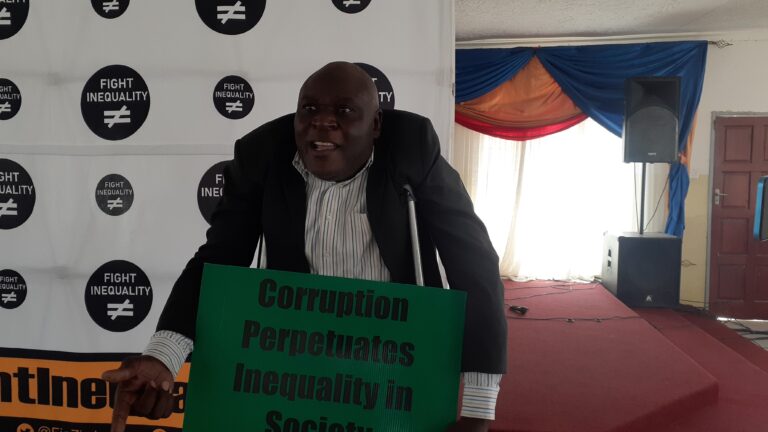
The call was made during a people’s assembly organized by Fighting Inequality Alliance (FIA) Zimbabwe in Masvingo on Monday September 18 where PWDs said there was need to make sure that they are represented within the women and youth quota systems through allocating a percentage for women with disabilities and youth with disabilities in the quota systems provided.
Disability Amalgamation Community Trust (DACT) Director Henry Chivhanga said inequalities were still existing in proportional representations as people with disabilities were not included and proposed that the electoral law be amended to ensure that parties allocate a certain percentage for people with disabilities within the youth and women’s quota.
“I believe there is need to have equality and equity within the proportional representations available, we need to have a segment that says every political party shall have 10 percent of women quota (for pwds) on the party list submitted to Zimbabwe Electoral Commission (ZEC) and failure to do that will attract a penalty, the carrot and stick system can help us achieve equality within the quota system within the women and quota and youth quota as well.
“In the national assembly, the electoral act must for instance in Masvingo province where there are 26 constituencies must have about three seats provided reserved for pwds which means political parties must sponsor pwds candidates in the required constituencies for there to be equality to make sure everyone is represented, ” said Chivhanga.
Cover Mugwadi from Masvingo also said there was need for the quota system to be implemented for pwds throughout other various sectors including accommodation and shopping malls.
“The quota system issues also include vendors in flea markets, shopping malls and council shops, there are no pwds renting in those spaces. People with disabilities are also often excluded when it comes to council flats and most are homeless yet if the quota system was being implemented they would get a place to stay,” said Mugwadi.
He further said there was also need for bill exemptions for pwds as some are not employed and yet are expected to pay council bills.
“Pwds are expected to foot their bills like any other person but are not given opportunities to work even in council,” said Mugwadi.
Prazen Jakata said there is still a gap in proportional representation as it does not include pwds.
“We were expecting to see women and youth with disabilities taking positions in proportional representations but we do not have such particularly here in Masvingo considering the length and breadth of the province as we have close to half of pwds living here,” said Jakata.

Man killed over empty scud container

0

Bright Zhou

A 43-year-old man from Village 3B Mukosi Settlement, Masvingo under chief Shumba was murdered on September 16, 2023 after throwing an empty scud container that belonged to a drunk man into fire.
Masvingo Provincial Police Deputy Spokesperson Assistant Inspector Lorraine Chanakira Ndlovu confirmed the incident and urged members of the public to resolve disputes amicably and to value the sanctity of life.
She also appealed to members of the public with information that can lead to the arrest of the accused person to report to the nearest police station.
“I can confirm the death of a Muchakata man who was killed over an empty beer container. We urge members of the public not to engage in violence and disputes should be resolved amicably, members of the public should respect each other and value the sanctity of life,” said Chanakira.
It is alleged that on the fateful day at around 1100 hours, 34 year old Taurai Murozvi visited the now deceased Ernest Chakauya’s house with an empty beer container in his hand and started insulting the latter’s wife Knowledge Magumbo calling her a lazy woman.
The two ignored Murozvi as he was drunk until he started vomiting which made Chakauya to force him out of the yard.
Chakauya then came back in the yard and threw the empty beer bottle into the fire and after a few minutes Murozvi came back and asked for his bottle he was told that it had been thrown in the fire.
The accused then took a log and hit the now deceased once on the left cheek and once on the head and he collapsed prompting Murozvi to run away.
Magumbo who was watching from behind called for help from neighbors who came and found Chakauya dead, Magumbo reported the incident to Muchakata police station.
The deceased’s body was taken to Masvingo Provincial Hospital mortuary and the accused person is still on the run.

It was not easy : CCC councilor narrates road to victory

Perpetua Murungweni

Masvingo Rural District Council (RDC)’s ward 25 has been a Zanu-PF stronghold having been held by Zanu PF since 1980 only to be won by the Citizens Coalition for Change (CCC) in this year’s election.
The new Councillor Tarusenga Mapamba said it was not an easy task winning in ward 25 which has been held by his uncle and namesake who later passed on the baton to Livison Mudzonga who has been there since 2005 and seeking for a fifth term in office.
“Ward 25 has been a Zanu-PF strong hold for the past 43 years and it was a tough journey for me to win. There were a number of cases of intimidation from Zanu PF and people were told not to vote for the opposition as usual in rural areas.
“It was difficult for me to gather people to campaign or hear their grievances. At times was I was denied a chance to speak at community gatherings by the former councilor because I was from the opposition.
“Sometimes we would hear that after leaving a certain area, people were intimidated and we would need to go back again to convince them to remain resolute,” said Mapamba.
He had to take advantage of funeral gatherings to meet different people in the ward where he would secretly exchange notes and sell his manifesto to the people.
“I had to make sure that I attend every funeral gathering, contribute some food and the help with some requirements, I bought big 3 legged pots (mabhodho) and plates for burial societies and I had to make sure that I am part of the community and because of that I became part of the society and I think that is how they accepted me to lead them.
“My good relationship with the people as Christian and member of the Zion Apostolic Church also helped me to sail through,” said Mapamba.
He said he was born and bred in the same ward so he understands what people need very well as he has been part of the community since birth.
“I was born in the area and I understand the challenges people in this area face and that gave me the spirit to stand still and fight so that I get a chance to fix what is wrong in the community.
“The community also complained on the system of employment recruitment that is being used at Rio Zim Renco Mine and it is one of the things that I want to adress,” said Mapamba.
He said his developmental plan involve engaging people and hear what they want then engage potential organizations to address the challenges.
“I am going to spearhead development through interacting with people and get to know what they want. I will the look for potential investors, and engage the business community and Rio Zim Mine so that we work together, creating employment and addressing other challenges,” said Mapamba.
The 49 year old Mapamba began his political journey in 2013 when he joined Mavambo party under Simba Makoni and then joined MDC alliance in 2018. He later joined CCC during its inception in 2022.
Mapamba did his Primary at Muchibwa and proceeded for secondary at Shonganiso Mission High before coming back home for A level at Tugwane High.
He is currently working as a Maintenance Fitter at Renco Mine.

Veld fires threatening livestock in Masvingo

Faith Duri

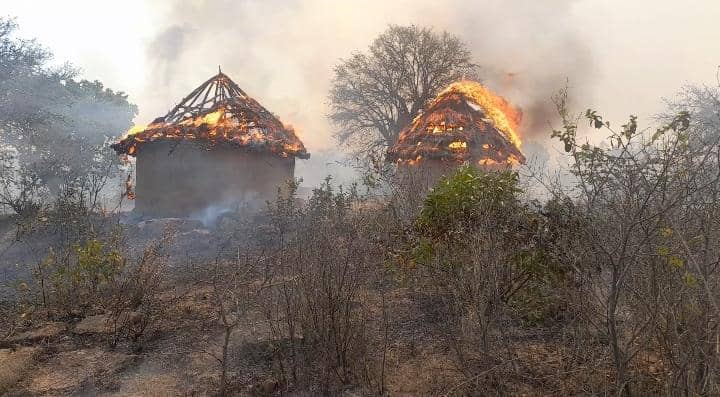
As the fire season is currently ongoing, a number of veldfires have been reported in the province and the fires are posing a great threat to livestock which devour grazing lands.
These fires pose an immediate threat to the safety and wellbeing of animals as flames sweep through grazing lands trapping livestock leading to injuries and in worst case scenarios, loss of valuable livestock.
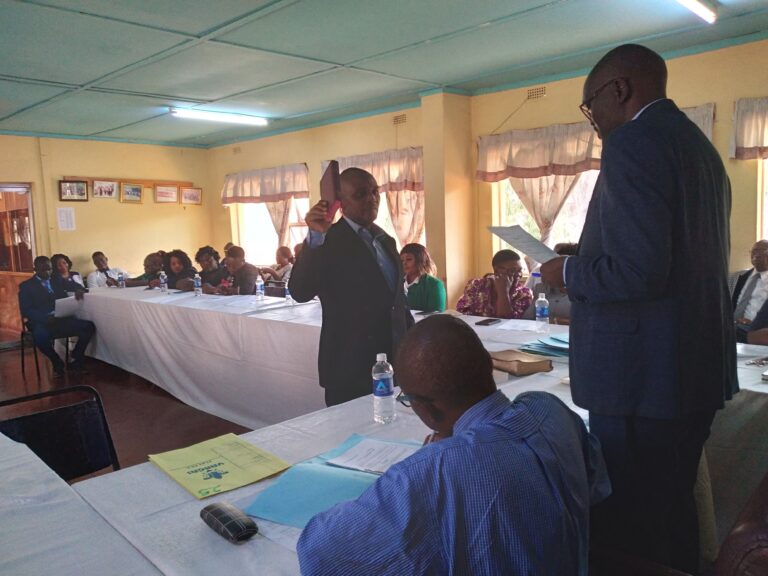
Speaking at a workshop on Government High Level Retreat on the backdrop of the formation of a new government to steer Zimbabwe held on September 20, 2023 at Great Zimbabwe University Law School Masvingo Provincial Veterinary Officer Kramer Manyetu said veld fires were causing loss of grazing lands which leads to shortage of available forage for livestock.
“The issue of veld fires is threatening our livestock especially these days as cases of veld fires are increasing in our province” said Manyetu
He went on to challenge traditional leaders to take a leading role in minimizing veld fires through enforcement as well as arranging reaction mechanism if fire broke out saying it was not the duty of the Environmental Management Agency.
“We cannot let the Environmental Management Agency (EMA) be the only organization in veld fire control. Traditional leadership should help us also and even if it means for civil protection committees to have fire brigade trucks to extinguish the fires as they often take two days spreading and people wait for EMA to take action.
“Animals are now suffering from shortage of pastures and if a fire starts in Chivi District instead of waiting for it to take two days spreading waiting for EMA, councils should also help to extinguish the fire before it spreads and destroys livestock,” said Manyetu.
EMA statistics from September 11, 2023 shows that the province had recorded one loss of life, 64 veld fire incidences, and a total of 21 388.36ha of land was burnt.
They also indicated that they have issued 32 tickets and three cases were pending in courts.
Masvingo provincial EMA spokesperson Munyaradzi Mtisi is urging people especially in rural areas to have fire guards so as to prevent these fires from spreading.
“The issue of veld fires is something that needs to be taken seriously, we are encouraging people especially from rural areas to have fire guards so as to prevent the fire from spreading,” said Mtisi
Recently there was a horrific fire that destroyed 500ha of land in Zaka which left a lot of people and animals stranded as the grazing lands for cattle were destroyed hence forcing them to walk long distances to other villages.
Veld fires pose a significant loss in Flora and Fauna, which results in bio diversity loss and can drive certain vulnerable species that are battling for existence in extinction.

Why negotiation for salaries and wage increments in the Public Service take longer

0

By Shadreck Zangairai

Zimbabwean legislation recognises the right to engage in collective bargaining. This is done at both enterprise level, through works councils, and at industrial level, through the auspices of employment councils. However this right does not apply to the public service employees who are covered by the Public Service Act Chapter 16:04 and the Health Service Act Chapter 15:16. Ideally there is no collective bargaining in the entire public sector but there is only consultation between employee associations and the Public Service Commission. These consultations are recognised through the establishment of a forum called National Joint Negotiating Council (NJNC), and Health Service Bipartite Negotiating Panel (HSBNP). After consultations, the employer is not bound by the decisions reached and can implement what it believes to be fair disregarding the other parties’ view or submissions. Consultations are also provided under section 24(1) of the Public Service Act.
Recently there has been speculations and expectations of wage and salary increment by the Public Service employees. Negotiations scheduled for the 7th of July 2023 were halted due to discrepancies in the increments demanded and offered, hence the negotiating principals wanted time to consult. This was confirmed by the Public Service, Labour and Social Welfare Minister who told the Herald of the same date that the National Joint Negotiating Council meeting was paused for further consultations. From the foregoing, it is undeniable that collective bargaining in the public service is quite different from collective bargaining in the private sector, both structurally and conceptually. In fact, it may be argued that there is consultation and not collective bargaining in the public service.
Negotiation in the public service is unique in that the state has dual responsibility of acting as both the employer and the legislative authority. As an employer, the state has to rely on efficient revenue collection so as to offer sound wage increases and at the same time it has to utilise the revenue collected prudently and remains accountable for public expenditure, hence the involvement of the Minister of Finance who has the responsibility to justify expenditure in parliament. In such circumstances, bargaining parties in the public service cannot be said to enjoy an autonomous relationship when it comes to collective bargaining, as it seek to achieve a balance between promoting collective bargaining and living within its own means.
The fragmented nature of the labour legislation in Zimbabwe disadvantages workers in the public sector and takes away their right to actively participate in negotiations. Besides the absence of the right to negotiation, the platform for bargaining is also not there. Members of the negotiating team (from the government) don’t have the mandate to decide on behalf of the government, but will have to collect the employee proposals for consultation with their principals. This reinforces the fact that negotiations in the public service are merely consultations. These consultations may take longer thereby keeping workers in waiting.
Unlike in the private sector where the Labour Act is enforced, the Public Service Act provides the legislative framework in the sector. According to SI 141/97, the National Joint Negotiating Council is more of a consultative forum rather than a negotiating forum, as decisions or conclusions made by the Joint Negotiating Council are subject to considerations by the Minister for approval or rejection. This therefore delay negotiations and employees are vulnerable because their employer is also the legislative authority. Therefore one can conclude that there are no negotiations but mere consultations as the representatives of the employer present at the negotiating table do not have the mandate to agree or disagree with the position tabled by the employee representatives. The Minister therefore has the power to make unilateral ‘take or leave’ decisions on the salaries, allowances and conditions of service in the Public Service.
Again, to some extent, government interventions can also cause delays in reaching agreements in the public sector. The Finance Ministry has on many occasions delayed the negotiation process through announcing a wage freeze for all civil servants. This is one of the challenges causing delays in reaching settlements. Other challenges causing delays include, lack of good faith between parties especially government, lack of conducive political, economic and social environment and the repressive and unsupportive legislation. This is because the public service regulations recognise consultations, with the employer having final say in the consultations. On the other hand, collective bargaining without the full right to strike tend to tilt the bargaining power to employers. The International Labour Organisation (ILO) convention on freedom of association embodies the right to strike in collective bargaining.
As a suggestion, the legal framework for negotiation in the public sector needs to change. Thus there is need to push for the harmonisation of the labour laws in the country. This will mean that the public sector will also be accorded the full right to collective bargaining thereby empowering unions. In addition, collective bargaining without the full right to strike tend to give more bargaining power to the employer. Zimbabwe legislation needs to be reformed in this area and afford a balance to negotiating parties. There is also need for the establishment of an effective Employment Council to create a platform for meaningful social dialogue. Furthermore, there is also need to repeal relevant provisions of the Public Service Act, Public Service Regulations, Health Service Act and the Health Service Regulations which grant excessive powers affecting social dialogue such as setting of conditions of service and dispute resolution.

Disclaimer: The information contained herein does not serve as alternative to legal advice. The author do not accept any liability for any damages or losses suffered as a result of actions taken based on information contained herein.

Shadreck Zangairai is a Human Resources Practitioner and for feedback, email: shadreckzanga@gmail.com,
+263772939877/713068365

Massive win for FC Wangu Mazodze

0

Decide Nhendo

FC Wangu Mazodze (The Kingdom Boys) seem to have gone back to its winning streak after defeating the visiting side Grayham FC on September 24, 2023 at Mucheke stadium with a walloping four goals to nil bagging three points and comfortably maintaining its seat on top of the log table with 45 points.
The game did not disappoint as it lived up to its billing and the log leaders started the game in a high morale creating several chances and scored three goals in the first half, overwhelming the visiting team and scored the fourth score in the second half.
FC Wangu Mazodze star Washington Ncube scored a hat trick in style sending the fans into wild celebrations that vibrated the whole stadium.
One of his scores was a magnificent header and he assisted Ngoyi Mani Gloire who scored the fourth goal.
Grayham FC tried to raise their tempo on the second half, but failed to register any shot on target even though the players managed to knock three to five successful passes while the play displayed by the hosting team showed that it was ready to be promoted to premier league.
Speaking to TellZim News after the match Ncube said he was happy by his own performance and promised fans the league title.
He said they were not backing down on their mission to get into Zimbabwe Premier League Soccer (PSL) and encouraged fans to supporting them.
“I am happy that we won this match and as a team we are not stepping back on our PSL promotion quest and we are not going to be removed from the top.
“I urge all The Kingdom Boys supporters to come in their numbers and support us as we work to bring PSL into Masvingo City,” said Ncube.
Third placed Rusitu Tigers FC dismissed JM Busha FC with two goals to nil as they continue with their unbeaten run for nine consecutive games with 43 points.
Bikita Minerals FC defeated the Kingdom Boys’ homeboys Masvingo United with a goal to nil getting 41 points.
Tennax FC won with two goals to one against Mutare City to square points with FC Wangu Mazodze at 45 points.