
Home Blog Page 217

Mental health, drug and substance abuse in schools. What is the missing link in the school health policy?

By Charity Shumba (Assistant Educational Psychologist)

Policy- what is it all about?

A school health policy is a clearly defined document / policy that promotes health and wellbeing in schools. In 2018 the government of Zimbabwe through Ministry of Primary and Secondary Education in collaboration with Ministry of Health and Child Care launched the Zimbabwe School Health Policy with a vision of having a primary and secondary education system with an enabling environment for the provision of equitable, sustainable and quality health services for all learners.

The policy objectives seeks to provide competency based health education, including life skills that are age appropriate, culturally relevant and scientifically accurate in the school setting, improve access to and use of health and nutrition services at school, promote safe school environments that are stimulating, socially supportive and hygienic for learners, teachers and community in the school setting.  The policy also seeks to strengthen multi-sectorial, collaboration and coordination in school health programming as well as strengthening the organisational structure and professional capacity development of teachers to enable the developments.  It also seeks to provide opportunities for physical education and recreation to enable access of young people to constructive activities and strengthen school programmes, for counselling, social support and mental health promotion.

The school health policy is based on three implementing strategies which includes mainstreaming of health topics into the curriculum for all schools, provision of school health package and  strengthening of  inter-ministerial  linkages  and coordination of all stakeholder support for Enhanced System management, Coordination,  Monitoring and Evaluation, encouraging  Public –Private Partnerships

 Zimbabwe School Health Policy implementation successes                  Through the implementation of the ZSHP quite a number of programmes are being implemented in schools, these have strengthened the education, health and general welfare of the learner.

  • The Ministry of Education in collaboration with Ministry of Health together with other stakeholders have promoted health behaviours and improved awareness about health issues among learners and community at large.
  • Health services such as vaccination on COVID 19, TCV and other diseases are brought to schools and communities for ease access with the aim of creating a healthy learner.
  • Through collaboration of the two ministries together with other partners most schools have safe water sources which contributed to a healthy and hygienic school environment.
  • There is also improved menstrual hygiene in schools through provision of sanitary wear for vulnerable children and bins for safe disposal by the government in schools though there is need to secure more reusable pads for sustainability.
  • Guidance and counselling is being taught in schools from starting from ECD.

The school health policy has significantly managed to standardise and improve the general implementation of health programmes in schools. This has helped to improve access to health services that has transformed the well-being for learners.

The missing link

The Zimbabwe School Health Policy has managed to contribute immensely towards learner wellbeing; however there remain significant gaps in other critical areas which are often neglected and associated with adulthood such as mental health, drugs and substance abuse. This has been evidenced by an increase in cases of suicide, drug and substance abuse and other wanton behaviours being exhibited by learners in various learning institutions. We have witnessed quite a number of children who decided to take their lives, for example the recent ZRP high school case where an A level student committed suicide in the school premises.  Our children, both boys and girls are abusing drugs and various substances in schools and at home. The issue of suicide, drug and substance abuse has become a worrying trend among our children both in and out of school and suicide is now considered the fourth leading cause of death among teenagers and adolescents.

The most recent trends seem to point to the fact that children are succumbing to serious mental health issues as well as poor copying mechanisms which makes it difficult for them to bear   with day-to-day stressors and experience leading to such terrible things as suicide or resorting to drug abuse. What makes matters worse is that a lot of people  view   learners as incapable of  experiencing high levels of stress, emotional distress and depression  and as a result   little has been done to focus on the learner while much effort is being dedicated to adults mental health issues Children are facing a lot of life pressures, pressure to succeed, to finish school work , some are coming from broken families, child headed families, families with gender based violence which all contribute  negatively to their mental health.

To make matters worse the current economic condition in Zimbabwe is making most parents to concentrate on hustling to put food on the table to the extent that they do not have time for their children. The issue of social media is also affecting a lot of families as people will spend most of their time on their phones during family time which makes it difficult for children and parents to have that special time talking, discussing issues affecting them. Drug abuse is also associated with mental health issues, research indicated that children who are involved in drugs and substance abuse are more likely to commit suicide or to have mental health problems compared to those who are not involved in drug use. Sometimes children commit suicide with a mind of fixing those whom they thought would have wronged them and they do so without understanding that death is permanent.

Some of the challenges that are contributing to all these problems is that our teachers are not capacitated to handle children with various mental health problems and there is lack of mental health training among teachers and school administrators.   There is no standardised curriculum when it comes to dealing with mental health in children especially in schools. Teachers try and use their experience from guidance and counselling to help but there are some cases which needs mental health experts for the children to be fully helped.

Another contributing factor is the general lack of  motivation among  teachers who instead of utilising the time allocated  for guidance and counselling  and general health education, they use that slot as an opportunity for conducting extra lessons which have been sustaining many in the face of crippling economy and low remuneration . The ultimate product of such appalling situation is an academically intelligent learner who has poor copying mechanisms when faced with life problems and shallow in solving life problems.

Staff attrition also negatively contribute to gaps in  policy implementation in school, for instance if we lose teachers with institutional memory on issues affecting learners and their behaviours or character, it becomes difficult to longitudinally track  and subsequently monitor the behaviours  of those children who exhibit metal health and drug abusing proclivities.

There is limited referral services for mental health as well as key staffs addressing mental health issues considering number of learners and cases needing their services. For instance the number of mental health experts and professional (psychologists, psychiatrists, counsellors) manning the provincial education offices in the Ministry of primary and Secondary Education are very few compared to the overwhelming number of cases arising every day.  This results in poor case management and piece meal solutions to all the emerging issues.

How do we proceed?

For every policy to be successful, the implementers of that policy should take full participation and ownership of the programme. So in this case the government, teachers, parents and children are the centre stage of the problem and obviously part of the solution in effective school health policy implementation therefore the following recommendations could be adopted:

There is need for the government to allocate more funding on the health and education sector for easy implementation of the policy to facilitate availability of awareness and psycho social packages including from private actors so that learners become more empowered to cope and deal with the key drivers of suicide and drug and substance abuse.

Mental health curriculum should be part of in service training for all teachers just like core curriculum activities, than it to be post basic training which one needs to acquire after the teaching certificate. This will enable all teachers who mostly act in loco-parentis to be able to deal with all cases professionally and in a sustainable manner. More so, there is need for schools to seek the services of educational psychologists to handle complicated cases and assist during capacity development of teachers.

There should be a standardised curriculum for mental health in schools and each school must have a mental health expert to help with mental health awareness and issues affecting our children in schools. More awareness campaigns on mental health issues are needed as mental health is a reality.

Schools, districts and provinces should create a database on issue of learners so that other new teachers who come to that school can easily access information about the learners. This makes it easier for the new teacher to quickly know their children and easily know how to help the child or intervene in certain situation. It is of paramount importance for school to ensure that there is conducive learning environment which is free from bullying.

Parents should use positive parenting methods which allow them to have good relationships with their children  making it easier for them to open up to their parents whenever they  are facing challenges as well as learning and getting good advices from parents than getting wrong information and advices from outsiders and social media. Parents should always find time to talk to their children so that they understand them better and become aware of what is happening to their children’s lives. Parents should monitor their children regularly so that they know their movements and whereabouts than just letting their children do as they please. Parents should treat suspicious mental health issues with the urgency it deserves by seeking professional help from mental health experts when necessary than wait until it is too late.

Children should be taught to understand that life is valuable; one leaves daily and die once. Killing oneself is permanent, there is no life after death and taking one’s life is not an option and is not solution. Our children should understand that resorting to drug and substance abuse is not a solution but rather another problem which will be more difficult to solve. Children should be encouraged to open up whenever they are facing challenges as it is always ‘said a problem shared is a problem solved’.

Government should strive to   avail better remuneration to teachers in line with the u decent work agenda as this will limit teacher attrition and enhance sustainable behaviour change culture in schools

Editorial Comment: Curriculum issues need multi-sectoral approach

0

With government embarking on a curriculum review process paying attention to the Competence Based Curriculum with Continuous Assessment of Learning Activities (CALAs) taking centre stage, a lot has to be taken into consideration if ever the noble idea is to bear fruit.
After government made it clear that they aim to produce learners who have the relevant skills that are useful in real life situations, there is need for that same government as a policy maker to ensure the input of every stakeholder in curriculum issues is taken into consideration.
Thus the success of this whole competence-based education system will hinge on the incorporation of ideas from all key stakeholders unlike a situation whereby government will just impose itself over other key stakeholders whose input is critical in implementation of curriculum issues.
Government must seriously revisit and consider its stance on the role of educators in the success of any curriculum and thus should make sure they shift from the use of force through imposition of directives on an already demotivated teacher. Initially government should have taken the input of teachers, their views and positions with regards to the issue of CALAs since they are the ones on the ground guiding the teaching and learning processes.
Secondly, the role of parents in curriculum shows how key a stakeholder they are in any given curriculum implementation situation. Since parents are the ones who bear the brunt of the whole cost of the learning of their kids, government should have taken into consideration the role of parents instead of just taking them by surprise and expect them to foot the costs.
After the realization that the old curriculum didn’t address the needs and demands of this contemporary society, government should thus have made sure that enough resources are availed in schools countrywide to ensure the intended goals of the updated curriculum can be realized and that entails making available of teaching and learning materials timeously as well as addressing such key issues like teacher-pupil ratio as well.
Teachers especially those in service need to upgrade their knowledge bases to meet the demands of the new system and that means not only school administrators attend such upgrading workshops. Bearing in mind also that the content in other learning areas like ICT, and or Science and Technology is a bit too much for the young learners, the way to go will be for government to position the young learners to what suits them and thus making sure relevant content is imparted to them suiting their grade levels. By making sure that the content suit the grade level, enough resources are availed and teachers are motivated, only then can glimpses of success filter through the education system while at the same time avoiding overburdening parents and other stakeholders.
Government through the Ministry of Primary and Secondary Education thus should act in sincerity even when it comes to judging how the updated curriculum has fared over the previous seven years and that will see them come back to the drawing board and avoid working with manipulated and doctored results.
Teacher representatives unions should also be taken into consideration as they form an integral party in the whole success or failure of any given curriculum.

National Lithium Ore Policy: A Step in the Right Direction?

Zimbabwe is a mineral commodity-dependent nation. The Reserve Bank of Zimbabwe (RBZ) statistics show that in 2022, the nation generated a record US$11.6 billion in foreign currency receipts. Of this total, export proceeds contributed about 64% (US$7.4 billion) with minerals alone constituting 75.7% (US$5.6 billion) which is 11.8% higher than the 2021 mineral export value of US$5.01 billion.
Trend analysis of official trade statistics shows that gold has been Zimbabwe’s traditional top export revenue generator. However, there are other minerals like lithium also showing great prospects. With the government recently approving the national lithium ore policy, this week’s column, therefore, analyses the intentions of this new policy.

Global Lithium Developments
The global economies particularly advanced countries like the US and the European Union (EU) are witnessing a seismic shift from fossil fuel dependency toward electric vehicles (EVs) and clean energy technologies. The International Monetary Fund (IMF) projects that the globe must reduce its greenhouse gas emissions by at least 25% by 2030 in order to fulfill the goals set in the 2015 Paris Climate Agreement. This accord seeks to limit the increase in global temperatures to 1.5 degrees, for instance, through the reduction in world carbon dioxide emissions to net-zero by 2050.
As such, mineral commodities such as lithium are significantly benefiting from this shift to a green economy. With a high energy density, lithium is used in the production of rechargeable lithium-ion batteries which have become one of the main energy storage solutions in modern EVs. This has seen global demand for lithium skyrocketing, expected to reach approximately 2.5 million metric tonnes (MT) by 2030 up 756% from 2020 levels of about 292 000 MT. McKinsey predicts that because of surging demand for Li-ion batteries, “revenue along the entire value chain will increase 5-fold from about US$85 billion in 2022 to over US$400 billion in 2030”.

Zimbabwe Lithium Developments
With rising lithium demand, the base metal has great potential to significantly contribute to Zimbabwe’s economic growth and development. The nation holds Africa’s largest lithium reserves and the fifth-largest deposits globally. Currently, Zimbabwe is estimated to have the highest concentration of Africa’s lithium projects under exploration.
Some of these major projects include among others; Prospect Resources’ US$422 million deal with China’s Zhejiang Huayou in 2022 where the latter acquired controlling rights of Prospect’s Arcadia mine; Mauritius’ African Metals Management Services and Southern African Metals and Minerals with a combined 74% stake in Bikita Minerals were acquired by Sinomine’s Hong Kong unit; Premier African Minerals (PAM) which holds lithium claims at Fort Rixon entered into a joint venture agreement with Lithium Consolidated Mineral Exploration (Li3) to acquire a 50% interest in PAM’s lithium assets located in Mutare Greenstone Belt.

National Lithium Ore Policy
The rushed acquisition of local lithium mines by foreigners and the massive exportation of unprocessed lithium ores by artisanal miners has posed major obstacles to the development of the lithium sub-sector.
Cognizant of the foregoing, the government initially imposed a ban on the export of raw lithium in 2022 through statutory instrument 213 of 2022 (SI 2022-213). The SI 213 allowed exportation only for those with written exemptions from the Minister of Mines and Mining Development on condition that they are either exporting samples for assaying abroad or provides proof of exceptional circumstances allowing for exportation.
As a follow-up to the 2022 raw lithium export ban, authorities recently approved the Lithium Ore Policy (LOP). The LOP contains the following principles: Any individual or entity which owns a lithium concession can mine lithium ores for either processing at its own Approved Processing Plant (APP), or for sale to those with approved processing plants locally; Any individual and or entity wishing to process lithium ores will be required to construct an APP locally; Ore movement permits for lithium ores will only be issued where such ores are destined for a local APP;
Also, lithium ores can only be stored at the mining site where such ores were mined, or at a local APP; Any entity will require a Lithium Ore Purchase Licence to buy ores from miners. A local APP will be a condition of getting the Lithium Ore Purchase Licence; All players in the Lithium sector whether miners or holders of APP shall submit a summary of monthly reconciliations of Ore movements to the Ministry of Mines and Mining Development; and for any material to qualify as a concentrate for approval for export, it shall meet the minimum set technical specifications and the minimum selling price as set by the Minerals Marketing Corporation of Zimbabwe regularly.

Intentions of the New Policy
The Lithium Ore Policy (LOP) which seeks to prioritize local beneficiation and value addition of lithium is a step in the right direction as it is in sync with global dynamics. For instance, Chile, the world’s second-largest lithium supplier is set to nationalize its lithium industry to boost its economy and protect its environment. Also, Mexico has already nationalized its lithium deposits to maximize benefits from the “white gold”.
As such, Zimbabwe’s LOP has great potential to empower and transform the livelihoods of local artisanal miners in lithium-rich communities. Exports of value-added lithium and lithium products will help create jobs for locals and generate significant amounts of forex. Zimbabwe is in dire need of forex to accumulate reserves. These reserves are key in supporting the volatile ZWL, addressing the balance of payment imbalances, and use during natural disasters like El-Nino-induced droughts.
The latest LOP, therefore, intends to prepare Zimbabwe for the new green economy. The rising demand for green energy and low-carbon technologies is boosting lithium demand. As such, the lithium sub-sector needs to be well prepared to meet domestic demand.
An unprepared lithium sector will struggle to meet the rapid increase in future domestic demand thereby possibly slowing the integration of renewable energy technologies. If this happens, citizens particularly those living in areas prone to climate-change-induced disasters will continue to bear the brunt of climate impacts thus widening inequalities. So, it is high time that authorities pursue greening of economic policies to achieve climate justice.
Furthermore, the LOP intends to ensure supply chain security from the rising volatility of global geopolitics. The world has learned some lessons from the Russia-Ukraine war as well as the COVID-19 pandemic about the dangers of overreliance on imports. This has therefore changed the way countries should look at mining and mining projects. Cognizant of this, there is a great need for critical mineral strategies including the building up of domestic industry to avert shortages, economic crises, and the fragility of supply chains.
Generally, new technologies require an adapted workforce to operate increasingly complex machinery and perform data evaluation. Yet, finding and training locals to fill these roles can be a cumbersome task for the mining industry. Also, growing negative public perception and concerns around the future of mining, especially during bust cycles scare away potential mining workforce.
So, with climate change forcing nations to adopt green technologies, it is high time that authorities institute mining policies that entice foreign investors to commit to the development of the local industry by bringing their technologies and expertise. This will help build an interdisciplinary and technical local workforce.

Parthian shot
I believe that policy intention is not policy implementation. As such, authorities must strictly adhere to their lithium policy since previous episodes show that crafted policies such as the diamond, chrome, and black granite policies are inconsistently implemented. The government must also ensure that awarding lithium licenses is a transparent process and that license costs are affordable in order not to crowd out the poor majority.
More so, the government must ensure that big companies especially foreign-owned ones with approved processing plants (APPs) are purchasing lithium ores from local artisanal miners at competitive prices to avoid the overexploitation of indigenous people. Last but not least, authorities must devise additional policy sweeteners to lure foreign and domestic investors to strengthen the lithium value chain.

Parents urge government to avail resources for CALAs

Perpetua Murungweni

Parents in Masvingo who attended the curriculum review consultations organized by the Ministry of Primary and Secondary Education (MoPSE) have rejected the implementation of Continuous Assessment of Learning Activities (CALAs) demanding that government should provide enough resources in schools for kids to do partake in the programme.
CALAs are part of a revolution from the old knowledge-based final examinations model to a competence-based exit profile evaluation for Grade Seven, Ordinary Level and Advanced Level learners introduced in 2015.
During the curriculum review consultations held on May 23 and 24, 2023, parents and guardians at Mucheke High school said CALAs were poorly implemented by government as parents cannot afford resources required for the learning activities.
“As parents, we do not want CALAs in schools because we cannot afford the resources that are needed for the programmes to be done. We can only accept CALAs if government provides resources in schools.
“If government does not issue resources in every school what it means is the CALA is exclusive to learners from little income families who could not afford it, contrary to its principle of inclusivity,” said Fungai Taruberekera.
Another parent at Don Bosco Primary School said that parents don’t want cala because it’s very expensive to parents and guardians, who have to pay money for every cala project that the kids are doing.
“After paying school fees we have to pay money for every Cala project that our children are doing because, we don’t have the resources at home and its very expensive,” said Brighton Shava.
Shava also said that most of the learners are benefiting nothing from the cala because most is the work is being done by the parents due to lack of resources.
“We don’t want the cala as most of our kids are not benefiting from it due to lack of resources, in most cases we end doing the research on behalf of our kids maybe at work where we can access the internet or at our friends’ home,”

Masvingo registers only 7 schools in 2023

…262 schools yet to be registered

Beverly Bizeki

The Human Capital Development department with Masvingo Provincial Development Committee (PDC) has revealed that the province registered seven schools during the first quarter of the year 2023 with 90 percent of the 262 satellite schools in the province yet to be registered.
This was revealed by the committee chairperson Provincial Education Director Shylet Mhike Acting during a PDC meeting held at Civic Centre Hall in Masvingo on May 23, 2023.
“For the first quarter of 2023, we were only able to register seven schools all of which are private schools. We have 262 satellite schools of which 90percent do not meet registration requirements,” said Mhike.
Mhike also urged members of the PDC to engage parents in acquiring enough structures for the schools so as to qualify for the registration.
“We appeal to you to mobilize parents so that they can get enough structures so that we register these schools,” said Mhike.
Mhike also revealed that the department has failed to fulfill its school feeding programme as the ministry has not had grains required for it.
The department has also surpassed its targets in increasing the number of schools offering Science Technology Engineering and Mathematics (STEM) and Grade 7 schools with the department enrolling 350 000 grade 7 learners surpassing the 300 000 target for the year.
Minister of State for Masvingo Provincial Affairs and Devolution Ezra Chadzamira who chaired the meeting urged the committee to focus on important projects and ensure that projects are completed before embarking on new ones.
Government through the Ministry of Primary and Secondary Education (MoPSE) last embarked on a crackdown of illegally operating schools mainly in urban areas with some being closed for offering lessons without proper or no registration.

CSOs demand reduction of 2023 candidate nomination fees

Beverly Bizeki

Civil Society Organizations (CSOs) have petitioned the Zimbabwe Electoral Commission (ZEC) and government calling for the reduction of candidate nomination fees for the 2023 elections and pleaded for youth, gender and disability sensitive fees to advance inclusive representation in public offices.
The petition dated May 15,2023 follows the amendment by government in statutory instrument 144 of 2022, Electoral which stipulates that constituency Member of Parliament are expected to pay US$ 1 000, provincial councils pay US$ 100 with aspiring presidential candidates expected to pay US $ 20 000.
In a statement the CSOs which include WELEAD Trust, Magamba Network, Institute for Young Women’s Development Youth Decide Zimbabwe, Junior Court Club, Zimbabwe Human Rights Association and Accountability Lab Zimbabwe, petitioned ZEC to effect a downward review of candidate nomination fees.
“We demand that for the 2023 General Elections, the Zimbabwe Electoral Commission urgently effect a downward revision of the candidate nomination fees to the rates that were used during the 2018 General Elections that is US$ 1 000 for the president and US$ 50 for the constituency members of parliament,” read part of the petition.
The CSOs also demanded that government set amounts which are affordable and sensitive for the marginalized communities.
“We demand that going forwards, the ZEC and responsible minister of Justice, Legal and Parliamentary Affairs must in consultation with citizens and stakeholders, ensure that any set amounts are affordable , gender, youth and disability sensitive,” added the petition.
The petition also demanded that the parliament of Zimbabwe and responsible government line ministries ensure that the electoral commission is adequately funded in a way that totally removes or ensures that prospective candidates pay a minimal affordable fee.
In the 2018 election, only six individuals under the age of 35 were elected to the National Assembly with a paltry 2.85 percent of young people in the parliament of Zimbabwe.
Young women and people living with disabilities are therefore facing the low levels of representation as evidenced by the outcome of the 2018 elections which saw women constituting 13.3 percent in local government and 31.5 percent of the 210 National Assembly seats.
In 2022, women and youth lamented the fees gazetted by ZEC saying they deprive them of a chance to participate in electoral processes as they are not well resourced to do so when compared to their male counter parts.

Calls for policy shift to counter Hawala-remittance system

Champion Mudavanhu—Own Correspondent

Policy changes to promote innovation, public convenience, and build public trust in the local financial system have been highlighted as the much-needed panacea, particularly in countering the vibrant hawala-based informal money transfer system to channel more remittances revenue to the fiscus.
In simple terms, Hawala is a money exchange system that allows for an informal transfer of funds from one person to another without the actual movement of money, permitting anonymity as it requires no documentation.
An article published by this paper earlier this month proved how government is losing out on potential revenue in the form of both direct and indirect taxes through the operations of unregistered therefore unregulated money transfer companies that have established offices in all the country’s major cities and towns and in some growth points.
Several economic and financial luminaries reacted to the story, with policy change recommendations seemingly being the common ground in their arguments.
Local entrepreneur and CEO of Fresh-in-a-box, Kuda Musasiwa, argues that there is no practical way to stop the unregulated Hawala system.
“They can`t. as long as there is arbitrage and incentive to go around the system.” By definition, arbitrage is the practice of profiting from price discrepancies across marketplaces, where traders purchase the less expensive form of a currency, commodity, or assets that are valued differently on two different marketplaces,” Musasiwa said.
Financial expert and Chartered Accountant, Kudakwashe Mugova, who is based in South Africa, buttresses Musasiwa`s position and said these transactions are hard to control.
“I think cross border transactions are hard for us to control especially with the US$ as the medium of exchange in our economy,” Mugova said.
The same view is held by Great Zimbabwe University Munhumutapa School of Commerce Economics lecturer, Dr Talknice Saungweme, who highlighted the need for the government to make the formal financial transfer system more accessible and convenient.
“The first thing is to make the formal system more convenient. Any general person should be able to access the facilities, even in the rural areas. For the meantime, it is really difficult for a person in the rural areas to access it (money transfers), but if it`s done through the informal agencies, they will make sure the person gets their money,” Dr Saungweme said.
Dr Saungweme further suggested that government should make accommodations to be able to tap into the revenue stream of the informal money transfer sector.
“The government can avail facilities through the banking system, or maybe even through the retailers (look at the South African system) where retailers have a part to play in the disbursement or in ensuring that the public have access to their monies. It is also important for the government to be as flexible as possible, to have as many players as options for people, and then just tie-up the loose ends, making sure that every cent that comes into the system is accounted for,” he added.
This view was seconded by Mugova who added that Zimbabwe does not have enough control due to lacking of banking infrastructure.
“We don’t have enough banking infrastructure to control it. It`s not like in SA where the regulator has strong institutional controls,” he added.
Dr Saungweme added that the current interest and tax regimes need to be reviewed and aligned with reality if the formal system is to gain any market share controlled by the informal sector which charges below the formal 10percent.
He argues that the government needed to work with the law of numbers to try and attract as many people as possible so that even if it charges little amounts they still turn out substantial because of the numbers.
South African based economic and political analyst, Kudzai Mtisi, said that it is difficult to regulate the operations of the unregistered money transfer agents, or to prosecute the perpetrators using the Reserve Bank of Zimbabwe (RBZ) Act [22:15], the National Payment Systems (NPS) Act [22:43], and the Exchange Control (EC) Act [22:05].
“The major challenge is the corruption of the law enforcers. These people unregistered money transfer operators are known,” he said.
Mtisi said the government needs to consider why the people who use the informal system do so in order to come up with a meaningful position.
“The starting point is knowing why individuals choose these folks (unregistered agents) over the registered one. That will help in addressing the issue.”
“It should be more of an information campaign rather than a law enforcement blitz. It’s about discouraging people from using unregistered agencies. In many countries, government departments run adverts warning people about using unregistered agencies. At least with registered agencies, you are guaranteed that your money is safe. We need to be a nation that provides information in ways that provide easy access. A simple google search should give a list of registered agencies. We should warn people through marketing campaigns. No hardball approach,”Mutisi said.
Dr Saungweme was however tentative on being asked if he would recommend regularizing the Hawala system as an issue of policy.
“When we talk of policy, it`s not something that the government can just use opinions, it should be tested. There is need for a thorough investigation into the system before we can then say we are going to adopt it and use it. It depends with our structure, the depth of our financial system and other supporting systems that can then make it function efficiently. I recommend we study the system first,” Dr Saungweme said.
The RBZ public relations department did not respond despite asking for questions in writing. Follow-up phone calls were made to the PR department, and they indicated that they were waiting for response and clearance from the Financial Intelligence Unit (FIU) and the Exchange Control Unit, and then ended up not picking up calls.
Similarly, ZIMRA PR were responsive initially and asked for a formal email request which was sent. They indicated that they were waiting for an appropriate response from the relevant department that deals with revenue collection in the case of financial institutions.

(This story was written with support from the Voluntary Media Council of Zimbabwe (VMCZ) Investigative Journalism fund.)

AGWRF tackles misinformation, rumours around Cholera, health issues

TellZim Reporter

Civil Society Organization Adolescent Girls and Women Rights Forum has embarked on a drive to combat misinformation and spreading of rumours that have taken centre stage following the recent spike in Cholera cases in Masvingo province.
AGWRF director Priscilla Mafa confirmed the news adding that the organization has been doing rounds gathering information regarding false narratives pointing to Cholera in mining areas around Masvingo district with the aim of correcting the problem.
“AGWRF has been moving around gathering information (rumours) surrounding Cholera in Masvingo district with the objective of combating misinformation through dissemination of facts about the disease.
“The organization through Internews’ Rooted in Trust (2.0) local acceleration project is moving in mining communities around the district conducting community listening meetings on misinformation around the disease and other topical health issues,” said Mafa.
She also added that the implementation of the programmes would be done through both online and physical sessions with online having commenced last week while physical are set for May 29 onwards.
“We conduct focus group discussions with women and adolescent girls
in Masvingo Urban and mining communities which include Mashava, KwaSteven and Bhuka. The implementation commenced last week (online) and will be continued from May 29 (physically).
“The main idea behind the project is curbing misinformation trough gathering rumours around Cholera and other health issues before creating content which we will share on various platforms. On the content, we identify the rumour and provide the fact while we will also do films on the activities,” added Mafa.
Misinformation has been a major undoing fuelling the spread of diseases in the country especially in times pandemics like Cholera, Covid-19, HIV and AIDS among other diseases as rumour mongering takes centre stage making it difficult in some cases to handle and control the spread of the diseases.

Agronomist urges Chiponda Garden farmers to plant high breed crops

Perpetua Murungweni

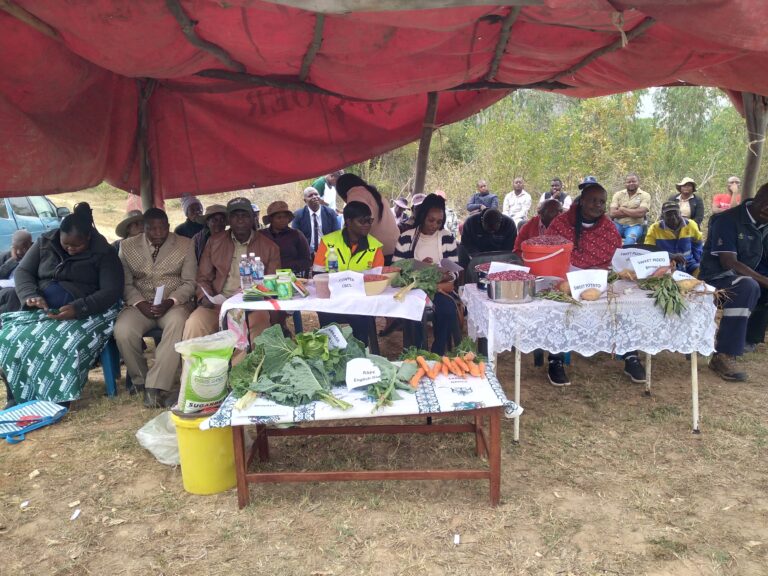
Chiponda community garden members have been urged to plant high breed crops because they are more disease resistant than the usual crops.
Speaking to farmers during a horticulture field day at Chiponda village under Chief Nyajena, ward 25 in Masvingo Central on May 23, 2023 Vengai Dhefu of Farm and City said farmers should plant high breed crops in order to reduce diseases in horticulture farming practices.
“I strongly urge you farmers to try high breed crops because they are more disease resistant since you are lamenting about water, and that lack of water for plants may cause different diseases,” said Dhefu.
He also urged farmers to practice early planting as a way of mitigating climate change effects.
“You should also try and practice early planting of your crops due to climate change and I also urge you to consider the weather conditions so that you can be guided on what to plant and at what time. Due to water supply challenges, you should also try to adapt to small grains such as wheat, sorghum and millet because they are drought tolerant crops,” said Dhefu.
Chiponda Agriculture Extension (Agritex) supervisor Tinashe Chirambadare promised to teach and mobilize garden farmers in adapting to high breed crops.
“High breed crops as mentioned by Farm and City have advantages especially in this project since we are having water challenges and our crops are being affected by different diseases. As the supervisor, I am going to mobilize farmers to adapt to high breed crops because they are not only disease resistant but they have a high yield,” said Chirambadare.
Kumbirai Chomunogwa the garden secretary said high breed crops are disease resistant and have high yields as witnessed on our sugar beans yield.
“High breed crops are disease resistant because we never had disease challenges with NUA 45 which is a high breed sugar bean crop that we planted this season and we also witnessed a high yield of the sugar beans,” said Chomunogwa.
Last year TellZim News had a partnership with Chiponda garden farmers where they distributed inputs among them vegetable and maize seeds a move welcome by the farmers.

Covid 19 sends 32.6 million African girls out of school

….PAP throws weight behind #AfricaEducatesHer campaign

Brighton Chiseva

MIDRAND – As the effects of Covid -19 pandemic still linger in Africa, its ravaging effects impacted a lot of girls especially on the education front where more than 30 million girls have been forced out school.
The Pan-African Parliament (PAP) has vowed to support the African Union (AU) International Centre for Girls and Women’s Education in Africa (CIEFFA) on its campaign, #AfricaEducatesHer.
PAP declared its support after receiving the shocking statistics by CIEFFA during a day’s workshop which indicated that a total number of 32.6 million girls from both primary and secondary schools were send out of school by the effects of the global pandemic.
The workshop was running under the theme: Contribution of Pan African Parliamentarians for National Implementation of the AfricaEducatesHer Campaign to create legislation to ensure learning opportunities in post Covid-19 for girls.
Giving her presentation at the workshop, the AU CIEFFA Acting Coordinator Simone Yankey-Ouattara said there are 32.6 million girls out of school and close to 10 million are likely not to return to school.
“There are 32.6 million out of school girls both in primary and secondary schools and 9.3 million of them are likely never to set foot in school again,” said Yankey-Ouattara.
PAP Chairperson of the Committee on Education, Amina Abdou Souna said the purpose of the workshop was to give a platform to suggest and implement solutions to the effects of Covid-19 on girl learners.
“This meeting is meant to find lasting solutions to issues affecting young girls and since the pandemic started, girls have been immensely affected. Statistics show that 11 million girls are unable to go to school as a result of this pandemic, so it is our duty as parliamentarians to see to it that we have results,” said Souna.
PAP President Chief Fortune Charumbira said it was the duty of the parliamentarians to make sure that their respective countries are implementing the Dakar Declaration of Education For All (EFA) which is a global commitment to provide quality basic education for all children, youth and adults.
“It is our duty to oversee that our countries are implementing the Dakar declaration, what member states have done, if they have moved, to what extend. We should pass laws in our national budgets when we pass them; we have to make sure the budgets cater for the education of girls and young women’s education.
“By doing that, we will be promoting the AfricaEducatesHer campaign. We as PAP are happy to say we are part of this campaign in full,” said Charumbira.
He went on to say every parliamentarian will have to introduce the campaign to his own parliament and said as PAP they were modelling a law on gender equality under which #AfricaEducatesHer automatically falls.
“As PAP, I am proud to say that we are currently developing a model law on gender equality which includes #AfricaEducatesHer,” said Charumbira.