Home Blog Page 341

Government should tackle recalls issue once and for all

The new trend of getting rid of political enemies being employed by MDC-Alliance leader Douglas Mwonzora is digging far deeper in the taxpayers’ pockets than government is ready to admit.
The state of affairs in most local authorities mainly in urban areas has become worrisome and need attention from government if the interests of the general populace are to be served.
This new tool for settling political scores serves no good to the electorate but only detrimental to service delivery to which these elected councillors would have been chosen to represent.
The fact that wards and constituencies are left with no representation to spearhead development as a result of political aggrandizements just show how lagging behind Zimbabwe is with regards to corporate governance practices and as a result the nation goes nowhere.
To top that, those in positions of authority that is the judiciary, legislature and executive are not seized with the vitally necessary question: are these by-elections elections not worsening the burden on the already struggling taxpayers and at whose detriment is the denied service delivery?
Surely it is only to please a few greedy individuals on the political landscape.
Whether setting a bad judicial precedence or not , how can someone who was not even elected either as an MP or let alone a councillor be allowed to wantonly go against the interests of so many people from the Zambezi to Limpopo? Government should act in sincerity and stop forthwith this cheap politicking game which seems to reward cowardice and mediocrity at the expense of merit.
People who are chosen by the electorate should be dismissed through the ballot than one individual.
As a result it is the duty of the three arms of state to ensure the tenets of democracy are preserved and practically done than just preaching a gospel of constitutional democracy when certain individuals are allowed to infringe on other citizens’ fundamental rights. There is no way a political party can claim to serve the interests of a people when in actual fact it will be fighting those people it purports to represent by fighting their interests.
It is high time politicians have self-introspection and put forward national interests before personal greediness and quest for false political mileage. As such the issue of recalls needs urgent attention with the seriousness it deserves so that sanity once more prevails in local governance as people need proper services and hence a better and improved way of life.

Invasive lantana Camara: A losing battle in Masvingo?

…as communities continue losing hectares of land to alien species

Courage Dutiro

In Zimbabwe, climate change and invasive alien plant species are among the top threats to the ecosystem and Masvingo province has not been spared either.
Invasive alien species are plants that are introduced in an environment where they are not normally found.
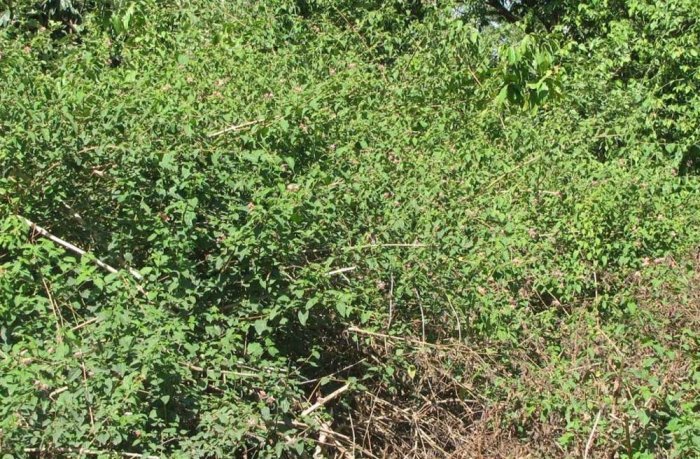
Driving along Masvingo-Topora road, one would realise the dominance of the shrub where suffocating of the indigenous species can easily catch one’s eye.
Statistics released by Environmental Management Agency (EMA) Masvingo province shows that an estimate of 2473.17 ha of land has been affected by Lantana Camara in the province.
The dominance of Lantana Camara affects ecosystems’ equilibrium which is important in the fight against climate change effects.
A Zero Farm villager in ward 7 of Masvingo Rural District Council who only identified himself as Tatenda said when the plant invades the farming area, it becomes difficult to destroy the plant but the plant leaves are beneficial as they generate organic fertilizer.
“It is difficult to remove Lantana Camara for farming reasons, but when you succeed in clearing the land, the soil will be rich. The plant’s biomasses generate organic fertilizers,” he said.
Communities seem to be surrendering in the battle against Lantana but raising awareness and educating the communities about toxicity of the plant can assist in tackling the problem.
An environmental champion, Tendai Mafuka said most people lack knowledge about Lantana Camara.
“Some people use it as a hedge and this is a clear sign that many people do not have knowledge about it being one of the most hazardous weeds,” Mafuka said.
EMA Masvingo district field officer Celestino Uriga said the battle against the evergreen shrub cannot be won in a single year and they are encouraging communities to use mechanical techniques to eradicate the plant.
“The battle against Lantana Camara cannot be won in a single year. We urge communities to use mechanical methods rather than chemical ways in destroying the alien plant. The plant affects the soil conditions such as the soil Ph and this will also affect the growth of other plants.
“We encourage communities to clear and revegitate the cleared area to enhance ecosystem restoration. Efforts are being made to eradicate the alien plant in the province,” said Uriga.
The plant can also reduce grazing land for livestock and arable land.
In Zimbabwe agriculture is regarded as the backbone of the country’s economy with cattle and other livestock being a source of wealth and living in most rural areas.
Masvingo provincial agronomist Sabina Chaduka said the invasive plant threaten food security as it shrinks arable land leaving farmers with little land for farming purposes.
“The plant is highly prolific. It spreads very fast in a short period. It can probably reduce arable land,” said Chaduka.
Lenin Chisaira an environmental lawyer and Director of Advocates for Earth said Zimbabwe’s environmental laws give duty upon owners of lands, traditional leaders as well as local authorities to clear invasive species.
“Invasive alien species pose a significant danger to the local environment, especially to indigenous plants and animals. Section 118 to section 127 of the Environmental Management Act deals with the legal and control aspects of alien invasive species in Zimbabwe.
“The Act gives a duty upon occupiers, owners of lands as well as traditional leaders and local authorities the duty to clear or cause to be cleared and any invasive alien species on their lands and to report the occurrence of any invasive alien species to inspectors from EMA. It also gives EMA inspectors the power to enter any land to check for invasive alien species and the power also to clear such species at the expense of the land occupier.
“The Act also give local authorities the power to make by-laws compelling occupiers of land within the area of the local authority to keep their land free from invasive alien species,” said Chisaira.
The offence for not acting on invasive species is placed under level eight (8) of the standard scale of fines and is pegged at a fine of ZW$ 50 000.
He also said the environmental laws are not being implemented and the responsible authorities should up their game in enforcing the Act.
“The environmental laws are not being implemented enough. I suggest EMA should start with fining local authorities who are not acting on invasive alien species in their jurisdictions. EMA should also impose fines on state authorities on whose land invasive alien species are found,” he said.
In the province, lantana camara is also threatening the tourism sector.
In 2019 the United States (US) Embassy injected US$ 475 000 towards the clearing of Lantana Camara that is threatening the Great Zimbabwe monuments.
The monuments are recognised as a world heritage site by United Nations Educational, Scientific and Cultural Organization (UNESCO).
The National Museums and Monuments of Zimbabwe (NMMZ) Masvingo regional director Lovemore Mandima said they have succeeded in clearing Lantana Camara on the hill complex.
“Lantana had over the years obliterated the walls and platforms in that area. It is hoped that by the end of the project, visitors will be able to better appreciate the terraced platforms and walls around the Hill Complex.
“We managed to clear the southern terraced areas of the hill complex during the first phase and we are planning to start the second phase in March. Clearance of lantana was done using both by mechanical and chemical means. A herbicide known as Kaput was applied to the cut stem,” said Mandima.
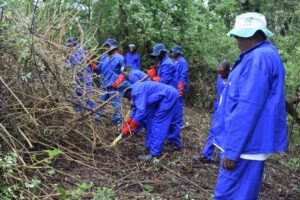
Clearing of Lantana Camara at the Great Zimbabwe monuments

He also said technical advice in the project has been offered by the Agricultural Research Council of South Africa.
Developing strategies to adapt to the invasion can be a better way to go.
In India some rural communities have turned to lantana Camara as the raw material for basket and furniture production.
In Zimbabwe, rural industrialisation and gradual change of livelihoods to furniture making using the plant in the rural communities that are battling with the invasive plant can also be a way to solve and adapt to the Lantana Camara invasion in communities.
Also combined efforts from various stakeholders can be a way tackle the problem.

Embrace PWDs, Midlands community urged

Tinaani Nyabereka

Gweru-The Senator Representing Persons with Disabilities, Anah Shiri has called for an inclusive empowerment approach towards people with disability in the province.
Shiri urged the community to shun acts of discrimination by embracing persons with disabilities (PWDs) in all activities.
Speaking during a handover of foodstuff in Gweru last week by ZANU PF aspiring Member of Parliament for Mkoba constituency William Gondo, Shiri urged the community to remember persons with disabilities in developmental initiatives.
“We must support the constituency of the disabled in the party and avoid discriminating them. We must also work and focus on the development of our community together despite being disabled or not,” said Shiri.
Recently the nation saw the appointment of the first visually impaired High Court Judge into office by President Mnangagwa.
“As a nation we are forward. We have Justice Deme, a judge who is visual impaired and we have never heard of such a judge since independence.
“Also Zimbabwe Electoral Commission (ZEC) recently mobilized PWDs so that they participate as officials in electoral processes. We are happy with this development,” added Shiri.
Zanu PF Gweru District Chairperson Brown Ndlovu said the party was determined towards assisting everyone including those in need.
“We are donating hampers here which include sugar, salt, soap, flour, matches, buckets and we are targeting persons with disabilities. This donation is in line with Gondo’s charity work as well uplifting their wellbeing.
“This program will not end here, but we are expanding it even to the rural areas. We also have plans to put in place a provincial association which will engage periodically to deliberate and address various issues affecting you,” he added.
ZANU PF aspiring Member of Parliament for Mkoba constituency William Gondo said the party was ready to work with persons with disabilities in all wards.
“As your child and aspiring MP for Mkoba, I am here to serve you and work with you on various challenges affecting our communities,” Gondo said.
Recently Zimbabwe took a stand to advocate for an end to harmful practices, discrimination, marginalisation and exclusion of PWDs from participating in different sectors of the economy.
Last year President Emmerson Mnangagwa launched the country’s national disability policy as efforts to empower the disability cluster.
The policy which was developed with support from various stakeholders including the United Nations seeks to address the marginalization and discrimination of PWDs while it also strives to empower PWDs by enabling them to contribute towards the national development agenda.

Only 65 people registered to vote in January

Fredrick Moyo

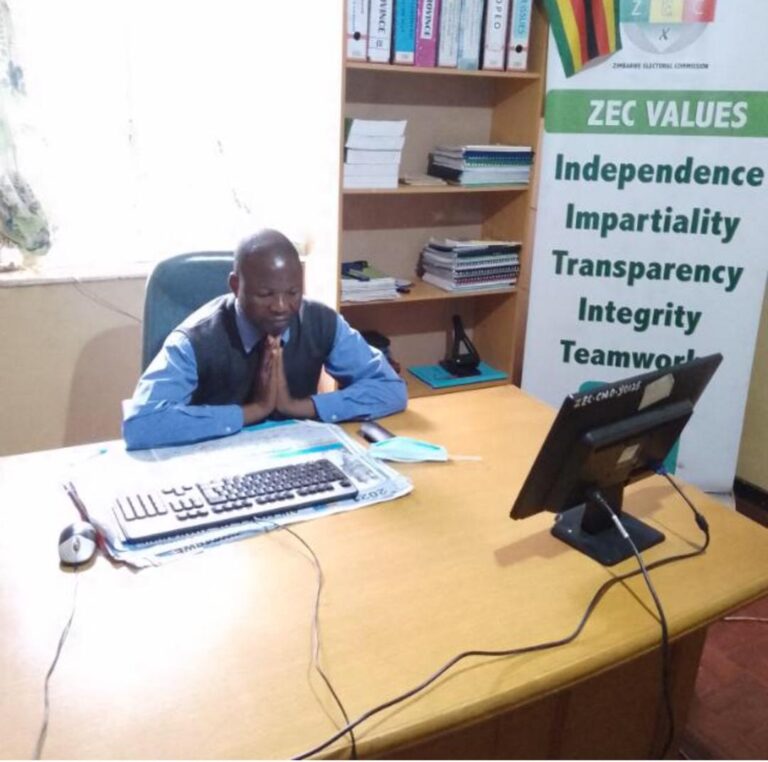
Masvingo province recorded only 65 new voter registrants during the month of January, together with 54 transfers, the Zimbabwe Electoral Commission (ZEC) provincial office has confirmed.
Masvingo ZEC Deputy Provincial Election Officer (PEO) Maxwell Ncube confirmed that the registration figures are continuing to increase as compared to last year statistics and encouraged people to take advantage of the current ongoing mobile registration blitz.
“If you take a closer look at the registration statistics for January compared to what was happening in 2021, you will notice that there has been a slight increase in the turn up.
“I would like to take this opportunity to encourage all prospective registrants to take advantage of the mobile registration that is currently going on. They should come in their numbers and register. It is very important that they register as we are preparing for delimitation that is all about numbers,” said Ncube.
From the 65 people who registered to vote in January, there are 13 females and 52 males, while from the 54 transfers there are 14 females and 40 males.
ZEC is currently holding a mobile registration blitz that is running in two phases in which the first phase began on February 1 ending on February 28. The second phase will begin on April 10 to 30.
The mobile registration exercise is meant to make people in marginalised areas and those who have to walk long distances to access the offices to be able to register and also increase the numbers of people who are currently registering to vote.
Some Civic Society Organisations (CSOs) were given the green light to conduct voter education by the electoral management body.

Chiefs urged to promote cultural heritage through radio

Beatific Gumbwanda

CHIREDZI-Minister of Information, Publicity and Broadcasting Services, Senator Monica Mutsvangwa last week challenged Chiredzi traditional leaders to utilize Avuxeni community radio station to promote their cultural values which are slowly being eroded by Westernization as well as help in castigating traditions that encourage child marriages and suppressing the rights of women.
Last week the Ministry of Information, Publicity and Broadcasting Services held World Radio Day commemorations at Tshovani Stadium, in Chiredzi where they officially commissioned Avuxeni Community Radio station, the first community radio station in Zimbabwe to have gone on air covering Chiredzi district as well as Rutenga and Mwenezi.
Speaking during the commemorations Minister Mutsvangwa challenged Chiefs to take the opportunity to promote their cultural heritage that is slowly deteriorating due to globalization and westernization.
“Chiefs, Avuxeni Community Radio was brought for you to help in promotion of your cultural heritage and traditions so that people, especially youths will understand the importance of their cultural values, where we came from and are heading. This will also help preserve our culture as we need to pass on our cultural heritage from one generation to the other.
“We also have other traditional issues that chiefs need to castigate which include child marriages and those that suppress the rights of women, who are always being abused by their husbands,” said Minister Mutsvangwa.
She also highlighted that Avuxeni community radio has a role to play in the unification of communities, where children will be taught to respect their elders.
Media Institute for Southern Africa (MISA) National and Regional Chairperson, Golden Maunganidze who is also the Great Zimbabwe University Campus Radio Director applauded government for licensing community radio stations which he said will help in promoting community development through broadcasting in their vernacular languages.
“We are happy with what government is doing in licensing community radio stations, like today we are celebrating Avuxeni community radio here in Chiredzi with other community radios which were licensed last year. This is a very important gesture, which, as Chiredzi community should celebrate.
“Avuxeni can now broadcast in Xhangani and other local languages and this is going to promote development and all licensed community radios will bring development in their respective areas whereby communities will find solutions to problems they are facing,” said Maunganidze.
Xhangani is among the cultures that have managed to keep their culture and heritage in one place while other traditions have been corroded by globalisation.

Inside peek into P.E.D’s professional ladder

Rutendo Chirume

Shylatte Mhike is one of the three women who hold a position of higher authority in government in Masvingo province.
Hailing all the way from Manicaland province in Chimanimani district, at 55 years she is the Acting Provincial Education Director (PED), a position she landed in 2020 from her then boss Zedius Chitiga following his retirement.
Mhike attended her junior education at Mutambara Primary School before her secondary education at Lydia Chimonyo between 1973- 1984.
In 1985, she moved to Bulawayo where she pursued her studies at Hillside Teachers College as a trainee teacher for Diploma in Secondary Teaching specializing in Geography and English which she completed in 1988.
Immediately after she graduated she was deployed to Masvingo’s Zaka District in 1990 where she taught for the next decade.
During an interview with TellZim News, she revealed that she managed to acquire her Advanced level certificate while trying to balance between teaching and studying. She then sat for geography and sociology through distance learning and scored 10 points.
In 1997, she enrolled for a Bachelor of Education in Geography degree at the University of Zimbabwe and was awarded the book price for being the overall best student for 1998 academic year and finished her Masters of Education degree in Curriculum Studies at Great Zimbabwe University in 2003.
She continued with her teaching career. In 2002 while teaching at Zaka High School, she got promoted to the post of school head at Chinyaradza Secondary School where she worked for years until she was elevated to Zaka District Education Officer (DEO) in 2007 and worked there for three years up to the time when she was moved to be Provincial Schools Inspector (PSI) for Geography between 2010-2014.
The next three years saw her being moved from one district to another in Midlands province as DEO and PSI till 2017 when she got transferred back to Masvingo province to assume the post of deputy director.
When asked about plans to further her education, Mhike said she has been caught up between her private life and the job which requires more attention thereby hindering education progression, but however said the sky should be the limit for women who have time and opportunities to further their studies.
“When I was young, I loved reading and had planned to have a Doctorate and even be a university professor by the time I get to this age, but through family responsibilities and the job I have now it is difficult to spare a little time to further my education but for women who have time to study the sky is the limit and they should not do that only for self-actualization, but also as way to climb the corporate ladder to bridge the gap between men and few women who are in the industrial sector especially those with higher positions,’’ said Mhike.

Urban local authorities: The new political battleground

…residents remain at the receiving end

Emmanuel Chitsika

So goes the proverbial saying that when elephants fight it is the grass that suffers: from the election of executive mayors to now ceremonial mayors, it all reflects the kind of powers the leadership at Town Houses commanded at turn of the millennium vis-a-vis the currently obtaining situation.
So much has played out on the roles of authorities running affairs of local councils with the main political parties now using the platform to gain or propel political mileage over rivals, all at the expense of ratepayers, who then get substandard service delivery.
Local authorities, since the old dispensation have seen a number of political battles with the most notable being the battle to control Harare between former Local Government minister Ignatius Chombo versus then MDC executive mayor Engineer Elias Mudzuri, that culminated in the suspension of the latter being replaced by deputy Mayor Sekesayi Makwavarara who all of a sudden paid allegiance to the minister defying party directive.
The sudden about turn by government to replace executive mayors with ceremonial ones has been regarded as concerted effort of trying to wrestle control of power from the opposition by the ruling party. However the battle for control of the institution led to shift of power to the Town Clerks whose allegiance is questionable.
With a ministry that boasts of the minister, deputy, permanent secretary and directors within the ranks of its organogram, one tends to wonder where all these civil servants would be when the elected members fail to adhere to their given mandates and thus sincerity seems to be lacking when one looks or judges on whether or not they have citizens interests at heart considering that the blame game is reining supreme in urban centres where the opposition controls and not the opposite side.
Masvingo United Residents and Ratepayers’ Alliance (MURRA) spokesperson Godfrey Mutimba said service delivery and local governance in the country has been too politicized.
“Service delivery in the country has been politicised with the minister of local government being given too much powers to interfere in the processes and businesses of local authorities. The minister has powers to determine what happens at local authorities at the expense of elected representatives who are councillors who of late have been stripped of the powers. The shift from executive to ceremonial mayorship in which the mayor cannot even fire incompetent secretariat is another issue.
“Council management as well was given too much power in the process. The oversight and policy making roles of councillors who just meet once a month has not been effective leading to the deterioration of service delivery. Right now service delivery in most if not all urban councils is in tatters at an alarming level. The council is now run by management who directly report to the minister. For example the devolution funds, the minister directly instructs councils on how the funds should be used whereas in normal cases councillors and residents should sit down and decide on how to spend the funds,” said Mutimba.
He also exonerated councillors from the blame which he described as a political gimmick with not value than being useless and the elected representatives are just figure heads to say the least.
The interference and mediation of the minister has led to deterioration of service delivery and so is the blame game on opposition-led municipalities which turns out to be a useless rhetoric that is high sounding nothing because everyone would realise the councillors have got no power over affairs in councils. The set-up in council management has been systematically positioned in such a way that it is composed of ruling party sympathizers following the Zanu PF hand book.
Combined Harare Residents Association acting chairperson Reuben Akili said the blame game between the ministry and councils emanate from skewed accountability mechanisms.
“What is important is to understand that the current blame game between the ministry and councils emanates from skewed accountability mechanisms for example the key issue like government repairing roads in local authority areas and then on the other hand expect the same local authorities to account for the loads which they would not even have contributed towards like looking for contractors, financing and supervising.
“There should be clear mechanisms in terms of the law to ensure local authorities play their roles and central government plays its role. What we would envisage is that local authorities are the ones that are supposed to be dealing with issues of service provision and at the end of the day the responsible minister should play an oversight role but not interference. For example in Harare the ministry even failed to dismiss errant directors which to some extend has cost council of its revenue as they have to pay people who would be in the process of dismissal,” said Akili.
He also said the composition or structure of the local government board is another cause for concern in local governance.
“If one looks at the structure of the board, he/she would see that it goes against the provisions of the constitution (Section 275) which gives local authorities the right to self-governance. Basically, when we look at the deterioration of service provision in urban areas, both central and local governments are equally to blame because they are all guilty of the same offence as they have contributed to the collapse of the sector.
“Local authorities themselves are not that transparent over the manner in which they use their money and the role of the minister to ensure local authorities perform properly other than just watching. The minister is also expected to perform and make sure things happen in local authorities. Both the minister and councils are failing residents. It is the battle for control of urban authorities is the major undoing and thus all the parties are liable to blame,” he added.
Social commentator Ellaine Manyere said the urban local authorities have been turned into grounds for fighting political wars especially when one looks at how government interferes in the affairs of councils.
“Basically I think urban councils are used as battle grounds for politics especially when one looks at the situation when government slashed to zero the debts urban residents owed council which later on negatively impacted on their operations and the money was never recovered from government.
“Service provision in most urban councils has gone down. It surprises that each time the minister of local government and or resident minister visits a local authority, the resultant comment in the media following such visits is like the MDC –led local authority is not doing enough and thus failing. It seems they are doing their best to ensure the elected councillors fail. When one looks at the kind of road infrastructure being constructed under various programmes, the roads will not take even two months to deteriorate and at the end of the day councillors will shoulder the blame. Thus urban councils are used as the fighting ground unlike the rural which the ruling party controls,” said Manyere.
Mutare Residents and Ratepayers Association (MRRA) programmes director David Mutambirwa accused government through the ministry of local government for employing a command approach towards the running of council affairs which he said is meant to erode gains of democracy.
“I think the command system of governance being employed is going to erode all the gains of democracy, social cohesion and multiparty governance which had been cultivated over the years. This is clearly centralisation of power which is against democracy and good governance.
“It is also in contradiction with the constitution which provides for devolution of power. It takes away power from people thereby leaving them helpless. It is a recipe for the lack of peace and sustainable development,” said Mutambirwa.
The notion of devolution of power once again comes under scrutiny to some larger extent and one doubt the sincerity of government to the principle of decentralising power to lower ties of government.
Urban councils have thus been taken as politicking and inter political war zone where each party would flex muscles to show who controls power over who and this control of the corridors of power has resulted in detriment as far as service delivery is concerned.

105 hours community service for assaulting female passenger

Russell Mapuvire

ZVISHAVANE- A 26-year-old taxi driver appeared before Zvishavane magistrate Archie Wochiunga on February 15 facing charges of assault and damage to property after attacking one of his passengers.
It was the state case as presented by prosecutor Isheanesu Mashayanye, that Tinashe Mpofu a Toyota FunCargo driver residing at 1305 Isaya Park assaulted and damaged items of a female passenger Miranda Phiri (20) of village 19 Oreti under Chief Mafala.
It is reported that on February 8, 2022 at around 1630hours Phiri boarded a white FunCargo driven by Mpofu on her way back home. She told the driver that she was to be dropped at Madata bus stop before Dadaya turnoff along Zvishavane-Mbalabala road.
When she saw that the driver had passed her station, she reminded him but he was defiant telling her that he was going to drop her where he wanted.
Mpofu then stopped the car and ordered Phiri to disembark and she told him where she wanted to go saying she could go not back on foot because of the heavy luggage she was carrying.
He came where she was seated and pulled her hair forcing her out of the car. Mpofu started to throw her luggage on the ground and demanded his money whilst man handling her by the neck.
After that, he took her left hand and forcefully bent her fingers, slap her once on left cheek before she fell down.
Mpofu started kicking her several times on her ribs, stomach and lower abdomen. During the assault, her cellphone fell down and Mpofu stepped on it several times until it ceased to function. He went on to step on her plastic bag with groceries several times and almost all the groceries got crashed.
Phiri told him that he had damaged her phone when he was on his way to his car and went back to her, hit her three times with open fists on back of her head and she fell down.
He went back to his car and he reversed it saying that he wanted to kill her but other passengers told him to stop and he drove away.
Mpofu, who pleaded guilty was then ordered to perform 105hours of community service at Gresham primary school and failure to do so will result in him being sentenced to three months in prison.
He was also ordered to pay ZW $64 400-00 for the damaged property which include a laptop and a cellphone and he should complete the payment before 30 March 2022 or he will be imprisoned for four months.

Encompass climate change and environmental issues- journalists urged

Rutendo Chirume

Journalists in Masvingo have been challenged to prioritise climate change and environmental issues in their reporting as a way of covering up the gap in the information dissemination channel.
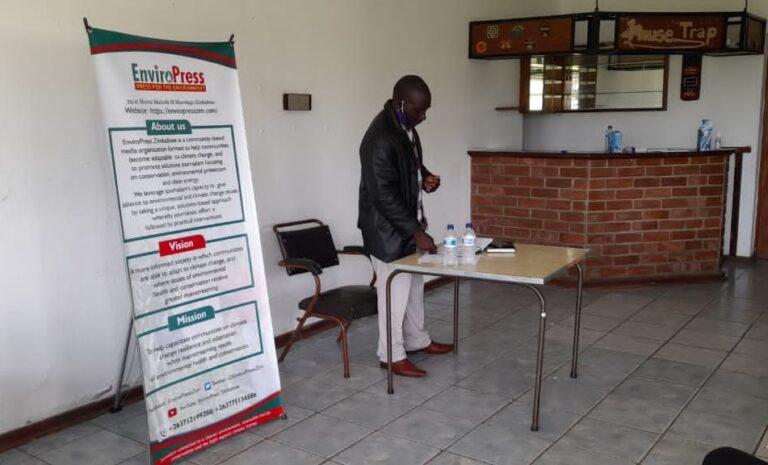
Addressing media practitioners during a two-day workshop organised by the EnviroPress at the Civic centre in Masvingo Central Business District (CBD) on February 15-16, Media Consultant Matthew Takaona called upon journalists to fill in the gap by concentrating more on issues that seek to address climate change issues and the environment.
The workshop sought to call on journalist to give attention to issues of environment and climate change which are being ignored as a beat in the newsrooms.
Takaona bemoaned the state at which the media in Zimbabwe lacks coverage on environment and climate change before urging journalists to fill that void by reporting on issues to do with climate change management and conservation of the environment.
“Issues of environment and climate change are considered less important in most media houses because of the political economic situation in media houses where editors and consultant managers would be vying for the mostly sexy stories. The media lack space on environmental reporting but they are very pertinent issues in the ecosystem and therefore news rooms should fill that gap especially in the main stream media,” said Takaona.
He also said environmental issues are very pertinent but as a country there is a huge gap on environment and climate change reporting saying such issues are not given any prominence.
Another facilitator at the workshop, Dr Gift Gwindingwe spoke on the need for protection of natural resources and taken care of.
“Natural resources should be taken care of. Let us manage our own environment hence try not to vandalize them.
“Citizen Journalists should report on issues affecting the environment and avoid the blame game by assuming responsibility towards such issues. Dumping of diapers is a form of witchcraft. The environment needs to be well managed so that we can eradicate poverty as through natural resources, we gain prosperity,” said Dr Gwindingwe.
The topic of discussion during the workshop was Biodiversity and Conservation.

Chiredzi administers nearly 400 booster shots

…as they thrive to reach 100k vaccination target

Beatific Gumbwanda

CHIREDZI District has already began administering Covid-19 booster shots, with almost 385 people having been inoculated as of February 2022 while more than 70 000 people have since received their first doses while 60 000 have been inoculated twice in a bid to prevent the spread of the deadly Corona virus, TellZim News can report.
A Covid-19 booster shot is an additional dose of a vaccine given after the immunity provided by the initial shots has begun to decrease over time. The booster helps people maintain strong protection from severe coronavirus disease effects, even against the Delta and Omicron variants.
In an interview, Chiredzi District Medical Superintendent, Doctor Brian Dhlandhlara said the district has since started administering booster shots and they have so far jabbed 385 people, with 79 988 people having been vaccinated with first shots while 59 997 with two shots.
“Chiredzi District has since started administering Covid-19 booster shots with 385 people having been vaccinated while 59 887 have been fully vaccinated and 79 988 have since been jabbed once,” said Doctor Dhlandhlara.
A Center for Disease Control (CDC) study shows that being fully vaccinated plus receiving a booster shot provides better immunity from severity of the disease, hospitalization and death due to Covid-19 compared to only having two shots.
Chiredzi, being the economic hub for Masvingo province, with a vibrant agricultural industry employing more than 20 000 employees as well as its proximity to South Africa and Mozambique, where people are illegally crossing in and out of the country, risking people from various Covid-19 variants, booster shots will help with an advanced protection.
Chiredzi is exponentially growing with an estimated population of about 120 000 people with almost half of the population having received their first jab.