—
He who said it can not be done must not disturb the one doing it!
—
Tel : +263 39 262 401
It is a good thing to dream and live in the beauty of our dreams. Many a time we all go through times in our lives when we come up with ideas of things that we would like to accomplish in life; the schools and universities we want to go to, and places we cherish to be in the years ahead. It is a natural human tendency, it seems, to come up with an ideal which should be fulfilled in future and we feel bad when those dreams do not come true.

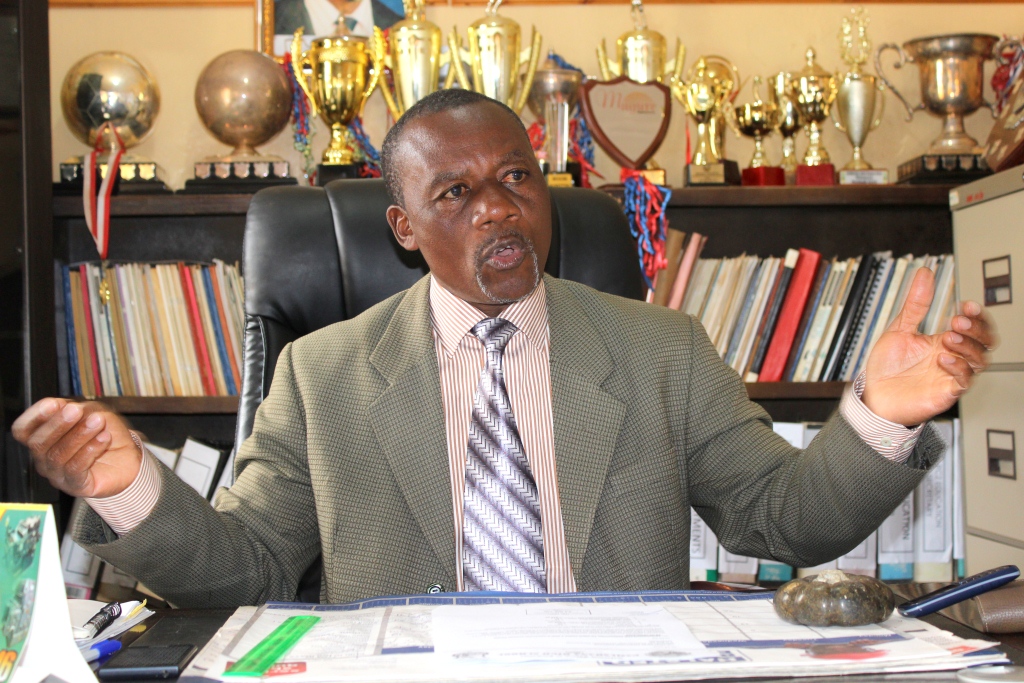
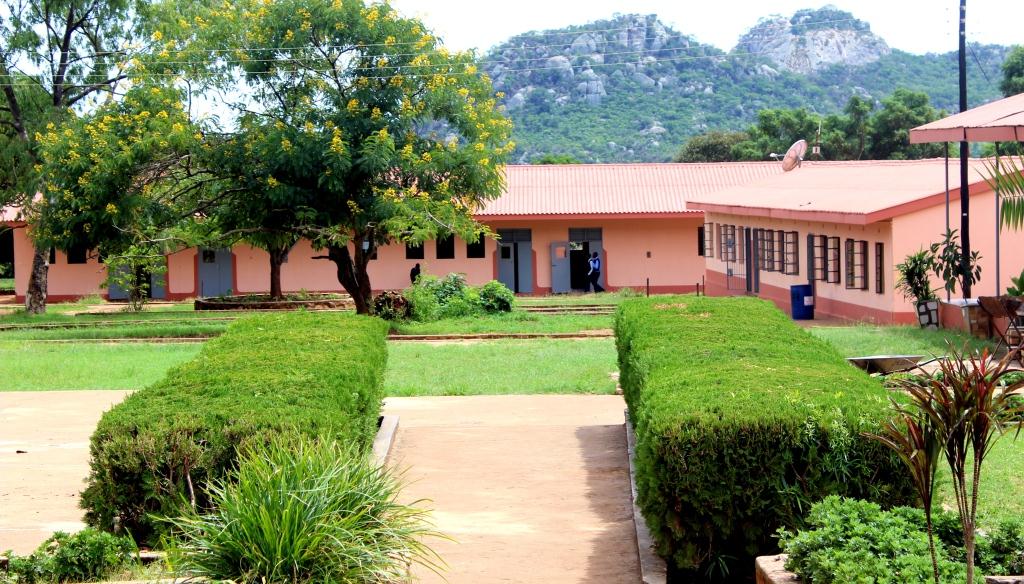
Located 75km from Masvingo town along the Masvingo-Mutare highway, Pamushana High School is one school which is living in the beauty of its dreams and, it seems, the head Johnson Madhuku still dreams big.
Madhuku has so far propelled Pamushana to greater heights with the most notable achievement being the transformation of Pamushana into the best school not only in Masvingo province but in the country at large. The ‘A’ and ‘O’ Level Zimbabwe Schools Examination Council (ZIMSEC) results released recently bear testimony to the school’s massive stature and repute in the realm of education.
Pamushana scored a whopping 100 percent and 94.74 percent pass rate for ‘A’ and ‘O’ Level respectively in the 2015 examinations, with 36 pupils recording 15 points and above, while 98 candidates scored 5As and above.

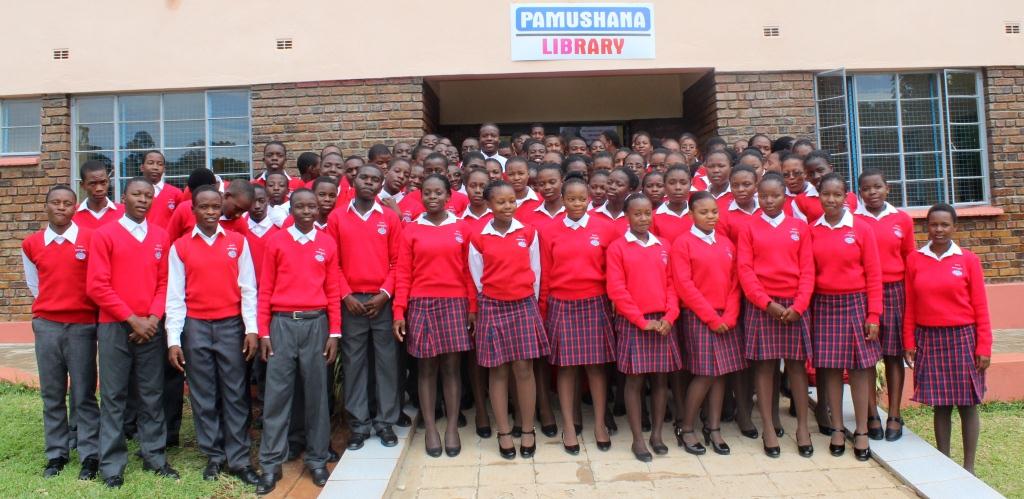
As if to match the leaps and bounds made in academic performance, Pamushana is also rebranding uniforms and has come up with new school colours. The school is moving away from the traditional blue uniforms to a new one, one of a kind – scorched purple and charcoal grey skirts, charcoal grey trousers, white shirts, red blazers, red jerseys and ties. The uniform indeed gives Pamushana a world class image befitting a school of its calibre.
“We are rebranding; we are synonymous with quality and we always want other schools to have something to learn from us. We are gradually changing our uniform – I brought the samples of the new uniform from Australia last year though we modified them a bit,” said Madhuku.

“We are known for producing good quality results – our O’ Level results were very good and there is no known record of a school which ever obtained 200 As. We have 201 As in Integrated Science out of 209 candidates, 181 As in Geography out of 209 and 109 As in Shona out of 193 candidates. We are happy with the quality of results because we do not recruit brilliant pupils only as many people think but we boast of highly qualified and experienced teachers who can mould even worst performers into brilliant stars.
“I want to thank the parents, Minister Dr (Lazarus) Dokora, Permanent Secretary Dr Slyvia Utete-Masango for their overwhelming support,” Madhuku added.
At ‘A’ Level, the school had 36 pupils with 15 points and above, with each of the two best candidates scoring 20 points. Over 30 pupils also passed with 14 points while 120 got 10 points and better. Pamushana also has an impressive record in sports, arts and culture and it broke the schools record in the country when it got three nominees at the National Arts Merit Awards (NAMA) last year.
Pamushana has been dominating schools sports in the country, particularly in netball where they won the Tanganda Tea trophy for four consecutive years. The school constructed a state of the art library last year, which was described by the Minister of Primary and Secondary Education Dr Lazarus Dokora as world class, and acquired a latest Scania model bus among many other projects.

Madhuku said the main idea is to educate the whole person and, surely, any parent who dreams of providing his or her child with best education, would recommend Pamushana High.
“Our graph keeps rising; I remember once telling my staff that before I leave this school, I wanted to have at least 30 pupils with 15 points and above, but now with 36 pupils having achieved that mark, we have far exceeded our own targets. Our target now is 40 with 15 points and above this year. I think the results we are producing are out of this world and we are almost at our zenith. We can actually produce a whole class of law or medicine students for the University of Zimbabwe (UZ). Our enrolment is around 1 200 with a staff complement of 38 qualified teachers and 6 student-teachers. We are short of 10 teachers but still our results are still extremely good. We boast of highly qualified and experienced teachers. Pamushana however, has become a hunting ground for many schools especially private schools who lure our teachers with lucrative allowances to join their schools,” said Madhuku.
“We are however, not deterred; our aim is to educate the whole person – complete person with academic, arts, sports and culture (ubuntu), discipline as well as upholding Christian values, and we don’t believe in things that are sub-standard. We go for quality and we are not extravagant. Thus we bought a state-of-the-art bus because we want pupils to enjoy the luxury because that is what their parents want,” he added.
Madhuku also plans to build a security wall at the boys’ and girls’ hostels this year to improve security and privacy since they are too close to the administration block. They also want to build an administration block and a state-of-the-art hall. The hall will accommodate music, arts and culture pupils as well as other school functions. Madhuku added that they have plans to build more teachers’ quarters so that they can accommodate more teachers at the school.
“This has become a fishing pool for many schools and I’m losing a lot of teachers to other schools, mainly private schools. My teachers are very hard working and we also want to provide the best possible accommodation for them. We have drilled six boreholes to solve water problems and we have resuscitated our agriculture projects,” he said.
Pamushana also boasts a state-of-the-art E-Learning centre which is being equipped with computers and internet connectivity. They also have an E-learning centre for junior classes equipped with 60 computers.
Pamushana also has more than 15 athletes who will represent the province at the national finals later this month. The school scooped 17 gold medals at the just ended provincial athletics finals held in Bikita.
Madhuku has not led only Pamushana to glory but has been elected to lead other organisations such as the National Association for Secondary School Heads (NASH) and the Confederation of School Sports Associations of Southern Africa (COSSASA) over the years.
—
The composition of urban and rural district councils in Masvingo province, and indeed in the rest of the country, represent the long journey that lies ahead towards the attainment of equal representation of men and women in local governance.
Local governance is regarded by many as the most important area of governance owing to its almost unequalled proximity to the people.
As the cornerstone of service delivery to the public, matters of local governance are reasonably expected to reflect inclusivity and are also expected to show some inclination to the gender cause that the country seems to be cozying up to.
It is unfortunate however to note that the case in the councils that were elected in 2013 stands in stark contrast, with entry into council largely having been determined by political affiliations and the level of influence that each candidate could assert.
At municipal level, the two main parties that contested the elections and that currently share the spoils of their political exploits, ZANU PF and MDC, did not have a gender programme when they fielded their candidates.
Unlike at legislative level where proportional representation is legally in place, there are no related policies at local government level although technically, this area carries more weight in addressing women’s practical gender needs, their immediate welfare.
There were no female quotas and neither was there any attempt to strengthen the hand of female contenders during their primaries. It was a matter of on your marks, get ready and go, even though that straightjacket approach has continuously proved to be unhelpful in efforts to attain gender balance.
In particular, Masvingo urban elected an all-male council, with the only female councilor in the previous council, Grace Josia of ward 10 falling at the ZANU PF primaries to Lovemore Mufamba, putting paid hopes for any female representation in the council.
In Masvingo rural, the situation is no less gloom, with female councilors numbering only four out of a total of 35. Ironically, it is Virginia Hwena of ward 19 and Sungano Machakanure of ward 30 who are said to be the best performing council employees. This is so despite that the position of Chairperson and Chief Executive Officer, perhaps the most influential roles in a council set-up, are occupied by males.
Maina Mandava, a distinguished former parliamentarian who served in Zimbabwe’s successive male-dominated legislature for years, said it requires a drastic ideological shift among women themselves if meaningful change is to be realised.
“The problem is never about women’s competencies or lack thereof. Rather, the problem lies in the engrained mistrust among women themselves. Women seem not to have as much confidence in other women as they do in men. We constitute the biggest voting bloc yet we keep on voting men into office. Why?” said Mandava
Gutu, a vast district with 41 wards, has also lagged behind in with regards to equal representation within its council. In the 2013 elections, 38 wards were snatched by men, with a paltry 3 going to women, a development that further solidified the gender imbalance.
Mpandawana, the seat of council, recently gained town status but gender activists will be outraged to know that the first six members of the town board, which came into existence in January 2016, only has one woman – Susan Samatenga – whose duty on the board is to represent the interests of residents.
She will be expected to strike a fine balance between articulating and pushing the overall cause of her mandate without ignoring the women’s agenda within the male-dominated board of a town marred by unemployment, gender-based violence and child prostitution.
Similarly, of Chiredzi Town Council’s eight councilors, only one, Jessica Mutiyaunga is female. She is the chairperson of the Environment Committee with the rest of other committees and other crucial posts in the town council led by men.
“The program is aimed at institutionalizing gender mainstreaming in all policies, programmes and budgets of government and selected private sector organization.”
This is what the Ministry of Women Affairs, Gender and Community Development says of its gender mainstreaming programme. Difficult though to see how policies crafted in the name of development can omit mainstreaming in local governance, when it is the most relevant to the most immediate development goals of society.
A superficial glance at Bikita reveals more or less the same disturbing pattern of wide discrepancies in the distribution of power between men and women. Although Councillor Clara Makura of ward 29 is the current council chairperson, it is no doubt that real power lies with men who dominate the council.
With only three female councillors out of 32, the rural council is yet another microcosm of that which is wrong with the organisation of our socio-political system, a system that needs to be urgently overhauled to promote the full participation of women lest the country’s development potential becomes a nullity.
Engineer Cecilia Nyamande, a civil engineering technician with Bikita Rural District Council said society cannot expect any miracles in its quest to achieve gender equity.
“It should start in the families; we should be educating the girl child and helping her to realise that there are no limits to what she can achieve in life. That can be instrumental in developing her confidence and self-esteem, with the ultimate result being more women bidding for better posts in councils and elsewhere.
“There is a growing consensus that societies that give women prominence in leadership roles enjoy higher chances of being more peaceful and more prosperous than those on the contrary,” said Engineer Nyamande.
That view can probably be buttressed by even a superficial glance at Rwanda, a country ravaged by a horrendous, male-instigated genocide just over two decades ago. How the country has risen from the ashes to be the most promising economy on the African mainland remains an enigma to many.
This is partly attributed to the country’s robust women empowerment drive which has seen it being the only country with more women than men in its parliament.
The capital city, Kigali, which has a female mayor and vice-mayor, Monique Mukaruliza and Judith Kazayire respectively, is ranked one of the cleanest and most investor-friendly cities in Africa.
—
—
Memory Rasa
—
—