Home Blog Page 331

Zanu PF bullies Chiredzi council

…as council snubs provincial leadership

…DCC wants function re-organised

Beatific Gumbwanda

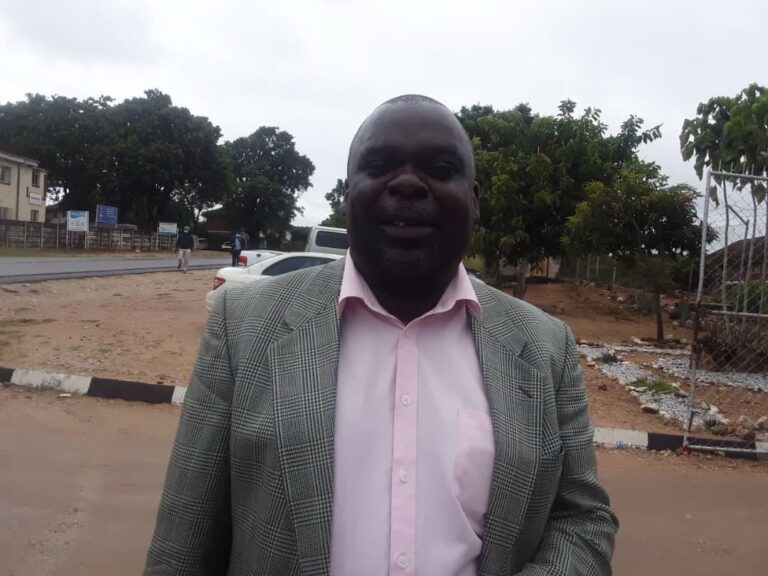
CHIREDZI- Town Council is under fire from Zanu PF , which is accusing the local authority for commissioning vehicles bought using devolution funds without inviting party leadership.
Last week, CTC officially commissioned four service delivery vehicles purchased using internal funds as well as two tractors that were bought using devolution funds at Melbourne Park Medium Density site where they also officially launched the sewer reticulation system in preparation for construction works by residents at the medium density site.
The event was graced by the Office of the District Development Coordinator (DDC) and Chiredzi West Member of Parliament, Farai Musikavanhu who told the local authority that they should have appreciated the works by the second republic by inviting the Minister of State for such a big event.
Writing in a Zanu PF WhatsApp group, Musikavanhu allegedly said Chiredzi Town Councilors owed him an apology for using his name as the guest of honor when in actual fact the town chairperson had invited DDC to be the guest of honor.
“Chiredzi town councilors owe me an apology for using my name in an attempt to sanitize their improperly sanctioned launch on March 22, 2022 to which their guest of honor as clearly stated by Council Chairperson Gibson Hwende was DDC Lovemore Chisema and not me.
“I made it clear in my remarks that the Minister of State for Masvingo Provincial Affairs and Devolution Hon Chadzamira was supposed to be the guest of honor at such a key function where tractors bought using devolution funds availed by the government of HE President ED Mnangagwa were being commissioned,” wrote Musikavanhu.
The legislator, is said to be struggling in the Mavhenyengwa ‘infested’ district, where Chiredzi North Member of Parliament Roy Bhila and former CTC Chairperson, Francis Moyo are alleged to be after his political throat, threatening his return in Chiredzi West.
Other sources within party structures claimed that the councilors were called for disciplinary hearing over the matter.
However, Chiredzi Zanu PF District Coordinating Committee (DCC) Siyaki Mundungehama denied having called councilors for the disciplinary hearing saying it was not his duty.
He however, went on to say there was a possibility that there could be a re-commissioning of the vehicles using proper protocols.
“That is very false, constitutionally; I do not do disciplinary issues. I presided over a meeting to prepare ourselves ready for the by-elections, ensuring that we had our agents for all the polling stations. If that happens (re-commissioning), it will then be purely a government programme. The government officials will be responsible.
“Devolution funds and what they purchase are government controlled, locally through local government and to some extent central government,” said Mundungehama.
Zanu PF provincial Chairperson Robson Mavhenyengwa said it was wrong for council to commission such projects without the local leadership and the Minister of state saying they are the representative of the people.
He went on to say even when commissioning projects funded internally they should invite the minister since the funds are from the rates paid by the people.
“We haven’t done any disciplinary for the councilors though council was wrong in not inviting the provincial leadership on the commissioning of vehicles since some were bought using devolution funds.
“Even those bought with internal funds, the minister should be there,” said Mavhenyengwa.
However, Chiredzi Town Chairperson Gibson Hwende said there was no law that stipulates that every commissioning they do they should invite the provincial leadership.
“There is no law that gives us who we should invite when commissioning our projects. However, depending on the source of funding and magnitude of the project, we sometimes need to invite people from higher offices.
“When commissioning devolution funded projects, the minister will be the right person to invite but it also depends on the size. So we had only two tractors under devolution so we saw it fit to do it locally. We have more projects and vehicles which are yet to be delivered that were bought under devolution funds so when we commission those that’s when we will invite him,” said Hwende
CTC has also purchased a refuse truck as well as fire tenders which are expected to be delivered soon.
Chiredzi town council has four Zanu PF Councilors and one independent while the other three got in on the MDC-Alliance ticket.
Zanu PF has been accused of using devolutions funds to bankroll their campaigns.
In the run up to the 26 March by-elections, the party was drilling boreholes and doing other projects in vacant wards using devolution funds.


Tobacco farmers venture into wheat growing

…Masvingo province kick start winter wheat farmers’ registration

Rutendo Chirume

With the tobacco season closing up, tobacco farmers have been roped into wheat growing in order to increase the hectrage as well as the output as the country prepares for 2022 winter wheat production.
Minister of Information, Publicity and Broadcasting Services Monica Mutsvangwa announced the new developments during a post cabinet briefing on March 29 and said the country has enough inputs for winter wheat farming and tobacco farmers assimilation into wheat growing will boost supply of the cereal in order to have sufficient domestic stocks.
“Pertaining to wheat, cabinet reports that in order to increase the hectarage under wheat as well as increase the output, tobacco farmers will be roped in to grow the crop. The transition to winter wheat by tobacco farmers is a welcome move and will go a long way in boosting supply of the cereal so that we have sufficient domestic stocks. Cabinet is pleased to report that the country has sufficient fertilizers for winter-wheat farming. Efforts are also being made to guarantee fertilizer supplies for the summer season,” said Mutsvangwa.
On that note Masvingo Provincial Crop and Livestock Officer Aaron Muchazivepi announced that winter wheat farming processes had started and currently farmers are expected to start registering with Agritex in order to get help in terms of inputs and other financial help.
“We are looking forward to start winter wheat season in Masvingo and all farmers with enough water bodies are encouraged to register with Agritex in order to get production input and support. We also have the presidential input scheme which will help the youth and small scale farmers with fertilizers, seed and chemicals needed. National Enhanced Agricultural Productivity Support Scheme will focus on commercially based farmers on irrigation facilities. Interested farmers should also fill forms for Agricultural Finance Cooperation at CBZ in order to get financial support and other inputs needed,” said Muchazivepi.
He emphasized early winter wheat planting and said all farmers in irrigation schemes with fallow land should revive them and prioritize it for wheat farming.
“All farmers in irrigation schemes who have fallow land should prioritize it into wheat planting .Those farmers who still have crops in their irrigation schemes should also clear them so that we can start preparing for wheat planting because we want to do early planting. Even those farmers who cannot remove their crops because they are not yet dry should go to GMB Masvingo Depot and get a drier there which they can use to dry their crops because by April 7 all farmers who want to do wheat farming are expected to have cleared their farms. By May 15 we want to have finished with wheat planting for this season,” he said.
Last year Masvingo province managed to plough 2000 hectares of wheat in total.

LEAD candidate gets 21 votes in Masvingo

… bemoans lack of youth vote

Melinda Kusemachibi

Labor Economists and African Democrats (LEAD) candidate in the March 26 by-elections has bemoaned lack of meaningful participation by youth in the electoral processes and expressed gratitude to the 21 votes she got which she ‘treasures the most’.
LEAD candidate Everjoy Chidindi (22) got the going tough as she succumbed to defeat by Citizens Coalition for Change (CCC)’s Richard Musekiwa in Masvingo urban ward 7.
Chidindi said she is very happy with the results she got as a young woman.
“The elections were fair and I am very much happy with the results. Personally 21 votes were fair considering that many youths did not vote, so I treasure those 21 people who voted for me for a start and I am happy because I barely campaigned as most of the times I was at school and I just came back for a week mobilizing people so 21 is a good start for me.
“As for 2023, yes I am going to participate again,” said Chidindi.
However, LEAD president Linda Masarira issued a statement that her party accepted the results though she had some reservations on the manner in which the campaigns were held.
“From LEAD, we accepted the results even though the pre-electoral period was marred by a lot of irregularities. This is because together with other political players we had to stand guard of ballot processes and securing safety of our votes during the process,” said Masarira.
She also added that the elections were not free and fair.
“The elections were not free, neither were they fair nor credible because the responsible institution short-changed both the voter and political players. Failure is a necessary step towards success.
“The lessons we learnt in the by-elections are very valuable to us as a party and we would not have learnt if we had not attempted to participate in the elections. It is not the size of dog in the fight that matters most that deals a killer blow. Bigger is not always necessarily better,” said Masarira.
She said that they had assigned a team of five to research on questions they have raised.
“Whilst others are celebrating, we have assigned five teams on the ground to do research on: why are people not going to vote enmasse? Why does this apathy cut across all divides? How do we restore confidence in the electoral process to the electorate? How do we ignite these dormant votes to our advantage? What do we lack that can strengthen our cause and struggle?” added Masarira.
In the run up to the polls, Chidindi at one point had to seek for the intervention of Zimbabwe Electoral Commission (ZEC) to reprimand Zanu PF candidate Prosper Dohwai who the former accused of abusing her during the campaign trail as Dohwai reportedly abused her in a WhatsApp group.
CCC scooped all the four vacant seats in Masvingo Urban ward 4 Aleck Tabe and Rocky Kamuzonda ward 3 will be first timers in council whilst in ward 7, Richard Musekiwa retained his post as he won with 1342 votes over Zanu-PF’s Prosper Dohwai who got 490 votes and MDC-Alliance’s Gertrude Chuma got 43 votes.
In ward 5, Daniel Mberikunashe managed to retain his post by 568 votes with Zanu-PF Hakinstone Chimwai getting 359 votes and MDC-Alliance’s Ephanos Makiwa getting 30 votes.

No to debt assumption: Biti

Melinda Kusemachibi

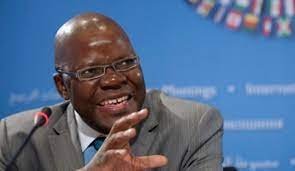
Government’s continuous assumption of debts of state-owned enterprises without determining how the arrears were accrued fuels corruption and misallocation of resources, former Zimbabwe Finance Minister Tendai Biti recently warned.
Speaking at Zimbabwe Public Debt Indaba organized by Zimbabwe Coalition on Debt and Development (ZIMCODD) held on March 29, 2022 in Harare Minister Tendai Biti said that debt assumption is a waste of time and command agriculture is the vehicle being used.
“Debt assumption is not just a catalyst for deep stress, it is a catalyst for group, parallel government ideality because they are running for a parallel government then these debt assumptions are then fostered on the ordinary people of Zimbabwe and command agriculture is a principled vehicle. So debt assumption is a waste of time, a waste of energy,” said Biti.
He added that debt assumption in form of US$3.5 billion was signed with farmers without legislature approval and it is being used to break the law.
“In 2019 the government of Zimbabwe came up with the financial bill of US$10,6b in which they sought condemnation of expenditure that they spent outside parliament between 2015 and 2018 to the sum of US$10,6 billion and they wanted us to condone it without giving out the details on what they actually spent the money.
“Debt assumption in the form of US$3.5 billion for farmers; the constitution is very clear that farmers will be paid for improvement, that an Act of parliament must define the formula, method that is going to be used but the government went on to sign the agreement with farmers without the legislative. Who are the actual farmers benefiting?
“Debt assumption is being used to break the law, cover up the law, used to override parliament, cover up for illegal guidance, for corruption and therefore we should say no to debt assumptions. Public Debt Management Act should be strengthened to say no to debt assumption,” said Biti.
Government has assumed a number of state-run firms’ debts amounting to billions of United States dollars despite warnings that it is cultivating a bad culture.
Some of these include Zisco Steel US$500 million and the Reserve Bank of Zimbabwe (RBZ)’s US$1.4 billion debts.
Biti added that government was giving out guarantees to private companies in 2020 when Covid-19 arose.
“Another form of debt assumption is illicit debt contractions which result in debt assumption and are the guarantees that government gave to private companies in 2020 when Covid-19 arose, government issued a lot of guarantees to the private sector. But why should government guarantee this to private sector?
“A lot of debt is by contracted through uproar, and I know that ZIMCODD is trying to file some court applications to challenge that. So guarantees are illegal and are also contributing to this debt hazard,” said Biti.
In 2019, government approved the assumption of TelOne’s US$383 million legacy loans. Cabinet last year also resolved to assume the Air Zimbabwe debt exceeding US$300 million. In January this year, government assumed US$3.8 billion fresh RBZ legacy debts.
This is the amount RBZ agreed to pay as opposed to over US$6 billion being claimed by 855 companies, which the apex bank failed to help repatriate funds due to forex shortages.
Biti also said that National Railways of Zimbabwe (NRZ) collapsed because of inefficiency, corruption and mismanagement.
“Another form of debt assumption over USD 2 billion has been assured this way, and to date parastatals national records of staffing, l believe around US$495m as huge but why is the NRZ collapsed? NRZ collapsed because of inefficiency, corruption, mismanagement. So government assuming that huge debt it is sanitizing inefficiency.
“It is sanitizing corruption. But why should tax payers pay for shaggy deals, corruption, mismanagement, incompetence? Because what they did as parastatals is they let their relatives run without qualifications and skills. Debt assumptions for National Railways of Zimbabwe (NRZ), Grain Marketing Board (GMB), Civil Aviation Authority of Zimbabwe, NetOne, TelOne, ZESA, are used for funding political campaigns,” said Biti.
In its February 2022 economic report, the ZIMCODD said as of September 2021, public and publicly guaranteed (PPG) debt was at US$13.7 billion. Of this debt, external debt constituted US$13, 2 billion while domestic debt was US$532 million. This public debt constitutes about 85% of the country’s GDP, way above the 70% threshold.
Accounting for the January 2022 assumption of RBZ debt, ZIMCODD said total public debt will expand to US$14. 2 billion.
The RBZ debt alone, totaling US$5. 4 billion now constitutes over 30percent of total debt stock.
Debt assumption, according to ZIMCODD will have negative socio-economic effects on ordinary people, as it translates to an extra financial burden on taxpayers.
“Generally, a debt-Gross Domestic Product (GDP) ratio shows a country’s capacity to repay its debts, with a rising ratio indicating that debt is growing faster than national income.
“As such, the ballooning Zimbabwe debt is a cause for concern, especially under the context of the Covid-19 pandemic, fragile domestic election season, worsening global geopolitics between nuclear superpowers, and a mounting global inflation wave.
“Therefore, there is a need to undertake an independent public debt audit that will inform the scale and nature of the country’s debts, which are often not transparently publicized.
“An audit will also become a building block to popularize discussion about the legitimacy of certain debts and whether they should be repaid,” read part of the ZIMCODD report.

By-elections low voter turnout: a threat to 2023 general elections

Fredrick Moyo

The just ended much awaited by-elections were sadly marred by a massive voter apathy with only 35 percent of eligible voters casting their votes and this could repeat itself in the upcoming 2023 polls if ever the March 26 elections are anything to by.
At stake were 28 parliamentary seats and 105 local government wards that are up for grabs in the by-elections left vacant due to recalls and death. The main opposition Citizens Coalition for Change won 19 out of 28 parliamentary constituencies while the other nine went to Zanu PF.
However it is the voter turnout that characterize these polls that has raised eyebrows as in Masvingo province, urban council elections saw 26 percent of the voters taking to the polls while in the rural areas a 50.1 percent was witnessed.
Speaking to TellZim News political analyst Dr Gift Gwindingwe said voter apathy might repeat itself in the harmonized elections set for 2023 as by-elections are a barometer to measure the political temperature in the country.
“By-elections can be taken as a barometer that has been used to measure political body temperature of Zimbabwe that is to measure the democratic elasticity of our political participants and it has also been used to test even potential of the main contesting political parties that is Zanu PF and CCC so what it definitely means is that both sides have noted their potentials, strengths and weaknesses and I want to believe they are working on such strengths and weaknesses because what has happened is partly a true reflection of the growth of the democratic space in Zimbabwe,” said Gwindingwe.
He also added that there will be stiff competition in the upcoming general elections as both parties will try and capitalize on their strengths, also work on their weaknesses and urge political parties not to talk much about vote rigging as it demotivates the electorate.
“My projection of the upcoming 2023 polls is that the competition is going to be very tense and each political party that has an ambition to win must pull up their socks, do their homework and fulfil their promises as people do not want to be taken for a ride.
“Regarding voter apathy, I have a totally different perception altogether, this idea of speculating about vote rigging can keep away voters so I think this speculation about rigged elections before it is rigged can keep away certain voters. So it is high time we do not hyperbolise and exaggerate some of these issues, contesting political parties should not shift blame especially those represented in parliament because it is in parliament that they should amend the laws,” added Gwindingwi.
He also said that youth participation is questionable in the electoral process hence there is massive voter apathy because the youth form the bulk of population in the country.
“Youth participation is questionable especially during elections and their reluctance to register to vote. The youth form the bulk of the population and if they have to participate in the electoral processes, definitely voter turnout will be good for the nation. The youth need to be properly socialised into the essence of voter registration and participating in voting and exercising their right to vote,” added Dr Gwindingwe.
Youth Decide Executive Director Learnmore Munhangu said they are concerned with the voter apathy as the youth were so reluctant and unconcerned with casting their vote in the just ended by-elections.
“As a youth-driven organization, we are so worried with the just ended by-elections results. The elections were marred with massive voter apathy. Citizens, especially the youth, were so reluctant and unconcerned.
“Apprehending from the past and not only in Zimbabwe, the voter turnout was very low during by-elections. Citizens prefer to vote just once in every five years. We expect a positive change in 2023 general elections,” said Munhangu.
He also said ZEC and other stakeholders should encourage citizens to register to vote so that the turnout improves.
“We implore with the Zimbabwe Electoral Commission to engage more stakeholders especially youth organizations and associations in mobilizing citizens to register to vote as well as turning out on election day. The situation can improve only if all forces join hands towards the intended goal. We want masses to determine their future,” said Munhangu.
Another political analyst Dr Davison Mugodzwa said the 2023 general elections will not be affected by voter apathy as citizens have seen the outcome if they do not participate in the voting processes.
“I do not think that the same scenario is going to be repeated. The youth and citizens have seen the results of the just ended by-elections and many who remained sceptical that they will not go and vote because elections are rigged have seen the outcome and I think a lot of people will go out in their numbers to vote,” said Mugodzwa.
He also added that CCC will gain more support in the urban areas and ZANU PF will remain strong in rural areas if the political field remains the same.
“If the situation remains the same on the political arena, CCC is likely to have overwhelming support in the urban areas because the electorate in this area is angry and hungry therefore the policy of the stomach will prevail as it has been evidenced with the just ended by-elections. In urban areas, people responded to their daily meal and the economy is biting therefore people will go for a party that is likely to solve their economic and political problems.
“In rural areas as it has been evidenced, Zanu PF is likely to remain strong if state apparatus deny CCC progression into rural areas to market their projects or ideas will have little impact in rural areas and this is going to repeat itself in 2023,” added Magodzwa.
Another political analyst Proffessor Nhamo Mhiripiri said voters have a tendency of not casting their votes during by-elections hence the upcoming 2023 general elections will not be affected by voter apathy.
“I would not worry much about voter apathy next year. The stakes will be high with more interests drived from the presidential elections. That one alone can induce interest around voting for MPs and councilors, since citizens throughout the country will vote for various representatives at the same time. Mind you, in most cases in the by-elections voters vote for one representative instead of the usual three,” said Prof Mhiripiri.
The recently held elections saw limited participation in terms of voters as most people feel the elections are of little significance as compare to presidential elections usually associated with more hype than local authority and parliamentary elections.

‘Even new born Zimbabwean babies owe US$100k to IMF’

0

Melinda Kusemachibi

Zimbabwe government has got a debt of US$19,5b or 68,5percent of its Gross Domestic Product (GDP) to the International Monetary Fund (IMF) which when analyzed translate to every child born in Zimbabwe having a debt of US$100 000, former Finance minister Tendai Biti has said.
Speaking at a Zimbabwe Public Debt Indaba held at Rainbow Towers in Harare on March 29, 2022, Biti who is also vice president of Citizens for Coalition Change (CCC) said Zimbabwean debts now exceed US$19, 5 billion as published by the reports of IMF on March 24.
“I was shocked this morning when l was preparing for my talk to actually discover that the consolidated debts of Zimbabwe now exceed US$19,5billion or 68, 5percent of gross domestic product. These figures are published in the conclusion of the IMF articles 4 report which was published last week (March 24, 2022).
“So for a country like this to actually have US$19 billion worth of debt, divide the debts to the population as we are about around 13 million people means that every child that is born in the country and everyone who is looking at me, owe the IMF from where you do not know at least US$100 000 and l know you do not have it,” said Biti.
According to the IMF report released on March 24, 2022 pandemics and natural disasters led to deep increase in inflation.
“Zimbabwe experienced severe exogenous shocks (cyclone Idai, protracted drought, and the Covid-19 pandemic) during 2019-20, which along with policy missteps in 2019, led to a deep recession and high inflation. Real GDP contracted cumulatively by 11.7 percent during 2019-20 and inflation reached 837 percent (y/y) by July 2020. The authorities’ swift response to the pandemic, including through containment measures, economic and social support, helped contain its adverse impact. Pandemic-related spending, equivalent to 2 percent of GDP, in 2020 was financed by reallocation within the budget.
“In 2021, such outlays represented about 1.6 percent of GDP, partially financed by the SDR allocation. In addition, expenditures were increased to bolster food security and farm inputs to vulnerable households. The Reserve Bank of Zimbabwe (RBZ) introduced a medium-term bank accommodation lending facility and private sector lending facility,” read part of the IMF report.
Zimbabweans are being heavily taxed through continuous price hikes, and the intermediated money transfer taxes that keep increasing.

The Master drops the paper—veteran Masvingo Teachers’ College lecturer calls it a day

Melinda Kusemachibi /Emmanuel Chitsika

‘When I have done the work you gave me Lord, give me that crown’ is undoubtedly a befitting statement for Tamuka Nyakunhuwa Shumba who recently retired after over three decades at Masvingo Teachers’ College, trading the paper for the hoe after leaving the teaching profession for farming.
After a glamorous career spanning for almost five decades, veteran lecturer Shumba has called it a day after so many teachers around the country have gone through his tutelage at Masvingo Teachers College.
Born on November 20, 1955 at Musume Hospital in Mberengwa in the Midlands province, Shumba did his primary education during the colonial era, which was his Sub-A at Vhumukwana Primary School before temporarily dropping out after being hospitalized with Tuberculosis but later proceeded to grade 7 at Makuva Primary School.
He enrolled at Musume Secondary School for his secondary education from form 1-4 and later sat for Advanced level examinations in Maths and Geography at Chegato High School. After completing his advanced levels, Shumba started his teaching journey by first testing the waters doing temporary teaching at Manyenge and Chaza primary schools when he got his EC number that he would use for the rest of his career with the Public Service Commission (PSC).
The veteran educationist trained as a primary school teacher at Mkoba Teachers’ College in Gweru and taught at various schools like Chikowore primary in Mhondoro, Chachitsa secondary before joining Masvingo Teachers in May 1990. One of the memorable times in his career was when he welcomed current president of Zimbabwe Emmerson Mnangagwa from Mozambique at Dambudzo secondary school with one of his colleagues now at Masvingo Teachers being his pupil.
“I taught at Dambudzo secondary school from 1981-86. I welcomed Emmerson Mnangagwa back from Mozambique in October 1981 together with Dr Sonile Gwede as my Head Girl (1981-84). I then transferred to Chachitsa secondary and mentored one Mr Makuchete (Gwede and Makuchete are among the four lecturers Shumba taught).
The legendary Shumba who was a guru in the field of research at the teacher training institution expressed how grateful he would be in case issues that trigger debate and other thought-provoking issues are raised.
“I enjoyed lecturing especially when there arose arguments, discussions and debates. Dictating lectures was boring, thus engaging them stimulated motivation in students. I taught in various areas including Theory of Education, HIV/AIDS education, Social Studies and Geography for secondary teachers as well as Research.
“Engagement made research interesting and an exciting experience to both the supervisor and supervisee especially towards Action research. May I encourage other lecturers to engage students in discussions. Team teaching breaks the monopoly and promotes team work,” said Shumba.
Commenting on the kind of person the veteran educationist was, former colleague and MTC lecturer in the Department of Theory of Education (TOE) Charles Chimbindi said Shumba was a committed and sociable team member and his legacy at the institution will be cherished.
“Mr Shumba was a committed member when it comes to work, he was sociable and he is a team player. Anything was possible to him,” said Chimbindi.
Shumba’s former high school student who was now a colleague at MTC, Philosophy lecturer Dr Sonile Gwede said that Shumba was his role model as he was a principled and hardworking man.
“Shumba my former teacher is and will always be my role model as he was a principled, hardworking, a straight forward man who achieved best results in every school he taught,” said Dr Gwede.
Shumba said he has now set his sights on venturing into farming.

Sahondo solitary strike sinks Paramount FC

0

Branton Matondo

Former Fc Platinum and Ngezi Platinum winger Blessing Sahondo has kept ablaze Central Region Division One soccer league after netting again for his telecom based TelOne in a one sided affair against Gokwe boys Paramount at Ascot stadium this past Saturday.
For a diminutive player who is physically appealing like Lionel Messi, most football fanatics are amazed by his stunning performances.
‘Odega’ as he is popularly known in the local football circles, also netted twice on week 10 round of fixtures in a sizzling derby that folded 2-2 against a veterans-driven Chapungu.
Sahondo’s solitary goal last Saturday increased his scoring tally from seven to eight goals in 12 matches.
Commenting on his stellar performance so far, Sahondo said that an eight to nothing loot against a dismal Filabusi side by the Wi-Fi boys has been the most memorable outing for him this season.
He scored twice that game.
“My best game so far is the one we played against Filabusi at Ascot Stadium. I managed to score and my teammates also managed to bang the net which is a good thing,” he said.
The striker wishes to play more and make more memorable achievements as the league progresses.
“Yes, I have been scoring goals but l am not feeling great because I want to aim higher, achieve something more than this. My greatest wish is to become top goal scorer of the year,” added Sahondo.
He commended gaffer Tendai Chikuni for giving him the opportunity.
“Chikuni is one of the best coaches I have ever met and I thank him for giving me an opportunity to play. One of my goals is not to disappoint the head coach and the rest of the team,” he remarked.
A few names have popped up on the score sheets for TelOne so far this season.
Former Highlanders main man Tafadzwa Sibanda who is currently on eight goals, TelOne son Thabiso Matshazi and former FC Platinum linkman Frank Bushiri are some of the players that have been scoring goals for the Telecom based side.
TelOne are currently second on the log, two points behind Sheasham and three points above Gatsi Mukombwes Vumbachikwe.
Meanwhile WiFi boys take on third placed side Vumbachikwe in a tight contest scheduled for Vumbachikwe stadium.
Construction boys take on Loss Control at Gweru Sports Club.
Thulani Sibanda and his power utility side ZPC Munyati will be hosting Tongogara.
Kwekwe United play Chapungu at Bagdad stadium while Dulibadzimu play Paramount at Gokwe Center.
Ama2000 better known as FC Platinum Under 19 play Filabusi at Mandava stadium. Week 13 round of fixtures will be completed by a fixture pitting Bishopstone and MSU, a match that will be played at Bishopstone Stadium.

Mwenezi East’s tragic successive elections stall development

Cephas Shava

Mwenezi –With regular/periodic free and fair elections being a yardstick for thriving democracy in a nation, Mwenezi East’s successive by-elections which on March 26 is set to hold its 4th election inside seven years, a factor proving nothing more than a double-edged sword for the long-standing orphaned constituency.
Since the recall of former Zanu PF Mwenezi East legislator Kudakwashe Bhasikiti in 2015, his two successors’ tenures ended prematurely before implementing any meaningful project.
Joshua ‘MaZebra’ Moyo who took over from Bhasikiti in July 2015 died on December 24, 2016. Moyo’s successor Joosbi Omar who won the Mwenezi East ticket following the April 2017 by-election was during the 2018 harmonised elections re-elected legislator only to succumb to Covid-19 in October 2020 leaving the constituency vacant again.
The constituency has for the past seven years been the province if not the entire country’s leading by-election host district owing to short-lived legislators. This has left the legislator’s office a disservice to the electorate who for long have been kept in electoral mode and at the mercy of politicians who merely offer nothing other than voluminous unfulfilled promises.
Bhasikiti’s successor, Moyo whom many locals regarded as the constituency’s hardworking, modest legislator served only from July 2015 and died on December 24 the following year. Given his short stint as legislator, judging Moyo could be a misnomer.
Replacing Moyo in the April 2017 by-elections, Omar, resourceful as he was managed to win the hearts of many who re-elected him in 2018 to represent Mwenezi East only for him to die in October 2020 following a short illness.
Although some critics are of the view that Omar made many promises during his campaigns and delivered too little when he got hold of the legislative steering, with at least some pointers of development attributed to his name still existing. A bakery pioneered by himself is functioning at Rutenga Growth Point. Some schools also got a share of desks and cement from the Constituency Development Fund (CDF) and some from his own personal resources.
The untimely death of previous Mwenezi East legislators within the past seven years is a major setback to the electorate. The sentiment was shared by longtime ward 3 councillor, Samuel Mabena.
Mabena who was also signatory to the late Omar’s CDF account told TellZim News that the short-lives of the Constituency’s legislators was a huge blow to the electorate.
“Before the late Omar’s death, we received CDF and managed to purchase sizeable bags of cement and desks among several other goods for some schools around the constituency. However, after the MP’s death, the district has not accessed any CDF funds but other areas with parliamentarians are receiving their share. So the absence of a legislator is greatly disadvantaging the constituency,” said Mabena.
Other locals felt the successive by-elections have done nothing for the betterment of the electorate except empty promises.
John Moyo a resident of Mwenezi East’s ward 13 argues that the by-elections have for the past years save as a wastage of resources which could have better been channeled towards the upliftment of stagnant projects which can usher a fresh dawn for the ordinary village folk.
“These regular by-elections are proving to be a disservice to the constituency and the entire country. Right now no meaningful project has yielded any result by these short-lived politicians who have been feeding us with fake promises. A notable example of a district’s dummy was the ground breaking ceremony to open the much awaited Manyuchi Irrigation which was conducted decades ago and thereafter politicians of different caliber visited the site with grand promises but to-date the area that was destined for the irrigation has developed a thick forest.
“There are no meaningful developments to showcase here despite the fact that the constituency has vast riches which include lucrative game reserves, mighty underutilized Manyuchi dam and high quality cattle among several others,” said Moyo.
Given the little resourced Mwenezi East candidates who will stand in the March 26 by-elections namely Zanu PF’s Master Makope, Citizen Coalition for Change (CCC)’s Tendekai Mandizvidza and FreeZim Congress’s Turner Mhango, critics argue that nothing much if any is going to be implemented by whoever is going to win the seat before next year’s harmonized polls.
The electorate only waits to see if ever their fate will change.

ZICOPE targets to clear lantana camara in Masvingo rural

Courage Dutiro

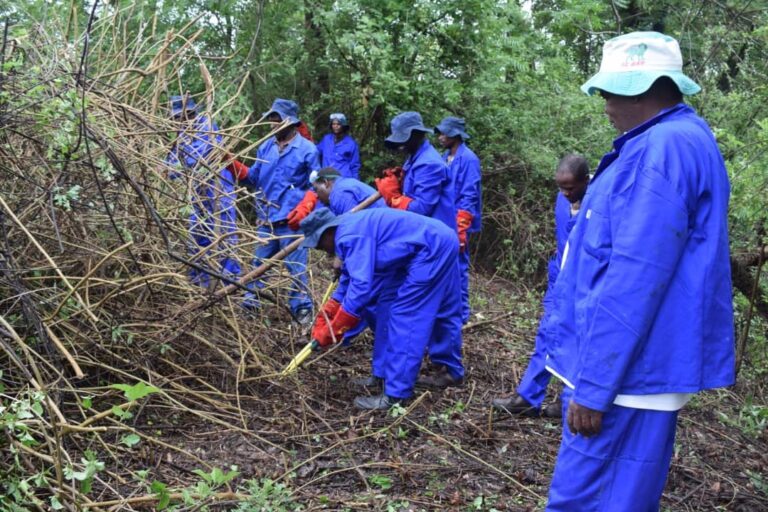
Zimbabwe Community Option for Protection and Empowerment (ZICOPE) recently said they are targeting to clear alien species in Zero Farm area in Masvingo rural as communities continue losing hectares of land to the invasive lantana camara.
ZICOPE Programmes Coordinator Raviro Mutonga said communities have to know the short and long term effects of lantana camara on their environment.
“Communities need to know the effects of lantana camara and as an organization we are targeting to clear the weed in Masvingo rural. At a site near Nemamwa turn off on the left side towards Great Zimbabwe hotel, we are targeting one km by 40 meters. So far nearly one and half hectares have been cleared. We are going to plant trees on that land during this month to commemorate Africa Environmental Day,” said Mutonga.
She also said that it is important to embark on such programmes of clearing camara as it helps the community to understand the importance of land degradation.
“It is important to embark on such programmes because communities have to understand the importance of conserving trees, soil and grass. Lantana Camara is a very deadly weed and it spreads so fast and in any area where it survives, it kills grass.
“As an organization we are into catchment rehabilitation of Mutirikwi and Tugwi-Mkosi. In that endeavor, we realize Lantana Camara is an enemy destroying the natural vegetation, again in our programme for environmental awareness, rehabilitation and management, we raise awareness in root causes of environmental degradation,” she said.
Mutonga further said, villagers in Zero farm are appreciating the programme and have urged people to take action against Lantana Camara.
“Villagers are very much interested and are doing the work without any incentive. They have understood the dangers of degradation, now they are making a difference in how they use and manage natural resources.
“Let us destroy Lantana Camara before it destroys our inheritance, the weed is very dangerous to both the livestock, human and grass. Let us guard jealously our surroundings and uproot the weed,” said Mutonga.
In Zimbabwe, climate change and invasive alien plant species are among the top threats to the ecosystem and Masvingo province has not been spared either.
Invasive alien species are plants that are introduced in an environment where they are not normally found.
Statistics released by Environmental Management Agency (EMA) Masvingo province shows that an estimate of 2473.17 ha of land has been affected by lantana camara in the province.
The dominance of lantana camara affects ecosystems’ equilibrium which is important in the fight against climate change effects.