Home Blog Page 267

2023 general election is the greatest outlook risk for Zimbabwe

Zvikomborero Sibanda

The Russia-Ukraine war and its primary ripple effects on international trade and cooperation is a major source of volatility and uncertainty particularly for developing economies like Zimbabwe.
This war poses catastrophic long-term impacts on global economic activity. It is already compounding the problems that were initially worsened by the COVID-19 pandemic such as public debt. Many emerging and developing market economies are grappling with unprecedented debt levels with data showing many at risk of defaulting. As their debt ratios breach 100percent of the gross national product (GDP), debt servicing costs are now gobbling the larger chunk of government budgets thus crowding-out critical public services, safety nets, private sector support, and infrastructure development.
With a clear uncertain future for the global economy, it is looking gloomy for Zimbabwe, a country that heavily relies on both foreign-produced goods and primary commodities which are too susceptible to severe global fluctuations. This shows that the domestic economy is inadequately insulated from global economic fluctuations. Since 2019, the nation has struggled to contain excessive currency fragility and is experiencing a sustained increase in general prices that continues to plunge the majority of the population into poverty. For instance, official statistics show the price of basics mounting by 268.8% in the last 12 months through October 2022. The World Bank also estimates that 40% of Zimbabwe’s population is living in extreme poverty. Independent economic commentators attribute all this to government officials’ economic and financial mismanagement driven by massive policy inconsistencies, fiscal indiscipline, illicit financial flows (IFFs), corruption, greed, and impunity among others. The obtaining dire socio-economic situation is likely to worsen as the nation gears for a general election in less than 7 months from now.
Generally, in a developing nation set-up, elections pose greater economic risks. The election cycles are largely characterized by political violence, police brutality, unwarranted arrests of activists, human & property rights abuses, and a compromised judiciary. Also, the election risk emanates from the ‘politics of public spending’ as many empirical studies like the one by Ebeke and Olcer (2013) have proved that during election years, government consumption increases leading to higher fiscal deficits. A granular analysis of government policy direction in recent months signals elevated fiscal spending for 2023 due to rising political pressures. For instance, the government has announced plans to increase household agricultural support for the 2022/23 season under Pfumvudza Scheme to 3.5 million from 2.3 million who participated in the previous season. This ambitious plan comes at a time the cost of fertilizers and some critical farm inputs have burgeoned significantly, being largely driven by the Russia-Ukraine war and its ripple effects on global food and energy prices.
A question for objective inquiry is, whether this doubling of 2023 Pfumvudza Scheme beneficiaries was coincidental or it was just a deliberate move by those in the corridors of power to appease the ruling party’s rural strongholds. These state-funded farm inputs are reportedly being distributed on a partisan basis. But, in an ideal set-up, productive government subsidies should be allocated and distributed to all intended beneficiaries transparently to curb abuse and waste of taxpayers’ hard-earned dollars. For the record, I am not against the State’s provision of social safety nets especially given the obtaining context of chronic inflation. While the government’s yearly unwavering support to vulnerable societal groups like rural smallholder farmers is highly commendable, it remains to be seen if the Treasury will be able to bear the ballooning spending burden sustainably, that is to say, be able to achieve optimal spending levels by all government line ministries, departments, and agencies without jeopardizing the stability of its financial position.
Nevertheless, based on historical trends, there is a strong basis to question the sustainability of increased public spending aimed at shoring up incumbents’ electoral chances. As such, the already overtaxed consumers and businesses should brace for increased and regressive taxes in the upcoming fiscal year as it will be inevitable for Treasury to find ways to match revenue collections with elevated spending needs. The adverse impacts of high taxes on the general well-being of the economy and citizens, therefore, cannot be overemphasized. Typically, high taxes have repercussions on saving culture, business investment, domestic production, labour’s ability to work, consumer incomes, and poverty prevalence, among other effects.
More so, the nation is witnessing regressive legislation being proposed likely because of the upcoming general elections. These include inter alia the pending Patriotic Bill, the Health Service Amendment Bill, and the Private Voluntary Organizations (PVO) Amendment Bill. A simple analysis of the contents of the PVO Bill shows that the main motive of the Bill is to silence civil society organizations (CSOs) despite CSOs being very crucial when the common objective is to respect the tenets of a thriving democracy. For example, the PVO Bill will give too much power to the Executive to control and interfere with the work of non-governmental organizations (NGOs), it increases the surveillance and monitoring of these NGOs, and it potentially criminalizes NGO work and human rights defending.
If passed, the regressive Bills being proposed would leave the poor and vulnerable groups who rely the most on support from NGOs worse off. It is well documented, for instance, that Zimbabwe’s public health care sector receives hundreds of millions of US dollars in donor support annually to reduce malnutrition in children and fight diseases like malaria, tuberculosis, and sexually transmitted infections (STIs) among other health initiatives. Apart from targeting NGO work, the mounting number of episodes of political violence being witnessed across the country like the bloody violence that occurred in Matobo last month is alarming. Political disputes which degenerate into full-scale violence and civil unrest scare away capital thus constraining business investment -both foreign and domestic. In short, election seasons in developing nations like Zimbabwe are characterized by an increased investment risk premium. The need for the suppliers of loanable funds and entrepreneurs to trade/invest cautiously to avoid excessive losses in 2023 is expected to exert adverse pass-through effects on economic activity.
It is, therefore, my view that in order not to derail the moderation of currency depreciation and price inflation witnessed in recent months, authorities should prudently navigate the upcoming election season. There are increasing calls to ensure that the Treasury cool down election-linked spending pressure in the months ahead otherwise the private sector would be crowded-out by excessive domestic public borrowing. Thus, the nation will remain trapped in a vicious circle of macroeconomic volatility. Also, I submit that lawmakers should not rush to pass archaic legislation that scares away investment and isolates Zimbabwe from the international community. Progressive legislation that leaves no one and no place behind is critical for Zimbabwe if she is to achieve robust and sustained economic growth in line with the aspirations of Vision 2030.

Zvikomborero Sibanda is an economic analyst and an astute researcher. He writes in his personal capacity. He can be contacted via email:

bravosibanda@gmail.com
Twitter: @bravon96

No significant change in major Masvingo dams

TellZim Reporter

Recent rains that fell in the Southern Region did not register much change in Masvingo’s major dams as evidenced by dam level statistics released by the Zimbabwe National Water Authority.
Whilst most of the dams’ levels in the Runde Catchment had not receded much from last rainy season, there was no significant change from the nearly two weeks of rain experience across the region.
Two of Masvingo’s biggest lakes, Tugwi Mukosi and Mutirikwi, which are still at 92.72 percent and 92.83 percent full respectively both had a slight decrease of -0.15 and -0.85 percent respectively.
Manjirenji, Gozho, Makonese and Muzhwi dams were 100 percent full as at November 14 2022, with very slight changes from October 24 2022, which was before the onset of the rains.
In March 2022, ZINWA confirmed that most of the province’s major dams were over spilling despite low rainfall that was being experienced at that time.

19 years on, pupils still learning under trees

…use bricks as chairs, laps as desks

Brighton Chiseva

MWENEZI – One will be forgiven for imagining a school with state-of-the-art facilities when hearing the name Turf Primary School which is located in ward 15 of Mwenezi District, about 52 kilometres due East from Masvingo – Beitbridge road but getting on the ground will show you the total opposite.
Having been established in 2003, just after the chaotic land reform programme which saw people flocking to white owned farms in Mwenezi and Chiredzi districts, Nyangambe Turf Primary School has never seen any meaningful development, with pupils still learning under trees with no chairs nor desks.
Pupils from grade one to six endure the scotching summer sun under leafless trees which shed their leaves during winter, using mud bricks as chairs and their laps as desks.
There is no better season for the pupils as they have to endure June and July’s colds, the sun in summer and rains in the wet season.
The school only started showing signs of development in 2020 when the first classroom block opened doors to Early Childhood Development (ECD) level A and B as well and grade sevens, leaving the rest under trees after a story by TellZim News which saw Unicef providing roofing material after parents moulded bricks and contributed money for roof trusses and other material requirements.
Turf Primary School has an enrolment of more than 311 pupils; 150 boys and 161 girls, who in most cases will not go to secondary school after completing grade seven owing to the distance between the area and the nearest secondary school which is 80 kilometres from Turf.
Speaking during a tour by Minister of State in the President’s office responsible for monitoring the implementation of government programme Joram Gumbo, the school heard Bernad Chauke said the school has a plethora of challenges which many would find difficult to believe in this era.
The only two blocks at the school are not fully functional, with the only one being used since 2020 and the second one will be open for use soon if funds permit for its completion.
“During rains, all our pupils will be crowded in the available class, a situation that is difficult for us to deliver lessons. During sunny days pupils are exposed to the harsh summer sun under trees since each class was allocated its tree to do lessons under,” said Chauke.
Chauke went on to say pupils at the school were far behind in terms of Information and Communication Technology (ICTs) since the school has no single computer or any source of electricity even if they are to have a computer anytime soon.
“Our pupils do not even know a computer; we don’t have any computer at the school let alone electricity. During lessons, we just show them pictures of computers and in some cases if one of the staff members has a tablet we will show them and that will be the closest thing to a computer they will know,” said Chauke.
Connectivity is another challenge, a development which has seen the school taking time to access communication from the district offices and other stakeholders.
He went on to say they have no security at the school as there is no fence or perimeter wall, a development which has seen both wild and domestic animals frequenting the school premises .
Chauke also said the area had no health facility with the nearest being Mwenezi District Hospital which is more than 100km away.
“There is no health facility near here so it’s difficult to deal with any health emergency at school and even the community around.
“There is no transport to connect us to the main road though the road is in good good shape. We appeal to authorities to avail even a single Zupco bus here so that we can link with other areas when we need services,” he said.
The school has no staffroom and for meetings teachers gather under a thatch shade, a place where they can also connect to the network.

FC Wangu Mazodze shines at Eastern Region D1 award ceremony

0

Courage Dutiro

Masvingo based Division 1 Eastern Region Soccer League (ERSL) newcomers FC Wangu Mazodze walked away with three gongs from the D1 ERSL 2022 award ceremony recently held at Golden Peacock Hotel in Mutare.
The team’s spokesperson Sukuoluhle Ndlovu said the awards are a clear indication that the team will finish on a high note come next season.
“We got three awards, this is a great milestone for the team as a whole. It was a great honour for Zhalala Zhululu. We are deeply honoured as our work was recognized by Zimbabwe Football Association ZIFA Eastern Region Soccer League.
“It is our first year playing professional football and three awards are an indication that next season we are going to finish on a high note,” she said.
The team won the most promising team of the season award.
In recognition of his excellence, efforts and achievements in ZIFA Eastern Region Soccer League, the club’s chairperson Dr. Richard Wangu Mazodze scooped the best Club chairperson of the season award,
Zhalala Zhululu player of the season Marvelous Jenjere was among the list of the most promising players of the 2021/ 2022 season award.
Among the list of the Soccer Stars and Most Promising Players in Eastern Region Soccer League Masvingo United FC had Captain Admire Banda whilst Chiredzi Stars provided Tafara Ginya and Renco Mine FC had Leon Ngwenya.
Green Fuel FC’s Lloyd ‘Samaita’ Mutasa took the coach of season award after finishing the season undefeated.

Govt bureaucracy hindering development – Zanu PF MP

0

…Mwenezi still underdeveloped

Brighton Chiseva

MWENEZI – Zanu PF Member of Parliament for Mwenezi West Priscilla Zindari Moyo has lamented bureaucratic measures that one has to get through when applying for approval to construct infrastructure like schools saying they are hindering development.
Moyo was speaking during a tour of Nyangambi Turf Primary School in Mwenezi by Minister of State in the President’s Office responsible for monitoring the implementation of government programmes Joram Gumbo.
Moyo said Mwenezi was largely a resettlement area and had no schools but it is taking too long to get approval to construct schools in needy areas.
“The problem we have here in resettlement areas is that it is a big challenge to get approval to construct schools here. Minister, please help us so that approval for construction of schools in resettlement areas be granted in time. Our kids are staying far away from their parents because there are no schools simply because approval letters are taking time. For example this school; I had to travel up and down a lot because the authorities could not issue aproval for this school. It took long for the school to be pegged and it was not because parents were not forth coming but it’s because of the laws that are in place,” said Moyo
She said she came into office when there was nothing to show that there was a school and children were learning in shacks made of grass but now it was better though there is still a long way to go.
“When I first came here, there was nothing to indicate that there is a school, there were shacks but now it’s better, we have two blocks but still most learners are still learning in the open,” said Moyo
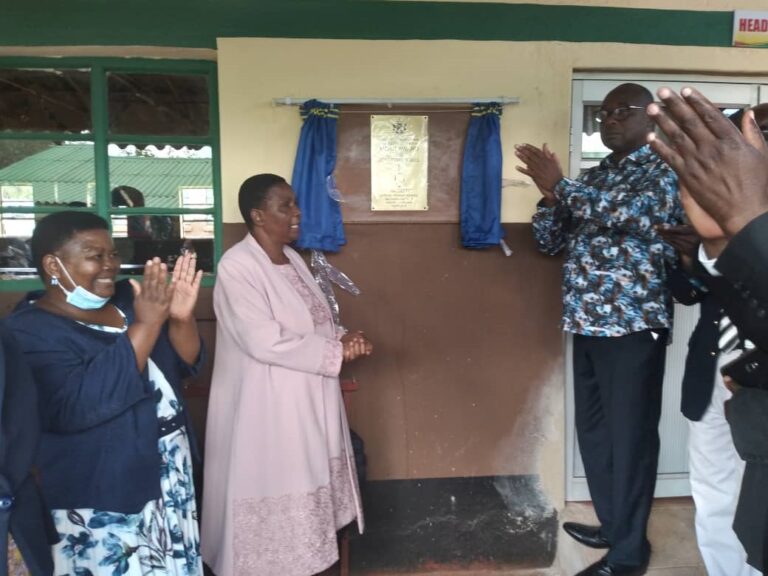
Nyangambi Turf Primary School was established in 2002 at the height of the land reform programme and did not have any meaningful infrastructure since then until the first block was constructed in 2020 after TellZim News wrote a story on the state of affairs at the school prompting Unicef to intervene.
The second block which is almost complete was constructed by students from Mushagashe Vocational Training Centre through devolution funds.
In his speech Gumbo urged the private sector and communities to join government efforts by providing local resources including labour to develop schools.
“I have been briefed that the community participated in the construction of the classroom block. Indeed parents should complement government efforts by contributing towards the development of schools in your communities through offering various services including labour. I also call upon private sector players to join hands with government and help in the development of the school,” said Gumbo
He said he will engage relevant authorities to attend to outstanding challenges at the school so that they are addressed.
“I would like to assure you that my office will be engaging the relevant authorities to ensure that these challenges are attended to,”
Mwenezi RDC Chairperson Joram Ncube said as a district they pledged to use devolution funds to needy areas than simply dividing the funds amongst the wards.
“Here we did not just divide the money amongst our wards. We did what we call positive discrimination where the funds were directed to needy areas of the district and this school is one of them,” said Ncube
The school is still in dire need of resources to meet set standards as the majority of the pupils are still learning under trees using bricks and stones as chairs.
Only ECD and grade seven pupils have classes and chairs as well as tables.
The school head Bernad Chauke said they were still far from making Nyangambe Turf a standard school.
“We are happy with the progress we have so far but it’s still not enough, we need more blocks and staff houses to make our school better. We call upon goverment and other stakeholders to chip in and asist us,” said Chauke.
One parent, Tolerance Gumbi from Kovogo Village said the situation was still bad at the school as the available classes could not accommodate all pupils if it rains prompting pupils to abscond classes when it is raining.
“The situation was bad and it’s now better but these two blocks cannot accommodate all pupils when it’s raining, so we appeal to responsible authorities to help so that we have more classes and staff accommodation at our school,” said Gumbi.

Mthuli destroying Zanu PF from within

0

Prof Moyo once said the best way to destroy Zanu PF is to do it from within and very few took him seriously. It is unfortunate that Musorobhangu was kicked out of Zanu PF before he completely destroyed it but haaaa anga afamba nendima. The 10th of Mugabe’s youth interface rallies was supposed to be the last nail on the coffin but junta rakazojamuka big time, and we all know what happened after that. Mapombi to do not want to be drawn into talking much about that otherwise ndinorara zvangu ndapfekedzwa Apolo-jersey sera Kudzai Chipanga kkkkkkkkk ko karipiko kamfana kaye I heard he was readmitted into Zanu PF kkkkkk haaa Zanu ndisinjonjo chaiye. Haina mugoni iyi, chero Ngwena yenyu yakatizira Mozambique yakapfeka cowboy hat zvadzvanya. Though ED jumped our border for safety, I liked his confidence when he wrote that long letter saying he would be back in two weeks to liberate the people of Zimbabwe from the dictator. That was impressive. Again, I do not want to be dragged into a discussion about whether did he delivered the economic and social emancipation he promised when he said he was going to be back in two weeks. We all know what happened thereafter. But we cannot lose hope, 2030 is still more than half a decade away who knows we may achieve the upper middle income target, where every person in Zimbabwe, including the newly born babies would be worth an average earning of US$4000 per annum. This is very possible Cdes, with all these pro-poor projects being initiated by the government – presidential poultry , inputs, livestock schemes and many more mungati zvingakona?
Mapombi is always a gentleman ndinofira kutaura chokwadi. There is only one person who is busy destroying what our good President is doing. No matter how much ED tries to deliver akasungwa mbiradzakondo chaidzo, kuitwa chidembo tamba tamba muswe ndakabata. The guy must have learnt and mastered the skill from Prof Moyo so well. The guy is Mthuli. Yes, Mthuli of the infamous phrase ‘Zvakarongeka’ when in actual everything is in shambles. Hapana chakarongeka in Zim at the moment zvinhu zvakaita manyama amire nerongo.
It’s not surprising that Mthuli is destroying Zanu PF from within. This is the same guy who was once named by the late MDC leader Morgan Tsvangirai (May His Soul Rest In Eternal Peace) in his shadow cabinet as the minister of finance. He must have some connection with opposition politics. Mapombi will leave that for another day. All I can say is Mthuli is on a serious mission to destroy Zanu PF. There is no more evidence to that than his pathetic reforms and policies that are announced overnight, and scaring real investors away. When I talk about investors I’m not talking about the Chinese vanouya kuzogara muma container while busy looting our minerals for a song. I mean real investors who can develop our infrastructure kwete torai mari same age boys. Its not that Mthuli doesn’t know the policies and monetary reforms that can stabilise our economy but he is on a mission thats why he lied kuti zvakarongeka iwo achingori masvanhikongonya kutarisana kwevakarambana.
Mthuli knows that if civil servants get a decent salary then ED will win resoundingly come 2023 so as a result he has been dodging increasing salaries for civil servants since 2018. All he did was coming up with dubious allowances and no fixed salary amount. If you ask a civil servant today how much he or she is earning in terms of the ZW$ or RTGS the majority will not give you a definite answer because the figures change every day and there is no explanation to that. In fact there is no logic. The majority civil servants are only certain about the Covid-19 allowance and the US$125. Mthuli is trying hard to make sure that the civil servants are very angry and the blame is on ED as the Head of State and Government. By so doing the majority of civil servants will vote for opposition, except for very few teachers vaya vakanwirwa mvura naED zuro uno uno uyu.
As if that is not enough, Mthuli is now further embarrassing the President by his so called Special Presidential bonus kkkkkkkk haaa zvandinooneswa ini Mapombi ini zvazvinokunda ngoma kurira. Honestly who does that? Special Presidential bonus? KKkkkkkk nonsense. What is special about a bonus that is payable over two months? Ndohu special hwacho here kuti inouya muchidimbu chidimbu over two months? Its a 13th cheque that is known by everyone so why making it look like it’s a Special Presidential bonus. If it’s really a special one, why not pay it separately from the usual bonuses the civil servants get every year?
Mapombi can tell you that this was very deliberate by Mthuli. Its an attempt to discredit ED, the guy is destroying the ruling party every day, slowly but surely. Mapombi has worked in government herself before she left for greener pastures – which never was though kkkkk. Yes, you may laugh all you want but I can still brag that its better to survive on rotten bananas and maputi than to be a civil servant. Yes, I will not sell my dignity for a song. Anyway, I’m diverting from the point I wanted to raise. I wanted to say all the time I worked as a civil servant I haven’t heard anything like Special Presidential bonus. Even my friends at ZCTU may agree with me that izvi zvatotangawo naMthuli izvi. Everything in Zim is now of presidential quality, even the bonuses kkkkkkkk haaa Mthuli wakaoma ndibate ruoko. Shake my hand Mthuli – you are a genius I must say. Mapombi never thought you would destroy it sefani so.
By the way, yapinda here presidential bonus nhai maCivil Servants weee? Kkkkkk haaa ndanzwa mbabvu nekuseka zvangu nhasi. But Mutuvi usazodaro so. Its not right. It’s not a crime being a civil servant. We always know that the 13th cheque is paid in November every year manje iyi ndeipi iyi yekupa bonus yatongoziva tese kuti Special Presidential Bonus? Kkkkkkk Mapombi don’t see anything special about ka bonus kari kutoitiwa split and paid in two months.
But have you noticed that everything is now linked to the president? Mapombi is not amazed by the level of bootlicking iriko iyi because ndozvinoita vanhu vane nzara kutsvaga kuda kudya. We now have Teachers 4ED, Vapositori 4ED, Mahwhindi4ED, Manásinéni 4ED, the list is endless kani imi. Kutsvaga kuda kudya mkwese uku but the truth is havasi vose vanoti Mwari Mwari vanopinda humambo hwedenga, I am not reffering to pastors and mapositori 4ED kkk.
Anyway guys its lunch time now let me go ndindokanga zvangu maputi angu for lunch ndizvidyire. But before I go, Mapombi wants to say to Mthuli faka pressure – ramba wakadzvanya. You are destroying Zanu from within and those vanokasira kuonera madhiri acho are fully behind you. Faka pressure Mthuli. Aaaaah nhasi zvangu ndichanzi ndava kuita zvemukomana nekuramba ndichingoti faka pressure ikoku kkkkkk. In fact some are saying kuti faka pressure is promoting violence hameno kana makambozvinzwawo. Mapombi will not be dragged into such a trivial discussion. Let me avoid the term so that I don’t get in trouble ndikaswera zvangu shaya dzapesaniswa ndikazotadza kutsenga maputi zvakanaka, Mthuli bhora mberi! Bhora Mugedhi! Ibhola igedhini, Mboko iMboko

Dadaya Mission learner electrocuted

Tinaani Nyabereka

A 15 year-old Dadaya High School learner died after he was electrocuted in an incident that occurred on November 12, 2022 at around 1700 hours at in Zvishavane.
The deceased has since been identified as Tanaka Chihwendo.
Midlands Provincial Police Spokesperson Inspector Emmanuel Mahoko called for close monitoring of electrical appliances.
“We urge institutions and authorities in charge of public infrastructure and facilities to ensure that their implements are safe for the public at all times,” he said.
Chihwendo is reported to have been playing soccer with his friends near the boys’ hostels.
The now deceased learner is said to have accidentally touched a naked wire that was hanging from an electricity pole and was electrocuted.
He was rushed to Zvishavane District Hospital where he was pronounced dead upon arrival.
The matter was reported to the police and investigations are underway.

Expensive feed, power cuts causing decline in fish production

Branton Matondo

The importation of fish feed from China and Southern Africa Development Community (SADC) region has weighed down fish farmers in Zimbabwe causing a decline in productivity and demand, an expert has said.
Fish farming is a growing agro-based industry that has both small and large scale players.
Due to the amount of tariffs on fish feed from China through the South African coast and fish meal from SADC countries like Namibia, Malawi, South Africa, Tanzania and Zambia, Zimbabwean fish farmers have gone to face a tough obstacle of failing to reach audible productivity.
Speaking to TellZim News at a recently held fish farming strategy launch in Mutare, Zimbabwe Fish Producers Association (ZFPA) chairperson Garikai Munatsirei said breeding and commercialization of Tilapia is a fast growing venture in Zimbabwe but the high cost of accessing fish feed is weighing on production levels.
“Among the many challenges faced by fish farmers in Zimbabwe, the chief obstacle is pricey fish feed. It’s very difficult to access standard fish feed for a standard harvest. Shortages of maize and soya beans which can also be used to make fish feeds have also pushed the industry to the edge. In terms of soya beans, it’s taking long to grow enough for the sector but the country ends up importing soya beans from Malawi, South Africa and neighbouring Zambia,” said Munatsirei.
He added that tariffs are a major blow to the effective production of fish farming and aquaculture initiatives since most of the local fish farmers are artisanal.
“The major setback now comes in paying tariffs and border charges making fish feed very expensive. So it’s quite simple, the final product becomes expensive because a fish farmer encounters high expenditure and costs hence reducing the demand,” he added.
Challenges facing fish farmers range from hefty imported fish meal, security and demand.
Coordinator for Spring Glory fish farming Simon John cited the same challenges when TellZim reached him for comment at the farm based in Manicaland.
“The first major challenge is feed then followed by electricity shortages because projects like the one here at Spring Glory farm require 80% electrical charge for standard operation of machinery. This month we lost 240 breeders to power cuts,” bemoaned John.
He added that demand for fish farming produce is low at the moment as they have only two established outlets in Mutare.
However, in a bid to address the issue of hefty fish meal a unique project at Haggai farm in Mutasa constituency managed by one Godfrey Chironda and meant to curb the acute challenges is currently underway.
Chironda said the project is organic, unique and cost effective in its bid to address impending challenges.
“This is a black soldier fly project which we use to produce larvae. It has actually 50 to 60 % protein level and it can directly replace fish meal which is very expensive. The idea is to have a significant fall of feed to have better returns on the market,” said Chironda.
The project at Haggai farm which is a single pilot project in Zimbabwe to produce environmentally friendly fish feed has attracted attention from international organisations.
Food and Agriculture Organisation (FAO) of the United Nations (UN) delegation led by Fish4ACP Programme Management Unit Focal Person for Zimbabwe Yaiza Dronkers visited Haggai farm.

Decibel homecoming: “Urban groover” promises fireworks

0

Theresa Takafuma

One of Zimbabwe’s finest ‘urban groove’ genre artistes Daniel ‘Decibel’Mazhandu has promised a good time at his homecoming show that will be held at Civic Centre in Masvingo on December 3 this year.

Decibel, who is based in the United Kingdom will return to his roots in Masvingo where he promised to give music lovers a run for their money as he sets the stage ablaze with a mixture of classic hits as well as new tracks he has been working on.

Speaking from his UK base, Decibel said he had missed performing for his fans back home whom he said he was sure they missed him too.

“We will definitely play all the classics kumbodzora ndangariro (to reminisce the old times) both for myself and the fans to be honest. I have missed performing for them and they have missed me too,” Decibel said.

He also said he had a number of new tracks in the bag which he will play at the show, which he was reserving specifically for fans from his hometown, saying he was still the same man he was when he hogged the limelight in Zimbabwe.

“I have new tunes that some may have heard but most have not. Also some brand new ones that I will perform live for the first time in front of my home crowd.

“I am definitely the same person (although) 17 years is a long time. Maybe my accent changed slightly, maybe complexion, superficially, but the man inside is still the same straight shooting, genuine, what-you-see-is-what-you-get kind of guy. Typical boy from Pangolin—DB ready to have a good time,” he said.

The artiste, who found an organization called the Decibel Trust through which he advocates for youth empowerment through arts and sports, to discourage them from engaging in drug abuse and other social ills said there will be performances from young Masvingo artistes who he has been working with to discover their passion and talent in music.

“Many youths are being sucked into consumption of dangerous illicit brews and drugs primarily because of idleness and poverty. We are actively encouraging and facilitating youths to try music, poetry, drama and sports to occupy themselves and potentially discover their passion and talents.

“This would take them away from the streets and make them healthier physically, mentally and financially. It is a long road to walk but the journey has already begun. Some of the proceeds of the show will definitely be going towards the cause,” Decibel said.

The ‘Chido’, ‘Nakai’ and ‘Madhara’ hitmaker is returning to Zimbabwe for the first time in 17 years.

Gweru Zimdancehall chanter urges young people to persevere

Yeukai Munetsi

Gweru-Upcoming Zimdancehall Chanter Tatenda Lawah (18) popularly known as ‘Detective Rhymes Da Depot King’ has encouraged fellow young and upcoming artists to work hard and persevere despite the prevailing economic hardships.
Speaking on the welfare of artists in the face of prevailing challenges, Lawah urged young and upcoming artists to persevere despite the economic meltdown bedevilling the country.
“To all upcoming artists my advice would be for them to work hard and let their success make noise. They should not be deterred by the economy,” he said.
Lawah started singing when he was only 15 and to date has 10 tracks to his name.
Some of the tracks include Madam vePagwazhi, Vakanditeya, Prayer, Attention ft Jah talk and Ndakabatwa.
“I started singing in 2017 but because I had no access to a studio at that time, I only became more pronounced in 2019,” he said.
Having lived in the Souljah Love era, Detective Rhymes said that he was inspired by the now deceased legend.
“I was motivated by Souljah Love to the extent that I felt as if it was me. He was my inspiration and I always admired how he performed when he was on stage.
“His songs contained a deeper meaning about life and I felt we spoke the same language,” he added.
Detective Rhymes has managed to release 10 tracks with Madam Vepagwazhi as the hit song.
His dream is to follow Souljah Love’s footsteps or even surpass him.
Currently Lawah is working on his 11 track project which he said will be availed to the market once it is done.