Home Blog Page 269

Masvingo a sleeping giant?

Beverly Bizeki

Various presentations held at the first edition of the Masvingo Business Expo have exposed the various gaps and opportunities that the ancient city has in terms of business showing the need for investments in order to make it a business hub.
The expo held at Flamboyant hotel saw the convergence of over 100 exhibitors from around the country discussing on new business opportunities for the ancient city.
Masvingo Local Authorities Forum Chief Executive Officer Alexander, Mutembwa who presented on investment opportunities in Masvingo said local authorities are key in development issues in the country.
“Without local authorities, there cannot be any organized socio-economic development in the country,” said Mutembwa.
Chief among the investment opportunities in the province’s seven districts which was topical at the event was power generation and tourism owing to the plenty water bodies available in the province.
Mutembwa also cited the possibility of establishing a 5MW hydro power plant to feed the national grid in Mwenezi.
Zimbabwe Tourism Authority Executive Director, Reason Machigere highlighted the need to sweat out the resources in the province citing the underutilization of dams as well as limited number of hotels with the city said to have only 8 hotels.
ZIMTRADE Eastern Regional Development Officer Admire Jongwe said Masvingo can be translated to a greenbelt as it is renowned for its huge water bodies whilst leveraging on the climate conditions.
“Masvingo is renowned for its large water bodies and good climate conditions which are suitable for most of the horticulture products that can do well in this region for instance citrus with a protocol brokered between Zimbabwe and China now in place,” explained Jongwe.
Jongwe also emphasized on the need for smallholder farmers to move to the export market.

JESUS WALKS WITH ME

0

The Missing Pieces

With Yeukai Musara

One day my nephew and little brother were playing with the jig saw puzzle and they were trying to put pieces back together and trying to copy exactly the same way the picture was portrayed on the puzzle box.
However they tried to join the various pieces together so that they could bring out their image out. Some of the pieces matched, others did not and this was a 1000 piece puzzle that they needed to finish up, with some pieces missing as well and l saw them change their game to play another one.
This got me thinking; in life how many people are trying to put back puzzle pieces of their life together and cannot seem to be able to handle it and they are missing other pieces to put in or replace in order to bring out a good image that have to try and accomplish?
Replacing the pieces in life is one of the most delicate things that one can face when they try to do it on their own but, God can make all things better and replace it piece by piece.
There are people who have broken pieces in their lives that they are just trying to mend or try to fix hoping that they can do it themselves.
There are people who are here who have lost various pieces in life and just want them back or want them renewed.
Some have lost treasures that they had desired to have kept but wrong decisions led them to lose them or they have been broken into various pieces and putting them together is just not working.
Do not lose heart because my bible tells me in the book of Ezekiel 37; God spoke to Ezekiel and ordered him to prophesy to the valley of dry bones in order for them to have life.
The only part that l am going to focus on is verse 7 that he prophesied as he was commanded by God and there was a rattling and the bones came together, bone by bone and the sinews and flesh came upon them and the skin covered them over.
God is replacing back your pieces, piece by piece and making a new start to what you have wanted to do or wanted to have become.
Every piece in your life that was missing is being replaced bone by bone or piece by piece.
God is replacing the missing pieces in your life that maybe whole again and that you gain back your position at a higher level full in him.
May God replace every missing piece in your life today and may he accomplish all that you wanted with the pieces in much more abundance.
Continue to pour out to God and he will replace your life, situation back piece by piece, bone by bone.
I can imagine them flying everywhere from various places where the devil had hidden them or kept them away from you and now God is replacing them piece by piece.
God replaces the pieces in our life as well as he places his own spirit within us so that we may move together with him in one accord.

Further verses:

Psalms 104 v30
Isaiah 32v15

Lands ministry in soil, water conservation blitz

0

Beverly Bizeki

Participants at the recently held soil and water conservation policy stakeholder consultations conducted by the Ministry of Lands, Agriculture, Water, Fisheries and Rural Development have agreed to incorporate local leadership including traditional leaders in the fight to conserve soil and water as key natural resources.
They said as the country is facing high rates of soil erosion mostly at 50 tonnes per hectare every year, there is a need for the country to come up with a policy conservation of soil and water.
National Acting Director of the Department of Agricultural Engineering Mechanization and Soil Conservation Herbert Gutu who was representing Chief Director Engineer Edwin Zimhunga said the consultations were initiated by high rates of siltation taking place in rivers and dams reducing the water holding capacity of dams.
“We have realized the high rate of siltation in our rivers with soil erosion rate at 50t/ha in some areas is affecting the water holding capacity of our dams which eventually affects the sustenance of livelihoods.
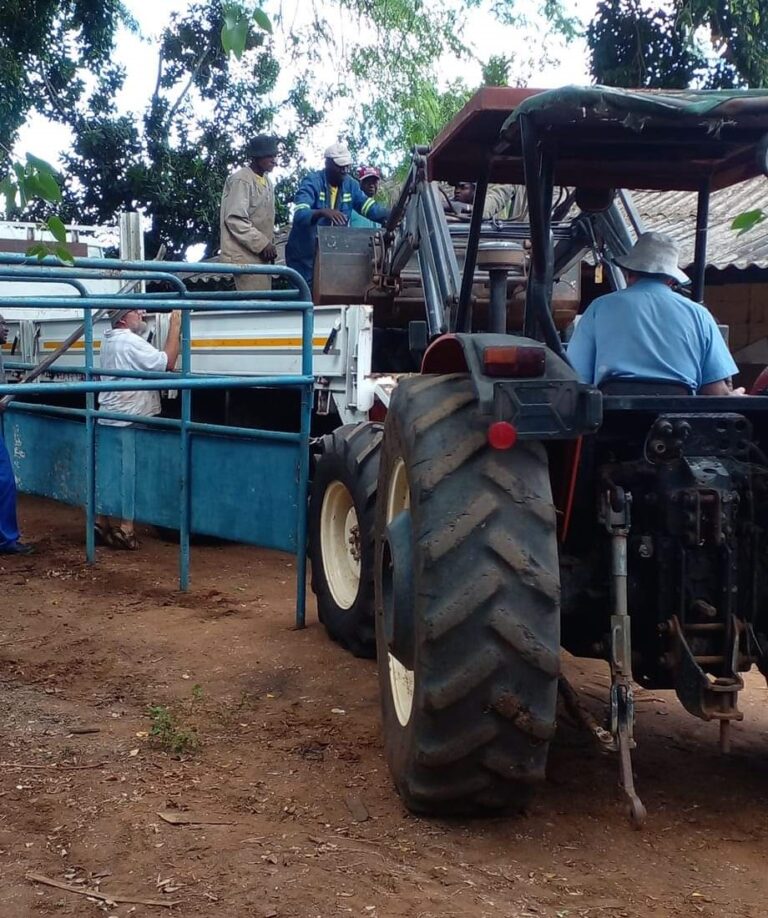
“Having realized this, the ministry has just started a soil conservation blitz this year intending to ensure that everyone has access to services for designing, pegging and conservation works with the ministry availing 30 tractors for the country’s 10 provinces to ensure every piece of agricultural land or not has conservation works on it to reduce the effects of soil erosion,” said Gutu.
Masvingo Ministry of Agriculture Provincial Director Aaron Muchazivepi challenged traditional leadership to play their role in soil and water conservation.
“Local village heads and Headmen are supposed to spearhead these programmes (soil conservation blitz) for people to be able to take up the programmes,” said Muchazivepi.
One participant pointed out the need to ensure local or traditional leadership play roles towards such initiatives.
“Local government has traditional leaders who are mostly responsible for parceling out land especially in rural areas hence the need to have them on board in making decisions to do with soil and water conservation,” said one of the participants.
Major causes of soil erosion raised at the meeting include stream bank cultivation and veld fires which cause the loosening of soil particles and eventually soil erosion.
Another participant also stressed the need to implement policies formulated for success of the programmes.
“Whatever we put on paper must be implemented, the Tugwi-Mukosi feasibility report was made some few years back but we still have people farming in the buffer zones which has ended up in some rivers feeding in to the dam heavily silted so there’s need for implementation after formulating policies,” said another participant.
As climate change continues to take toll, there is need for more efforts from all stakeholders to conserve natural resources like water hence the call to make conservation works compulsory in farming as well as natural resources like forests.
The consultation meeting is one of the many that are being held nationwide in order to come up with the first draft of soil and water conservation policy.

ZWAYAT value addition clusters benefit women, youth, marginalized

Branton Matondo

Zimbabwe Women and Youth in Agribusiness Trust (ZWAYAT) is leading the organic crop value addition chats following diverse engagements with local and regional organizations for impartation of value addition, finance and organic cropping knowledge to women, youth and marginalized members of the society.
With the food market dominated by genetically modified products (GMO) and fast grown produce, cries from consumers to increase cropping and selling of organic products continue to pour.
Commercialisation of the farming and agro-based projects continue to hamper marginalized producers who are in most cases located in remote vicinities.
ZWAYAT leader Mrs Cecilia Muchechesi who has enrolled a plethora of value addition clusters meant to benefit ignored small scale farmers and producers said the organisation has assisted and continues to assist a lot of women from various districts across Zimbabwe.
“As ZWAYAT, we recently registered with the Zimbabwe Goat Producers Breeders Association (ZGPBA) to help subsistence goat producers within our organization and how best they can come up with a good end product. Besides goat farming, we have also engaged with ZimTrade. ZimTrade teach members on how to assess markets and competitiveness. First Mutual is also helping out in educating our members on financial literacy because most of our target members are based in rural areas where some of them are not literate enough to conduct businesses,” said Muchechesi.
ZWAYAT was also a signatory of Mutare declaration for Food and Agriculture Organisation (FAO) endorsed ‘Strategy Launch for the Sustainable Development of the Tilapia value chain in Zimbabwe’ launched in Zimbabwe’s eastern border town on November 11.
Muchechesi added that value addition makes a big difference in the world of small scale farm produce.
“ZWAYAT is also a member of Commesa Federation of Women in Business (COMFOB) and we are also a member of Network of African Women in Business (NAWOB). Most of the people we are working with are women and youth in the rural areas. We have engaged women from various districts of Zimbabwe who do their projects on diversified small scales. When women and youth harvest their crops, ZWAYAT value adds by processing, packing, and branding because it benefits the producers in times of exchange on the market.
“From the time we were awarded, we have never looked behind. Our members are at the moment gaining expertise from Quality Assurance Consultancy Company who operates under Africa Continental Preferential Trade Area.
“The idea is to impart knowledge on organic crop farming. Members will also receive eco-marked certificates for the course,” she added.
ZWAYAT clinched bronze medal at a Small to Medium Enterprise (SME) Expo held at Rainbow Hotel from October 19-22 this year.

‘Tongaat pivotal for Zim’s economic turnover’

….circulates millions of United States dollars across the country

Beatific Gumbwanda

CHIREDZI-Zimbabwe’s sole sugarcane producer, Tongaat Huletts Zimbabwe (THZ), which is the biggest employer outside government, has a much large potential to help Zimbabwe’ economic turnaround through its support to more than 200 indigenous companies under its supply chain system.
More than ZW$ 20 billion and close to US$ 100 million dollars is circulating annually across the country.
Masvingo Chamber of Small to Medium Enterprises (SMEs) in collaboration with the Lowveld Business Development Association (LOBDA) organized an annual supplier’s conference with Tongaat Huletts Zimbabwe (THZ) which was held at Clevers Hotel in Chiredzi recently, where the sugar giant indicated that they are circulating billions of dollars to indigenous companies through its supply chain system.
Weston Jemwa, THZ’s Supply Chain and Procurement Executive said the company has close to 30 000 line items from both Hippo Valley and Triangle which they purchase annually from its various procurement sectors in the Carpex and Packaging, Logistics, General, fleet and mill which suppliers should select their specialty from.
“We have a sustainable procurement policy where we tray and balance all our suppliers nationwide as we are a national company. 50% of the sugar we produce is being consumed in Harare, so as a company we try to balance our suppliers from across the country as we also need them to support us.
“We have close to 30 000 line items where suppliers choose from, even local companies, from Masvingo Province, should have a piece from that cake. We do not need a situation whereby one asks me what to supply. A lot of people are vying for low hanging fruits as most companies are scrambling towards sugar transportation, that is not only the service we need from local companies. Imagine during that time of quail birds, everyone wanted to have them, and some even sold their cattle to get into that business,” said Jemwa.
Jemwa also said from April to date, they have an expenditure of close to US$ 100 million and ZWL$20 billion which was paid to close 200 companies in Zimbabwe, with 119 companies being from Masvingo province.
“We have 119 local suppliers from Masvingo province who from April to date have paid ZW$ 2 billion and US$4.3 million while ZWL$16 billion and US$60 million has been paid to other suppliers across the country,” added Jemwa.
Masvingo Chairman for Chamber of SMEs, Venancio Kurauone also said the company should also act as guarantors to the local suppliers to help their growth.
“The company should have an Enterprising Department to capacitate local suppliers by being their guarantors in order for them to be able to supply huge quantities of products without financial hiccups,” said Kurauone.

Zimbabwe to benefit from OACPS and FAO driven Tilapia plan

Branton Matondo

With majority of Zimbabwean artisanal and commercial fish farmers facing torrid challenges, a fresh tilapia value chain strategy driven by FISH4ACP, global fish farming pusher Organization of African Caribbean and Pacific States (OACPS) with the help of European Union and a German based entity was launched by Food and Agriculture Organisation (FAO) in Zimbabwe in Mutare.
The project was introduced as a way to curb malnutrition, hunger, achieve better and sustainable agro-business.
The official implementation of the strategy dubbed ‘Strategy Launch for the Sustainable Development of the Tilapia value chain in Zimbabwe’ was graced by dignitaries from the Ministry of Lands, Agriculture, Fisheries, Water and Rural Development, the Agricultural and rural advisory services department, fisheries and aquatic resources management, fish farming community and international representatives.
Ministry of Lands, Agriculture, Fisheries, Water and Rural Development representative Milton Makumbe said Zimbabwe will benefit a lot from its inclusion in OACPS grouping.
“We feel very honoured to be among the OACPS groupings as Zimbabwe seeks to implement FISH4ACP programme. Government fully recognises the role of fish farming in addressing food nutrition, employment creation and empowerment of rural vicinities. The emancipation of tilapia production will be a firm step in the achievement of National Development Strategy (NDS) 1,” said Makumbe.
He added that government is aware of the low fish consumption in the country and this has had negative impact on fish market movement.
“Government notes concerns of the low levels of fish consumption in the country as highlighted by 2.6 kg per capita. It’s a sad reality looking at the fact that Zimbabwe has vast water bodies which can be utilized for fish production,” he added.
Fish4ACP Programme Management Unit Focal Person for Zimbabwe Yaiza Dronkers said the strategy is a package meant to target various objectives from value addition to sustainable production.
“The areas that we have now concluded are increase of economic performance, value chain in Zimbabwe and ensuring inclusivity and social sustainability. OACPS will pay particular attention to small and medium scale fish farmers who have the ability to support economic boom.
“FISH4ACP is a five year initiative that is driven by OACPS and FAO is the implementing organization. European Union (EU) and the German Federal Ministry for Economic Cooperation and Development (BMZ) are co-funding the projects in Zimbabwe and the 11 other value chains,” said Dronkers.
With Zimbabwe targeting 14 000 metric tons of fish for both local consumption and export, the strategy is geared towards value addition of the most popular fish in Zimbabwe, tilapia.
Zimbabwe Fish Producers Association (ZFPA) chairperson Garikai Munatsirei told TellZim that in as much as the strategy is launched and in motion, government should prioritize rectification of challenges facing fish farmers.
“The fish farming industry is facing a lot of challenges that affect final product sale. Fish produce ends up expensive because inputs and other related costs are high,” said Munatsirei.
He added that government should address regulations guiding fish farming sector.
“When a fish farmer is a victim of theft, culprits should be awarded the same as someone who has stolen cattle. Fish theft is the same as stock theft because a lot of inputs are invested into the business.” he said.
The event also marked the signing of Mutare Declaration for ‘Strategy Launch for the Sustainable Development of Tilapia value chain in Zimbabwe’.
Signatories were Ministry of Lands, Agriculture, Fisheries, Water and Rural Development representative Mr Milton Ncube, Chair for Farmed Tilapia Value Chain Working Group Mr Sokonia Kaitano, Vice Chairperson for Tilapia Value Chain Working Group Afra Nanhanga and Zimbabwe Women and Youth in Agribusiness Trust (ZWAYAT) Champion Mrs Cecilia Muchechesi.
Muchechesi said the opportunity is one in a million for young women and youth to venture into fish farming.
The event was also buttressed by two field trips to Manicaland based fish farming projects.
The first field was slated for Spring Glory farm coordinated by John Simon while the second one was at Haggai farm managed by Godfrey Chironda.
Haggai farm specialises in the farming of black soldier fly larvae which is a tried and tested organic fish feed.

2023 general election is the greatest outlook risk for Zimbabwe

Zvikomborero Sibanda

The Russia-Ukraine war and its primary ripple effects on international trade and cooperation is a major source of volatility and uncertainty particularly for developing economies like Zimbabwe.
This war poses catastrophic long-term impacts on global economic activity. It is already compounding the problems that were initially worsened by the COVID-19 pandemic such as public debt. Many emerging and developing market economies are grappling with unprecedented debt levels with data showing many at risk of defaulting. As their debt ratios breach 100percent of the gross national product (GDP), debt servicing costs are now gobbling the larger chunk of government budgets thus crowding-out critical public services, safety nets, private sector support, and infrastructure development.
With a clear uncertain future for the global economy, it is looking gloomy for Zimbabwe, a country that heavily relies on both foreign-produced goods and primary commodities which are too susceptible to severe global fluctuations. This shows that the domestic economy is inadequately insulated from global economic fluctuations. Since 2019, the nation has struggled to contain excessive currency fragility and is experiencing a sustained increase in general prices that continues to plunge the majority of the population into poverty. For instance, official statistics show the price of basics mounting by 268.8% in the last 12 months through October 2022. The World Bank also estimates that 40% of Zimbabwe’s population is living in extreme poverty. Independent economic commentators attribute all this to government officials’ economic and financial mismanagement driven by massive policy inconsistencies, fiscal indiscipline, illicit financial flows (IFFs), corruption, greed, and impunity among others. The obtaining dire socio-economic situation is likely to worsen as the nation gears for a general election in less than 7 months from now.
Generally, in a developing nation set-up, elections pose greater economic risks. The election cycles are largely characterized by political violence, police brutality, unwarranted arrests of activists, human & property rights abuses, and a compromised judiciary. Also, the election risk emanates from the ‘politics of public spending’ as many empirical studies like the one by Ebeke and Olcer (2013) have proved that during election years, government consumption increases leading to higher fiscal deficits. A granular analysis of government policy direction in recent months signals elevated fiscal spending for 2023 due to rising political pressures. For instance, the government has announced plans to increase household agricultural support for the 2022/23 season under Pfumvudza Scheme to 3.5 million from 2.3 million who participated in the previous season. This ambitious plan comes at a time the cost of fertilizers and some critical farm inputs have burgeoned significantly, being largely driven by the Russia-Ukraine war and its ripple effects on global food and energy prices.
A question for objective inquiry is, whether this doubling of 2023 Pfumvudza Scheme beneficiaries was coincidental or it was just a deliberate move by those in the corridors of power to appease the ruling party’s rural strongholds. These state-funded farm inputs are reportedly being distributed on a partisan basis. But, in an ideal set-up, productive government subsidies should be allocated and distributed to all intended beneficiaries transparently to curb abuse and waste of taxpayers’ hard-earned dollars. For the record, I am not against the State’s provision of social safety nets especially given the obtaining context of chronic inflation. While the government’s yearly unwavering support to vulnerable societal groups like rural smallholder farmers is highly commendable, it remains to be seen if the Treasury will be able to bear the ballooning spending burden sustainably, that is to say, be able to achieve optimal spending levels by all government line ministries, departments, and agencies without jeopardizing the stability of its financial position.
Nevertheless, based on historical trends, there is a strong basis to question the sustainability of increased public spending aimed at shoring up incumbents’ electoral chances. As such, the already overtaxed consumers and businesses should brace for increased and regressive taxes in the upcoming fiscal year as it will be inevitable for Treasury to find ways to match revenue collections with elevated spending needs. The adverse impacts of high taxes on the general well-being of the economy and citizens, therefore, cannot be overemphasized. Typically, high taxes have repercussions on saving culture, business investment, domestic production, labour’s ability to work, consumer incomes, and poverty prevalence, among other effects.
More so, the nation is witnessing regressive legislation being proposed likely because of the upcoming general elections. These include inter alia the pending Patriotic Bill, the Health Service Amendment Bill, and the Private Voluntary Organizations (PVO) Amendment Bill. A simple analysis of the contents of the PVO Bill shows that the main motive of the Bill is to silence civil society organizations (CSOs) despite CSOs being very crucial when the common objective is to respect the tenets of a thriving democracy. For example, the PVO Bill will give too much power to the Executive to control and interfere with the work of non-governmental organizations (NGOs), it increases the surveillance and monitoring of these NGOs, and it potentially criminalizes NGO work and human rights defending.
If passed, the regressive Bills being proposed would leave the poor and vulnerable groups who rely the most on support from NGOs worse off. It is well documented, for instance, that Zimbabwe’s public health care sector receives hundreds of millions of US dollars in donor support annually to reduce malnutrition in children and fight diseases like malaria, tuberculosis, and sexually transmitted infections (STIs) among other health initiatives. Apart from targeting NGO work, the mounting number of episodes of political violence being witnessed across the country like the bloody violence that occurred in Matobo last month is alarming. Political disputes which degenerate into full-scale violence and civil unrest scare away capital thus constraining business investment -both foreign and domestic. In short, election seasons in developing nations like Zimbabwe are characterized by an increased investment risk premium. The need for the suppliers of loanable funds and entrepreneurs to trade/invest cautiously to avoid excessive losses in 2023 is expected to exert adverse pass-through effects on economic activity.
It is, therefore, my view that in order not to derail the moderation of currency depreciation and price inflation witnessed in recent months, authorities should prudently navigate the upcoming election season. There are increasing calls to ensure that the Treasury cool down election-linked spending pressure in the months ahead otherwise the private sector would be crowded-out by excessive domestic public borrowing. Thus, the nation will remain trapped in a vicious circle of macroeconomic volatility. Also, I submit that lawmakers should not rush to pass archaic legislation that scares away investment and isolates Zimbabwe from the international community. Progressive legislation that leaves no one and no place behind is critical for Zimbabwe if she is to achieve robust and sustained economic growth in line with the aspirations of Vision 2030.

Zvikomborero Sibanda is an economic analyst and an astute researcher. He writes in his personal capacity. He can be contacted via email:

bravosibanda@gmail.com
Twitter: @bravon96

No significant change in major Masvingo dams

TellZim Reporter

Recent rains that fell in the Southern Region did not register much change in Masvingo’s major dams as evidenced by dam level statistics released by the Zimbabwe National Water Authority.
Whilst most of the dams’ levels in the Runde Catchment had not receded much from last rainy season, there was no significant change from the nearly two weeks of rain experience across the region.
Two of Masvingo’s biggest lakes, Tugwi Mukosi and Mutirikwi, which are still at 92.72 percent and 92.83 percent full respectively both had a slight decrease of -0.15 and -0.85 percent respectively.
Manjirenji, Gozho, Makonese and Muzhwi dams were 100 percent full as at November 14 2022, with very slight changes from October 24 2022, which was before the onset of the rains.
In March 2022, ZINWA confirmed that most of the province’s major dams were over spilling despite low rainfall that was being experienced at that time.

19 years on, pupils still learning under trees

…use bricks as chairs, laps as desks

Brighton Chiseva

MWENEZI – One will be forgiven for imagining a school with state-of-the-art facilities when hearing the name Turf Primary School which is located in ward 15 of Mwenezi District, about 52 kilometres due East from Masvingo – Beitbridge road but getting on the ground will show you the total opposite.
Having been established in 2003, just after the chaotic land reform programme which saw people flocking to white owned farms in Mwenezi and Chiredzi districts, Nyangambe Turf Primary School has never seen any meaningful development, with pupils still learning under trees with no chairs nor desks.
Pupils from grade one to six endure the scotching summer sun under leafless trees which shed their leaves during winter, using mud bricks as chairs and their laps as desks.
There is no better season for the pupils as they have to endure June and July’s colds, the sun in summer and rains in the wet season.
The school only started showing signs of development in 2020 when the first classroom block opened doors to Early Childhood Development (ECD) level A and B as well and grade sevens, leaving the rest under trees after a story by TellZim News which saw Unicef providing roofing material after parents moulded bricks and contributed money for roof trusses and other material requirements.
Turf Primary School has an enrolment of more than 311 pupils; 150 boys and 161 girls, who in most cases will not go to secondary school after completing grade seven owing to the distance between the area and the nearest secondary school which is 80 kilometres from Turf.
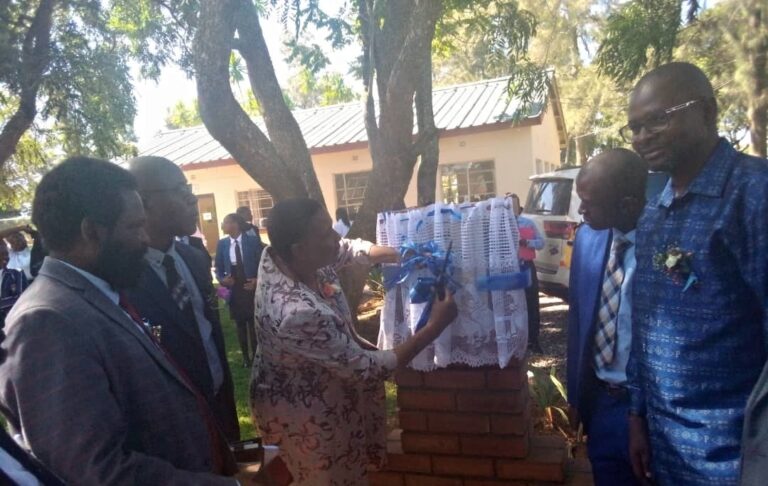
Speaking during a tour by Minister of State in the President’s office responsible for monitoring the implementation of government programme Joram Gumbo, the school heard Bernad Chauke said the school has a plethora of challenges which many would find difficult to believe in this era.
The only two blocks at the school are not fully functional, with the only one being used since 2020 and the second one will be open for use soon if funds permit for its completion.
“During rains, all our pupils will be crowded in the available class, a situation that is difficult for us to deliver lessons. During sunny days pupils are exposed to the harsh summer sun under trees since each class was allocated its tree to do lessons under,” said Chauke.
Chauke went on to say pupils at the school were far behind in terms of Information and Communication Technology (ICTs) since the school has no single computer or any source of electricity even if they are to have a computer anytime soon.
“Our pupils do not even know a computer; we don’t have any computer at the school let alone electricity. During lessons, we just show them pictures of computers and in some cases if one of the staff members has a tablet we will show them and that will be the closest thing to a computer they will know,” said Chauke.
Connectivity is another challenge, a development which has seen the school taking time to access communication from the district offices and other stakeholders.
He went on to say they have no security at the school as there is no fence or perimeter wall, a development which has seen both wild and domestic animals frequenting the school premises .
Chauke also said the area had no health facility with the nearest being Mwenezi District Hospital which is more than 100km away.
“There is no health facility near here so it’s difficult to deal with any health emergency at school and even the community around.
“There is no transport to connect us to the main road though the road is in good good shape. We appeal to authorities to avail even a single Zupco bus here so that we can link with other areas when we need services,” he said.
The school has no staffroom and for meetings teachers gather under a thatch shade, a place where they can also connect to the network.

FC Wangu Mazodze shines at Eastern Region D1 award ceremony

0

Courage Dutiro

Masvingo based Division 1 Eastern Region Soccer League (ERSL) newcomers FC Wangu Mazodze walked away with three gongs from the D1 ERSL 2022 award ceremony recently held at Golden Peacock Hotel in Mutare.
The team’s spokesperson Sukuoluhle Ndlovu said the awards are a clear indication that the team will finish on a high note come next season.
“We got three awards, this is a great milestone for the team as a whole. It was a great honour for Zhalala Zhululu. We are deeply honoured as our work was recognized by Zimbabwe Football Association ZIFA Eastern Region Soccer League.
“It is our first year playing professional football and three awards are an indication that next season we are going to finish on a high note,” she said.
The team won the most promising team of the season award.
In recognition of his excellence, efforts and achievements in ZIFA Eastern Region Soccer League, the club’s chairperson Dr. Richard Wangu Mazodze scooped the best Club chairperson of the season award,
Zhalala Zhululu player of the season Marvelous Jenjere was among the list of the most promising players of the 2021/ 2022 season award.
Among the list of the Soccer Stars and Most Promising Players in Eastern Region Soccer League Masvingo United FC had Captain Admire Banda whilst Chiredzi Stars provided Tafara Ginya and Renco Mine FC had Leon Ngwenya.
Green Fuel FC’s Lloyd ‘Samaita’ Mutasa took the coach of season award after finishing the season undefeated.