
Home Blog Page 5

Reformed Church in Zimbabwe mourns Rev Magadure

0

By Virginia Njovo

The Reformed Church in Zimbabwe (RCZ) is mourning the passing of Reverend Magadure Magadure, a devoted servant of God whose ministry was marked by humility, faith and dedication.

Rev Magadure, who was born on May 20, 1974, in the area under Chief Mugabe in Masvingo, died on February 3, 2026, at his rural home. He was 51.

Known for his deep commitment to the Church and the community, Rev Magadure devoted his life to serving as a Minister of the Word and Sacrament. He was also fondly remembered for his favourite hymn, “Kana vakundi vopinda kudenga, ndinoda kuva mumwe wavo kana vopinda,” reflecting his longing for eternal life in Christ.

Rev Magadure began serving the Church in its printing press department from 2010 to 2014. In 2015, he answered the call to ordained ministry and enrolled at Murray Theological College to pursue theological studies in preparation for the Ministry of the Word and Sacrament. He completed his training in 2018.

On December 2, 2018, he was ordained and began his ministerial journey at RCZ Chikwanda Congregation in Gutu. He faithfully served the congregation for six years before retiring on medical grounds on December 17, 2024.

Speaking at his burial on February 5, 2026, RCZ Moderator Rev Dr Ezekiel Baloyi described Rev Magadure as a true devotee of Christ whose legacy would endure.

“Rev Magadure’s ministry was marked by humility, dedication and faithfulness. His efforts will remain etched in the life of the Church and in the hearts of those he served. He was instrumental in the growth of the RCZ, and his legacy will continue to inspire generations,” said Rev Dr Baloyi.

Quoting Revelation 14:13 — “Blessed are the dead who die in the Lord from now on… Yes, says the Spirit, they will rest from their labour, for their deeds will follow them”, Rev Dr Baloyi said the Church was giving thanks for a life lived in faithful service.

“The Reformed Church in Zimbabwe has been robbed of a giant in the Ministry of the Word and Sacrament, but we commend his soul to the Lord,” he said.

Rev Magadure is survived by his wife, Svitsai, and their four children two boys and two girls.

Fishing trip ends in tragedy for Chiredzi man

0

By Ndinatsei Mavodza

MASVINGO – A routine fishing trip ended in tragedy for James Rushwaya (44) of Section 7 in Hippo Valley, Chiredzi, after he died in a suspected crocodile attack at Manhuwe river on February 4, 2026. 

Acting Masvingo Provincial Police Spokesperson Deputy Provincial Police Spokesperson, Assistant Inspector Masauso Patinyu confirmed the incident and said investigations are ongoing.

“We confirm the death of Rushwaya from Hippo Valley in Chiredzi who died after he had gone for a fishing trip at Manhuwe Village. His body was discovered with missing body parts. Investigations are still ongoing,” said Ass Insp Patinyu.

Assistant Inspector Patinyu urged members of the public to avoid fishing or working in crocodile-infested rivers, warning that such areas remain extremely dangerous.

“We urge all members of the public to avoid entering or fishing in crocodile-infested rivers and water bodies. These animals are dangerous, especially during the rainy season when water levels rise. Always be alert and keep a safe distance from riverbanks,” he said.

Circumstances are that  Rushwaya left his home on the day in question at around 9 AM intending to fish using casting nets.

Rushwaya returned home that day, prompting concern from his friends and family who began searching for him.

The search continued into the following day, February 5, but Rushwaya was still not found. 

On February 6, villagers teamed up and went to the river after suspecting that he may have been attacked by a crocodile.

During the search, villagers discovered Rushwaya’s clothes on the riverbank. 

About 200 metres from where the clothes were found, they spotted his body floating in the river and retrieved it.

Police attended the scene and observed that the body had missing body parts, including the right leg and private parts, which are consistent with injuries caused by a crocodile attack.

Rushwaya’s body was taken to Chiredzi Hospital Mortuary for post-mortem examination.

Crocodile attacks across the country tend to rise during the rainy season when higher water levels expand habitats and increase human activity on rivers and lakes, such as fishing and crossing waterways. 

Wildlife authorities have reported numerous human-crocodile conflict cases in recent seasons, with several fatalities and injuries recorded, particularly around water bodies where people and crocodiles share space.

Murray Theological College holds 101st licensing ceremony

0

By Virginia Njovo

Just months after celebrating its centenary, Murray Theological College of the Reformed Church in Zimbabwe marked another milestone with its 101st licensing ceremony, during which seven candidate ministers were officially licensed.

The ceremony which was held at Morgenster Congregation Church recently was attended by senior church leaders from across the country and beyond. Among those present were the Moderator, Rev Dr Ezekiel Baloyi, General Secretary Rev Lovemore Mashamba, Actuary Rev Charles Juro, and other members of the Synodical Executive.

The service was held under the theme ‘Called to Illuminate: Living as Salt and Light of the World,’ drawn from Matthew 5:13–16. Delivering the sermon, Rev S Kugedera urged the newly licensed ministers to remain faithful to Christ’s teachings as they begin their journey of service.

“As you embark on this new journey of leading God’s people, you are called to be the light. Lead with passion and humility, allowing the Holy Spirit to guide you as you live according to Christ’s word,” said Rev Kugedera.

College Principal Rev Dr Simbarashe Munamati, commended the candidates for their dedication and praised the institution’s commitment to holistic ministerial formation.

“Hard work, dedication, and the guidance of the Holy Spirit have brought them this far. As an institution, we have equipped them with knowledge, skills, and character to serve both God and humanity,” said Rev Dr Munamati.

Rev Dr Munamati said the college strives to foster spiritual growth, intellectual curiosity, and practical application.

“To our brothers, I say go forth with courage, conviction, and compassion. May your studies and experiences help you make a meaningful impact as messengers of love,” he said.

The church’s Moderator, Rev Dr Ezekiel Baloyi, reminded the newly licensed ministers that ministry is a sacred calling rooted in service rather than titles.

“A good minister is not known by position or title. It is a sacred calling to shepherd God’s people with faithfulness, humility, and courage,” said Rev Dr Baloyi.

He emphasized the importance of grounding ministry in both scripture and church order.

“The Bible must be in your right hand, for it is the living Word of God and the source of truth and spiritual nourishment. In your left hand must be the Book of Church Order, which will guide you in your service,” he said.

The newly licensed candidate ministers are Loveson Chiwara, Innocent Mawaya, Felix Mugwisi Tigere, Gerald Mupazi, Tafadzwa Ndaba, Shepard Nemarundwe, and Tsaurai Ruhode.

Berejena learner who shocked the nation after passing ‘A Levels’ at form 3 shares his story

0

By Tadiwa Shunje

MASVINGO — A Form Three learner from Berejena High School in Chivi has captured national attention after sitting for and passing A Level Arts examinations, an achievement rarely seen at his level. Lincoln Gopo earned 13 points in History, Economics, and Sociology, stunning educators and peers alike.

Gopo revealed that his motivation came from his role as a junior parliamentarian, where he frequently debates against A Level learners.

“I had to compete with senior students in debates, which pushed me to study harder and deepen my understanding of social and cultural issues. Learning about Zimbabwean history and culture strengthened my sense of patriotism and drew me toward Arts subjects,” said Gopo.

Despite his success at A Level, Lincoln is currently in Form Four, studying science subjects at O Level. He is sitting for 12 subjects and plans to increase them to 15, including Pure Mathematics, Statistics, and Additional Mathematics. His interest in science, he said, is inspired by historical figures such as Isaac Newton, whose work motivated him to understand how scientific knowledge was mastered in the past.

Gopo said balancing O Level and A Level studies was not easy but his determination and support from the teachers at his school as well as parents helped him triumph.

“While I was in Form Three, I had to learn O Level work while also preparing for A Level subjects. I used lunch breaks to consult senior students and follow their syllabus,” he explained, noting that the process demanded discipline, focus, and commitment.

Looking ahead, Lincoln aspires to study Constitutional Law at the University of Zimbabwe, while continuing with science subjects to broaden his academic scope. He credited his success to hard work, faith, and focus, urging fellow learners to ignore negative criticism. “People will always try to discourage you, but it is important to focus on your vision and work towards excellence,” he said.

Lincoln emphasized that he could not abandon his strength in Arts, public speaking, and debating, talents which he believes will help him reach his full potential.

Berejena High School offers both Arts and Science subjects at the secondary level and has a track record of producing learners who participate in academic, leadership, and debate programmes, including the Junior Parliament, which encourages civic engagement and academic excellence.

Masvingo Province commemorates World Wetlands Day in Bikita

0

By Virginia Njovo

Masvingo Province marked World Wetlands Day on February 6, 2026, at Nerumedzo Primary School in Bikita East Constituency, with communities urged to continue protecting wetlands through traditional knowledge systems.

Held under the theme “Wetlands and Traditional Knowledge,” the event coincided with the celebration of the Chinyamaparo Spring, a vital wetland resource that has been preserved for generations through cultural practices.

The Chinyamaparo Spring is one of the many wetlands whose protection is essential for the preservation and restoration of ecosystems, as well as for sustaining local livelihoods.

Speaking during the commemorations, Minister of State for Provincial Affairs and Devolution in Masvingo Province, represented by the Permanent Secretary, Dr Addmore Pazvakavambwa, applauded the Nerumedzo community for its continued commitment to protecting the spring.

“Today’s theme, Wetlands and Traditional Knowledge, is perfectly personified here. For centuries, the Nerumedzo community has protected this ecosystem using indigenous knowledge systems passed down by our ancestors, who understood that certain areas were sacred and had to be protected,” he said.

Dr Pazvakavambwa said the province was celebrating not only environmental conservation but also a cultural heritage that continues to safeguard natural resources.

“We are here to appreciate a miracle of nature, the Nerumedzo forest, famous across Zimbabwe not only for its beauty but also for its legendary harurwa (edible stinkbugs),” he said.

Environmental Management Agency (EMA) Provincial Manager, Milton Muusha, said Masvingo Province was currently protecting over 90 wetlands, with seven of Zimbabwe’s nationally recognised wetlands designated as being of international importance.

“The province is implementing 96 wetland protection projects in Gutu, Masvingo, Bikita and Zaka districts, all funded by the Government of Zimbabwe. Among these is the Driefontein Wetland, which is partly located in Gutu District,” said Muusha.

Muusha emphasised that traditional leadership and cultural values have played a critical role in wetlands conservation.

“Our discussions with local leadership here in Nerumedzo show that sacred cultural values have helped protect this wetland, proving that African heritage has always been the first line of defence for the environment,” he said.

Vengesai Village head, Maxwell Vengesai said ancestral rules and prohibitions have guided the community’s use of the spring for decades.

“We have been using water from this spring for generations by strictly following the rules we grew up knowing. This area is sacred, and there are many practices we must observe to ensure we do not lose this precious gift,” he said.

World Wetlands Day is commemorated annually on February 2, highlighting the importance of wetlands and the need for their sustainable management.

STREET SURVIVAL OR CHILD EXPLOITATION? EXAMINING THE REALITIESOF MOZAMBICAN BOYS WORKING IN HARARE’S INFORMAL ECONOMY

0

Across the busy streets of Harare, a troubling sight has become all too familiar. Young boys,
many of them hailing from Mozambique, can be seen weaving through traffic, clutching
small bundles of airtime cards, sweets, and cigarettes. Dressed in Econet-branded bibs, these
children have become a fixture in the city’s informal economy. Yet their determined faces
belie a much darker reality are these children simply trying to survive, or are they victims of
exploitation hidden in plain sight?
Upon cursory inspection, their endeavours might be misconstrued as manifestations of
entrepreneurial spirit or tenacity. These young boys, frequently distanced from the embrace of
familial bonds, endeavour to carve out a semblance of legitimate sustenance in a metropolis
that proffers scant avenues for those adrift. They vend airtime on behalf of Econet
intermediaries, accruing paltry commissions that scarcely suffice to procure their quotidian
sustenance. For numerous individuals, this represents the singular path to survival amid a
landscape where formal employment is a rarity and social security frameworks are tenuous at
best.
However, a meticulous scrutiny unveils a disquieting ethical and juridical conundrum.
Zimbabwe, akin to numerous nations, is governed by statutes that expressly forbid the
employment of minors and safeguard them from economic predation. Section 11 of the
Labour Act [Chapter 28:01] unequivocally stipulates that no employer shall engage a child or
young person in any occupation or endeavour that could imperil their health, safety, or moral
integrity. This edict is congruent with international accords, such as the International Labour
Organization (ILO) Convention No. 138 regarding the Minimum Age for Employment and
Convention No. 182 addressing the Most Heinous Forms of Child Labour. By such
benchmarks, the plight of these Mozambican youths engenders profound legal and ethical
quandaries.
The impetus for their exodus to Zimbabwe is ensconced in a labyrinthine amalgam of
humanitarian exigencies and economic malaise. A significant proportion of these children
emerge from regions in Mozambique ravaged by Cyclone Idai, which obliterated domiciles
and livelihoods in 2019. Others have fled the relentless turmoil in Cabo Delgado, where
violent upheaval has uprooted myriad families. Compounding this crisis are chronic
economic adversities that thrust families into destitution, compelling children to traverse
borders in pursuit of survival. The majority of these boys arrive in Zimbabwe bereft of
appropriate documentation, rendering them susceptible to exploitation and elusive to formal
safeguarding systems.
These children endure protracted hours of labour beneath oppressive conditions, perilously
exposed to the hazards of traffic, capricious meteorological extremes, and the incessant
exigency to fulfil sales quotas. Their earnings are scant, often merely sufficient to purchase
sustenance for a single day. Reports indicate that many reside in overcrowded and perilous
dwellings, stripped of access to adequate sanitation, healthcare, or educational opportunities.

This grim reality usurps their entitlement to a secure and nurturing childhood, egregiously
undermining their fundamental human rights and developmental prospects.
The role of Econet agents introduces an additional layer of complexity to this intricate issue.
While the corporation itself may not directly engage these minors, the intermediaries who
provision them with airtime derive profit from their labour. This circumstance invokes critical
inquiries regarding corporate accountability and the ethical scrutiny of commercial practices
within the informal sector. By wilfully averting their gaze from such arrangements,
corporations perpetuate a cycle of exploitation masquerading as opportunity.
Moreover, the predicament elucidates broader societal and policy deficiencies. The migration
of children from Mozambique to Zimbabwe epitomizes entrenched economic disparities and
the glaring absence of efficacious cross-border mechanisms for child protection. Both
sovereign entities bear a shared obligation to ensure that migrant children are not coerced into
exploitative labour due to the dual scourges of poverty and displacement, or the lack of
proper documentation.
To grapple with this conundrum necessitates a nuanced and variegated methodology. Law
enforcement entities must meticulously scrutinize and regulate the engagement of juvenile
vendors by mercantile agents. Social welfare institutions ought to discern and bolster these
youths through avenues of rehabilitation, enlightenment, and secure domiciles. Civil society
collectives can assume a pivotal role in advocacy and consciousness-raising, ensuring that the
populace perceives this predicament as an infringement upon child rights rather than a mere
economic enterprise.
In the end, the sight of youthful Mozambican boys vending airtime on the thoroughfares of
Harare ought not to be rendered as a banal norm. Their existence epitomizes a profound
systemic dereliction and economic desolation. While their fortitude is commendable, no child
should be compelled to barter safety, education, and dignity for mere survival. The
demarcation between survival and exploitation is perilously thin yet in this instance, it is a
boundary that society cannot afford to overlook.
Confronting this intricate dilemma will demand a concerted endeavour from a multitude of
stakeholders, encompassing governmental bodies, civil society entities, and the private sector.
Only through the recognition of the intrinsic dignity and rights of these children, alongside
the execution of holistic solutions that tackle the fundamental causes of their tribulations, can
we commence the metamorphosis of this disconcerting reality into one wherein all youth are
afforded the opportunity to flourish.
BY
Ngoni P Jemwa is a seasoned development practitioner with a deep understanding of
the complex challenges facing the globa South.
&
Aribino N. is a gender conscious writer and commentator whose work explores
intersections of identity, culture and social change.

Nyashanu High School posts 100% A level pass rate

0

By Karen Sibanda
Reformed Church in Zimbabwe run Nyashanu High School, located in Buhera District, has
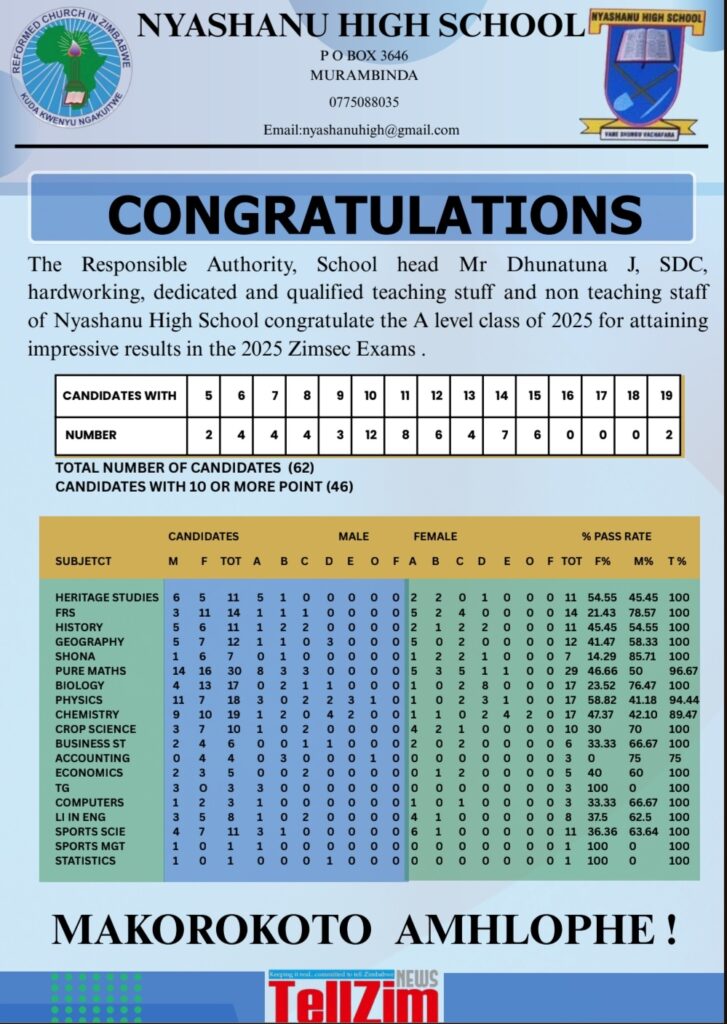
achieved a perfect 100 percent pass rate in the 2025 Advanced Level ZIMSEC Examinations.


According to the school’s statistics, the overall performance of learners was impressive. A total
of 62 learners sat for the examinations, with 46 candidates scoring 10 points and above. The
standout performances included two learners who attained 19 points and six who scored 15
points.
Further analysis shows seven learners recorded 14 points, four with 13 points, six with 12 points,
eight with 11 points, and twelve with 10 points.
The institution recorded a perfect 100 percent pass rate in most subjects. Specific subjects where
every candidate excelled include Heritage Studies, History, FRS, Geography, Shona, Biology,
Crop Science, Business Studies, Economics, Theatre General (TG), Computers, Literature in
English, Sports Science, Sports Management, and Statistics.
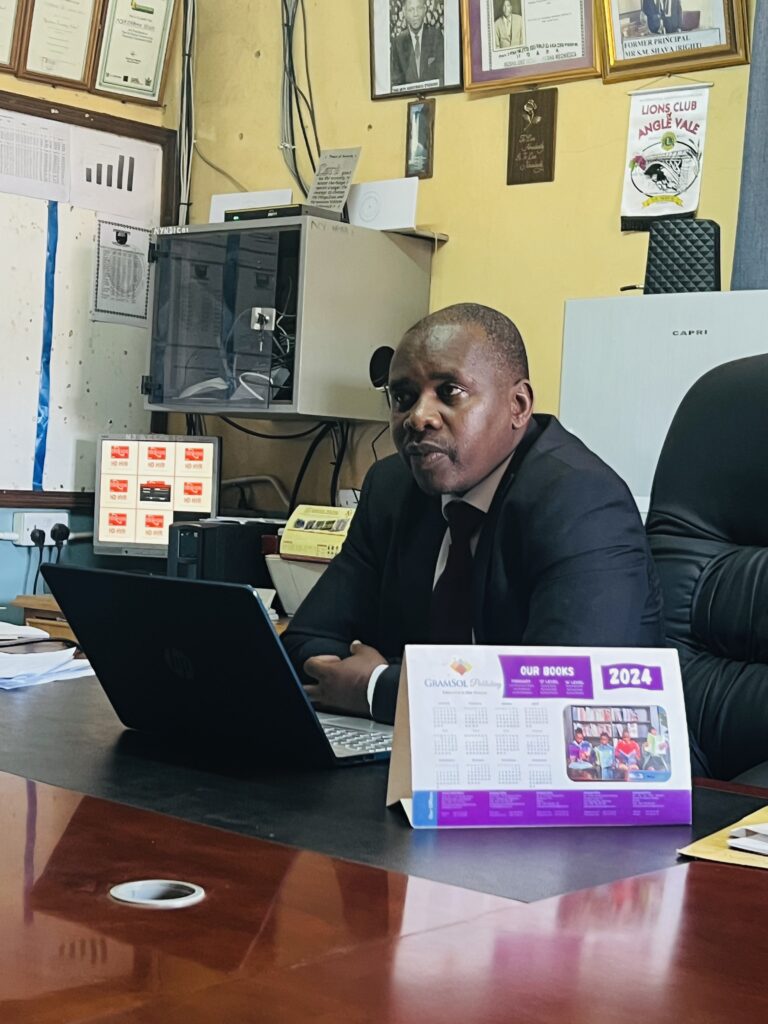
The School Head, Jackson Dunatuna, praised the dedicated teaching staff and the learners’
commitment.
“The students’ dedication and parental and guardian support is the reason why their hard work
paid well,” Mr. Dunatuna said.
Nyashanu High School is also famed for its agricultural prowess, which sustains its operations.
The school produces most of its own food and agricultural requirements, notably through
massive potato production, making it one of the few schools in the region to venture into such
large-scale farming.
The school’s location is also considered advantageous, situated away from negative urban
influences. This environment guarantees security and ensures learners have no access to

substances like drugs. The school boasts of having never recorded a single case of drug abuse,
fostering a safe and focused atmosphere conducive to academic excellence.

Ndarama High excels in Sciences, records 100% ‘A’ level pass rate

0

By Ndinatsei Mavodza

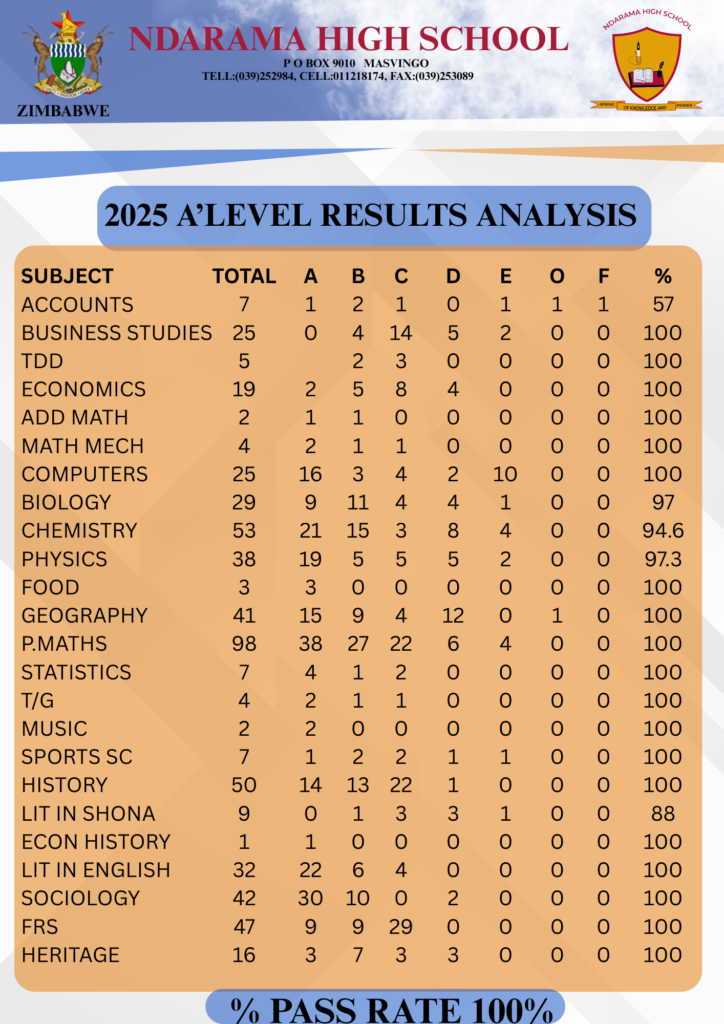
MASVINGO – Ndarama High School has achieved a 100percent overall pass rate in the November 2025 ZIMSEC Advanced Level examinations, with outstanding performances in the sciences reaffirming its position as one of Masvingo Province’s top day schools.

The perfect pass rate shows that all candidates who sat for the exams passed at least two subjects, with strong performances across the sciences, commercial and arts departments.

The government-run school offered a wide range of subjects including Statistics, Pure Mathematics, Computer Science, Music, Food Science, Sports Science, Heritage Studies and Textile Technology and Design, many of which achieved a 100% pass rate. 

The school head Oddy Matongo praised the dedication of both the leaners and their teachers saying they all worked hard to produce the remarkable results.

“The results are a results of combined efforts from the leaners and their teachers and I want to thank them all for raising our school flag higher,” said Matongo.

He went on to commend other stakeholders including parents whom he said were always supportive in the school development.

In the Sciences department, Pure Mathematics recorded the highest enrolment, with 98 candidates sitting for the subject and 38 scoring As, while Physics had a 97.3 pass rate. 

Chemistry, which had 53 candidates, recorded a 94.6% pass rate while Computer Science recorded 16 As out of 25 students, with a 100% pass rate.

The Arts department complemented the success in the science department as Sociology recorded 30 A grades from 42 candidates while Literature in English produced 22 As out of 32 candidates.

History had the highest enrolment in the Arts department, with 50 of the total candidates, all passing, and subjects such as Music and Heritage Studies also recorded a 100percent pass rate.

In the Commercials department, Business Studies and Economics recorded a 100% pass rate.

Despite the overall success, Accounts recorded the lowest pass rate at 57percent while Literature in Shona posted a pass rate of 88%. 

The results highlight Ndarama High’s continued commitment to academic excellence and its reputation as a leading school in Masvingo Province.

Gutu High shines with 98% ‘O’, ‘A’ Level results

0

By Beverly Bizeki

Reformed Church in Zimbabwe-run Gutu High School posted perfect pass rates in the November 2025 Zimbabwe School Examinations Council (ZIMSEC) examinations.

The school recorded a 98 percent pass rate at Advanced Level and 98.11 percent at Ordinary Level, underscoring its growing reputation for academic excellence.

At ‘A’ Level, 95 candidates sat for the examinations, with 93 learners passing two or more subjects. Of these, 12 candidates attained 15 points and above, while 61 learners scored 10 points and above.

The school also achieved 100 percent pass rates in several subjects, including Economics, Literature in Shona, History, Family and Religious Studies, Technical and Vocational subjects, Crop Science, Statistics, Computer Science, Sociology, Biology, Business Entrepreneurship, Communication Skills and Literature in English.

School head Mirirai Mutanda hailed the results as a product of discipline, commitment and teamwork.

“We are proud of our learners’ performance at both ‘O’ and ‘A’ Level. The results show that hard work and discipline truly pay off. We appreciate the unwavering support from the Responsible Authority, parents and staff, whose contribution has played a critical role in enabling our learners to excel,” said Mutanda.

At Ordinary Level, 159 learners sat for the examinations, with 156 candidates passing five or more subjects.

Of these, 37 learners scored five As and above, while 152 passed five subjects including English.

A total of 87 learners passed five subjects including English and Mathematics, while 88 candidates passed five subjects with Mathematics and Science.

Another 87 learners passed five subjects including English, Mathematics and Science.

The school also recorded 100 percent pass rates in several ‘O’ Level subjects, including Agriculture, Physical Education, Heritage Studies, Shona Language, Computer Science, Literature in English, Family and Religious Studies, Business and Enterprise Skills, and Textile Technology and Design.

Marriage celebration turns tragic as mother, toddler drown in Tugwi Mukosi dam

0

By Tadiwa Shunje

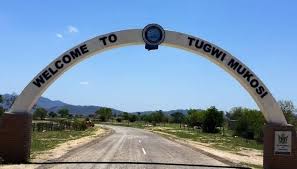
What began as a joyful marriage celebration ended in tragedy after a 26-year-old woman and her three-year-old child drowned in Tugwi-Mukosi Dam when a hired boat capsized during a leisure cruise in Chivi District on January 28, 2026.

Masvingo Deputy Provincial Police Spokesperson, Assistant Inspector Masauso Patinyu, confirmed the incident and said the victim, Liona Zendanyika (26) and her son Munyaradzi (3) both from Beitbridge were part of a wedding crew attending marooro (traditional wedding rites) at Dumbu Village, under Headman Gororo in Chivi District.

“I confirm the death of Zendanyika and Munyaradzi after the boat they had hired for a cruise struck a hard object in the water before it capsized in Tugwi Mukosi Dam,” said Ass Insp Patinyu. 

Ass Ins Patinyu urged members of the public to exercise extreme caution when engaging in recreational activities on water bodies, particularly during social gatherings.

“We advise to avoid overloading boats and to ensure that all safety measures are strictly observed, noting that Tugwi-Mukosi is a large and deep dam where negligence can easily turn fatal,” said Ass Insp Patinyu.

Circumstances are that on the fateful day, at around 1400 hours, members of the bridal squad decided to go for a boat cruise at Tugwi-Mukosi Dam, which is approximately one kilometre from the homestead where the wedding celebrations were taking place.

The hired boat was carrying nine adults and one child. About an hour into the cruise, at approximately 1630 hours, the boat reportedly hit a hard object, suspected to be a stone, causing it to crack and rapidly take in water.

Although the deceased were wearing life jackets, the boat quickly filled with water and capsized. The mother and her child became trapped and drowned at the scene.

Eight other passengers escaped and were rescued with the help of fellow revelers. The incident was later reported to the police.

Police attended the scene, and the bodies of the deceased were retrieved and taken to Chivi District Hospital mortuary for post-mortem examinations.