
Home Blog Page 555

Gono reaches out to Idai victims, schools

Beatific Gumbwanda
CHIREDZI – Successful indigenous sugarcane Rtd
Captain Faster Gono recently donated US$500 Cyclone Idai victims as well as desktop
computers worth US$800 to Chikomo and Bani Primary schools.
Gono gave the monetary
donation to Lands, Agriculture, Water and Rural Resettlement deputy minister
Peter Haritatos to help the cyclone victims in Chimanimani district.
He went on to donate the
computers to the two local primary schools to help motivate them as they
prepare to take part in the national quiz competitions next month.
The war veteran also parted
ways with RTGS$120 which he gave three pupils for winning the quiz competition
at provincial level.
“I deem it important to
come to the aid of our fellow citizens whose lives were disrupted by Cyclone Idai.
They need as much help as they can get from any one of us. Let’s also motivate
each other to support our primary schools so that we help them to do better.
Let’s support our children who are going to represent us at the national quiz
competition,” said Gono.
Bani Primary School head, Dr
Evangelist Svosvo said she was humbled by the support coming from well-wishers
and from Tongaat Hulett Zimbabwe, the responsible authority.
She said the school had also
got help from local companies to enable them to go on educational trips in Mutare,
Bulawayo, Harare, Masvingo and Gweru in preparation for the national
competitions.
“We are still appealing
to well-wishers to donate towards our national competition. We are going around
with three children namely Albert Mutunhu, Tadiwa Tivatye and Tanaka Machocho
on educational trips in preparation for our national competition,” said Dr
Svosve.
Those who need to assist
financially can use Bani Primary School EcoCash biller code 61953 or call Dr
Svosve on 0772631135

Rimbi Primary School gets help

Percy Muhoma

CHIPINGE – The Zimbabwe Cyclone Relief Go Fund Me recently
came to the aid of Rimbi Primary School by providing roofing and other
materials needed for repairs on a classroom block damaged by Cyclone Idai.
The
work was completed in 12 days at a cost of around $4000.
Speaking
to TellZim News, Rimbi Primary head, Tangirai Simango thanked the relief fund
for the assistance, saying the school could never have afforded to do the work
on its own.
“We
are thankful to those private citizens who mobilised funding and responded to
our cry for help. We had a whole block whose roof was blown away. The block has
now been restored to good condition.
“We
are still appealing for more donations because we have three houses for our
teachers and a hall where our ECD attend lessons which were destroyed by the
strong winds of the cyclone,” said Simango.
A
local resident, Anesu Mlambo said though the area did not record as much human
life losses as Chimanimani district, many schools, shops and clinics had been
affected, with villagers losing their crops.
“People’s
lives were spared but we are now poorer. Many public facilities were razed down
and we do not have food.
“Our
crops were destroyed by strong winds and we appeal for help as we no longer
have the means to fend for ourselves,” said Mlambo.
The
money was raised through an online aid mobilisation platform called GoFundMe.
USA-based
Zimbabwean citizen, Freeman Chari, a biomedical scientist and software engineer,
came up with the idea which ended up raising tens of thousands of dollars for
relief effort.
Work
is also being done at Ngangu Primary School in Chimanimani district.

Chiredzi youths fail army test

                                     File picture

Only 17 people made the
cut to join the Zimbabwe National Army (ZNA) last week at Chikombedzi, despite
the army relaxing its entry requirements for marginalised communities, an
official has said.
Chiredzi South MP, Rtd
Brig Gen Calisto Gwanetsa said only 17 people from Chiredzi qualified after
other pre-requisites such as physical fitness, aptitudes test and body mass
index-related to body and capability of being a soldier were waived.
Standard requirements
for the intake were five ‘O’ level subjects, but Chiredzi just like Binga,
Kezi, Maphisa, Mbire and other border areas, were exempted due to their
dispositions, with candidates having a minimum of two subjects allowed to
attest.
Other requirements were
that those from Chiredzi would be given preference and only those with national
registration numbers starting and ending with 14 were considered.
“The age limit was
between 18 and 22 and preferably those who sat for Ordinary Level exams between
2017 and 2018. Those with Advanced Levels were being considered for officer
cadets and artisan positions, but strictly on regional basis.
“Despite all the
exemptions, very few met those requirements. They tried by all means to favour
those from the rural areas of Chiredzi, but to no avail. They even went to the
extent of saying those from Chiredzi who sat for exams outside Chiredzi and in
particular in major urban centres were not considered, but that did not help
(either),” Gwanetsa said.
He said out of seven
wards in his constituency, only four have secondary educational qualifications
and most of the people do not have primary documents.
“We have been
harping on the same string about how people from Chiredzi are critically
neglected and marginalised, but to no avail. If we do not have people with two
Ordinary Level passes, do you then expect us to have teachers or nurses from
the area? I think it is important for us to continue encouraging our communities
to go to school.
“Remember my
constituency borders Mozambique and South Africa, so most children skip the
border after completing Grade Seven to look for employment (in neighbouring
countries),” Gwanetsa said.
Zim Sentinel

Chaos reigns at Una Una, nomadic Mutoda takes over

                                   Masvingo United chairperson Hubert Fidze

…Greenfuel part ways with Shariwa over poor results

Clayton
Shereni

Barely three weeks into the 2019 Eastern Region Division
One (D1) season, Masvingo United FC and Green Fuel FC have parted ways with
their coaches, as a dark cloud hangs above the two teams that continue to fire
blanks on the pitch.
Many questions about the two teams’ ability to deliver
Premier Soccer League (PSL) action to their respective communities remain
unanswered.
They have been struggling to pick up maximum points in
their last three encounters, spelling doom to their coaches.
Shadreck Mugurasave who was unveiled as Una Una’s head
coach a few weeks ago, recently resigned from his post after garnering two
points from three matches.
He reportedly succumbed to disagreements in the club and
the fact that he had no binding contract with the club.
A leaked WhatsApp chat also raised many internal issues
that could have weighed heavily on Mugurasave.
Masvingo United chairperson, Hubert Fidze said he was
still to get to the bottom of the matter as to why the coach had left.
“Yes he has left the club but I am still trying to
find out what really happened but there are a lot of issues. There is a lot at
stake and I am going to dig and get to the bottom of it all,” said Fidze.
Ezekiel Mutoda has taken over the reins at the
Mucheke-based side on interim basis as the club hunts for a permanent coach.
At Chisumbanje-based Green Fuel, former Shabanie Mine FC
technical director Taku Shariwa has put an end to his long-time working
relationship with the club.
Shariwa cited ‘differing ideologies’ as the main cause of
his departure after he helped the club to earn only one point on from three
matches. The club currently sits one place above bottom-placed Chiredzi FC.
“If you can’t solve a problem in a marriage then you
have to let go. There was no bad blood between me and my former paymasters. It
was a matter of different ideologies,” said Shariwa.
However the same fate seems to be spilling into the PSL
as Dynamos have dismissed their lanky coach Lloyd Chigowe for a dismal
performance at arguably the country’s most successful club.

Press Release: Peace initiative discusses nature of religion

The Era of Religion
Never Fades Away
Since the bombings of the World Trade Centre on September 11
close to two decades ago, the rise of extremism and the acts of violence in the
name of religion have grown rapidly across the world. Today, we see that there
have been a series of bombing and shootouts and places of worship are no longer
seen as sacred, but rather as targets. These events have brought concerns over
religion to the forefront and have inspired the international community to
create platforms for dialogue in search of the role religion can play in realizing
global peace and security.

A Platform for
Comparative Studies on Religious Scripture – World Alliance of Religions’ Peace
(WARP) Office
As a new attempt, a platform for religious leaders to
establish a network of peace with the aim of enhancing understanding of
religions through scriptures has been carried out in 220 locations from 130
countries. The “World Alliance of Religions’ Peace (WARP) Office”, is a platform
established in 2014 by an international NGO named Heavenly Culture, World
Peace, Restoration of Light (HWPL) which works to find the nature of religious
values for peacebuilding through scriptures. HWPL is registered under the UN
ECOSOC, it has its headquarters in Seoul, South Korea and seeks the role of
religion in conflict resolution and prevention through the network of global
religious leaders.
In the month of April, an international conference named The Role of Cultural Diplomacy in Approaching the Protracted
Conflicts” was held in Romania alongside HWPL. At the event, Chairman Lee of
HWPL shared that: “Through the WARP offices, religious leaders bring their
religious scriptures to examine trustworthy, physical evidence of religion.
These comparative studies have been put in place to ensure that there are no
more wars that will be triggered by religion.” The Chairman also added that the
culture of earth cannot disguise the one of heaven with a mans
yardstick of judgment and that religion is to learn the world of spirit and
teachings of God. “This is the heavenly culture that guides us to the world of
peace,” Chairman Lee shared.
The religious network of peace has been further developed to
appeal to the young generation and to build the confidence of religion through
communication and understanding. “Various religious teaching program for youth
such as religious youth peace camp gives lesson for participants to learn about
the general history of world religions, find the root cause of and plausible
resolutions to religious conflicts and disputes, examine the religious
community’s roles for peace, and experience cultural exchanges,” said Dr. Ahmed
Jasem Hmood Al-Maliky, Sheikh of Office of the Religious Reference Sheikh
Mohammad Al Yaqoobi in Iraq.

The archives of mankind: Language as a cultural tool

Elizabeth Duve Dziva
Gaston
Bachelard once said a special kind of beauty exists, which is born in language,
of language and for language. Language is one very essential aspect of culture
which needs to be jealously safeguarded.
It
is sad to note that present-day parents take pride in grooming a generation
which does not really know how to effectively communicate in their vernacular
languages. Whoever brought the idea that English speaking is the ultimate
measure of intelligence is neither wrong nor right but is mistaken.
Of
course, the essence of acquisition of a second language and in our case English
can never be disregarded for English is an official language in Zimbabwe which enables
us to communicate universally. All the same, the word second should not be
undermined. This explains that under normal circumstances, the very early stages
of a child’s socialisation should be done in the primary language be it Shona, Ndebele,
Tonga, Nambya, Venda, Shangani or any other of our various mother tongues.
It
is very unfortunate when a language is lost, for the death of a language marks
the death of the knowledge that goes with it. Language is the breath of God for
it distinguishes men from animals hence the need to be regarded with the weight
it carries.
With
language come wise sayings that are essential to humanity. These include
proverbs, idioms and expressions with lessons of things that we realistically
encounter every day. In fact, language expresses people’s thinking and even Biblically,
God created the world by word. Most of us, regret that our language and other
facets of our culture are being eroded but at the same time we do nothing to
preserve them.
We
live in an era of terrible self-denial and rejection and it is a pity that in
most cases, individuals subconsciously get into self-denial. Today, the
relationship between who someone is and how he expresses himself is worlds
apart. Talk of language use in dating and courtship. Back then, a young man’s
oratory ability in his own language would credit him the woman of his dreams.
In
Shona, demagogic orators would use rich, sweet talk like “svusvura ndadya,
mhodzi yechingwa, chigagairwa chemoyo wangu, vachirera nherera” and that
would move and melt a lady’s heart. But today try it and all young ladies in
the hood will take to their heels and point at you as a mad man or otherwise
your male counterparts will label you a disgrace, a backward and barbaric
individual (Bhambi). What a pity!
It
is time we march towards avoiding a situation whereby our various vernacular
languages fall into disuse. After all, we do not need to ask for anybody’s
permission to preserve our language, it is all upon us. Ridiculous as it may
sound, there shall come a time when we will pay millions of dollars to the very
few speakers left in order to resuscitate a once free of charge tool.
As
a matter of fact, the government should consider having one indigenous language
as a core subject at Ordinary level. Let us make it a priority to impart on our
children the ability to communicate in our mother tongue and the knowledge that
comes with it. It does not necessarily mean that we need to preserve word for
word but the general style and force of the language.
Elizabeth
Duve Dziva is an Archaeological and Cultural heritage practitioner, the views
in this article are solely those of the author in her private capacity and do
not represent the views of any organization email:duveelizabeth@gmaíl.com

‘Towns should modernise to attract business’

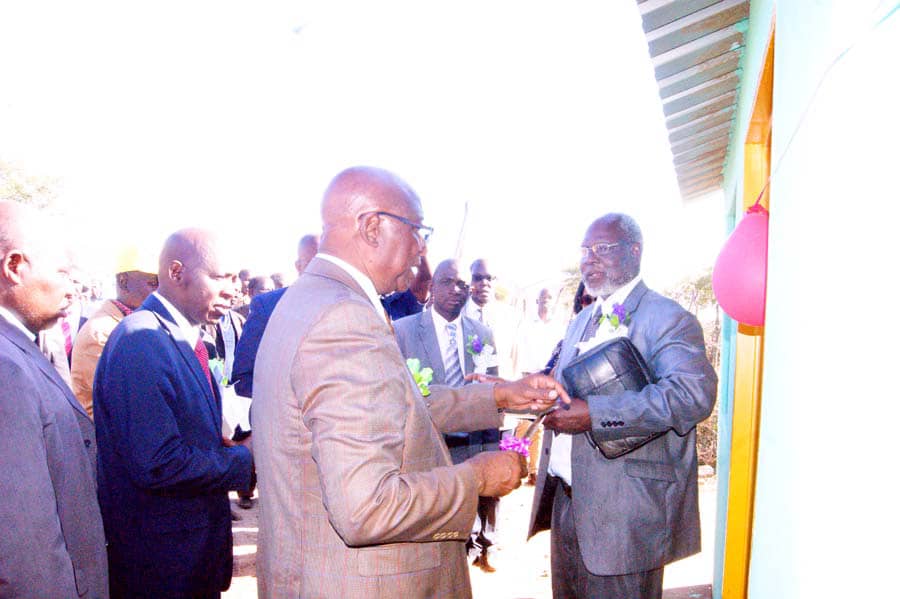
            Chadzamira commissions newly-surfaced West Road
CHIREDZI – The Minister of State
for Masvingo Provincial Affairs, Ezra Chadzamira recently commissioned Chiredzi
Town Council’s newly-surfaced 2.4km West Road and called for improved urban
areas to attract investment.
A total of $590 240.55 was
used to tar the road.
Chadzamira said construction
of road infrastructure should enable council to redesign its urban landscape
towards setting up a modern city.
“I urge Chiredzi Town
Council and all other local authorities to have a serious desire for the
creation of an enabling environment to allow businesses to grow. I urge you as
council to be competitive institutions in attracting investors by improving the
ease of doing business and by riding on the current legislative changes that
the 9th Parliament is putting in place,” said Chadzamira
“The commissioning of
this road, in my opinion, is symbolic of the potential that Chiredzi and indeed
Masvingo have in terms of becoming a transport and economic hub linking
Zimbabwe and the region to foreign markets. Let us think outside the box and
dream big as we envision the opportunities offered in this region.
He said the province had to
deliver its fair contribution towards the national goal of a middle income
economy by year 2030.
“We have a huge task to
deliver an $8 billion dollar provincial economy by 2030 in fulfillment of the
National Vision that Zimbabwe becomes a prosperous and upper middle income
economy,” he said.
Addressing the same gathering,
Chiredzi Town Council chairperson, Gibson Hwende said their aim was the
attainment of municipal status by 2023.
“Apart from the roads, council
is also doing water and sewer as well as solid waste management projects as
reported in our district and provincial plans. We are receiving Public Sector
Investment Programme funds every year that is helping us to undertake some of
these projects and wish to thank central government for that,” said Hwende.

Conflict over control of St Engenas Zivavose High

Brighton Chiseva

ZAKA – The Chikato and Mawewe
families are at each other’s throats over custodianship of Zivavose High,
creating serious fissures that are having serious implications on cohesive
administration of the school.
Parents
have begun to complain that the school was no longer serving the interests of
pupils and parents due to endless squabbles.
The
family members are divided as to who should be recognised as the responsible
authority and they accuse each other extorting the 10 percent of the school
proceeds which the responsible authority must get.
One
of the groups, led by Alletah Chikato, claims that Phanuel Fana Chikato, who is
the Archbishop of a breakaway church called St Engnas ZCC Rugare, is side-lining
other family members.
Alletah,
who took over from Maxwell Mawewe as education secretary, and her group is
alleged to have tried to close down the school a few weeks ago in a bid to
force the head to recognise them as the responsible authority and Chikato as
the education secretary.
Zaka
District Schools Inspector (DSI) Samson Chidzurira confirmed the troubles at
the school but was quick to say they had no power to interfere.
Provincial
Education Director (PED) Zadius Chitiga said the families should come together
and resolve their differences then appoint an inclusive responsible authority
board which they will present to the ministry.
“The families are disturbing the smooth running of the school. They should sit down
and unite, form the responsible authority board which will then be presented to
the ministry and we will work with that,” said Chitiga.
Other
disgruntled family members accused Phanuel of fraudulently annexing the school
using an illegitimate responsible authority board formed a few years ago under
his church which was formed as recently as 2014.
“Initially
the school was not under the ZCC. It was only named under ZCC for smooth registration
as the then colonial government did not approve blacks to own schools. However,
Fana formed and registered his school under the new name in 2014 after the
death of his father and forged documents and claimed that the school is under
his church,” one family member said
She
said building of the school began in the 1970s but it opened in 1982, adding
that the church and the school were two different entities.
“Fana
is forcing himself onto the school under the guise of the church thereby
depriving the rest of the family board members their inheritance rights of
ownership,” she said.
When
contacted for comment Phanuel dismissed all allegations against him, saying he
was not getting any financial benefit from his role.
“It’s
all lies. I am not getting any money from the school though it belongs to my
church. My father was the responsible authority before he died and now that I am
in charge of the church meaning the church I lead is the responsible authority.
The matter is before the courts and I will wait for the outcome,” he said.

‘Zim elections dividing people’

                                            Thomas Mbetu
Anymore Magawa

Masvingo
United Residents and Ratepayers Association (MURRA) board chairperson Thomas
Mbetu has said the country’s winner-takes-all electoral system was
retrogressive, calling for a new system that accommodates election losers.
Speaking
during an inter-generational dialogue meeting organised by Youth Forum and TellZim
News at Charles Austin Theatre recently, Mbetu said the current system was
serving no purpose except dividing people and stunting development.
“We
should change the electoral system because it is dividing people. The
winner-takes-all-system means that the winner will have control over everything
and will ignore those who lost regardless of their numbers.
“This
creates polarisation as the losers will resort to opposing for the sake of it due
to the feeling of alienation. This means the people will remain divided and
bitterly opposed,” said Mbetu.
He
said it was critical that those who lose elections are not shunted out of the
system as they might have something positive to contribute.
Zanu
PF Ward 10 councillor, Sengerai Manyanga claimed his party valued political
dialogue, saying President Emmerson Mnangagwa had acknowledged that by creating
a platform of engagement with those who lost the 2018 presidential poll.
“We
should have dialogue all the time despite our political differences. This is
the reason why President Emmerson Mnangagwa called for dialogue with losing
presidential candidates,” said Manyanga.
He
praised the dialogue meeting for creating a chance for people to interface,
saying as a councillor, he was eager to take advantage of such arrangements to
report back to the people.
“As
long as I am in council, I will fight hard to expose corruption. We recently
exposed another corruption scandal and I want to thank TellZim News for the
work they are doing in exposing corruption,” said Manyanga
He
was referring to recent news stories on how council management failed to
surface a short strip of road despite having received over US$40 000 payment
for the road from Nyaradzo Funeral Services company over three years ago.

Pregnant women fetching own water at Chingwizi Clinic

0

Cephas Shava

MWENEZI – Chingwizi
Clinic, the only health facility for thousands of people displaced by the
flooded Tugwi – Mukosi Dam back in 2014, is struggling to give quality health
services as it does not have running water.
Located
in Ward 13 Mwenezi East under Chief Chitanga, the facility was built by the
army after years of struggle.
The
clinic also serves many expectant mothers, making the water shortages all the
more serious a problem.
The
clinic currently depends on water supply from a borehole which is outside the
facility’s fence. The borehole produces salty water and is too heavy to operate
for pregnant women.
Ward
councillor Takura Mudavose said he had raised the issue with the Minister of
State for Masvingo Provincial Affairs, Ezra Chadzamira.
“The
absence of water there is a worrying problem given the number of people who
rely on that clinic. The borehole that is closest by is not efficient; it is too
heavy and it doesn’t produce good water. You can imagine the trouble,” said
Mudavose.
He
said he hoped plans by the National Aids Council (Nac) to pump water from
elsewhere directly to the clinic will materialise.
TellZim
News recently visited the remote area and spoke to many expectant mothers who
had bad stories to tell.
“You
have to go to the borehole with a container and fetch your own water for use.
The water is not good and you can hardly drink it. There is often not enough
water to wash your hands after visiting the toilet,” said one pregnant woman.
Since
their relocation to the area after the floods of February 2014, people in
Chingwizi have remained largely without access to basic necessities of life
despite endless promises by politicians.
Many
primary school children learn under deplorable pole and grass makeshift
shelters that make them vulnerable to the slightest changes in weather.