Home Blog Page 556

Corruption-ridden Zinara accused of disrespecting parliament

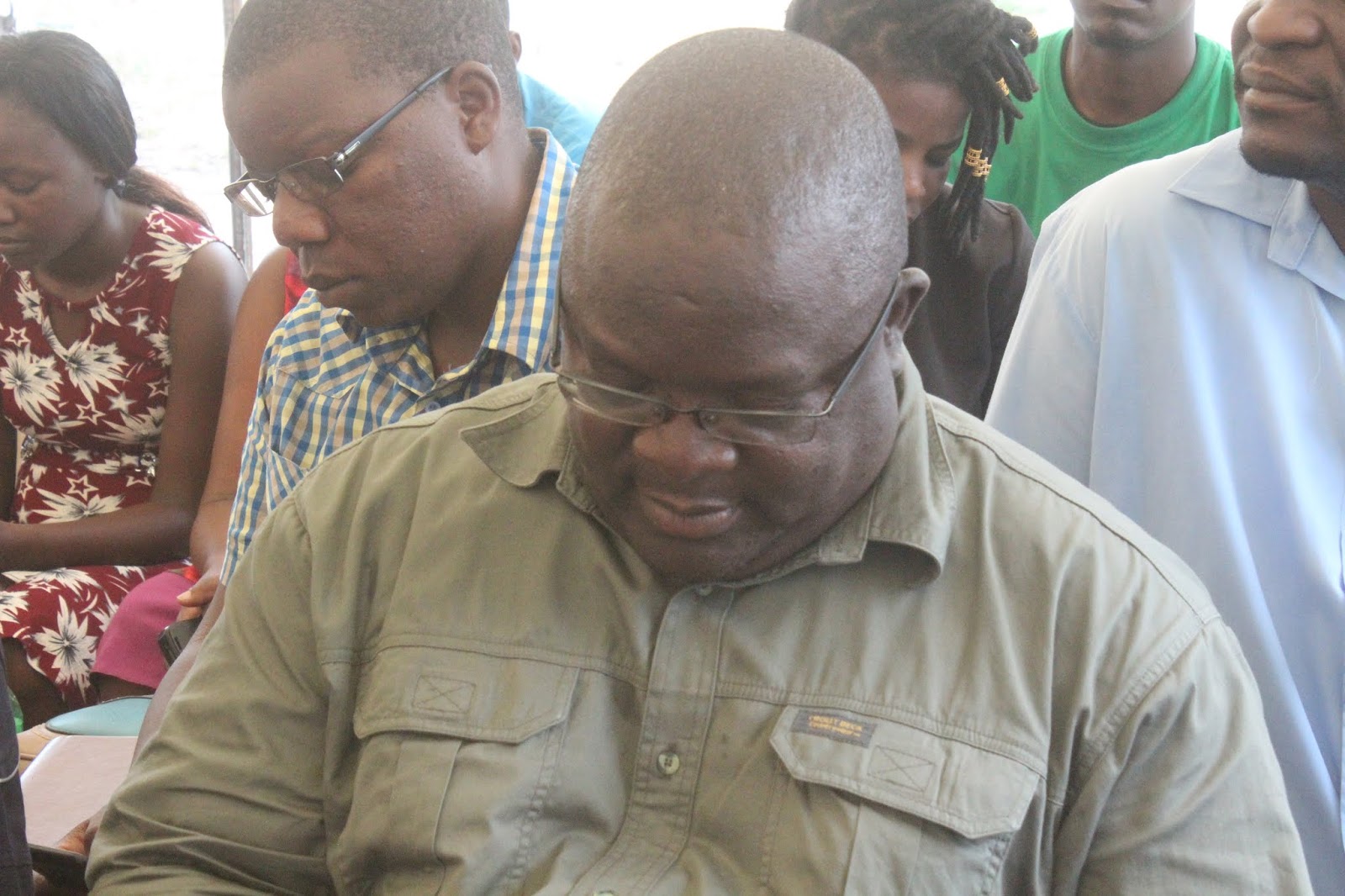
                  Raidza (centre) and his committee colleagues during proceedings


Shingirai Vambe

HARARE – Zimbabwe National Road Administration (Zinara) board
members led by Michael Madanha on Monday came to parliament unprepared to
answer questions from the Parliamentary Portfolio Committee on Public Accounts.
The board members were expected
to give oral evidence to the committee on the 2016-2017 adverse report by the Auditor
General. They, however, angered parliamentarians by failing to answer questions
from the committee.
Initially, the board members must
have presented itself before parliament on Monday, May 06, but they did not go
due to other reasons.
With MDC Harare East MP Tendai
Biti being absent, the committee was chaired by Zanu PF Mberengwa East MP Marko
Raidza who then asked the team to return on May 20 after they failed to respond
to issues raised.
This angered many other MPs who
felt that parliament was being taken for granted.
“They should go back and read the
report then present the case before this parliament,” said MDC Harare North MP
Rusty Markham.
Madanha, who is a Zanu PF member
and former Transport deputy minister, became Zinara board chairperson in
January after the dissolution of the previous board in October 2018.
Responding to other questions
that were raised during the abortive session, Madanha said the board was only
three months old and had not had ample time to study the AG’s report.
MPs, however, accused the board
of disrespecting parliament’s business and wasting taxpayers’ resources by
trivializing the house which uses public resources to organise a session.
Zinara is currently embroiled in
corruption scandals, with executives accused of milking the State-owned company
of millions of dollars for personal use.

Govt releases 5.9 Million for Chingwizi people

Brighton
Chiseva
Government says it has released $5 906 400
million to compensate the Chingwizi people who were displaced by the floods in
in the Tugwi-Mukosi basin back in February 2014.
Masvingo Provincial Administrator (PA)
Fungai Mbetsa confirmed the development and said the money was already in the
appropriate account.
He said after the verification process, the
beneficiaries will start to receive their money.
“We received the balance which will cover
the remaining 80 percent owed to the flood victims who have been settled in
Chingwizi and we will start doing transfers soon.
On Monday, we will visit Chingwizi to do a
verification process especially on banking details if they are still the same and
making sure that the beneficiaries are still the same,” said Mbetsa
Mbetsa said about 2 000 beneficiaries who
benefited from the initial 20 percent pay-out in 2017-18 were the ones who were
going to benefit from the latest allocation.
On those who died, Mbetsa said the heir or
the estate executor will come forward and get the money on behalf of the
family.
The amount each person will receive will be
determined by the number of property lost when they were moved mainly from
Chivi district to Chingwizi.
Mbetsa said the money was meant to help
victims built their homes while the government finds them more land for
agriculture.
He said the province’s priority was to make
sure that the Chingwizi people get irrigable land because the area they were relocated
to is small and dry therefore not practise farming.
“One of the province’s priorities now is to
make sure that Chingwizi people do not remain social welfare cases where they
rely on food hand-outs. We are looking for land where they can do irrigation
and benefit from the water that displaced them.
We understand that the one hectare they
were allocated to is not enough for them since their families are growing and
also that the land is dry,” said Mbetsa

Zivhu buys fishing boats for Chivi South youths

Moses Ziyambi
Chivi South Member of Parliament
(MP) Killer Zivhu has bought dozens of fishing boats to enable young people in
his constituency to do commercial fishing in Tugwi Mukosi Dam, TellZim News has
learnt.
Over 20 of the targeted 50 boats
have already been purchased and will be distributed to youth in the
constituency upon completion of a course on how to drive them.
“Twenty of the boats will be
engine-powered so we will take some of the beneficiaries to Kariba for a driving
course which will enable them to safely operate the boats. The whole project
will benefit over 50 youths from Chivi South. As their MP, I want them to have
a chance to change their lives for the better rather than simply cross the
border to South Africa as many of them are doing,” said Zivhu.
He said he expected the project
to contribute to the economy of the area, with more parents being able to send
their children to school.
“There is a ready market for fish
in surrounding areas so there won’t really be a problem in marketing them. The
project will also supply fish to prisons in Chivi, Mwenezi, Chiredzi and
Masvingo districts so that inmates there can enjoy an improved diet.
“We have already applied for
fishing rights from Zimparks and the beneficiaries are expected to hit the
ground running this coming August. They could start even now, but the boat
drivers have to undergo training first. Zimparks also have regulations that
discourage fishing in winter because that’s the time when the fish should be
left to breed,” said Zivhu.
He said he hoped the programme
will expand to more people of the constituency if resources become available to
buy more equipment.
“People voted for me and I should
therefore live up to their expectations or at least be seen to be working for
community development. This is my small contribution towards President
Mnangagwa’s Vision 2030,” said Zivhu.

MSU offers Sign Language courses to civil servants

    MSU Vice Chancellor, Prof Muzvidziwa and MSULI director, Prof Magwa and others tour the              building where the institute is housed at MSU main campus in Senga, Gweru.
Tinaani Nyabereka.

GWERU
The Midlands State University (MSU) is set to offer Sign Language courses to
civil servants as a means to help
promote the language’s use and accommodating people with disabilities in public
spaces.
Speaking
at the commissioning of the Midlands State University Language Institute (MSULI)
on Monday, May 06, Professor Wiseman Magwa, who is director of the institute, said he
was optimistic about the future.
He said he was pleased with their work record which includes effectively coordinating the
translation of the national constitution into 15 official languages.
“The
language institute is here and is now a reality. We want it to grow to become a
centre of excellence in language research and consultancy services in the region.
Short courses on offer include teaching of marginalised languages, thesis and
dissertation language editing, Braille and transcription services, document
proof-reading and editing, research in indigenous languages and culture among
other services.  
“The
institute has already made an impact by successfully coordinating the
translation of the National constitution into all our 15 languages including
Sign Language. We are the first country to achieve this initiative internationally.
“We
have partnered the Ministry of Justice, Legal and Parliamentary Affairs,
Parliament of Zimbabwe, the Zimbabwe Catholic Bishops Conference, Ministry of
Health and the Zimbabwe Gender Commission and have been tasked to offer Sign
Language to all nurses, doctors and police officers to improve their areas of
operations in delivering services. We are not limited to them only but also
extending these courses to everyone who want to undergo the courses on offer,”
said Magwa.
MSU
Vice Chancellor Professor, Victor Muzvidziwa said the Institute was going to
help stir national growth and development agenda in all aspects.
“Language
is not an important vehicle only but a crucial cog in realising true national
development. So the commissioning of this centre today will drive the national
agenda of growth and development.
“The
recognition of our national languages should be seen as the core component of
establishing a national consensus that will lead to unity, peace and
development,” said Muzvidziwa.
. 

Gwenhoro Dam fast running out of water

.…‘only
five months supplies remain’
Tinaani Nyabereka
City
of Gweru has rung alarm bells over its precarious water supply situation
following revelations that its main supply dam, Gwenhoro, will run dry within
the next five months.
Addressing
residents at the commissioning of two refuse compactors at council offices
earlier this week, Mayor Josiah Makombe revealed that the dam was only 26
percent full.
He
said the city needed urgent financial support to transfer pumping equipment
from Gwenhoro to Amaphongokwe Dam.
“Let
me advise you that Gwenhoro Dam is now at 26 percent which translates to only
five months’ water supply considering the consumption patterns. Amaphongokwe is
at 75 percent which is enough to take us an additional 12 months but our
pumping facilities there are broken down and we cannot utilise the resource.
“We
need  rehabilitation works at our
treatment plant and raw pump stations (Gwenhoro and Amaphongokwe) which need replacement
of obsolete pumping equipment and the repair of mainlines and major fittings at
a cost of US$10 million.
“The
city’s population of around 200 000 requires 60 million litres of water per day
plus industry demands 20 million litres which all adds up to 80 million litres.
Currently, we have an output of 40 – 43 million litres per day from Gwenhoro
and 1.5 million from White Waters Dam, giving us a total output of 43 – 44
million litres which is not enough for the city.
“So
with the deficit of 15 million litres per day, we cannot fill our reservoirs
and such high-lying areas as Haben Park, Mkoba Village and Ridgemont being the
most affected areas,” said Makombe.
The
Minister of State for Midlands Provincial Affairs, Larry Mavhima commended
Gweru City Council for acquiring the refuse trucks which he said will greatly
help to improve service delivery.
“I
call upon council to ensure the collection of refuse timeously and make sure the
heaping of litter in locations becomes a thing of the past. We don’t want to
suffer from such diseases as cholera again,” said Mavhima.

No congress re-run, declares Gumbi

Upenyu Chaota

MASVINGO – Disgruntled
MDC members who were left seething with anger after chaotic districts and
provincial congresses in Masvingo will have to live to fight another day after
provincial chairperson James Gumbi has dismissed rumors that there will be a
re-run for 20 districts on Saturday (May 11, 2019).
The
Masvingo provincial congress gave MDC leader Nelson Chamisa a torrid time after
it emerged that the provincial executive led by Gumbi had manipulated the
processes to their favor.
Members
of the Tongai Matutu-led team refused to accept the Gumbi executive and are
believed to be the ones behind the peddling of information calling for congress
re-run in 20 districts in the province.
The
Matutu team is at war with the Gumbi executive whom they say is illegitimate
and have vowed to organise parallel party programmes.
In
a statement, Gumbi said he was aware of some mischievous party members who are
sending falsehoods saying there will be congress re-run in 20 districts in the
province. 
“I
have noted with grave concern that there are some mischievous elements amongst
ourselves who are posting and spreading falsehoods on social media that there
are District Congresses to be re- done on May 11, 2019 in respect of 20
districts.
“I
wish to put the record straight that as the duly elected chairman of the province,
such utterances are not only unfounded but also falsehoods and wishful thinking
bend on misleading our esteemed members.
“Please
note that there cannot be a congress after congress,” said Gumbi.
Gumbi
warned that those found wanting will face disciplinary action.
Meanwhile,
Chamisa has put in place an appeals committee which will look into all cases of
disgruntled provinces after there was an outcry in Bulawayo.
There
has been no formal challenge from Masvingo.

Two Lundi High pupils drown in Runde

                                          The late Prism Mvere
Cephas Shava

MWENEZI – Two
pupils who were doing form six at Lundi Christian High School drowned in Runde
River on Saturday, May 05, in what some suspect to be a mermaid attack.
They
had gone to the river to do laundry and their lifeless bodies were retrieved
the following day.
Police
at Masvingo provincial headquarters confirmed the matter saying they had
received a report to that effect.
The
sciences pupils were identified as Prism Mvere and Douglas Maramba from Rutenga
and Chikombedzi respectively.
They
were day scholars lodging at the mission’s premises to attend holiday lessons.
Mwenezi
District Schools Inspector (DSI) Luckson Zanamwe confirmed the tragedy.
“The
two boys who were doing form six at Lundi High School drowned along Runde River
on Saturday and their lifeless bodies were later recovered the following day,”
said Zanamwe.
Reliable
sources at the school said pupils went to the river reportedly to wash their
blankets and clothes.
“They
left their place saying they wanted to do some laundry but they did not return.
When authorities were alerted, they searched for them at the river but they found
only their scattered laundry and a bucket close to a pool in the river,” said a
source.
A
concerted search by various authorities yielded nothing the whole of Saturday
only for the lifeless bodies to resurface the following day without any sign
the two could have been attacked by a crocodile attack.
Many
people who are familiar with the area now suspect that the two were seized into
the water by a mermaid.
“One
body emerged first but the other did not immediately appear until some rites
were performed. After the procedure, the remaining body emerged but with some
blood stains on the nose.
“They
are clearly victims of a mermaid attack. They are not the first people to fall
victim of such an attack at that place,” said a resident of Lundi business
centre.

Local artist gets international with jaundice film project

Courage Dutiro

A
Masvingo-based artistic director is helping to market the province through the
production of an educational short film that fights social stigma against
people suffering from jaundice and cerebral palsy.
Unworthy?,
which is being produced by Kudakwashe Zoromera, is expected to be released at
the end of this winter season.
Jaundice
is a yellow colouring of the skin which happens when a chemical called bilirubin
builds up in the blood. When too much bilirubin builds up in the body, the skin
and whites of the eyes look yellow.
Cerebral palsy is a group of permanent movement
disorders that appear in early childhood with symptom differing among sufferers
but including poor body coordination, stiff muscles, weak muscles and tremors.
Zoromera,
who wrote and is directing the film, said the project was an attempt to tackle
head on all the society’s negative attitudes towards people with rare physical
and medical challenges.
“Unworthy?
brings out some vital knowledge of medical conditions as a way of fighting stigmatisation
and encouraging greater understanding.
“Society
often views people living with such conditions as outcasts yet these people are
just like any other individuals alive; with feelings, will-power and often
hearts of gold. The point is that people with such conditions deserve to be
treated like any other human being,” said Zoromera.
The
33-year-old artist revealed that the film stars Johnson Tevera, a boy with such
conditions, who undergoes painful biases in an ignorant and tolerant community.
Zoromera
said the project, which has a multi-racial cast, was now at pre-production
stage with the shooting stage expected to begin this week at places that are
beautiful and of cultural importance.
He
expressed optimism on the potential of film in the country, saying his own work
will also be aimed at convincing tourist to visit local attractions.

What goes around comes around: Grace Mugabe’s political journey 2014 – 2017

Tatenda Murenjekwa
The
writer wishes to highlight Grace Mugabe’s political journey and her use of the
G40 cabal in dismantling the Zimbabwe African National Union for Patriotic
Front (Zanu PF). Apart from reflecting Grace Mugabe’s shortfalls, this series shows
the transition of power caused partly by Grace’s unwise public utterances.
Events that coerced Mugabe to resign such as the Solidarity march, military
intervention and the impeachment are also revisited.
The first lady that
never was
The
political journey that Grace Mugabe and the G40 cabal anticipated remained
elusive due to the military intervention to restore order in Zanu PF. The first
lady was presumably among the corrupt individuals who surrounded Robert Mugabe.
In her endeavour to be the Vice President of Zimbabwe, Grace Mugabe used
unorthodox means that amalgamated to the expulsion of Joice Mujuru and later
Emerson Mnangagwa.
Grace
Mugabe’s political profile had soared in the past few years as the 52-year-old
had positioned herself as her husband’s successor. While married to an air
force pilot, Grace met the much older president years ago when she served as a
secretary in his office. The couple have a 41-year age gap and Robert Mugabe
was still married to his first wife Sally when he met Grace. Sally, who was
suffering from a terminal illness, died in 1992.
Four
years later, Mugabe and Grace married in an extravagant ceremony attended by 40
000 people including former South African leader Nelson Mandela. Grace Mugabe
seemed to struggle to emerge from the shadow left by the president’s first
wife. She was later nicknamed Gucci Grace due to her extravagant spending and
twice use of diplomatic immunity as a shield from accusations of assaulting a
British photographer in Hong Kong and whipping a South African model with an
electric cord. An attempt to set up a dynastic succession prompted the
Zimbabwe’s military to finally step in.
Grace
was accused of being determined to succeed her husband and in the end proved
her husband’s downfall. The old adage that ‘a week is a long time in politics’
rang true for Robert Mugabe and his over-ambitious wife as the crowds gathered
at the Zimbabwe Grounds and at Freedom Square in the capital calling for
Mugabe’s exit. The tables have been turned and all of a sudden Zimbabwe has
experienced what others call a historic transition. In October 2017 Sakubva Stadium
in Mutare, Grace said she was not afraid of being shot by the army and this
infuriated the commanders. Mugabe survived that long because he had the backing
of the military even at the time when he lost an election in 2008 against
Morgan Tsvangirai. The army only intervened this time around because he was now
persecuting his war-time allies and threatening their interests. The general’s
positions were on the brink.
Grace
Mugabe used other politicians to further her political ambitions known as the
G40. This group included Walter Muzembi, Letina Undenge, Kudzanai Chipanga,
Chimedza Saviour Kasukuwere, and Patrick Zhuwao among others. Kudzai Chipanga
will certainly be a good example to the young people of Zimbabwe of how they
should not be used by politicians. While he had been making annoying statements
on behalf of certain senior officials, it was him who appeared on TV with a
bloodied and swollen mouth-not the senior politicians.
…To
be continued
The writer is a holder
of an Honours degree in History and is a product of Great Zimbabwe University
(GZU). He writes articles for educational purposes.

Venerated emblems: Totems as biological, historical and cultural icons


Elizabeth Duve Dziva
The subject of
totemism is very wide, complex and normally results in more questions than
answers. The topic still remains necessary and worthy of an exploration so as
to have a clearer understanding of how we have been ignorant or rather
reluctant to preserve and conserve this very essential part of us.
From a general
perspective, a totem (mutupo/isibongo) is a natural object, animal, plant or
bird assumed as the emblem of a person, clan, family or group and gives a sense
of identity.
Connotatively,
totems are the symbolic significance of a being, an icon that we can turn to
for various essential reminders. Among the various legends accounting for the
origins of totemism, one has it that upon realising that they were multiplying
at an alarming rate, our Bantu forefathers chose emblems which even after
migration and expansion would help them identify their kinsmen. The choice of a
totem was guided by a survival instinct or otherwise the chosen creature would
be of some importance to their survival in the clan.
Totems are of
religious, historical and biological importance to individuals. Back then, so
strong were the beliefs in totemism unlike today when people of the same totem
marry, the deeper meaning of (kudya mutupo). In our culture that is considered
as incestuous since people of the same totem are of the same bloodline.
Punishments for such an acts ranged from paying a plain white cow called
chekaukama to cutting a finger or in acute situations, death. Not only is
marrying a person of the same totem a cultural abomination but also biologically
disapproved since there will not be genetic variation with consequences that
can be best explained by biologists. Hence, it is very important for
individuals before dating or engaging into serious courtship to know their
partners’ totems.
Today, very few
individuals can recite their praise poems yet they are not aware that totems do
not only carry a deep religious meaning but often carry important historical
information about a certain clan. Thus, totems are very essential sources of
history. Culture, history, identity and personality are intertwined. We should
always bear in mind that this world and everything about it does not belong to
us but to the generations ahead of us, hence there is no need to shy away from
such aspects of culture like totems. We must not deprive our successors of an
important aspect of identity by bringing to extinction something that we, as
the present generation, never invented. Let us avoid carrying the never-ending
blame of destroying such practices like totemism for they give one spiritual,
emotional and intellectual distinction.
Though it varies
according to individual beliefs, totems are of religious significance, it works
for others for it all comes back to what one thinks and believes.
Traditionally, it has always been believed that an individual carries the
traits of his or her totem, most applicable to animal totems.
Coster Manyowa
points that even Jesus Christ had a totem (Lion of Judah). Our Zimbabwe is a
multi-tribal country but it is very essential to note that those are just
dialects but we are one, with the same totems expressed in different languages
since we are of the Bantu origin. Some of the totems include the Lion (Shumba/Sibanda)
which has various classifications like Jichidza, Shumba Garwe, Shumba Murambwi,
Shumba Mhazi, Shumba Tembo. There is also the heart (Moyo) classified into
Chirandu and Zuruvi, the elephant (Zhou), the zebra (Dhuve/Dube), the pool
(Dziva), fish eagle (Hungwe), the pig or wild boar (Humba), cattle leg (Gumbo),
the eland (Mhofu) the buffalo (Nyathi), the monkey (Shoko), the porcupine (Ngara),
Impala (Mhara), the Sheep (Gwai), the mice (Mbeva), the fire (Moto), the ant
(Ishwa), the cow (Nkomo) among others. It is essential for us to be able to recite
our praise poems and those of our spouses hence passing the cultural practice
to our descendants.
Not knowing who
we are is our doom and the curse of black humanity. Let us not be blindly
ashamed of a very important part of us, for our sake and for the love of
infinite generations ahead of us.
The writer is an
archaeological and cultural heritage practitioner. The views expressed in this
article are entirely those of the writer and do not necessarily represent any
organisation.
Contact: duveelizabeth2gmail.com