
Home Blog Page 6

Mutodi, Mavetera leave Bikita South behind

0

…villagers travel 5km in search for network, water

By Staff Reporter

BIKITA – Bikita South legislator Energy Mutodi and the Minister of Information, Communication Technology, Postal and Courier Services (ICTPCS) Tatenda Mavetera are being accused of betraying President Emmerson Mnangagwa’s efforts to leave no one and no place behind amid reports that Bikita South villagers walk as far as five kilometers in search of mobile network and clean safe water for domestic use.

Villagers from Ward 27 in Odzi, Chief Mabika’s are often disconnected from the rest of the country and the world as they have no mobile network, and they have to travel more than 4km in order to get erratic connection and clean safe water for their domestic chores.

Odzi Business Centre, with over 30 shops, grinding mills, and food vendors, is crippled by a total absence of cellular network and a perennial water crisis. 

When TellZim News visited the area, the crew experienced the sad reality and the burden that comes with being a Bikita South villager; this sharply contradicts the promises of inclusive development by the second republic.

Speaking to TellZim News, one villager from Muzongomerwa Village, Taruvinga Nyama, said they miss important announcements such as funerals due to network challenges. 

“We have to travel long distances to get network so we cannot do that frequently, as such we end up missing important messages about funerals, illness or other developments that need urgent attention,” said Nyama.

Another resident from Neguvhe Village told TellZim News that locals no longer carry their phones when they are moving around as there is virtually no network.

“I see you have phones, we don’t travel with ours anymore. If you need network, you have to travel about four to five kilometres to Chenjere area or Mukuti area, so why should I carry it every day?

“We are appealing to the government and other responsible authorities to intervene and save the situation which is affecting social life as well as our children who often need connection for their studies,” he said.

Contacted for comment by TellZim News, Bikita South legislator Energy Mutodi gave a mixed response, appearing unaware of the water issue while acknowledging the network problem was beyond his direct capacity.

“Isn’t there a borehole at the shopping Centre? I did not know it was condemned, the councilor did not tell me.

“They should tell the councilor who would bring the report to me as well as council so that we find a solution,” said Mutodi.

On the network challenge, he said it was a large scale infrastructural issue that required government intervention.

“I know of the challenge but that’s beyond an MP, I cannot address that with my own resources, there is need for government intervention and the network service providers. This is not peculiar to our area only, it’s a national problem.

“Minister Mavetera is aware, she promised us to address the challenge in our area and others and we are still waiting.”

Residents who spoke to TellZim News with regards to water challenges said at the local shop they pay a dollar to get water from the local church.

‘We used to have a borehole here but it was condemned by council saying the water was contaminated by blair toilets we have here. So now we often travel long distances or get it from the church up there. However, we have to pay a dollar to get access,” said the resident.

 The water scarcity extends beyond the shopping centre. Another resident from Neguvhe area said the water challenge was affecting many villages and they often travel for 2 or more kilometres to get water. 

The local said they often get water from the local school borehole which is not ideal under normal circumstances as that arrangement affect the school’s supply.

“The water challenges not only affected the business centre but Neguvhe village and other surrounding areas saying they travel 2 kilometres to get water from Neguvhe Primary School,” said the resident.

The community members also raised the issue of siltation in the local dam, which he said affects both locals and livestock during the dry season.

Villagers called upon authorities to help desilt the dam and said they were ready to provide labor and other services in the process.

Contacted for comment, Bikita RDC Chief Executive Officer (CEO) Arnold Mtuke said he was not aware of the water challenge at Odzi Business Centre.

On her part, the local councilor Rodah Makaza confirmed the condemnation of the borehole which she said only provides water for other uses like gardening.  She however said the business centre relied on the church borehole but said she wasn’t aware that people were paying.

“It’s true, the borehole was condemned, it’s now being used for other uses like gardening, however, we were relieved when the church sunk its own borehole and I didn’t know that people were paying. I will engage the business community chairperson and see how we can address the challenge,” said Makaza.

On the issue of network, Makaza who is also Odzi High School head, which is less than a kilometer from the business centre, said as a school they relied on Stalink WIFI which they opened to the community but it was not enough since it’s not all issues that can be dealt via WhatsApp.

“We use Starlink WiFi at the school and we have opened it to the community, however, not all issues can be done on WhatsApp and also not everyone has a smart phone especially in rural areas. So the network issue is really a challenge here,” she said.

Masvingo Mayor’s Cheerfund soars past target, triple 2024

By Virginia Njovo

The Masvingo community demonstrated exceptional generosity as the Mayor’s Cheerfund for 2025 raised a total of USD 28,715, significantly surpassing its USD 20,000 goal. 

This year’s achievement marks a dramatic improvement, tripling the USD 7,000 raised against a similar target in 2024.

The successful fundraising drive, championed by Mayor Alec Tabe, featured five key events designed for broad community participation: a swimming gala, a soccer tournament, a half marathon, a golf tournament, and a fundraising dinner. 

The 2025 initiative ran under theme, “leaving no one behind,” and was reflected in both the variety of activities and the wide range of beneficiaries.

Speaking at the handover ceremony at the Masvingo Civic Centre Hall on December 17, Mayor Tabe expressed profound gratitude to Masvingo community for heeding to the cause to put smiles to the less priviledged.

“I want to thank the business community for giving back to the community of Masvingo, to the residents of Masvingo for their continued support towards the elderly and less privileged,” he said.

The raised funds and goods were donated numerous institutions and individuals in form of cash gifts and Christmas grocery hampers.

Beneficiaries included Alpha Cottages, Ngomahuru Hospital, Magaretta Hugo and Capota School, Morgenster Hospital, Masvingo Provincial Hospital, Mucheke Old People’s Home, and Jairos Jiri, among others. 

A highlight of the ceremony was a special donation facilitated by Commissioner Sternly Kondongwe of the Zimbabwe Prison and Correctional Services, who gifted a wheelchair to a member of the community in need.

Representatives from the receiving institutions shared their appreciation with Alpha Cottages Superintendent Chishamiso Mhizha saying the donation will put smiles on the kids.

“I want to express my gratitude to the Mayor of the City of Masvingo with this gesture during this festive season, I want to thank all the management of the City council who have made this day possible, not forgetting those who have stretched their hands towards us the less privileged,” said Mhizha.

Capota School for the Blind representative Mildred Baye also thanked the Mayor and his team for the gifts they have received.

“I want to thank the Mayor and City of Masvingo Management for this remembrance during this festive season, we greatly appreciate, we have received cash and some groceries from this program,” said Baye.

The 2025 Mayor’s Cheerfund stands as a testament to the power of collaborative civic effort, turning community spirit into tangible support for the city’s most vulnerable residents.

Masvingo City allocates US$50 000 for SMEs Innovation Hub

By Ndinatsei Mavodza

In efforts to support the city’s growing small business sector, Masvingo City has set aside US$50 000 in its 2026 capital expenditure budget for the Small and Medium Enterprises (SMEs) Innovation Hub, a dedicated space for entrepreneurs to operate, grow and innovate. 

SMEs make up a significant part of the city’s business operations occupying around 84% of all business operating spaces.

Despite their prevalence, many entrepreneurs struggle with access to affordable and organized spaces that allow them to conduct their business.

The Innovation Hub is expected to address this challenge by providing structured spaces where small businesses can operate efficiently.

The initiative complements the Manhede Business Mall project which received US$150 000 in the same budget as the council seeks to modernize business operations while reducing illegal vending in markets such as Chitima and Chesvingo Safe Market.

Markets construction, with a budget of US$65 000, will focus on refurbishing and expanding organized trading spaces. 

By creating safer and more structured market environments, the city aims to enhance trade efficiency by reducing illegal vending and improving overall hygiene standards in commercial areas.

To improve urban safety and accessibility, the city has set aside US$100 000 for public lighting. 

Upgraded streetlights will illuminate key streets and commercial areas, enhancing security for residents and supporting businesses that operate after daylight hours.

Masvingo City will invest US$50 000 in water retention measures to better manage drainage issues.

Construction and operational timelines for the innovation hub are expected to be finalized following the full budget approval with officials promising a modern and fully equipped facility to serve Masvingo’s small business community.

With the city’s small business sector forming the backbone of local commerce, the project is expected to boost economic activity, create new opportunities and improve market organization across Masvingo.

Masvingo City proposes US$32 million budget

By Ndinatsei Mavodza

Masvingo City fathers have approved the council’s proposed budget of US$31, 941 996 for 2026 financial year. The budget prioritizes completion of pending projects and considers new high impact projects as well. 

Finance Committee Chairperson and ward 9 councilor Benard Muchokwa confirmed the approval of the budget at council recently. 

“The projected revenue for the 2026 financial year is US$31, 941 996 composed of US$23, 373 588 (73percent) internal revenue and US$8, 568, 408 (27percent) external funding.  The budget is a zero surplus budget,” said Muchokwa. 

Of the projected US$31 million, the biggest chunk is allocated towards water and sanitation which has 39 percent and social services which has 27 percent.

“This budget was prepared using the programme-based budgeting approach and the programme allocations directly reflect the priorities of council. 

“Governance and administration has 22 percent, Water, Sanitation and Hygiene, 39 percent, social services, 27 percent, Roads seven percent and Public safety and Security Services five percent,” said Muchokwa. 

The major highlights of the 2026 budget include establishment of Runyararo Secondary School which takes US$100 000 and ward retention funds which has US$50 000. 

The local authority is also proposing to have an alternative power supply and has budgeted US$5, 500 000 for a solar plant. 

According to the local authority electricity is one of the major expenses churning about 25 percent of the council’s revenue. 

Sugar Industry on the brink as Tongaat shifts to Agriculture council

0

By Beatific Gumbwanda

​Zimbabwe’s sugar industry is facing a potential explosion of industrial unrest following the strategic withdrawal of the country’s sole sugar-producing giant, Tongaat Hulett Zimbabwe (THZ), from the National Employment Council for the Sugar Milling Industry (NECSMI). 

​The move, which saw THZ subsidiaries Triangle Limited, Hippo Valley Estates (HVE), and the Zimbabwe Sugarcane Association Experiment Station (ZSAES) pull out of the specialized council, is seen as a tactical shift to join the National Employment Council for the Agriculture Industry (NEC Agriculture). 

THZ Industry and Corporate Affairs Executive, Doctor Dahlia Garwe, confirmed the withdrawal, stating simply that Triangle, HVE, and ZSAES had indeed moved to join NEC Agriculture. 

“Yes. That is the correct position. Triangle, HVE and ZAES have pulled out of the National Employment Council of the Sugar Milling Industry and are joining NEC Agriculture,” she said.

​The primary driver behind this migration appears to be a drastic reduction in labor costs. Under the previous NECSMI framework, the lowest-paid workers received a monthly wage of US280. However, following the shift, THZ has already implemented pay cuts, reducing those wages to US180. 

​By joining NEC Agriculture, THZ aligns itself with a council that stipulates significantly lower minimum wage requirements, with Grade A1 (Lowest Paid) having a Minimum of US$80 per month. Grade C2 with a minimum of US$159 per month.

​The move has been met with fierce resistance from labor representatives. Secretary General of the Zimbabwe Sugar Milling Industry Workers Union (ZSMIWU) and current NECSMI Chairperson retired army captain Faster Gono slammed the move as “improper”. 

​Gono argued that the volumes of scale between a multinational giant and small-scale farmers make the comparison invalid. 

​“It is not possible that someone with in excess of 1000 hectares equals someone with a minimum of 20 hectares.

 “THZ should not look at retaining high profit volumes whilst underpaying their workers according to their volume of scales,” added Gono

​Gono further noted that while small out-grower farmers currently struggle with lower scales, they would be willing to pay higher wages of up to US$350 if they operated at the same capacity as THZ. 

​2025 has proven to be a disastrous year for the sugar sector. Beyond the current wage dispute, the industry has been rocked by Mass Retrenchments as close to 1,000 employees were laid off by THZ earlier this year.

THZ is reportedly seeking the total dissolution of the NECSMI following its withdrawal from the Zimbabwe Sugar Milling Industry Employers Association (ZSMIEA) effective September 1, 2025.

​As the industry teeters on the edge, the transition from industrial milling status to a general agricultural subsector threatens to redefine the livelihoods of thousands of workers in Zimbabwe’s Lowveld. 

Chiredzi RDC Adopts US$9.5 Million 2026 Budget

By Beatific Gumbwanda

The Chiredzi Rural District Council (CRDC) has adopted a ZiG360.02 million (US$9.47 million) budget for the 2026 financial year, marking a decrease from the 2025 budget of ZiG348.28 million (US$11.61 million).

The budget, running under the theme “Enhance drivers of economic growth and transformation towards Vision 2030,” was presented by Finance Committee Chairperson Councillor Togarepi Mupedzanhuna, who described it as a people centred approach to revitalize the social contract.

The total anticipated revenue of ZiG360.02 million is projected to come from both internal revenue and government transfers, with a nearly equal split between the two sources.

“During the 2026 Financial Year, we anticipate that the council budget will be ZiG360,018,270.00 (USD$9,474,165.00). Some ZiG176,897,676.00 (USD$4,655,202.00) will be Own Revenue and ZiG183,120,600.00 (USD$4,818,963.00) will be Government Fiscal Transfers,” said Mupedzanhuna.

Key components of the 2026 revenue estimates include Property Taxes and Estate Funds, with government transfers accounting for approximately 50.86% of the total.

“The 2026 estimates are made up of Property Taxes contributing ZiG59,076,540.00, Transfers from Central Government ZiG183,120,594.00, Fines and Penalties ZiG5,556,740.00, Licences and Permits ZiG18,946,572.00, Estate Funds ZiG94,248,055.00 and other revenues ZiG16,302.00,” said Mupedzanhuna.

For the 2026 financial year, the council has benchmarked its tariffs and adopted dual invoicing in both United States Dollars and ZiG, with payments accepted in any currency at the prevailing exchange rate.

The council faces a significant liquidity squeeze due to current monetary policies, which has affected stakeholders’ ability to pay debts. This strain has resulted in the council failing to remit USD$33,000.00 and ZiG3,950,073.00 in employee statutory obligations for the period January 1 to October 31, 2025. Corporate companies, government departments, and other stakeholders collectively owe the council ZiG80,437,768.80.

Mupedzanhuna indicated that the budget will allocate funds primarily towards strategic capital projects intended to accelerate the district’s development.

“The 2026 Expenditure will be premised on Strategic Projects, which will propel Chiredzi District to an Upper Middle-Income Economy by 2030. The 2026 capital projects will be skewed towards water and sanitation, road network, education and health which are basic drivers of investment opportunities,” he said.

The council plans to spend ZiG230.10 million on capital projects, prioritizing the Minimum Service Delivery Standards for water, sanitation, waste management, roads, and public lighting. Government transfers are expected to fund most capital projects, with disbursements prioritized for clinic equipment and ongoing infrastructure.

The total allocation for the Compensation of Employees, including councillor’s allowances, is set at ZiG60.54 million, representing 16.81% of the total budget.

MARCFT commemorates disability day with action for hearing-impaired community

0

By Ndinatsei Mavodza

MASVINGO – While many marked the International Day for Persons with Disabilities with speeches, the Masvingo Association of Residential Facilities Trust (MARCFT) chose a different path, gathering over 50 hearing-impaired persons in Rhodhene on December 5 for a focused event addressing their unique challenges.

The voluntary charity network, which works with care homes and special schools across the province, dedicated this year’s commemoration to the deaf community, highlighting the communication barriers that often exclude them from vital services and information.

MARCFT Executive Director Zendakwaye Zendakwaye explained the deliberate focuson the community saying it was often overlooked among other people with disability.

“This year, we decided to make a deliberate effort to specifically recognize those living with hearing impairments. This population is often excluded, especially when it comes to access to information,” Zendakwaye told TellZim News.

Attendees outlined significant hurdles faced in daily life, particularly within the healthcare system, where the absence of sign language interpreters compromises both service and privacy.

Zendakwaye described a common, inadequate workaround where they have to write their symptoms down for the nurses to read.

“In most cases when they go to clinic, they have to write down their symptoms and hand them to nurses for onward communication to doctors. There is a clear need for more inclusive health services,” he said.

Communication during the event was facilitated by sign language interpreter Beatrice Sithole.

Linking the gathering to the ongoing 16 Days of Activism against Gender-Based Violence, MARCFT Programme Coordinator Kudzai Dakwa noted that hearing-impaired individuals were frequently isolated from support services due to language barriers.

“If you see signs that someone among you is facing gender-based violence, talk about it. Let us not be quiet,” said Dakwa.

Participants shared personal struggles, including one woman who described facing emotional abuse at home because her disability sometimes prevents her from quickly responding to her husband at the door.

The event also served as a platform for health education, with information shared on breast, cervical, and prostate cancer, encouraging early screening. All attendees received practical support in the form of clothes and mealie-meal.

Aligned with this year’s global theme, “Fostering disability-inclusive societies for advancing social progress,” the national commemorations were held concurrently at Zaka Primary School in Zaka district.

ZRP Masvingo appeals for information on missing boy (11)

0

By Karen Sibanda

 The Zimbabwe Republic Police (ZRP) in Masvingo Province has made a public appeal for assistance in locating an 11-year-old boy, Delight Matondo, who has been missing since November 18 2025.

Masvingo Provincial Police Spokesperson, Inspector Kudakwashe Dhewa, confirmed the incident in a press statement issued on 4 December 2025, urging members of the public to assist with any information that may lead to the boy’s safe location.

Delight, a juvenile from Victoria Range, Masvingo, was last seen at around 6:00 AM on the day he went missing. He is approximately 1.05 metres tall, dark in complexion, and of medium build. At the time, he was wearing a striped red T-shirt, maroon trousers, and black push-in shoes.

Police say efforts to locate the child have so far been unsuccessful and fear for his safety are mounting.

Anyone with information is urged to contact Inspector Zivai Mlambo, Officer-in-Charge at ZRP Chikato on 0775 769 826 / 0392 262 137, or the Investigating Officer, Constable Sibongile Magonde,on 0783 217 981.

 Alternatively, tips can be relayed to the ZRP Masvingo Press and Public Relations Office via 0392 264 421 / 0775 996 945.

Masvingo dam levels surge as Tugwi Mukosi reaches 95.1% Capacity

0

By Karen Sibanda

The recent rains across the country and Masvingo Province have brought a welcome boost to dam levels, with many reservoirs reaching impressive capacities, as reported by the Zimbabwe National Water Authority (ZINWA).

The overall water levels in major dams have risen significantly, offering hope for agricultural and domestic water supply amidst ongoing seasonal concerns.

As at December 1, Tugwi Mukosi Dam, the largest inland reservoir in the country, was at an impressive 95.1% capacity. This is particularly crucial for communities and farmers relying on this essential water source for irrigation and consumption.

Lake Mutirikwi, the second largest, has also seen a notable increase, with its water level now at 83.7%, up from the previous week, reflecting a steady improvement in the Runde Catchment.

Similarly, Manyuchi Dam has experienced a rise to 84.2%, bolstering supplies for the surrounding areas of Chivi and Mashava. These increases signify a positive trend that is crucial for sustaining agricultural activities in the region.

In contrast, Lake Chivero, one of the country’s major water bodies, remains at a lower level of 54.4%. While this is an improvement, it highlights the need for continued water conservation efforts, especially in light of varying rainfall patterns across different regions.

ZINWA’s statement emphasized that the overall average for major dams in the Runde Catchment had surged to a reassuring 67.5%, noting that this improvement was a direct result of the recent wet spells.

“The increasing levels in our dams should allow for better management of our water resources this season,” read the report.

While several dams are nearing full capacity, five dams including Nyatare and Gonye have already reached their endpoints, further alleviating concerns about irrigation shortages for the upcoming agricultural season.

However, ZINWA also cautioned against complacency, urging stakeholders to continue efficient water management practices to ensure sustainability through potential dry spells. The authority reaffirmed its commitment to monitoring and managing water resources effectively, as fluctuations in weather patterns remain a concern for the region.

Hailstorm leaves Buhera school reeling, appeals for urgent help

0

By Simon Masore

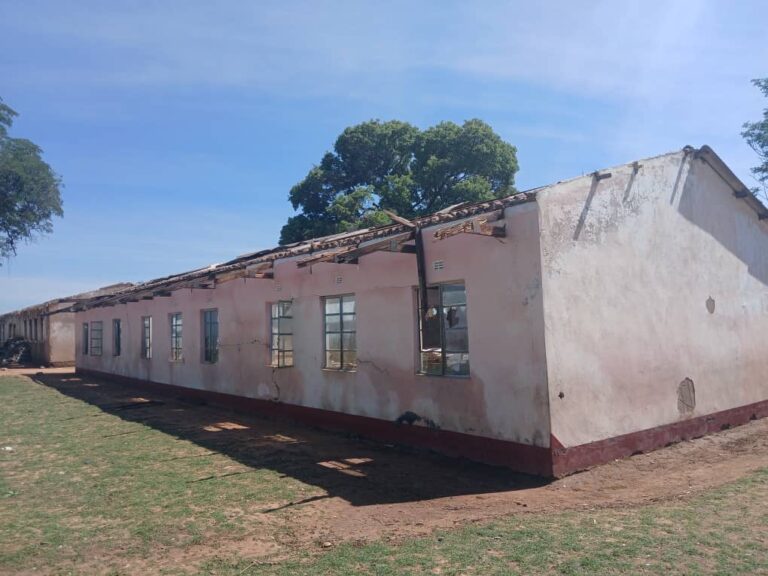
BUHERA – A severe hailstorm in Buhera West’s Ward 16 has caused extensive damage at Bika Primary School, blowing the roofs off of one classroom block and destroying textbooks, furniture, and other critical materials.

School Development Committee (SDC) Chairperson Nelson Munyaradzi Chamunorwa confirmed the incident that happened on November 27 and appealed for assistance to repair the damage before schools reopen.

“A lot of textbooks for different subjects were affected, four subjects had 70 books each, three other subjects had 90 each, then Shona had 10, English 10, and Mathematics 50. The class had 40 learners and each had 8 books, totaling 420,” said Chamunorwa.

He reported that one classroom was flooded, damaging approximately 620 textbooks and 320 exercise books, most of which are now unreadable. The storm also ruined furniture and building materials.

“The rains soaked and deformed five wooden tables as well as 10 wooden benches. Twenty eight iron roofing sheets were bent and seven ridges, all roofing nails and six window panes were destroyed,” said Chamunorwa.

Other items destroyed include teaching charts, chalks, rails, and eight teachers’ record books.

Chamunorwa said the roof of a second block was loosened and temporarily secured with wire, but a permanent solution was needed.

“Another block had its roof shaken, so just yesterday (December 4) we met as parents and tied the sheets with wire, but we feel it’s not sustainable. We are appealing for help to remove that roof and put a new one with iron trusses, which won’t be affected by termites,” he said.

Ward 16 Councillor Thomas Matsenhura echoed the call for urgent intervention and said appeals had been sent to the local council, the Ministry of Primary and Secondary Education, and the school’s alumni.

“The school is in dire need of help. We have since written to several organizations including the Ministry of Primary and Secondary Education, council, as well as to old students,” said Matsenhura.

He acknowledged that the council may have exhausted its year-end budget but expressed hope for a positive response. Matsenhura also called on individuals and the corporate sector to assist in addressing the school’s critical needs.