Home Blog Page 638

Shabani Primary exhibits hockey talent in Lusaka

0

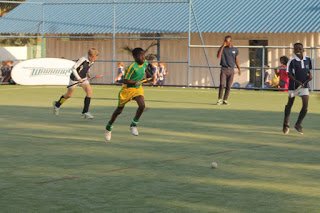
Akan Nyahwa of Shabani Primary races for the ball in one of the matches

Exsto Makunzva

ZVISHAVANE – Shabani, Hartman House and Hellenic Primary schools hockey teams were recently in Zambia for a tournament organised and hosted by Lusaka International Community School (LICS).
Shabani finished as quarter finalists in a tournament that featured such teams as Italian School – who emerged as de-fending champions – as well as Martin House, who finished at number three behind the hosts LICS Warriors, and Musikili.
On the first day, Shabani Primary suffered from fatigue after enduring the over 600 km road journey to Lusaka, un-like their Harare counterparts who flew to the venue.
This year, the tournament was played at two venues; seven matches at LICS and 11 at the Olympic Youth Develop-ment Centre (OYDC).
Shabani Primary’s first encounter was against Hartman House and the match ended in a goalless draw.
Hellenic Primary reached the finals and won the seven aside girls and went on to be winners of the other 11 aside matches the following day after beating the hosts in the finals.
Hartman House, who were number seven in the seven aside boys, surprised many by reaching the finals with Musikili in a thrilling encounter where the winner was decided through a shootout after settling for a one all draw.
Speaking after the tournament, Shabani Primary coach, Gordon Munyaradzi Misihairambwi said he was happy with the performance of his boys and girls.
“We have learnt a lot and I think next time, we need to be better prepared. We could have done better if we had brought everybody with us. Some of our key players could not make it to Lusaka and that affected our game plan,” said Misihairambi.
LICS Warriors coach, Thomas Mumba said they were happy to be hosts of the tournament.
“I am happy, we have had three schools from Zimbabwe unlike last year when we had only Shabani Primary School. Our visitors gave us a good run for our money and helped to improve competitiveness in the tournament. I hope we will have even more schools from Zimbabwe next year,” said Mumba.Local

Lowveld university gets more land

0
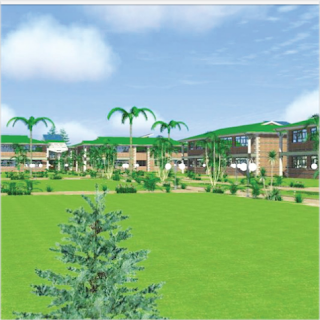
An artist’s impression of UOL


Beatific Gumbwanda

CHIREDZI – Construction of the proposed University of the Lowveld (UOL) is expected to begin after the July 30 elections, with Chiredzi Rural District Council (RDC) and the Chiredzi Town Council having now allocated 127 hectares more land in addition to the 123 hectares al-ready set aside for the purpose.
In a letter of confirmation to the university board chairperson jointly written by the RDC and town council, dated June 25, 2018, the two authorities confirm allocation of the land.
“Chiredzi RDC and Chiredzi Town Council jointly acknowledge receipt of your request for the allocation of additional 127ha of land for the setting up of a University within the remainder of Buffalo Range.
“The two planning authorities kindly advises your office that they have no objection in allocat-ing you the requested additional land in question but subject to the release of the land by Ministry of Lands, Agriculture and Rural resettlement,” reads part of the letter.
UOL managing director, Absalom Chikoto said the project was initially allocated 123ha of land which he said was not sufficient.
“We were at first given 123ha yet a campus should have a minimum of 300ha. The remaining 50ha will be allocated soon and we will begin construction soon after elections,” said Chikoto.
The UOL project is a brainchild of the Conservation Trust, with funding for construction raised through a build, operate and transfer agreement signed through several local banks.
The university is expected to start with seven faculties namely; medicine, humanities and educa-tion, culture and heritage, science, engineering and technology, natural resources and ecological sciences.education

Mahwende provides free Wi-Fi in Ward 6

0

Wellington Mahwende

TellZim Reporter

Zanu PF candidate for Masvingo Urban Ward 6, Wellington Mahwende is probably the most outstanding aspiring councillor in Masvingo.
Mahwende outpaced other contestants both from his ward and others in Masvingo after he provided free Wi-Fi at all shopping centres in the ward.
Instead of going to town and pay for internet services, people from other wards are flocking to Ward 6 where they just disembark at shopping centres and enjoy free Wi-Fi.
The password to the internet is mahwende2018.
Mahwende said he is now above politics of slogans and promises.
“I am a man of action, I don’t just promise but I do. Come to my ward and witness how I have helped young people who want internet facilities. For me it’s about looking at the service which is most sought after in the ward and provide that to the people,” said Mahwende.
Apart from free Wi-Fi, Mahwende said his manifesto was very clear and straight forward.
“I simplified what I am going to do once elected into office. I will make sure that Ward 6 will never be the same again. On the top of my priority list is to make sure that people have clean water all the time. There will be no more water disconnections in Masvingo, we are lobbying for pre-paid water meters so that people are charged what they would have used,” added Mahwende.
Some residents in Ward 6 praised Mahwende for being more responsive to the needs of the people especially the youth.
“He is the most ideal leader that I have interacted with so far…look at how he has helped our children with free internet. We are happy to have someone who is quick to respond to our needs,” said John Mafa from Majange shopping centre.
Mahwende’s biggest threat so far is MDC-Alliance’s David Vasivenyu Chimombe who was once the councillor of that same ward between 2008 and 2013.politics

Local govt deserves fresh minds: MDC Alliance youth secretary

0

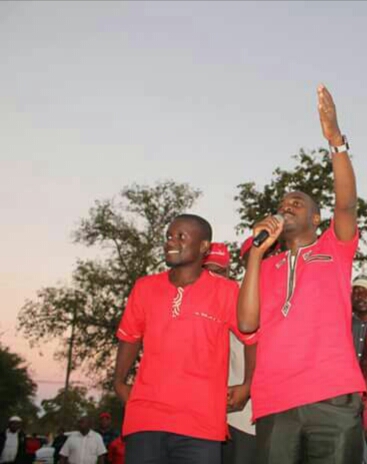
Mapuranga (left) with MDC Alliance leader nelson Chamisa during a rally in Mwenezi recently

Cephas Shava

MWENEZI – The dominance of ‘outdated’ minds in most rural district councils is an obstacle to development and there must be fresh minds in the local authorities to reverse the trend, MDC-T district youth secretary Lovemore Mapuranga has said.
The 29-year-old Mapuranga, who is contesting for the Ward 2 seat under the MDC Alliance banner, said many youth-focused initiatives had failed to take off in the district because the youth had chosen not to run for political office and were therefore not decision-makers.
“For years now, local government posts have been occupied by the same old clueless characters, most whom seem not to understand the duties of a councillor. Fresh and innovative minds that think outside the box should now take over. In Ward 2, we have dams that are supposed to be fully-utilised for the benefit of the community but they remain underutilised.
“For the purpose of pushing meaningful development and vigorously influencing projects for youths and women, I am running for councillor. For youths’ voices to be effectively heard, they need to be part and parcel of the system which makes critical decisions,” said Mapuranga.
Mapuranga holds a Bachelor of Social Sciences honours in Sociology and is the youngest councillor aspirant in the district.
He said his campaign was going largely well and had been received by people of all age groups who are keen to see a different calibre of leadership in the council.
“Recently, some of my supporters were intimidated by war veterans from within the ward. They were moving around warning people against voting for the opposition but I am sure I will win if the election is held in a truly free and fair environment,” said Mapuranga.
Mapuranga is contesting against three other candidates; current Councillor Munyaradzi Sigogo, who is running as an independent after Zanu PF disowned him for flirting with the opposition, Simbai Dziva who is also an independent, and Zephaniah Zhou of Zanu PF.politics

Female candidate Madzivire talks jobs for constituency

0

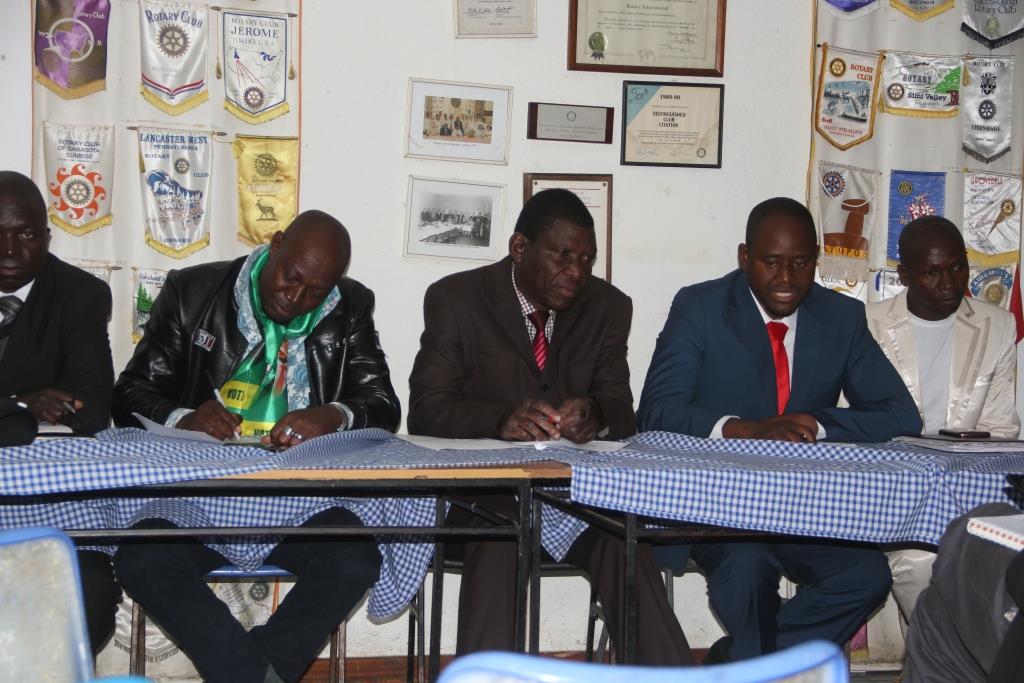
Rose Madzivire, sandwiched by other candidates speaks during the dialogue  meeting

…seeks to divorce herself from ‘violent’ past
Tiyani Hahlani

Centre of Gender and Community Development in Zimbabwe (CGCZ) on July 04 organised a public dialogue meeting for candidates approved to contest in Masvingo West.
Held at Bere Community Hall in Mashava, the event attracted wide interest from residents who took the opportunity to talk with the candidates in order to get a better understanding of what they have to give to the electorate.
The dialogue was held under the theme ‘What are the Youth and Women’s Expectations’ in recognition of the critical importance of these two groups in efforts to improve democracy so that it better reflects the nation’s true demographic image.
Below are the main highlights of what the candidates as part of the presentations and also response to the questions from the community.

Rosewita Madzivire
Madzivire, who is the candidate for the MDC Alliance, is the only female candidate in the constituency.
She promised to work for the resuscitation of the closed Mashava asbestos mine as well as for the reopening Sipambi Training Centre for the sake of employment creation.
“We want to reopen the Mashava mine so that the youth and also the women may have something to give them an income,” said Madzivire.
She found herself being quizzed on her alleged violent past when she used to be a Zanu PF member and close confident of current party provincial chairperson, Ezra Chadzamira, whom she is now contesting against for the parliamentary seat.
“People do change and I have changed. If the Biblical Saul could change and be renamed Paul, I too can change,” Madzivire said in her defence.
Madzivire used to be the ruling party’s Masvingo Rural District Council (RDC) Ward 12 councillor until she got fired from the party in 2016 for joining the then Joice Mujuru-led Zimbabwe People First (ZimPF).
Other candidates who participated in the meeting were Daniel Mutarisi (independent), Henry Makusha (PRC) and Tichaona Mharadza (Independent) and Thomas Masvovere (MDC-T). Zanu PF’s Chadzamira did not turn up, although he had earlier promised to be there.

Daniel Mutarisi
He said he going to donate wheel chairs to disabled people and also help them to become self-reliant through projects that are specifically designed for them.
He said that he was greatly troubled that the economy still favoured adult males and was discriminatory against women and the youth.
“So we are going to have an engagement with the youth and the women in the communities so that we hear their concerns and push for favourable policies that address those problems and fight marginalisation,” he said.

Henry Makusha
“It has been a long time since the people in power promised to build better facilities for the informal sector but nothing has happened so as PRC, we have managed to build a clinic for you in Ward 12 Neshuro. We want to do something similar here,” said Makusha.
He promised to offer pieces of land for farming to the youth and women, saying they were suffering the most from the economic difficulties in the country.
Makusha urged the people to vote for him for change, saying the current government had dismally failed to do anything good for the community.

Thomas Masvosvere
He bemoaned the suffering in Bere community, saying the regular water cuts experienced in the community could only be addressed by an MDC-T government with him as MP for Masvingo West.
He also talked about employment creation, saying Mashava Mine ought to be urgently revived to give people in surrounding communities hope.
“We will also construct roads, implement many other big infrastructural project and revive what has been destroyed so that we rebuild our communities. As parents, you must be hopeful because we will provide free primary education if we are elected,” said Masvosvere.

Tichaona Mharadza
The former MDC Alliance member based his message largely on property rights and also such policy issues as maternal health, saying women could not afford the exorbitant fees being charged even at public hospitals.
Mharadza was quizzed on why he thought he deserved the vote once again when his tenure as the constituency’s MP between 2008 and 2013 had yielded little.
He however defended his record, saying he managed to repaint Bere Clinic among many other projects.
Mharadza said he will also make the clinics in the community user-friendly especially for people with disabilities.local

‘Masvingo ready for Chamisa’

0

James Gumbi


Upenyu Chaota

All roads lead to Mucheke Stadium this weekend where the MDC Alliance presidential candi-date, Nelson Chamisa will address his last rally for Masvingo Urban ahead of the July 30 harmo-nised elections.
Chamisa is expected to be accompanied by other alliance principals among them Tendai Biti, Welshman Ncube and Jacob Ngarivhume.
The Chamisa-led MDC-T Masvingo provincial chairperson, James Gumbi said the long wait was finally over as a star rally will be held on Sunday, July 15.
“President Chamisa came to Masvingo Urban earlier this year and addressed a rally at Mamutse Stadium but he was not the president then so there were growing calls by people from Masvingo that they wanted to have a date with the president before polling day and the wait is finally over.
“Masvingo will speak and we are expecting a historic turn-out,” said Gumbi.
He said the oversubscribed rally addressed by Chamisa in Chiredzi about two months ago would be overshadowed by the expected turnout this weekend.
The Chiredzi rally at Tshovani Stadium had a record crowd of over 30 000 people.
“This will be the last rally for president Chamisa in Masvingo Urban before the July 30 polls and we will pledge to take back the parliamentary seat which was stolen from us by Zanu PF in 2013.
“No one will be left at home because wherever president Chamisa goes, huge crowds follow him because he is the only hope for impoverished Zimbabweans. From Masvingo, the people’s presi-dent will round up the province with rallies in Gutu district,” said Gumbi.top news

Zanu PF, MDC Alliance supporters disrupt elections debate

0
Image result for Innocent Gonese

Lloyd Shunje in Mutare
MUTARE – Rowdy Zanu PF and MDC Alliance supporters yesterday, July 12, came to Mutare Museum and disrupted an elections debate organised by the Zimbabwe Elections Support Network (ZESN).
The debate was meant for all the 10 Mutare Central constituency parliamentary candidates and members of the public, but moderator Violet Gonda had to call it off after spirited attempts to control the unruly party supporters failed.
Candidates that had turned up for the event are Innocent Gonese (MDC Alliance), Nancy Saungweme (Zanu PF), Apross Mushunje (ZIPP), Marvin Rumugwe (MDC- T), Tendai Samupindi ( PRC), Emmanuel Mauya (NCA), Patrick Chidhaka (Independent), Nathan Zimbudzi (Pre Zim Party Congress) and Allan Parunobva (Coalition of Democrats).
Tensions started when Zanu PF supporters booed Gonese after he was asked to introduce himself.
In retaliation, MDC Alliance supporters booed Saungweme when he was asked to introduce himself, leading to the brouhaha.
The candidates had to leave the venue after Gonda’s efforts to return the house to order failed.
Speaking after the abortive function, Gonese said there were elements in the crowd that had been rented to discredit him.
“It was a planned thing; 30 seconds into my speech, there was already a pandemonium. The people who started it are from Zanu PF and our own people booed back,” said Gonese.
Rumungwe said the playing ground was not fair, claiming money had exchanged hands to discredit others.
“These people are using their money to hire people to come and disrupt the likes of us who don’t have money but have solutions for the constituency,” said Rumungwe.
Mushunje urged fellow contestants to desist from hiring supporters for such kind of meetings.
“Those people were hired by the Alliance and Zanu PF as they took it to be a rally. We urge other candidates to educate their people about the importance of these meetings. We have lost a good opportunity for dialogue,” said Mushunje.
Saungweme immediately left after the ruckus and could not be reached for comment though his supporters trooped out of the venue and gathered outside, singing their party’s songs.
Gonda later told TellZim News that she was disappointed by the lack of civility displayed by some people at the event.
 “We have held a similar debate in Harare with female aspiring presidential candidates and we have been to Bulawayo, but we have not seen such kind of behaviour.politics

Suppression of media freedom entrenches conflict

0

Journalists and media students take part in a march as part of the 2016 World Press Freedom Day Commemorations in Masvingo
Nevanji Madanhire

The Zimbabwean media, in hundred years of existence, has been shaped by conflict and successive governments have used anti-press freedom laws to barricade themselves against any criticism deemed a threat to their parochial interests.
But this suppression of media freedom has never served the purpose it was set to achieve. Instead, it has resulted in conflict being more entrenched with disastrous consequences to the country.
The Zimbabwean government which came into power last November and calls itself “the new dispensation”, should reflect on the media laws enacted by the past administration, which it was part of, and see if they in fact, helped sustain its hegemony.
The laws did nothing to hold the ruling party together; neither did they stem “regime change” which came to pass acrimoniously in November.
A perfunctory look at Zimbabwe’s media history shows how conflict has shaped he media’s response to conflict into the outrage it is, much to the detriment of the role good journalism should play in society.
It is only when the media is freed from conflict that conflict can be resolved.  When the media therefore calls for its right to operate freely, it is claiming and asserting its integral role in conflict resolution. A free media therefore, contrary to what governments think, is good for everyone including the ruling elite as it plays its part of being an honest and disinterested arbiter of conflict.
When the first newspapers were established in the late 1890s, there was no question about their mandate which was to help in building economic development of the new state called Southern Rhodesia.
This state had at its core the white settlers while the indigenous population was at the periphery and viewed as a threat.
By 1897 Fort Salisbury, the capital of the new settler colony had three newspapers namely, the Mashonaland Herald, the Zambesian Times and the Nugget.  By that same time Salisbury had already had its first permanent Post Office building, an Anglican cathedral, a market hall, a stock exchange meeting point, the first trading association, a hotel (the Commercial) and a pharmacy (Strachan’s Lion Pharmacy).
Africans on the other hand had their first designated “location”, where “natives” lived. The indigenous population had already revolted twice in 1893 and 1897 driving the settlers into a laager, a word that evolved to mean all the laws enacted to ring-fence white privilege.
The Rhodesia Herald, The Sunday Mail and their siblings The Chronicle and The Sunday News, successors of the Mashonaland Herald, continued the tradition of safeguarding white interests until the end of colonialism in 1980.
The media therefore promoted a kind of parochialism that said Africans (natives) were a threat to their civilisation and their economic development; therefore, any developmental issue had to focus on white development.
The colonial media therefore promoted the white settler economy. Indeed, at independence in 1980 the Rhodesian economy was touted as one of the best in Africa but this disregarded the fact that the majority lived on its periphery, almost in abject poverty. It was this scenario that drove the country into a costly war that ended white supremacy.
But did the media’s role change at Independence inspite of the weaknesses exhibited in the Rhodesian model? The laager mentality did not end with colonialism in 1980.  The new ruling class has outdone its colonial predecessors in controlling the media because of a siege mentality that has haunted its governmental history intractably steeped in perpetual conflict.
Zimbabwean media is deeply polarised and it seems it will take quite a while to destroy the polarisation. The media is not there to inform the public debate, but to support entrenched political positions hence it has often been labeled a sham.
Until the cordon of laws that has hindered press freedom and free expression is totally done away with, journalists will continue to have a siege mentality and polarisation will continue especially when media practitioners are overly aware the laws (in place) are applied selectively.
These laws are principally the Access to Information and Protection of Privacy Act (AIPPA) and the Public Order and Security Act (POSA). There has been some movement though with regard to a section of the Criminal Law (Codification & Reform) Act that criminalised journalists for defamation which has been deleted from the statutes.
In Madanhire and Another Versus the Attorney-General CCZ2/15, Section 96 of the Criminal Law (Codification and Reform) Act (Chapter 9:23) was declared unconstitutional as defined in Section 1 of the 6th Schedule to the Constitution of Zimbabwe in February 2016.
But the laws have basically remained in the country’s statutes without any attempt to align them with the 2013 Constitution even when AIPPA continues to criminalise journalists through Section 64 which makes “abuse of freedom of expression” a criminal offence.
Likewise, Section 80 of AIPPA should be revised or repealed altogether as it penalises “abuse of journalistic privilege” and limits foreign investment into media.
The continued statutory regulation of the media through laws such as AIPPA, has inherent problems. Those who argue for it say the fear of prosecution, which is its only known effect, prevents journalists from going astray. But the opposite seems to be true in Zimbabwe where the regulation is applied selectively. This has resulted in the emergence of a rogue element in journalism inclined towards tendentious reporting, hate speech and fake news.
In 2005 Francis B Nyamnjoh in a paper titled Racism, Ethnicity and the Media in Africa: Reflections inspired by studies of xenophobia in Cameroon and South Africa concluded:
“… the media have assumed a partisan, highly politicised, militant role in Africa. They have done so by dividing citizens into the righteous and the wicked, depending on their political party, ideological, regional, cultural or ethnic belonging.”
Zimbabwe has become the microcosm of everything that has gone wrong with the media in Africa, thanks to statutory regulation.  The state, by its nature, is averse to the free exchange of ideas and opinion because that would be a threat to its parochial interest of power retention. The ZMC is the agent of this pervasion and should be abolished in any country that purports to uphold the basic tenets of democracy.
The only regulation the media deserves should be aimed at guaranteeing, promoting and protecting the fundamental right of freedom of expression enshrined in the supreme law of the land. This can only be done through self-regulation. This is based on the basic reality that the media understands its own operating environment better than the state.
Once the media self-regulates, it begins to work according to a codified set of journalism ethics that are difficult to infringe principally because of an inherent peer review mechanism among journalists themselves.
Self-regulation is based on codified ethics agreed to be accuracy, impartiality and fairness.
There are underlying principles without which any journalist practice becomes sham. These include providing reliable information for responsible public debate, holding officials accountable and informing decisions of the electorate.
But due to the polarisation of Zimbabwean media born of statutory regulation, the media has become a circus, which willy-nilly disregards the ethical guidelines of honesty, decency and, sometimes, the protection of sources.
Every day the media spews partial and unbalanced drivel in the name of news. Both the public and private media are guilty though the former is protected selectively by the state.  But two wrongs do not make a right; they both should stick to professional ethics.
Impartiality means reporting should not support one political party, religion, people or ethnic group over another.  Statutory regulation has tended to entrench partisanship instead of fighting it. The public media has unashamedly stood out for the ruling party, warts and all, while the private media has stood, often equally militantly, with the opposition.
Because of Zimbabwe’s long history of ethnic conflict, ethnicity has come to the fore in the media with both the public media on the one hand and the private media and media development organisations on the other, dominated by individuals from ethnic groups, pushing certain interests much to the detriment of fairness and balance.
Balance which should provide clear distinction between fact and opinion has largely been relegated to the sidelines.
When the African Union Election Observation Mission in 2013, together with regional instruments such as the SADC Principles and Guidelines Governing Democratic Elections and the African Charter on Democracy Elections and Governance, supported the call for the improvement of the media landscape in Zimbabwe, it did not do so to support a “regime change agenda”. 
It did so as recognition of the media’s role in conflict resolution. Media development organisations and regional organisations such as the AU and SADC have recognised that “media can maintain its core professional values while also contributing to the resolution of conflict”.
The media can only do this unfettered by state control manifesting in the laager of laws such as those Zimbabwe has enacted since the turn of the millennium and has refused to align with the people-driven constitution of 2013 despite international outrage and the “new dispensation” promising a clean break from the past.


The writer is former editor of NewsDay and The Standard and writes widely on the state of the media in Zimbabwe. This article was commissioned by MISA Zimbabwe, as is part of its campaign on the realignment of media laws with the constitution of Zimbabwe with support from the European Union.

Masvingo lawyer drags ZEC, Econet to court over ED sms

0
Upenyu Chaota
More drama continues to unfold from the alleged President Emmerson Mnangagwa bulk text messages sent to many people across the country, with lawyer Owen Mafa of the Mutendi, Mudisi and Shumba Legal Practitioners approaching the High Court suing the Zimbabwe Electoral Commission (ZEC), Econet Wireless Zimbabwe, Zanu PF and Gutu West Zanu PF parliamentary candidate, John Paradza for sending him the text message.
In his High Court application, Mafa cites Econet Wireless Zimbabwe as the first respondent, Zanu PF as the second respondent, ZEC as the third respondent and Paradza as the fourth respondent.
“Sometime in January 2018, I approached the third respondent with the intention of registering as a voter in the July 30, 2018 elections. The third respondent requested for my contact details together with my residential address which I forwarded to her through an affidavit.
“On July 7, 2018, I was puzzled to receive a message from the second and fourth respondent on my contact details that I had solely provided to the third respondent.
“The messages were sent on my mobile number wherein the second and fourth respondent were urging me to vote for them and their presidential candidate Emmerson Dambudzo Mnangagwa,” the application reads.
“I had not at any time consented to the conduct of the second and fourth respondents. I am advised that the first respondent’s conduct of facilitating the conduct of second and fourth respondent contravenes the provisions of the Postal and Telecommunication Regulatory Authority of Zimbabwe (Regulatory Circular on Unsolicited Bulk SMS) Regulatory Circular No. 2 of 2013 as read together with Section 4 of the Postal and Telecommunications Act Chapter 12.05 of 2000.
“The conduct of the respondents was therefore unlawful and should be declared as such,” read the application.
The text messages have been received with mixed feelings as many seek answers as to how Zanu PF was able to get their numbers when all the fingered parties have denied responsibility.
Asked for his opinion, Great Zimbabwe University (GZU) law lecturer, Dr Admark Moyo concurred with Mafa’s arguments, saying people should be left to decide who could and who could not communicate with them.
“If any person or State agency reveals our contact details to another person or another State institution without our consent, the first mentioned person or agency is acting both unlawfully and unconstitutionally.

“Every citizen has the right to decide who should communicate with them and about what. Flooding citizens’ mobile phones with campaign materials without their consent violates the freedom of communication,” said Dr Moyo

First ever police, candidates dialogue

0

ZRP Ass Com Makedenge (second from left) with Zanu PF representative Fainos Makwarimba (left), MDC Alliance’s Jacob Nyokanhete and Sam Chapfudza (Independent)

…’our posters being defaced’

…ZRP praised for newfound professionalism
Upenyu Chaota
The Zimbabwe Republic Police (ZRP) on Friday, July 06, teamed up with local government and parliamentary candidates in Masvingo Urban, calling for a peaceful environment to prevail in the build up to the July 30 harmonised elections.
In a dialogue meeting organised by Tell Zimbabwe at Civic Centre last week, Assistant Commissioner Crispen Makedenge, who is in charge of operations in Masvingo province, said the force was ready to clamp down on any unruly elements of political violence and bring them to book.
“Peace begins with me, peace begins with you and peace begins with all of us. We urge all political parties and aspiring candidates to conduct their campaigns peacefully.
“We are glad that this year’s elections are peaceful as compared to previous elections. Currently the situation in Masvingo province is calm and we have very few cases of political intra and inter party violence.
“We have put in place citizen police investigators and have also lobbied the National Prosecution Authority (NPA) and the Judiciary Services Commission (JSC) to fast track all cases of political violence so that all the perpetrators are brought to book,” said Makedenge.
He said people should heed President Emmerson Mnangagwa’s call for peace and praised political parties for signing the peace pledge.
“As the ZRP, we have a constitutional mandate of maintaining peace and order before, during and after the elections.
“We are pleased that all parties signed the peace pledge and we hope that they will all walk the talk. Let us work hand in glove so that we have a smooth election. We need to show the whole world that we are a peace-loving nation because all eyes will be on us during this election,” Makedenge said.
Only once winner for each race
Masvingo Urban independent parliamentary candidate, Sam Chapfudza also took time to spread the peace gospel. He said his campaign had so far not experienced and human-induced obstacles and had not faced any hostility.
“The situation obtaining on the ground is so encouraging. There is peace all over and I hope all the parties will keep on campaigning peacefully.
“My posters and banners have not been tampered with, meaning there is tolerance. For peace to prevail before, during and after elections, there should be measures put in place to make sure that our people are happy with the governing of the country.
“There are 23 presidential candidates in the country and here in Masvingo urban there are three aspiring parliamentary candidates. We cannot all win in the election and it takes maturity for all candidates to accept the election results.
“We have to accept the outcome of this election so that peace prevails. Even here, we cannot all go to parliament. One of us has to go and the rest should accept the outcome so that peace prevails,” said Chapfudza.
MDC Alliance parliamentary candidate, Jacob Nyokanhete also hailed the levels of tolerance across the political divide though he complained that most of his posters were being torn away.
“For this election to pass legitimacy test, more still needs to be done. The level of tolerance across the political divide is laudable but we are still facing the challenge of our posters being pulled down.
ZEC must be truly neutral
“We call upon the police to deal with the culprits so that would be offenders would be discouraged. We need peace to prevail during this election period and we call upon the ZEC (Zimbabwe Electoral Commission) to play a neutral role in ensuring that the elections are credible.
“If ZEC fails to be professional and decides to side with Zanu PF then we will have a problem of a disputed poll which will render the whole process null and void. ZEC should be transparent and let all the political parties have access to the printing of the ballot papers just like our president Nelson Chamisa is pushing for,” said Nyokanhete.
President Mnangagwa has removed fear in communities
Zanu PF’s Masvingo provincial deputy commissar, Fainos Makwarimba, who stood for his party’s parliamentary candidate Taguma Benjaman Mazarire said tolerance is the way to go and people should desist from using violence as an instrument of coercion.
“This is the new dispensation and we have a new way of doing things. Gone are the days when we used to assault each other to gain votes. If you beat up a person you will go to jail and no party can protect you. I am glad that our police are now professional in this new dispensation and no one is above the law.
“We should remember we are all Zimbabweans first and that should be enough to give birth to the highest levels of tolerance we are seeing in the build up towards the July 30 polls.
“We should put Masvingo first when we vote in this election. If you choose a wrong candidate, we will remain underdeveloped as has been the case over the years. This time Zanu PF, has given you the best candidate and you should vote for him,” said Makwarimba.
Aspiring councillors at the dialogue also took time to spread the message of peace and called on the police to shun favouritism on all cases to do with electoral offenses.
Three other local government candidates; Collen Maboke, David Chimombe and Godfrey Kurauone also attended the event.
Moboke complained that all his posters had been removed by suspected Zanu PF activists while some of President Emmerson Mnangagwa’s posters had been put on top of his.top news