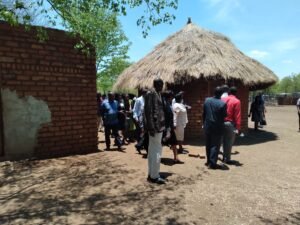
The long wait is over for people in Rupike and Mavizhu areas under Chief Nyajena in Masvingo South following the commissioning of Mavizhu Clinic last week by the Minister of State for Provincial Affairs and Devolution Ezra Chadzamira.
Plans for the construction of the clinic were finalised in 2016 between community leaders and Ward 23 Councillor Tichaona Machingambi who moved the motion in Masvingo Rural District Council (RDC).
After the motion was approved, the site plan and pegging was done in the same year, with local
people raising money through contributions but it was not enough to take the
project off the ground.
Masvingo South constituency MP Claudios Maronge actively took interest in the project when he assumed office in 2018 and managed to channel part of his Constituency Development Fund (CDF) towards the clinic.
The CDF disbursement was used to buy 720 bags of cement, 129 roofing iron sheets, 30 roof trusses, 21 doors and door frames, 27 window frames and window panes and a 6 kg packet of nails.
The money was also used to pay for labour with more materials being bought using plough back money from council and Renco Mine providing some materials like quarry stones among other things.
Masvingo RDC through devolution funds constructed standard staff quarters, toilets and water for both the clinic and community.
The eight-bed Mavizhu clinic will serve more than 10 000 households from Masvingo South and part of Masvingo Central constituencies.
Before its commissioning, people relied on Muchibwa Rural Hospital and Guwa Clinic which are both more than 30 km from other areas.
Maronge said the community has since resolved to start preparations for the construction of a secondary school and another business centre close by and said electrification of the clinic will be done early next year.
Nyajena – Acting Chief Nyajena is reportedly making a lot of money from village heads whom he is compelling to pay US$ 30 for a register which each village head is expected to have.
Village heads who spoke to TellZim News said they were asked to get copies of registers which each village head should have and pay US$ 30 per copy which the Chief claims is for his stamp.
Ward 25 councillor Livison Mudzonga confirmed the development and said the Chief was not charging for the register but his stamp which he charges US$ 25 for ordinary documents stamping.
“It is true village heads were given registers by the Chief. The registers are for free but the Chief’s stamp which is on every register is charged. However, when he came to our ward some village heads could not collect the registers since they had no money on them and will have to get money first,” said Mudzonga.
When asked on the importance of the registers, Mudzonga said each village head should have a list of households, in the register, each household has its own page with a list of members. When one dies, he/she is taken off the register with each new born being entered also in the register. The register will be used for planning purposes especially on social welfare aid distribution.
Contacted for comment Masvingo District Development Coordinator Roy Hove said there was no acting Chief Nyajena saying he was not aware of such a development.
“What I can say is there is no acting Chief Nyajena as it stands. We are in the process of selecting a substantive Chief since the acting Chief died this year. On that issue, I cannot comment on it because my office is not aware of it,” said Hove.
One of the former Chief’s officials Josias Hurudza from ward 23 also confirmed the development and said village heads from his area got the registers and no one was complaining.
One village head said the Chief was trying to fleece them money at a time when life is difficult for most of the rural folks saying the latter should sympathize with subjects.
“We are enduring difficult times here in rural areas, people are busy preparing for the farming season and on the other hand most people have no food. So we are forced to get the money from our subjects who have no money. So this is not fair at all,” said the village head.
Another village head said the money was too much considering the number of villages in his area saying US$ 5 was a reasonable figure.
“The Chief is milking us, $US30 for a stamp alone, that’s day light robbery. We understand that we have to pay something to him but that is too much. If he had asked for US$ 5, I don’t think we would be complaining.
“Imagine he has more than 100 villages under his jurisdiction and it means he will get more than US$ 3000 from the registers,” said the village head.
As the country is battling with climate change effects, Bikita South Member of Parliament Josiah Sithole has said solar-powered boreholes are going to bail out communities in the dry Mafaune area in ward 3 after expansion of the irrigation scheme’s farming land from 8 to 200 hectares (ha).
Sithole said historically Gowa irrigation was a project covering only 8 ha of land under irrigation.
“The irrigation scheme is a project covering about 8 ha in the dry Mafaune area in ward 3 in Chief Mabika’s area. Water was drawn from the nearby Turwi River.
“Feasibility study has shown that there is available land of up to 200 ha that the community has offered. Use of solar-powered boreholes and centre pivots has been suggested,” said Sithole.
He also said the expansion project is still waiting for government green light to kick start.
“Communities in the area cannot harvest any meaningful produce because the area is typically in the ecological region 5.
“We are only waiting for government to start work on this project to tackle the problem,” he said.
Sithole said he has been told by officials from Masvingo Irrigation Services that the irrigation that can benefit up to 200 families is now in the provincial master plan.
“After we visited the site with the officials, they told us that Gowa is now in the provincial master plan.
“Currently about 8 ha is under Mabika family. Proposals have indicated that 150-200 families will benefit, the majority of the beneficiaries being women,” said Sithole.
Minister of State of Masvingo Provincial Affairs Ezra Chadzamira maintains that full exploitation of idle water bodies and land would help to expand the province’s Gross Domestic Product (GDP) through agricultural growth.
MASHAVA- Recently resuscitated Chief Bere has promised to place at least 5 hectares (ha)of land in his area for the current 2022-2023 farming season which is meant to provide food to be stored at the Bere Royal Granary, clan spokesperson Adnos Chikomo has said.
Chikomo said the first area saw maize being planted on November 19, 2022.
“Saturday 19, was diarised as Chief Bere’s Zunde RaMambo planting day for the first crops that were supported by the State in form of Pfumvudza programme. Villagers from the 12 administrative blocks of the chiefdom gathered at Bere farm near Bhuka to plant 4 ha of maize.
“We started preparations this year but have since realized little progress from our intended target of at least 8 ha because of reasons beyond our control and the Zunde programme was a bit delayed as people had to focus on the Bhati incident that led to the death of one of our clan members (late Taurai Lovemore Takawira),” said Chikomo.
He said Chief Bere believes in even surpassing the traditional notion of the Zunde by even going to the extent of supplying food to the needy members of society housed at various shelters in Masvingo while using the project to bring unity of purpose among villagers.
“Our concept of Zunde RaMambo envisages a vision that goes beyond disaster preparedness. We have inside Bere territory Alpha Cottages children’s home, Mucheke Old People’s HOME, Masvingo Provincial Hospital, Masvingo Remand Centre, Alfred Walter Hostel and ZIMCARE Trust among other institutions whom we can feed with proceeds from the project in case of good harvests.
“To us peace is not simply normalization of relations between and among communities but more importantly the active promulgation of those common place customary practices that put our people together,” he added.
Zvishavane- As the call for women to take up leadership positions in political circles intensifies, two women in Zvishavane have expressed their interest to join the electoral race in the upcoming 2023 elections.
Speaking to TellZim News Zvishavane Ward 9 resident and aspiring candidate, Margret Musengi said capacitation about her rights as a woman has motivated her to aspire for councillorship.
She added that as a woman, she was confident that if men could rule, rather women could rule better as they understand challenges affecting the communities better than anyone else.
“I am happy because I was well capacitated as a gender champion to know that as a woman I have rights which include standing for positions in any political party of my choice.
“The right even entitles me to choose to contest as a leader at any level. Such knowledge has motivated me to wish to aspire for a position as a ward councillor next year.
“Being chosen as a councillor or MP is not meant for me to do what I want, rather it demands that I represent the people of my ward, constituency so that my community, province and country becomes a better home for all,” said Musengi.
She added that, having worked with her councillor who was also a woman she was going to look up to her for support and advice.
“I have learnt a lot from my sitting councillor and she has set a good precedence of governance. My interests are not meant to down throw her but rather working together with her and thus taking over from where she would have left going forward.
“Challenges in the community we live are still many like where I stay, we still face water supply shortages. Also network remains a challenge and we hardly communicate due to poor telephone network hence we end up receiving late messages. So our community which covers areas such as Niro needs a network upgrade. We also need electricity as most households don’t have electricity, so I will also strive to have these issues resolved.
“We also need good roads. I therefore urge women to be supportive as always so that fellow women get involved in development of local areas,” she added.
Another aspiring candidate, Stella Mugare of ward 6 said she wants development to take centre stage in communities.
“I have expressed my interests because I want development to be realized. The ward I come from is good and my councillor has been good as we don’t have any challenges.
“One thing I like about my councillor is that he has been encouraging us women in our ward to use the opportunities we have to assume leadership. He is very supportive and as I have shown my interest I will seek his support and advice on how best to I can lead people.
“It requires one to have a heart for the people first before one looks at his or her needs. If I get a position, I won’t feast but will return to the people. Development is by the people for the people,” she said.
Next year Zimbabwe heads for harmonized elections in most probably in August with new office bearers expected to be voted into office starting from local authority, parliamentary up to the Presidium.
Since the adoption of a new constitution in 2013, Zimbabwe has had a legislated quota of 60 seats distributed among parties on a Proportional Representation basis at the national level for women, in addition to the 210 seats open to women and men.
Although Article 17 of the Constitution provides for equal representation of women and men in all areas of decision-making, local government is not included in the constitutional quota.
This has seen women of late demanding the quota system to be implemented at council level to help increase their participation in local governance.
MASVINGO-It was all smiles and joy at the Emmanuel Homestead Orphanage in Sikato area of Masvingo on November 21 as families of children with special needs gathered together with Chief Executive Officer for Dawn David Foundation, Dawn David Chitapa for an awareness campaign where the children also received Christmas hampers from the organization.
The donation was coupled with an awareness campaign running under the theme ‘everyone, everywhere, awareness of people born different’ and sought to teach communities as well as demystify stigmas and myths around disability.
The foundation’s director Sarita Chitapa, a mother to a son with special needs, urged parents to not give up on their children because of disability but to support them as they teach communities around them to accept that they are born differently.
“I understand what my son needs more than anyone and hence I have since chosen to become his voice because he cannot talk which is what I advise all parents to not conceal their children’s disabilities but to stand by them and help them to achieve greater things in life,” said Sarita.
Sarita a pastor, occupational therapist and author of Born Different took her time to narrate to the audience her life together with her son who is the inspiration behind Dawn David Foundation of how she has fought for Dawn now aged 28.
“I had to learn to accept my son’s condition after 12 years of trying to find answers and eventually travelled to UK to seek answers to my son’s condition after doctors confirmed that he had autism and learning about the condition.
“I had to come back after 15 years to give back to society about what I learnt about autism thereby starting the Dawn David Foundation to bring about awareness and support to children with special needs,” he added.
55 children with special needs received the Christmas hampers from the organization.
Alexander Chibwana the Executive Director for Window of Hope an organization in Masvingo which established the Emmanuel Homestead expressed his gratitude towards Dawn David Foundation team and called on other stakeholders to support the homestead.
“We are grateful to Dawn David Foundation and all other partners who give a hand towards this homestead and are calling upon other players to participate as we are about to receive our lease so we may be able to start operating,” explained Chibwana.
Dawn David Foundation partners with Emmanuel Homestead on the disability wing focusing on autism, Down syndrome and cerebral pulses.
Although the home is not fully operational as they are awaiting certification, they have close to 50 children whom they give assistance outside the homestead.
“We are looking after some children outside the homestead whom we pay fees for, provide school uniforms as well as other needs,” said Chibwana.
The homestead has a capacity to house 40 children together with 10 care givers and is expected to open its wings anytime starting from December.
…bill addresses nominal and administrative reforms only
Fredrick Moyo
The Zimbabwe Election Support Network (ZESN) has expressed concern over the scope of the proposed changes that are contained in the recently gazetted Electoral Amendment Bill stating that the Bill addresses nominal and administrative reforms whilst ignoring pertinent reforms.
In a press statement released on November 22, 2022, the Civic Society Organisation (CSO) said the Bill addresses insignificant issues whilst ignoring relevant issues that can have direct bearing on elections in Zimbabwe.
“ZESN believes that the Bill addresses nominal and administrative reforms whilst ignoring pertinent reforms that may have a direct bearing on the transparency and credibility of elections in Zimbabwe. For instance, the removal of a driver’s license as proof of identity is purely nominal as the Zimbabwe Electoral Commission (ZEC) has always declined it as proof of identity for election purposes during voter registration and voting.
“ZESN is irked by the fact that the Electoral Amendment Bill is silent and does not address some of the key principles of electoral systems and processes on the conduct and management of credible, peaceful, free and fair elections as enshrined under Section 155 of the Constitution,” read part of the statement.
ZESN also said it is annoyed by the Bill which violates the constitution as it is decreasing the percentage of women in electoral participation.
“ZESN is concerned by the lowering of constitutional standards as elaborated in the recently gazetted Electoral Bill. The Bill creates a ceiling of thirty per cent (30percent) of women councillors as part of the quota system for women’s representation. However, this does not represent the fullness of the Constitutional Amendment (No. 2) provision which seeks to create a minimum threshold for women in local government at thirty per cent (30%) on a ward basis through a Proportional Representation (PR).
“The Bill further violates the Constitution as it contains a provision which will result in the decrease of the women’s quota percentage when a political party fails to present a full list of candidates for the local authority women’s quota. The provision makes women losers for their political parties’ negligence, maladministration or incompetence,” read part of the statement.
ZESN urged government to ensure equality of representation within existing ward boundaries and adopt an all-inclusive approach to electoral reform processes.
“ZESN calls government to consider the quota system design that ensures the minimum thirty per cent (30%) seats are within the existing ward boundaries through a portion of Proportional Representation and therefore ensuring equality in how representatives of the country take up public office in direct election seats as guided by the Constitution Amendment (No. 2).
“This will give relevance to the roles that women in the quota play at local authority level, which deals with day-to-day service delivery issues among others. An additional quota to the existing wards will make these women redundant, add an extra burden to taxpayers by having councillors without wards, perpetuate their marginalization and subject them to name calling as is the case with the National Assembly quota.
“We, therefore, reiterate our call on the need for the government to reconsider a formula that does not jeopardize the women’s quota as provided for by the Constitution. The need for government to sincerely drive the agenda for equality in representation cannot be overemphasised.
“ZESN, therefore, calls upon the government to adopt a holistic approach to the electoral reform process taking into account the Constitution of Zimbabwe, SADC Principles and Guidelines Governing Democratic Election, the recently ratified African Charter on Democracy, Elections, and Governance (ACDEG), as well as recommendations made by Election Observer Missions in the 2018 harmonised elections.
“Furthermore, ZESN reminds government of the need to expedite the electoral reform process to ensure that the legal, administrative and procedural changes are understood and implemented well ahead of the 2023 harmonized elections and beyond,” read part of the statement.
The gazetted Bill which seeks to amend the Electoral Act [Chapter 2:13] proposes the removal of the driver’s license as proof of identity for electoral purposes; seeks to disqualify previously convicted persons from contesting in elections and provides a timeframe (21 days) when a candidate may withdraw from contesting in a National Assembly or local authority elections.
The Bill also provides for the incorporation of the youth quota in the National Assembly and the women’s quota in local authorities which are both products of the Constitution of Zimbabwe Amendment (No. 2) Act, 2019.
Gweru- Residents have come out guns blazing towards the local authority accusing city fathers of conducting the 2023 budget consultations without the residents at heart and thus neglecting their input.
Residents expressed concern over council’s move to fast track the adoption of the budget without proper interrogation of the proposed tariffs.
Most controversial issues which came under spotlight were that of water meter estimates where residents urged council to do away with estimate-based billing process and scrap off the five percent interest on all debtors as residents were struggling to cope with the 2022 rebased bills.
Residents also urged council to downsize the rebased 2023 budget with a 50-75percent margin.
Some of the changes which were effected into the budget are the increase in the cost of graves in town where burial for adults will require US$ 50 from the 2022 approved US$ 21 while during weekends US$ 50 will be required from the currently pegged US$ 42.
However children will be required to pay US$ 25 to get a grave from the current US$ 10.50
Speaking during an interview after a Gweru Residents and Ratepayers Association (GRRA) budget engagement meeting yesterday, ward 4 resident Kenneth Sithole said the recently ended budget consultations were done haphazardly.
He added that as residents, they advocate for a turn down or failure to adoption of the budget citing a number of unclear issues.
“We were in ward 10, 11 and 14 where we managed to attend the budget consultations and agreed as residents not to adopt the budget until we understand how other wards received the budget.
“At least council must make sure that after conducting consultations; we conduct a feedback meeting inclusive of all wards so that we appreciate our input as residents.
“Our position as Gweru is clear; we don’t want the rebased 2023 budget to sail through. Let’s have it downsized with 50percent and be reverted to the 2021 budget that’s it. We don’t want to play games on things which affect us tomorrow,” Sithole said.
Mkoba 13 youth Juliet Mucharozva said council was pushing residents to adopt the budget without proper knowhow of the adoption process.
GRRA director Cornilia Selipiwe highlighted that two issues were involved regarding the proposed budget.
“I feel there are two issues involved. One is the aspect where the local authority is trying to smuggle the budget and go direct to the minister for approval without the consent of residents. The other issue is having residents who are adopting a document they don’t understand.
“We can’t predict council’s intentions as it seeks to smuggle the budget but rather a budget is not fully certified if it lacks the people’s voice. Clearly articulating the budget helps people appreciate the document, hence as resident associations, we have a mammoth task of helping people to understand how the adoption process impacts the budget process.
“Under normal circumstances a proposed budget should be different from the final one, as the proposed is tabled for scrutiny while the final contains inputs of all stakeholders and is submitted for approval. Of late, we have seen a bad culture in Gweru as a proposed budget sails through as a final document without the people’s views,” said Selipiwe.
Gweru Council Public Relations Officer Vimbai Chingwaramusee said consultations were conducted according to the given law despite low community turn out.
“Gweru City Council managed to conduct the 2023 budget consultations as stipulated at law and all stakeholders and wards were engaged by council.
“What disturbed us as council was the low turnout by youth, women and People with Disabilities. People didn’t attend the consultations at all. Imagine a big community like Gweru receiving very low numbers. We believe everyone must take part in these important budget processes,” she said.
Information obtained by TellZim News reveal that the low budget turnouts in Gweru were driven by frustrations as residents expressed concern over the unpredictable outcome of final budget.
However the proposed 2023 rebased budget is expected to be pegged at a total sum of US$ 46 million.
…Family demands answers on the deceased’s mysterious death
Emmanuel Chitsika
Family to the late Taurai Lovemore Takawira who was allegedly abducted and murdered in skirmishes believed to be part of the land ownership wrangles pitting Bere and Charumbira chieftainships near Bhati area in Masvingo West constituency have said they will only bury their late family member if some of their conditions surrounding his death are met.
Family spokesperson Sylvester Takawira said as a family, they were saddened by the passing on of Taurai and would only bury their relative if questions they have pertaining to his mysterious death are answered by the alleged perpetrators.
Sylvester went on to say the family is looking up to traditional leadership from across the country to help the family over the matter so that they would bury Taurai if they are satisfied on the cause of his death and the real characters behind his death.
“As a family, we are really saddened by the death of our loved one who just died under such unclear and mysterious circumstances. Since the day Taurai disappeared up to the discovery of remains believed to his, we haven’t had any answers to what could have happened to him or who is behind that death.
“As such we call upon traditional leadership even from the national Chief’s council to help us on how best we can handle this matter so that by the time we decide to bury the remains, we would be satisfied that everything has gone according to protocol and thus a decent burial for him.
“Apart from that, we also need to know the fate of the alleged perpetrators whom we strongly believe are the ones behind the death. If possible, engagement between the family and those of the perpetrators would bring some sort of appeasement to the family,” said Sylvester.
He also pointed out that the family is facing financial challenges as a result of the expenses encountered during the quest to establish the whereabouts of the late Taurai since his disappearance on September 30 up to November 3 where the remains were discovered.
He also said pathology test results revealed the late Taurai suffered a broken pelvis bone but the family is yet to get back results of DNA tests carried out to ascertain if the remains are the deceased’s.
Chief Bere’s spokesperson Adnos Chikomo also confirmed that the Chief had lengthy meetings with the Takawira family over a number of issues regarding the death of Taurai and the expected burial.
“Yes, we have had meetings with the Takawira family following the discovery of the remains believed to be of the late Taurai. Other than the confirmation from the late’s wife, we feel there is need for scientific evidence to support that the remains truly are Taurai’s.
“After that, there is need for proper consultations so that rituals linked to the burial of people who would have died in such a manner are performed and that include ‘cleansing the Bere land’ before he is buried,” said Chikomo.
He however dismissed reports he preferred to term ‘just rumours’ to the effect that the Chief had suspended working on the land for all people under his jurisdiction saying it is only work of the Bere’s adversaries meant to tarnish his image.
Taurai disappeared on September 30 near Bhati after he and two family members were attacked by assailants believed to be Charumbira loyalists in the area demarcating Bere and Charumbira chiefdoms.
…teachers living in grass thatched, run down huts for years …living and working conditions not for the faint hearted
Brighton Chiseva
MWENEZI – The first question one asks self after arriving at Nyangambe Turf Primary School in ward 15, Mwenezi West Constituency under Chief Chitanga is whether it is commitment or desperation for a qualified teacher to stay for a year or more after being deployed at such a school.
A straight answer is difficult to get even from the teachers stationed at the school but after speaking to them one can simply conclude; it’s both.
The teachers’ living and working conditions point to how the once noble profession has been stripped of its dignity with teachers being reduced to a mere laughing stock.
With only seven years before 2030, it remains to be seen if the authorities preaching of the Vision 2030 of an Upper Middle Class economy would beat the deadline as the clock seems to be ticking at an alarming speed.
It’s hard to believe that a teacher at Pamushana, Ndarama or Gokomere High Schools gets the same salary with a teacher at Turf Primary School where they share blair toilets with pupils. In most cases, unemployed graduates are desperate and they end up taking opportunities that come, with the hope of transferring after being attested in the civil service.
Recently, the Minister of State in the President’s office responsible for monitoring the implementation of government programmes Joram Gumbo came face to face with one of the most unbearable working and living conditions for a teacher during his tour of Masvingo province.
During his visit, Gumbo told the teachers to present all their problems so that he will take them to responsible authorities for them to be addressed.
Amalgamated Rural Teachers Union of Zimbabwe (ARTUZ) Masvingo Provincial Secretary General Andrew Munguri said the teachers are dedicated and patriotic saying government must rather provide an equalization fund to develop rural schools and teachers’ welfare.
“These are dedicated and patriotic teachers of the motherland. It is government’s responsibility to prioritise education. It remains a pipeline dream to have quality education under these dehumanising conditions. There must be an education equalisation fund to improve infrastructure and rural teachers’ welfare. Government is found wanting and sleeping on duty in this regard,” said Munguri.
There are nine unsung heroes at Nyangambe Turf Primary School about 52 kilometres from the Masvingo – Beitbridge road who are enduring some of the harshest conditions but are dedicated to their work.
The living conditions at the school are not for the faint hearted and one will be forgiven if they pack their bags and leave the school less than a week after deployment.
The conditions range from inaccessibility due to poor road network, shortage of standard accommodation, water woes to communication network challenges among others.
The nine teachers, five ladies and four men, are the school head Bernard Chauke who joined the school in 2018, deputy head Tavonga Mafuta who joined in 2019, the longest serving Nesbert Rudishua who joined in 2013, Musame Aleta who came in 2020, Tracy Musekiwa 2021, Itai Chigeza, Isaac Mafira, Rebecca Mavambira and Rhoda Dzingirai who joined the school this year (2022).
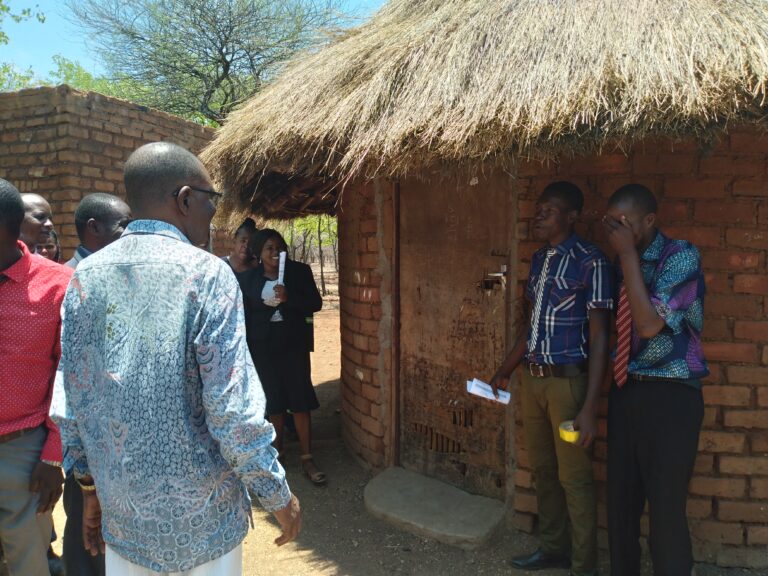
The nine teachers share two grass-thatched round huts and three flats a pointer to lack of privacy among the teachers.
The situation also forces the teachers not to stay with their families because the living arrangements not suitable for a family.
The teachers have no stand-alone toilets in the staff quarters and they have to share dilapidated toilets with learners which were built back in 2012—imagine sharing a blair toilet which is already dilapidated with ECD pupils who at times fail to make use of the squat hole and end up messing the whole floor.
They also share a makeshift bathroom which is made of tree poles and branches with a few empty cement sacks inside just to give cover to the essentials leaving legs and shoulders exposed when bathing.
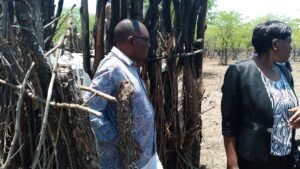
Minister in the bathing room at Nyangambe Turf Primary school
The water point is about 600 metres from the school which is a community borehole and teachers are forced to have a time table to fetch water to avoid congesting with the community who in summer will be drawing water for their livestock.
The area has no shops and teachers have to bring enough food for a month or so since it is difficult to get supplementary grocery items.
“There are no shops here and one has to bring all he or she can carry to avoid inconveniences where they run out of food or other requirements mid-month,” said one teacher.
There is no regular transport to the main road so teachers rely on local farmers’ vehicles or by chance visitors’ vehicles that will be travelling around the area.
The teachers risk spending two or three days holed up at the turnoff from the highway to the school and at the mercy of game rangers who can abuse them especially women.
Sometimes they end up sharing bread and other items they would have brought from town on pay day with game rangers who mane the entrance into a game reserve which they pass through to the school.
“When coming from town or anywhere else, we spend long hours a day or more with the game rangers at the main entrance since it’s risky to travel in the reserve on foot and again it’s a very long distance to the school. So we end up sleeping there and at times we have to share the little we have brought like bread and drinks with the rangers for the time we would have been there,” said another teacher.
During Gumbo’s visit to the school, Chauke emphasized on the need for responsible authorities to avail a ZUPCO bus to the area which he said will serve the whole community.
Masvingo ZUPCO depot manager Isaac Siazuza said he is not allowed to speak to the media.
In terms of accommodation, the teachers use poorly thatched mud bricks round huts with tiny triangle shaped windows which cannot be opened or closed and cannot be curtained where if one wants to close he or she has to use rugs to cover them completely.
The only better house is the head’s quarters, a two roomed flat which he shares with another teacher built of cement bricks but not plastered.
“The houses were constructed by the community but they are poorly thatched. The windows are tiny, the walls are not plastered and they have no cement floors,” said another teacher.
The teachers are most of the times out of touch with the outside world realities since there is network challenge at the school making it difficult to communicate with family and friends.
There is a point with access to connectivity which they use as a staff room though it’s under a tree with suspended poles and some grass thatch on top where open empty cooking oil containers are opened on top and phones are then placed inside while teachers are doing other work and if one rings then the teacher who is close to the place will then have to call the owner of the gadget.
“We are out of touch with the outside world because of network challenges, we have a spot where there is limited network and we hang our cell phones there. It’s difficult to access WhatsApp or any other social media platform,” said another teacher.
One would wonder how during the Covid-19 pandemic peak lessons were conducted as the ministry spoke of e-learning. The situation at Turf is a clear sign of lack of sincerity on part of the policy makers who are always bragging about the country’s literacy level while marginalized communities are left out.
With the implementation of the updated curriculum which would require teachers and learners to always refer to research instruments like the internet, there is no way meaningful learning and teaching would be realized under such a scenario. How would the learners participate in learning of areas like Information and Communication Technology (ICT) when communication network is hard to connect to?
There is no privacy at all at the school since the houses are shared; a married female is forced to share a house with a married male teacher.
The rooms are not properly partitioned and it’s really difficult to talk or do any other activity in the room without the person in the next room over-hearing.
“There is no privacy at all, you cannot bring a friend in the room and talk without the person in the next room hearing unless maybe you talk in whispers. This forces us to bring friends, relatives or spouses at very difficult times,” said another teacher.