Home Blog Page 531

Mutare villagers march against ritual murders

0


Munyaradzi
Goche

MUTARE

Scores of angry villagers last week filled Chitakatira Police Base demanding
local police to take action against the increasing numbers of ritual killing of
people in their area.
Many people have been
killed by a suspected group of human slayers (mabhinya) since mid-August 2019.
A member of Mugodhi
Apostolic Church John Muponda went missing on Monday last week and family and
church mates found his remains dumped partially decayed at Makuti Farm in Vumba
on Saturday.
A church congregant who
refused to be named for own security reasons suspects that Muponda was murdered
even though post-mortem results were not yet out by the time of writing.
The female church
member also expressed her concern about what she considered to be lax policing
and investigative work by authorities.  
“John was someone close
to me. It’s so sad that he is no more. I am here out of anger. Why they are
killing others like chickens,” said the congregant.
Local traditional leaders
were also amongst the villagers who took part in the demonstrations.
One of them is Headman
Simon Chigodora who described the situation in the area as a very weird
one.           
“We
have not come here to damage police property. We just want to express our
worries. Most of these people has relatives and friends killed by those
criminals. More than three people were killed since the end of August. The Chigodora
community needs police attention,” Headman Chigodora told TellZim News.
Manicaland
provincial police spokesperson Assistance Inspector Luxson Chananda confirmed the
rise in cases of murders saying authorities were doing their work to fight all
forms of crime.                


‘Abundant but underutilised resources in Mwenezi’

0

Cephas Shava
MWENEZI – The district of Mwenezi is potentially one of the country’s richest, with capacity to support livelihoods for millions of people if its abundant natural resources are fully exploited and managed.
This was said by the Minister of State for Masvingo Provincial Affairs, Ezra Chadzamira while addressing Zanu PF supporters who gathered at Rutenga for victory celebrations hosted by Mwenezi East Member of Parliament (MP) Joosbi Omar.
Chadzamira pointed at the district’s vast unharnessed opportunities that include land, forests, wildlife and sunshine.
“Mwenezi district is blessed with vast God-given resources. In the entire province in particular and the whole country in general, Mwenezi is the district with many cattle. The district has fertile soils, diverse minerals, several game conservancies and many big dams like Manyuchi which are not being fully exploited for the benefit of locals,” said Chadzamira.
He warned against corruption at all levels of communities and called upon the people to work hard and make a success of the district.
With the prospect of a dry port being established at Rutenga, Chadzamira said there was a chance for the growth point developing into a large urban area, bigger than City of Masvingo.
Omar’s victory celebrations were held under the theme ‘Celebrating Loyalty and Faith in Developing Mwenezi East Together as One Team’.
The event was attended by Zanu PF politburo member and senator for Chivi-Mwenezi Josaya Hungwe, other MPs and various government heads of departments.


Chivhu man cuts self to death in butchery

0

The late Jasper Nyamande
Elliot Jinjika
CHIVHU – In a stranger than fiction
case, a 29-year-old man recently left the small town shocked and baffled after
he killed himself by cutting his throat using a knife at a butchery at Old
Location shopping centre where he worked.
Sources
who spoke to TellZim News said Jasper Nyamande had spent the day asking his
co-worker Persuade Kasekudzwa and other people around to cut him to death but
they took it lightly as a joke.
They
later on went into the butchery after being suspicious of events only to find
Nyamande on the ground and in a pool of blood, with a knife on his side.
“He
persisted that he needed someone to cut him on the throat but we all thought
that he was joking but we were later on shocked to realise that something was strange
had happened in the butchery. We saw him lying in a pool of blood and he had
already killed himself,” said the source.
Efforts
to get a comment from Kasekudzwa – the co-worker – did not succeed as he could
not be reached on the phone.
The
butchery had also closed early in response to the grisly act of alleged
suicide.
Mashonaland
East provincial police spokesperson Tendai Mwanza confirmed the incident but
could not shed more light on the details.
He
however said there was always a solution to life challenges and urged people to
never contemplate suicide even in the most difficult of circumstances.

Gweru suspends ‘incompetent’ town clerk

0

Tinaani Nyabereka
Gweru
City Council on Tuesday, October 15, confirmed the suspension of town clerk Elizabeth
Gwatipedza saying the move was necessitated by deteriorating service delivery
standards and her failure to effectively carry out her duties.
Mayor
Josiah Makombe said the suspension was due to the failure by Gwatipedza, as the
accounting officer, to effectively run council operations.
“We
are coming from a special council meeting were deliberations on the suspension
letter have been made. The letter was issued yesterday and councillors have
harmoniously adopted the move.
“So
she is now suspended pending necessary processes which need to done according
to the law. So it’s just a suspension whereby she must answer to the charges.
“Being
the accounting officer, she was supposed to act and implement service delivery
operations to the expectations of residents. Roads are bad, refuse is not being
collected and water issues – all those are not well. We want to make everyone
understand that we mean business. This is council’s decision and six charges
are being levelled namely gross incompetence and failure to manage departments
amid others,” said Makombe.
He
said the suspension was not politically-motivated but was meant to point out
the direction that the city should take.
“This
is purely on employment basis where one is supposed to be accountable. It’s not
a political decision; we are declared politicians as councillors but our staff members
are not politically-enclosed. We cannot use politics on our staff. Mrs
Gwatipedza was employed on merit,” Makombe said.
Local
residents groups have of late complained that municipal services are
deteriorating, pointing to a recent service delivery report as evidence of
corruption and mismanagement.
Gweru
Residents and Ratepayers Association (GRRA) director, Selipiwe Cornelia accused
Gwatipedza’s office of deliberately failing to respond to questions arising
from the adverse report.
Among
many other evidence of gross incompetence, the report points to glaring mistakes
by the director of engineering Robson Manatsa, regarding water capacity and recordings at Gwenhoro
Dam and the procurement of an old backhoe loader which the department had
claimed was new.

Mwenezi senator attacks exploitation of district by ‘outsiders’

0

 Manyuchi Dam is a white elephant despite widespread poverty in Mwenezi


…as
cotton farmers reject RTGS dollar
Cephas Shava
MWENEZI – People
from outside Mwenezi are reaping ‘excessive’ benefits from the available vast natural
resources in the district at the expense of locals who continue to wallow in
abject poverty.
These
concerns were raised recently by Chivi-Mwenezi Sanator Clara Shumba while
addressing farmers from across the district who gathered at the Rutenga Cottco
Depot.
In
her address, Shumba regretted that locals continued to wallow in miserable
poverty while those from outside the district were becoming rich owing to what
she claimed were inequitable resource allocation priorities.
“I
once asked the minister (the Minister of State for Masvingo Provincial Affairs Ezra
Chadzamira) over these issues. In Mwenezi district, we have vast resources but
unlike in other districts where locals benefit from their own resources, the
people here are poor.
“As
I speak, we are all aware that vast tracts of land here are owned by people
from outside the district yet locals have nothing to show. This is very
retrogressive in as far as promoting the district’s sustainable development is
concerned,” said Shumba to a loud applause from gathering.
On
their part, farmers rejected payment for their produce in the country’s
currency known as the RTGS dollar, demanding that they instead be paid in the
US dollar.
Farmers
attacked what they considered to be discriminatory payment processes, saying
tobacco farmers were being paid in US dollars for their produce.
“The
RTGS money is completely useless such that paying us using it is tantamount to
day-light robbery. We need payment in the form of hard cash and not electronic
money. For us cotton farmers who are paid in local currency, we feel government
is segregating us, given that tobacco farmers are paid in US dollars,” fumed
one farmer.
Mwenezi
East Member of Parliament (MP) Joosbi Omar and Shumba promised to swiftly
forward the farmers’ concerns to responsible authorities.   
 

Mugabe as a benevolent dictator: 2008-2017

0

Tatenda
Freeman Murenjekwa
This article
seeks to reveal the good and the bad side of Mugabe’s rule from 2008 to 2017
though the late nonagenarian ruled Zimbabwe for 37 years.
His tenure of
office was cut short by a military coup of November 2017. During his tenure of
office, Mugabe managed to use his diplomacy to settle down the political,
social and economic woes bedeviling the country leading to the formation of the
Government of National Unity (GNU) in 2009. He was also able to sanction and
control price hikes although the economy continued to decline.
This paper is
also going to showcase the bad side of Mugabe; that is his use of the Machiavellian
philosophy to prolong his stay on power. He was accused of vote-rigging and his
contribution towards economic instability which was accelerated by his cold war
politics cannot be taken for granted. Mugabe’s ‘Look East Policy’ also affected
Zimbabwe’s economic growth. Current President Emmerson Mnangagwa is trying to
move away from Mugabe’s approach by calling for the re-engagement policy in an endeavor
to kick-start the economy. The writer, however, argues that Mugabe did more
harm than good in as far as improving the political, social and economic status
of Zimbabwe is concerned. However, when juxtaposed with Mnangagwa, it can be
argued that Mugabe was better.
A DIPLOMATIC
CADRE
Mugabe used
diplomacy in resolving political and economic crisis affecting the Zimbabwean community.
In 2008, Zimbabwe was plunged into a political crisis emanating from the disputed
elections which Mugabe was alleged to have vote rigged. In an attempt to calm
the tense political sphere, a union of convenience was facilitated by the
SADC-sent mediator Thabo Mbeki. Mugabe agreed to have talks with the so-called
winner of the elections; Morgan Richard Tsvangirai for the sake of political,
social and economic relief. In 2009, Mugabe, Tsvangirai and other lesser
players signed the Government of National Unity. The period post-2009 improved
in terms of the political, social and economic situation in Zimbabwe. Mugabe
refused to let go crucial ministries in order to further prolong his stay on
power. Tsvangirai was mandated to drive the economy in an endeavor to lure
support from European countries. During this period, the multi-currency system
was implemented by the then Finance Minister Tendai Biti proved to have the
solutions to the country’s economic woes.
Mugabe proved
to be a capable leader in the sense that he was able to sanction economic saboteurs
and contain price hikes. On the other hand, Mnangagwa is too soft to contain
price hikes and he is failing to ease the political, social and economic crisis
affecting Zimbabweans. Most if not all Zimbabweans have lost confidence in Zanu
PF’s so-called austerity measures as fuel queues, price hikes, poor water and
electricity supplies persisted. Some Zimbabweans regard Mnangagwa and Mugabe as
‘Siamese Twins’ in their rulership. Over and above, Mugabe was a diplomat.
Despite his shortcomings, Mugabe could stand his ground and use diplomatic
means to coerce economic saboteurs to minimize unjustified price hikes.
MUGABE’S USE
OF REPRESSIVE STATE APPARATUS
Mugabe used
repressive state apparatus in the name of police, army and the Central
Intelligence Organization (CIO) to deal with opposition. Opposition members and
supporters suffered a lot of atrocities in the hands of Mugabe. According to
Jocelyn Alexander and Blessing-Miles Tendi, Zanu PF used the CIO police and
army to intimidate opposition members and their sympathisers. In retrospect,
when Edgar Tekere formed the Zimbabwe Unity Movement (ZUM) in 1989, he was the
first party to pose a real challenge to Mugabe who hoped to run unchallenged
and establish a one party state. Violence against the opposition during the
1990 elections culminated into the shooting of Kombayi who dared to challenge
Vice President Simon Muzenda in Midlands’s city of Gweru. The use of violence
towards opposition party members and their subordinates became part and parcel
of Zanu PF’s strategies to contain opposition.
Apart from
Mugabe’s positive achievements during his tenure of office, Mugabe brutalizes
opposition party members and supporters. Many were left homeless, orphans and
crippled before and aftermath the election period. According to Blair (2002),
Mugabe was a quintessential purveyor of power politics. Bratton (2014), also notes
that Mugabe’s path to the apex of state power, by bullet as well as ballot,
shapes the way he has subsequently governed. However Mnangagwa cannot be exonerated
from Mugabe’s use of Machiavellian philosophy to safeguard his hold on power. Mnangagwa
was Mugabe’s right hand man. Mnangagwa tried to portray himself as a renewed
person who diverted from his predecessor’s path but Zanu PF will always be Zanu
PF as shown by the August 1 incident.
MUGABE and MNANGAGWA
Comparing
Mugabe to Mnangagwa, one can say Mnangagwa managed to divert from his
Godfather’s footsteps by looking at the way he championed democratic space and
his re-engagement strategies. Zimbabweans from all walks of life however have a
nostalgic feeling in the sense that under Mnangagwa’s reign they are suffering
and living below the poverty datum line. According to Southall, there is much
in the transition from Mugabe to Mnangagwa to suggest continuity rather than change.
Southall (2017) notes that Mnangagwa’s cabinet was designed to establish his
authority within Zanu PF, build bridges to potential opponents and re-assert
the ruling party’s alliance with the military. As such it came as a major
disappointment to the mass of Zimbabwe’s who had been hoping against the odds,
that Mnangagwa would separate the wheat from the chaff. According to Thorncroft
(2017), the response of opposition forces to the new government was voiced by
Tendai Biti who denounced it as both ‘betrayal of Zimbabwe’ and a ‘military
junta’. Magaisa argues that Zimbabweans are disheartened by the apparent
failure of the Mnangagwa regime to arrest the deteriorating economic situation.
To him, after Mugabe, the only way was up or so it seemed but the regime looks
and sounds clueless with each passing day. Mnangagwa has so far proved to be a
failure in resolving the economic woes which he and his predecessor created.
Innocent Gonese, the chief whip of the main MDC said “Robert Mugabe was no
good, he was cruel and heartless and in spite of his array of degrees his
appreciation of the law of economics was zilch. I never thought that he could
get someone worse than him. “While others are of the opinion that Mnangagwa
proved to be a failure, his followers are arguing that Mnangagwa has to be
given time to resolve the economy. Their argument being that there is time to
plant and time to harvest therefore they promise Zimbabweans that there is
light at the end of the tunnel. As cited in the Bulawayo 24 news, Trump said
Zimbabweans lived under better conditions during former Mugabe’s tenure of office
than they are doing under Mnangagwa.
Tatenda
Freeman Murenjekwa is a holder of a Bachelor of Arts honors Degree in History
and he writes articles for educational purposes. The views expressed here are
his, and do not in any way reflect the position of TellZim News.

No more free reign at ‘Chitima’, vendors warned

0

                                                         Levison Nzvura


….as council moves to
improve conditions at shanty market

Mukai
Musimwa
MASVINGO

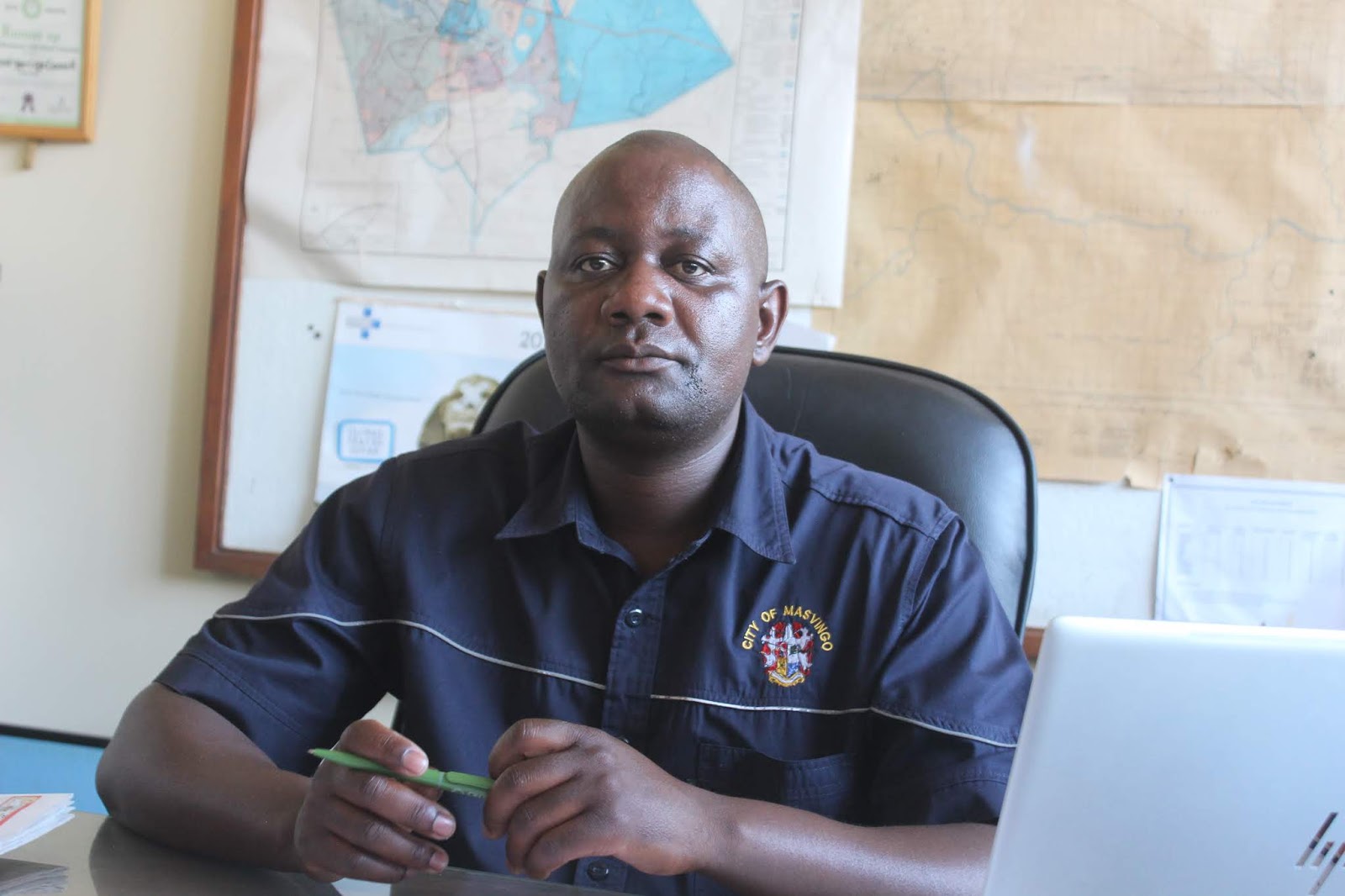
City of Masvingo Housing and Community Services director Levison Nzvura has
said council will no longer allow free reign at Chitima market, and is designing
a plan to allocate stalls to identified individuals who will regularly pay
rentals to council.
In 2015, council lost
much control of the shanty market following politicised protests by informal
traders who felt council was milking them dry by collecting daily fees without
improving facilities.
In an interview with
TellZim News, Nzvura said council was now moving to regularise business at the
market and come up with a database of people who will be allocated market
stalls.
“We have been unable to
keep track of the exact number of people doing business there because there is
no consolidated database of traders. People come and occupy a stall for a day
or two and then go away. Nobody pays for the bays except for a few so council
is making huge losses there,” said Nzvura.
He said despite not
collecting much in terms of revenue from traders at the market, council was
still providing water, removing refuse and maintaining the toilets.
 “We have done a lot to make sure conditions there
are good but sometimes the people themselves make a mess of their own market.
People use the strangest of objects in the toilets leading to blockages, and
it’s council that has to unblock them despite that most of the very same people
do not pay anything to use the market,” said Nzvura.
He said council
expected to complete the rationalisation of the clothing section of the market
first before moving on to the vegetable side.
“There are about 700
bays there and we want to know who owns which bay so that we can make follow
ups in terms of rentals. We will then use the money collected to improve
facilities and put a good shade starting with the vegetable section. We want a
proper market where people can go and shop with confidence,” said Nzvura.
He encouraged market
users and members of the public to contribute to cleaner surroundings by
avoiding littering and illegal dumping of garbage.

Hopeless situation at Chivhu Gen Hospital

0


…hospital
becomes place for prescriptions only

Elliot Jinjika

CHIVHU – Things are not going on well
at Chivhu General Hospital where power cuts have affected operations and a
severe lack of adequate water has put the lives of patients in further danger.
The
hospital is also struggling under a severe shortage of basic equipment and
drugs like syringes and paracetamol.
The
hospital serves the whole community of Chivhu and all the resettlement areas
around the small town.
As a
result of the crisis, many patients are returning home without getting the
required medical help on a daily basis.
TellZim
News recently paid a visit to the hospital and managed to speak to some patients
who said they were there simply for the sake of it.
“There
are no drugs here and we have been given prescriptions and we need to buy the
medicine on our own. There is no electricity most of the times and all services
have been hindered by power cuts. The X-ray is not in operation, the laboratory
is not working and the theatre too is not working,” said one patient as he
limped home.
An
expectant mother said she had been told by a hospital employee to get help
elsewhere as her chances of dying in labour at the hospital were way higher
than what is ordinary.
“I
met a hospital employee who advised to get assistance elsewhere because it was
not safe to use the maternity ward here,” said the expectant mother.
A
staff member who spoke to TellZim News blamed power cuts, shortage of equipment
and drugs, low levels of morale among employees and lack of adequate water for
the carnage at the hospital.
“The
lab cannot function without power and most notably the mortuary. The mortuary
needs electricity always hence we are in a complete state of paralysis. The CSSD
department is not properly functioning and activities in the theatre have been
disturbed. We have a solar system but it’s not working properly. Add all that
to the grievances of doctors and nurses and you have a complete catastrophe,”
said the employee.
Another
source said the hospital’s solar system contract was awarded to a dubious
company which failed to do the work properly, leading to below normal power
being generated.
“The
solar system produces power only for the lights. We heard that had the work been
done properly, we wouldn’t be facing a crisis of this magnitude,” said the
employee.
Chivhu
Hospital Medical Superintendent Dr Alice Kanyemba was out of office and could not be
reached for comment.

Ngomahuru: A place where all sanity has been lost

0

  Women’s lobby group WCoZ donated many items including sanitary pads to the hospital                 


Upenyu
Chaota
After enduring about forty-two kilometres of a sorry
excuse for a tarred road from Masvingo town along Masvingo-Beitbridge highway,
one comes across a faint signage signalling a left turn to Ngomahuru
Psychiatric Hospital, the second largest psychiatric hospital in the country.
It is only 10 kilometres from this point to the
hospital but the state of the road will take you close to an hour to get there.
One would be forgiven for believing this is the road
to hell, a place where no one wants to go or hear about but for some mere
mortals, it is a place that calls for the humanity side in us.
Along the dusty road just close to the hospital, one
makes a right turn and is left with only three kilometres to come face to face
with the harsh realities of Ngomahuru.
Around 170 inmates – 25 of them female – are housed at
the facility which has a capacity to hold 300 inmates if all things are alright.
At this hospital, mental disorders comes in all shapes
and sizes ranging from mild to extreme requiring the dedicated nursing staff to
provide utmost love and care. These nurses deserve a crown for the job they do
despite the harsh and poor working conditions.
The hard and honest truth is that the world views mental
illness with a lot of stigma and many relatives of the mentally-challenged
patients end up dumping them at this hospital never to return again.
Some inmates have been admitted at the institution for
over 20 years and to them, the nursing staff and other inmates have become
their families.
In the 2019 budget, the government allocated a measly
$755 million towards the health sector which was slightly increased during the
supplementary budget.
In these difficult times, the government has literally
turned a blind eye and ear on Ngomahuru which now relies heavily on donor aid.
Ngomahuru Psychiatric Hospital Medical Superintendent
Dr Parirenyatwa Maramba said the institution faced a number of challenges due
to the worsening economic situation.
The biggest challenge, according to Dr Maramba, is food
shortages. He said when patients receive their medication, they develop monstrous
appetites yet there is no food most of the times.
“Ngomahuru is the second largest psychiatric hospital
in the country. It has a bed set of 300 but on average we admit up to 170 and we
have between 25 and 30 females each time.
“There are many challenges. We don’t have sanitary
pads for female inmates unless somebody has made donations. We have received
some donations in recent days but we welcome more.
“The major issue on the ground is food. We need food
especially meat, cooking oil and sugar among other basics,” said Dr Maramba.
TellZim News learnt that the institution normally gets
mealie-meal and rice but there is no meat or beans with which to take the rice
or sadza.
Patients at times eat vegetables without cooking oil,
porridge without sugar and plain sadza.
“Our main funding comes from government and as you
know the country is going through a difficult time and funds are severely
limited. As long as the government does not have money, we also do not have
money.
“Our patients do not pay any money they are treated
for free so everything depends on the government which is currently struggling.
We need help from everyone who can come and assist. The government is trying
yes but it is not enough. We are overwhelmed with patients and we need a lot of
food,” said Dr Maramba.
One female inmate whom nurses said was getting better
and ready to go home, said she found herself at the hospital after she went
through massive depression.
“I am here because I went through massive depression.
I separated from my husband and when it was time to share property, I was
deprived of everything. My husband took everything and I was left with nothing.
“I was so depressed and I lost my mind. I was admitted
here but now I am ready to go home. I have communicated with people at home to
come get me or send me money but they refuse saying I should stay admitted,”
she said.
Women inmates at Ngomahuru are in dire straits and are
walking around without underwear and an urgent appeal has been made to address
this issue. There is need for bathing towels, detergents, uniforms among other
basics.
The Women Coalition of Zimbabwe (WCoZ) Masvingo
Chapter in partnership with the Roman Catholic St Peter’s and Paul’s Cathedral
Mothers’ Union donated hundreds of sanitary wear, soap, toothpaste among other
toiletries to ease the shortages.
“We are elated as a chapter to have contributed
towards alleviating the health crisis that is affecting our fellow sisters here
at Ngomahuru Hospital. The women activists initiated and coordinated this
response at chapter level and pledged to mobilise a $10 contribution per person
towards the purchase of commodities needed.
“What the WCoZ chapter members have done in
self-resource mobilisation has shown a great deal of maturity and this exhibits
a vibrant women’s movement capable of supporting one another through difficult
times,” said WCoZ Masvingo Chapter chairperson Joyce Mhungu.

Masvingo Provincial Hospital runs for weeks without incinerator

0

Moses
Ziyambi

Masvingo Provincial
Hospital recently spent many weeks using the council dump site to dispose of
potentially harmful medical waste materials that are normally fed into the
incinerator for destruction.
The hospital had run
out of coal that is used to generate the high amount of heat that an incinerator
requires to destroy different kinds of waste products.
A source at the
hospital said management had ‘slept on the job’ and failed to procure coal on
time, leading to a medical waste disposal crisis that lasted close to four
weeks.
“Somebody neglected
doing their job and we ended up without any coal. We resorted to using the
council dumpsites to dispose of some controlled medical waste materials
including sharps (syringes, needles, disposable scalpels and blades). It was a
very bad thing to do,” said a source.
The source also said
coal had last been procured in 2015 and there was supposed to be a replenishment
at the beginning of 2019 when stock levels became seriously subdued.
Materials that are
usually incinerated include pathological and infectious waste materials and
well as expired pharmaceuticals.
Pathological waste
refers to human tissue, organs and fluids while infectious waste means waste
contaminated with blood or bodily fluids and waste generated during
post-mortems.
Sources said the most
common pathological waste coming out of Masvingo Provincial Hospital is
generated in the maternity wards in the form of placentas that come out when pregnant
women give birth.
Infectious waste at the
hospital consists mostly of used bandages and cotton wool.
When contacted for
comment, Masvingo Provincial Hospital public relations officer Ruth Zulu
confirmed that the hospital had ran out of coal and had used the council
dumpsite.
She however denied
reports that the hospital had used the dumpsite to dispose of dangerous medical
waste, saying only ‘acceptable’ materials were taken there.
“We wouldn’t be that
irresponsible because we use the same neighborhoods as everybody else. Together
with our families, we are part of the community. Yes, we experienced a shortage
of coal due to the economic problems that every other institution is facing but
we eventually managed to procure 21 tons from Hwange and that should last us
for a long time depending on the amount of work that has to be done,” said
Zulu.
She said during the
crisis, the hospital improvised ways of destroying waste materials that could
not be disposed of at the dumpsite, but could not state categorically how the
improvisation was exactly done.
Masvingo acting town
clerk Edward Mukaratirwa said if medical waste was dumped at the council
dumpsite, it was done without express authority from the local authority.
“It was done without
our authority. Environmental health laws do not allow medical waste to be
dumped at such places. Such materials should be destroyed in the incinerator,”
said Mukaratirwa.
The dumpsite, which is
located right in the middle of Runyararo West and Victoria Ranch, has for a
long time been a burning issue as it is seriously affecting residents of the
two areas.