Home Blog Page 122

Economies of affection and vertical trust deficit

By Nicholas Aribino

Economies of affection and vertical trust deficit When countries enjoy growth with development, leaders of such countries naturally earn the respect of their followers without necessarily muscling it up. Growth with development is growth that comes with hybrid dynamics that straddles both quantitative and qualitative aspects of development. As opposed to quantitative growth that is aligned to International Financial Institutions like the IMF and WB, growth with development is sensitive to human security because it embraces the happiness index of a nation, which is the qualitative domain of development. Many African countries are failing to realise growth with development because of political patronage, economies of affection, tender-preneurship, selective application of the law, corruption and pernicious polarization. Arguably, where economies are belaboured with the above factors, they become disarticulated and, in the process, vertical trust deficit sets in, thereby complicating governance. It is the object of this opinion piece, to ventilate the extent to which economies of affection have wrought vertical trust deficit in Zimbabwe.
Vertical trust deficit is a situation whereby citizens no longer trust their leaders. This mistrust emanates from citizens’ observations of how decision-making, policy making, production and distribution of resources, appointments, procurement of goods and services and dissemination of information are done. Since independence, there have been a disturbing trend of economies and politics of affection where government tenders, land distribution and appointments of personnel to key institutions like commissions, parastatals, judiciary, government boards, ministries and departments are concerned. For example, land distribution has largely benefitted the political elite, with some of them having multiple farms at the cost of everyday people of Zimbabwe. Furthermore, findings of most land audits have not been released for public consumption because they contain names of BIG people. During the time of Gono (2003-2013) as the governor of Zimbabwe there were agricultural implements and loans that were given to a beneficiary population defined according to politics of affection, and these loans were later written off. At the time of Kumbirai Kangai as the Minister of Land and Agriculture (1994-2000), the Grain Marketing Board (GMB) was prejudiced of millions of dollars when he flouted tendering procedures. In 2015 the Auditor General’s report revealed that the Basic Education Assistance Module (BEAM), which is a safety net for orphans and vulnerable children, was at some stage ring-fenced (US$500 000) for food hampers for some officials in the Ministry of Public Service, Labour and Social Welfare, leaving multiply minoritized students without anything to cater for their scholastic needs. The Auditor General has on several occasions revealed deep dyed corruption within parastatals, government departments, parliament and commissions. Specifically, in 2016 a report by the Auditor General revealed that US$15 billion in diamond revenue had just dissipated due to lack of oversight and corrupt tendencies in the state-owned diamond company.
In the light of the above revelations of leakages within different public structures, the citizens naturally lose faith in the entire fabric of governance. When there is loss of faith in the system, citizens develop what is called vertical trust deficit. In an environment where there is vertical trust deficit as a result of economies of affection, institutions become dysfunctional because appointments to such institutions may be according to homophilic tendencies as compared to meritocracy. Filter bubbles and echo chambers are common in token economies because they characterize side taking rather than perspective taking. Economies of affection split nations into camps and these camps make it difficult for countries to be guided by issues when critical decisions are being made. Economies of affection identify with home or identity politics that can never help nations to converge on a common ground of building their nations. Where there are binary divisions, citizens will suffer as the distribution of resources will be done along political persuasions, key institutions like the judiciary and parliament will be guided by the strategic interests of people who wield social, political and economic power. The court judges in such nations become the spirit mediums of the political elites when they hand down judgements in court, and the parliament becomes an institution for settling scores and making laws that align to an incentive economy. As all these things happen, citizens will be observing and as they observe, their cognitive structures are coloured in a manner that creates a fertile ground for thinking that nothing good will come out of Nazareth. When such perceptions hold sway, citizens lose faith in the whole system of the nation and may fail to rally around the flag of their own country. Some of the citizens may even consider to migrate to other countries where they can build their careers and others may decide to remain in the country by riding on an unbanked informal economy where they get by through survivalist approaches of street smartness (kiya kiya, kungwavha-kungwavha).
Economies of affection do not come with any beneficiation, because they create the US vs THEM mentality which is toxic to growth with development. As we live in Zimbabwe let us realise that Zimbabwe is bigger than anyone of us and that social, political and economic circumstances change. In the event of shifting circumstances, we should be able to find one another as Zimbabweans. We only have one country, thence we need to develop it with an attitude of a singleness of purpose and fixity of focus. Economies of affection are not sustainable because circumstances change. Who ever thought that the late President of Zimbabwe R.G Mugabe would be buried in Zvimba, and not at the hero’s acre?

I am writing in my own capacity

UWPCG donates sanitary wear to Ndarama High girls

By Decide Nhendo

Masvingo Urban Women in Progress Community Group (UWPCG), a savings club that is donating sanitary wear to schools in Masvingo town recently took the charity initiative to Ndarama High School where they donated 139 packs of sanitary wear on July 26.
The donation is in fulfillment of the organization’s objective to mobilise resources to end period poverty in the province and it has so far donated 110 and 142 packs to Mucheke High and Masvingo Christian College respectively.
Speaking to TellZim News, UWPCG chairperson Regina Chabhanga said they realized that the girl child is more vulnerable hence they are trying to help, though in a small way.
“We do not have enough resources but we are going to do the little we can for our school-going children. Our wish is to extend to the communities and address other challenges affecting the girl-child,” said Chabhanga.
“We take heed to the advice we got from Masvingo Christian head Dr Edson Muresherwa to extend our hand to the boys also; so we are planning to come up with something for the boys soon,” Chabhanga added.
Ndarama High school head Oddy Matongo applauded the donation and UWPCG saying the donation would go a long way in serving girl leaners who are often absent themselves from school during their menstrual cycles due to lack of sanitary wear.
Matongo urged UWPCG and other players to take the initiative to rural schools as well.
“We are grateful because of what UWPCG has done, they have remembered the girl child by providing the essentials, and I pray that if resources permit, they should increase the numbers because we have a lot of girls who do not afford sanitary wear.
“I understand that we have economic challenges, but the effort by this group of women shows that they are determined to help the girl the child. This same initiative must be taken to rural areas because I am sure that most children there lack these essentials,” said Matongo.
UWPCG started in 2019 as a savings club and they contributed money which will then be lent to members who would return it with interest. They then started charity work where they help communities that are in need.

Rutenga woman dumps baby in blair toilet

0

By Rangarirai Shanyurai

In a distressing and shocking incident, a 20 year old woman from Rutenga was recently arrested for allegedly dumping her newly born baby boy in a blair toilet.
Zimbabwe Republic Police (ZRP) confirmed the arrest of Privilege Moyo over case of infanticide which occurred on July 15 at Village 9, Limbigia on their official X handle.
“The suspect dumped a newly born baby boy in a blair toilet immediately after giving birth to the child. The lifeless body of the infant was retrieved from the toilet on July 24 and was taken to Mwenezi District Hospital mortuary for post mortem,” reads the post.
Police in Harare are also investigating two other cases of infanticide whereby remains of a human baby where found under ZESA pillars while the other one was found wrapped in a plastic bag at a dumping site in Chitungwiza.
“The remains of a human foetus were found at an open space, under ZESA pylons in Kuwadzana 7, Harare on July 25 whilst another foetus was found in a black plastic bag at a dumbing site in Unit, Seke , Chitungwiza on July 25 at around 1000 hours,” reads part of the post.
The police are urging anyone with the information regarding these incidents report to any nearest police station.

Villagers in crisis as bridge damaged by cyclone in 2000 yet to be repaired

By Tatiana Mhararira

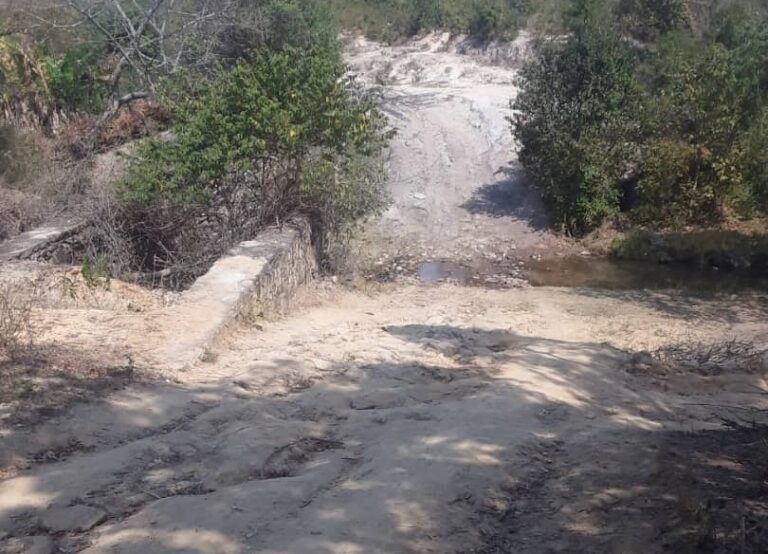
Since 2000, Madzive River Bridge that connects villagers from Hari, Mbeva and Mutonhodzi areas in Masvingo North has not been repaired and villagers are appealing to authorities to intervene.
The bridge, which connects roads network in Mbeva, Hari and Mutonhodzi villages, has an economic value since it links the community to Masvingo town where they access a number of services as well as selling their fresh farm produce.
Speaking to TellZim News, Ward 14 Councillor Misheck Nzvinginya whose ward the bridge is located said it is a vital economic resource that connects communities for different programmes.
“Most villagers from Mbeva travel daily to Masvingo to sell sugarcane and vegetables, and the damaged bridge has disrupted their economic activities because low lying vehicles struggle to cross through the temporary crossing point and it is worse during rainy season when the river gets flooded,” said Nzvinginya.
“Transporters who ferry villagers to and from Masvingo also face challenges, as the poor condition of the bridge has led to increased vehicle repairs, and the burden is felt by villagers as transporters transfer this cost to the villagers by increasing the fares,” Nzvinginya added.
During the rainy season, villagers on the other side of the bridge struggled to access essential services such as the grinding mill which is on the other side of the river.
A local villager Noah Machote said the situation was also affecting learners who cannot cross the river to school when there are floods.
“Most vehicles do not cross the bridge, and we are often forced to carry the sick on our backs to Zano Clinic, we have lost patients on their way to the clinic.
“The poor road network has also limited the movement of leaners to Makwavo and Zano schools, leading to increased absenteeism during the rainy season,” said Machote.
The prolonged abandonment of the bridge has had a significant impact on the economic and social well-being of the surrounding communities, highlighting the need for urgent intervention to repair the critical infrastructure.

Herbalist acquitted for culpable homicide

0

By Meditation Mposi

A 36 year old herbalist from Masvingo was lucky to escape imprisonment after Masvingo Magistrate Bishard Chineka acquitted him of attempted murder charges on July 31.
Innocent Tiringindi was dragged to court charged with culpable homicide as defined in section 49(1) of the Criminal Law Codification and Reform Act (Chapter 09:23).
It was the State case that on November 13, 2023, Tiringindi from ZBS, Masvingo was called by the now deceased Catherine Dube who wanted to buy Babado seed herbs to treat her stomach problem.
Tiringindi then went to Dube’s place of residence and delivered two Babado seeds at US$5.
Dube consumed the herbs on the same day at around 0500hrs as was prescribed by the herbalist and that’s when she started vomiting as well as sweating.
Tichaona Kubiku who is Dube’s husband then realized that the now deceased’s health was further deteriorating and rushed her to Masvingo General Hospital to seek medical attention.
Upon arrival at the hospital, Dube was pronounced dead after being attended to by the nurse on duty. The matter was reported to the police and a postmortem was conducted to establish the cause of death.
The postmortem report revealed that she died due to chemical toxicity and the abdomen, kidneys, liver and bowels were all injured. The report further noted that the damages could have been caused by consumption of poison, the body failing to accept a certain drug or the person may have been suffering from acids for a long time.
In acquitting, Tiringindi, Magistrate Chineka said the fact that the postmortem did not mention that the damages in the deceased’s body were linked to the Babado seed, means there was no enough incriminating evidence.
The Babado seed is used to treat people in Western countries and that Tiringindi was a registered herbalist who had treated a number of people including the deceased’s relative. The relative did not die.

Mandebvu convicted, gets 2-year jail term

By Perpetua Murungweni

After months of delays and excuses, Zanu PF Masvingo provincial youths chairperson Delight Mandebvu’s court was finally concluded, with magistrate Franklin Mukwanazi sentencing him to two years in prison.
However, Mkwananzi wholly suspended the jail term after considering that the accused suffered a broken leg, which medical reports indicated was permanently damaged, during the scuffle. The suspended sentence was also on condition that Mandebvu does not commit a similar offense for the next five years.
It was the State’s case as presented by prosecutor Godknows Mugondo that on March 2, 2024 Mandebvu assaulted former Masvingo City Mayor Collen Maboke and his wife after the latter’s car side-swapped the vehicle in which Mandebvu was traveling in along the Masvingo-Nyika road.
Mandebvu turned and pursued Maboke’s vehicle that was being driven by his wife and blocked it after 10km and he, together with his associates started beating up the two.
The case dragged for a long time as the accused person has been coming up with one excuse after another.
At one point Mandebvu, went on to file attempted murder charges against Maboke alleging that he was hit by Maboke’s vehicle, not by any other vehicle as was reported.
The other time Mandebvu told the court that he wanted to look for a lawyer outside Masvingo because the lawyers around were friends with Maboke hence they were compromised.

Regency Hotels struggling to pay workers

By Staff Reporter

MASVINGO – Regency Group of Hotels management is failing to pay its workers with some going for more than four months without salaries.
Regency Hotels runs Flamboyant, Chevron and Panyanda in Masvingo as well as Fairmile Hotel in Gweru.
Contacted for comment, Regency Hotels Managing Director Edison Zvobgo Junior who is also Masvingo Central MP could neither confirm nor deny as he said there were some challenges which had since been resolved.
“I have no comment on that matter but what I can simply say is that there were some temporary challenges that have since been addressed,” said Zvobgo.
Sources within the organisation said the salary issue had been taken to the National Employment Council (NEC) and the Zimbabwe Catering and Hotel Workers Union (ZCHWU). The hotel management was said to have tried but in vain to persuade workers to withdraw the matter.
ZCHWU regional organizing secretary Elliot Madzore confirmed that his organisation was dealing with the matter but referred questions to his superiors.
“Yes we are dealing with the matter but I cannot give you more details as I am not allowed to speak to the media, you should talk to my superiors for a detailed comment,” said Madzore.
However, sources said ZCHWU had since given Regency an ultimatum to clear all the salary arrears before they take up the matter.
“They are paying workers in batches and so far they have only paid 10 people for the month of March and they only paid the ZIG component and the rest are yet to get their salaries. However, they were given seven days to clear the arrears and if they fail the matter will be taken up to labor court.
“The matter was taken to NEC and we have had several meetings with the management which is trying to persuade the workers to withdraw the cases and pursue internal processes. The workers are irked by the fact that the management is not showing any remorse, rather they are boastful, arrogant and too reluctant to address the salary arrear issues,” said one of the employees who spoke on condition of anonymity.
Another source said there was serious mismanagement of the organisation which is witnessed by the deterioration of services and infrastructure which is in dilapidating state.
“Standards are getting down every day at all the hotels, there is no maintenance of infrastructure, and there are very old beds and linen, the workers have no motivation so the services are also getting lower,” said another source.
Flamboyant Hotel used to be one of the best in Masvingo town but the standards continue to deteriorate and is left at the mercy of those clients who want to book there or Chevron because of its proximity to town.

Masvingo RDC re-introduces clinic levies at all council health facilities

By Staff Reporter

In a sad development, Masvingo Rural District Council has reintroduced a clinic levy on all its health facilities in the district ending a 10 year free access to health care services.
Masvingo RDC chairperson Elias Jera confirmed the development to TellZim News saying the move was necessitated by high operational costs since donors who were funding the costs for the past decade had pulled out.
A notice was flighted by the local authority giving specifications of the levy which is effective from August 01, 2024 where adults are expected to pay US$1 whilst children will be paying US$0.50. Pregnant women will be expected to pay US$5 per pregnancy.
“Please be advised that council is re-introducing clinic levies in council clinics with effect from August 1 as follows. Adults US$ 1 per visit, children US$0.50 per visit, maternity US$5 per visit. The move has been necessitated by clinics’ running costs,” reads the notice.
Jera said they were aware of the difficult situation villagers were facing especially in rural areas but had no better options than to levy them operational costs only.
“We reintroduced the levy that had been stopped in 2014. We used to have donors who were funding these operational costs but sadly the funding partner pulled out recently, therefore, we had no other option than to reintroduce the levy so that we cover the operational costs,” said Jera.
“We are aware that people are struggling and they hardly afford to pay for the health care services but this was the only viable option if we are to sustain these clinics. Villagers will only pay operational costs,” he added.
The health facilities were being funded on a programme called Result Based Financing (RBF).
Access to health is expensive and dire as most health facilities have no medication and usually people go there to get prescriptions that they will use to buy medication from pharmacies.

‘Runyoka’ suffering man sets camp at married lover’s home

By Brighton Chiseva

ZAKA – A Bikita young man will rue the day he lustfully developed an adulterous relationship and having sexual intercourse with a married woman after he started experiencing severe stomach pains allegedly caused by juju popularly known as ‘runyoka’.
Nelson Matupire is said to have since relocated and camped at the woman’s place saying he will not leave until her husband cleanses him.
Matupire confirmed the development to TellZim News and said he was in pain for the past 12 Months and was appealing to well-wishers who can help him or refer to someone who can help him.
“I met the lady in BeitBridge and we got intimate after she had separated from her husband. After that I began to have problems, I have something like an STI on the privates and I feel like there are small insects that come out from there and fly leaving irritants (Uriri/unye) similar to hurukuru (The buffalo bean).
“When I tried to establish the problem that’s when I learnt that I had slept with a lady who was locked (akaiswa runyoka/Rukawo). When I tried to engage them they had reconciled and they both ran away and I struggled for a very long time. We visited faith healers who told me that the lady’s husband was responsible for my illness but he denies,” said Matupire.
He went on to say the lady only came back after she also started suffering from severe stomach aches which she later learnt was from the same charm put on her by her husband and she is now cooperating.
“The woman is now suffering from stomach aches and she was told it’s because of the charm put on her that was making her sick. So I am now staying at her place but the husband is still slippery,” said Matupire.
Asked how he was staying with a married woman in the absence of her husband, Matupire said they were just staying because of the situation and there was nothing going on between them and said he felt better if he is at the place and it gets worse if he goes back to his home.
“If I go back home, the pain increases and its better if I am here that is why I am staying but there is nothing between us and we cannot risk another engagement since she is also suffering. I have been in and out of police custody as I often clash with the family,” said Matupire.
Magadzire Village head Isaiah Zirumbwa Magadzire, where the woman comes from, confirmed the incident and said they were trying to assist Matupire but the biggest challenge was that the alleged perpetrator is nowhere to be found.
“The young man met this lady who is married in Beitbridge after she had separated with her husband. The two got intimate and the man started suffering from stomach pains in which he says he felt things like worms moving up and down his stomach.
“After the incident, the woman’s husband then followed up on his wife and they reconciled, however, the man continued suffering until he came here to engage the woman’s husband,” said Zirumbwa.
“The challenge now is that the alleged perpetrator denied having used any locking system (juju) and has since disappeared. So what we did is to seek help from the police to intervene and make sure that the man stays.
“As it stands they are staying together and Matupire sleeps in another room. Before, he used to sleep outside. We warned them against intimacy as that could worsen the situation,” he added.
He also appealed to those who may help the young man as he was suffering saying he has been getting help from different churches and now it’s better, “said Zirumbwa.

ZB Financial Holdings hosts Midlands SMEs Expo

By Tinaani Nyabereka

Gweru — The ZB Financial Holdings hosted a successful Small and Medium Enterprises (SMEs) Expo at Gweru Sports Club last Saturday July 27.
The Midlands SMEs Expo was held under the theme; ‘Accelerating SME Growth through Financial Partnerships,’ with an objective to enhance collaboration and support to Zimbabwe’s Micro, Small, and Medium Enterprises (MSMEs).
Speaking at the event, Minister of State for Midlands Provincial Affairs and Devolution, Owen Ncube applauded ZB Financial Holdings for its leadership and commitment to advancing the MSME sector.
“Zimbabwe’s economy, noting that they account for over 60% of economic activities, provide 4.8 million full-time jobs, and contribute USD 7.8 billion to the GDP. Despite this significant impact, MSMEs face challenges such as inadequate business management skills, limited mentorship, and poor access to markets, workspace, and affordable finance.
“The government’s efforts, guided by the MSMEs Policy Framework (2020-2024), include promoting access to finance through various funds and Savings and Credit Cooperatives (SACCOS), facilitating market access in partnership with ZimTrade, offering business and technical skills training, and encouraging the adoption of standards and product certification. Additionally, efforts to formalize MSMEs through business registration are ongoing,” said Ncube.
“Participants at the Expo are set to benefit from financial literacy training, opportunities to explore diverse funding avenues, and interactions with financial institutions to identify tailored financial products. The event also highlights sustainability practices through the Grow a Tree Foundation and provides insights into public procurement opportunities.” He added.
Speaking at the same event, Standard Association of Zimbabwe (SAZ) representative, Nyasha Mutseyekwa said they were there to work with SMEs in coming up with fine standards.
“So as Standard Association, we are not responsible for making standards, rather we invite other important stakeholders – be it academia, retailers, researchers, etc, so that they assist you. We want you to bring your products for testing before taking them to the market,” said Mutseyekwa.
“The benefit of us testing your products as MSMEs is, you get the market value and quality of your product. Even if you want to get a loan, once your products are certified, it brings in confidence to the lenders,” Mutseyekwa added.