Home Blog Page 271

Rural areas top mortality, orphanhood – ZimStats

Beverly Bizeki

Preliminary results for the 2022 population and housing census have revealed that rural areas in Zimbabwe top the mortality rates with a low life expectancy rate as compared to urban areas.
In a preliminary report released by the Zimbabwe National Statistics Agency (Zimstat), 121 078 deaths were recorded over the 12 months preceding to the census.
“A total of 121 078 deaths were reported in the last 12 months preceding the census. Crude death rate was 8 deaths per 1 000 population,” read part of the report.
Matabeleland South recorded the highest average death rate at 9.7 deaths per 1000 population.
Only 41.4 percent of the deaths were registered whilst 34.8 percent were registered in rural areas and 56.5 percent were registered in urban areas.
The national life expectancy stands at 64.7 years with females having a higher life expectancy of 68 years compared to males who have a life expectancy of 61.2 years.
Generally the life expectancy in urban areas is higher than in rural areas standing at 65.5 years and 63.3 years respectively.
The report also showed that the neonatal rate stands at 9.5 deaths per 1 000 live births whilst post neonatal rate stands at 14.7 per 1 000 live births with rural areas having higher rates of neonatal, post neonatal and infant child and under 5 mortality deaths.
1589 maternal deaths were recorded in the report.
“A total of 1 589 maternal deaths were reported against 437 478 live births giving a national Martenal Mortality Ratio (MMR) of 363 deaths per 100 000 live births. MMR was higher in rural areas (402 deaths per 100 000 live births) than in urban areas with 298 per 100 000 live births),” added part of the report.
The report further shows that the lifetime risk of maternal mortality is 14.6 deaths per 1 000 women of child bearing age and is higher in rural areas.
Lifetime risk of maternal mortality was higher in rural areas standing at 18.6 women per 1000 as compared to the urban risk of 9.8 women per 1000,” read part of the report.
The report also shows that 7.7 percent of children below 17 years are orphans with prevalence higher in rural areas at 8.4 percent as compared to 6.3 percent in urban areas.

Kwekwe man found hanging in bush

0

Tinaani Nyabereka

Police in Kwekwe are investigating a case of sudden death where the body of a 51 year-old man was found hanging from a tree in a bush.
The incident occurred at Forestville farm in Kwekwe Rural on October 6, 2022 around 0900 hours.
It is said that Leonard Chinembiri of Forestville Farm left his homestead wearing a white garment as if he was going for prayers.
On the same day at around 1000 hours Patrick, Zisengwe of the same area was herding cattle at a nearby bush when he saw the body of Chinembiri hanging from a Msasa tree with his neck tied with wire.
It is suspected that Chinembiri committed suicide.
The matter was reported to the police who attended the scene and body of the deceased was ferried Kwekwe General Hospital awaiting post-mortem.
Midlands Provincial Spokesperson Inspector Emmanuel Mahoko said investigations are still in progress.
“Police are appealing to members of the public to consider sharing their problems with a trusted friend or relative or make use of the Zimbabwe Republic Police (ZRP) Community Relations Liaison Offices located at every police station for assistance rather than taking own life,” he said.

Zimbabwe too far from DWA -ZCTU

0

Emmanuel Chitsika

The Zimbabwe Congress of Trade Unions (ZCTU) President Florence Taruvinga has said Zimbabwe is far from realizing the Decent Work Agenda (DWA) though the initiative was launched nine years ago.
In a speech read on her behalf last weekend by the national executive member of Zimbabwe Hotel and Catering Workers Union Netsai Matumbike at the ZCTU Southern region boardroom in Masvingo, Taruvinga said Zimbabwe is a long way from attaining the DWA set goals.
“The ZCTU has with conviction noted that the country is still far from attaining meaningful gains in the DWA. We have also realized that policies implemented by government have failed to respond sufficiently to the needs and dictates of decent work.
“Workers in Zimbabwe face the following high unemployment, poor quality and unproductive jobs, unsafe work, insecure income catalysed by the decimation of workers’ rights. Government and employers gained much ground, implemented measures against attainment of decent work while the labour movement was immobilized.
“Generally most workers are experiencing serious decent work deficits. Meagre wages, wage theft and precarious work are prevalent even in informal employment. Modern day slavery is over-pronounced at Chinese-owned companies which enjoy protection from government. How can we achieve DWA if our own government is guilty of protecting the major perpetrators of workers’ abuse?” said Taruvinga.
She went on to say achieving a decent wage on part of Zimbabwean workers is a major challenge.
“The World Day for Decent Work 2022 theme of ‘wage justice’ is an apt challenge to us. Our wages are very low and inadequate but we will continue to call for a Poverty Datum Line linked minimum wage as our starting point.
“The demands and issues that we raised over the years have not changed because our situation is not showing any signs of improvement, rather it’s getting worse.
“As part of 2022 commemorations, we highlight the following: advocating for amendment of repressive and draconian laws, evaluation and auditing of decent work achievements, dissemination of DWA information, campaign for labour law reform and gender equality as well as ratification of International Labour Organization (ILO) convention 190,” added Taruvinga.
She said the agenda can be achieved if all social partners namely government, business and labour.
Government and labour have been at logger heads as the latter feels the former is doing nothing to correct the situation in the country facing most if not all workers.

MEN’S MENTAL HEALTH

0

Voice Rossana Mutema

Men don’t seek help for mental health related issues, a development that has seen a number of cases of mental health problems being more prevalent in men as compared to their female counterparts. Many believe that men usually do not seek help as they are believed to be strong and are afraid to be seen as less masculine.
Societies which are mainly patriarchal teach boys to be strong and “be as man” even when going through an emotional overload. This has a bearing on how they handle any form of pressure as they would want to appear strong when they have to look for help.
Men also don’t want to be a burden to others and this result in them not sharing their problems. They do not want to share their feelings with family members or friends and this cause social isolation, exacerbates relationship difficulties and worsen feelings of depression and in worst scenarios, they commit suicide. Researches have shown that men commit suicide more than women while the number of attempted suicide cases are more in women than men.
Mental health affect all genders, but it is often overlooked in men and research on men’s mental health is given less priority. Men tend not to get attention because they usually don’t want to open up if something is troubling them be it depression, social anxiety and mental disorders.
Toxic illusion of masculine self and self-reliance lead to high levels of stress and poor mental health. This makes them find it difficult to be honest with loved ones and more importantly themselves. Societies judge men who talk about their mental health problems as weak and are often not taken seriously. Because of this, a number of men may find it difficult to speak about mental health and are reluctant to seek treatment to manage symptoms.
Despite the fact that men do not share their mental health struggles people around them are at the receiving end. Men with mental health problems are more likely to take alcohol and drugs to cope with their depression rather than talking about it. Some become more insensitive, get irritated fast, increased loss of control, risk-taking and aggression. To them ‘everyone around is the problem’. Some use the escapist behaviors, since they are oriented that a man should control his feelings and real men don’t ask for help they deal with it.
A lot needs to be done for boys and men who need to be taught to talk, share their problems and allow others to help them. They need to be taught that they too have feelings they must cry and be emotional, ignoring how they feel does not make the situation better. They need to be taught that being emotional is normal, everyone feels it and sharing is not a sign of weakness. Men should know that sharing and seeking for help is actually a sign of strength. Other issues of mental health just need us to open up and seek the necessary help needed.
Society is another port of call to address mental health problems. It needs to be made aware of how important mental health is a cancerous problem that knows no gender or social class. Society also needs to be made aware that the mentality that the word ‘man’’ implies strength, power and assertiveness is wrong. It implies that men are not supposed to have mental health problems. For years, men have been told that it is not appropriate to talk about their feelings.
They have had limits placed on what is okay and what is not, to talk about. A lot of suicides committed by men are a result of these stigmas that surround their mental health. It shows how many men suffer in silence and ends it with these self-inflicted deaths.
The vastness of responsibilities on men’s shoulders and what’s expected is too much and yet no one cares how they feel or check if they are. Things happen in life like difficulties with work or finances, breakdown of relationships, overwhelming family responsibilities or a significant setback. These challenges can take a serious toll on one’s mental health. The only option will be to talk it out. You will even notice more signs of poor mental health like hopeless or worthless and behaviors that usually destroy relationships, drinking more than usual and also isolating from family and friends.
However, establishing and maintaining relationships, talking about the hard stuff in life and taking action when times are tough and proven ways for men to stay mentally healthy and cope with the stress of everyday life. Good overall health and wellbeing is linked to not only better mental health but also reduce the likelihood of suicides. If people around all men are there for them when it gets overwhelming, they can share and seek the needed help with support of friends and family.
If you know someone who is emotionally distressed or in crisis, the first step is to talk to him. Begin a conversation with a friend, family member or a health professional. Talking, listening and being there for someone going through tough times can be lifesaving. Always check in if you know someone who is going through a difficult time. Ask if they are doing okay and be prepared to listen. It is important for us to check in on our loved ones, if we can’t help we can always seek help for them. Untreated mental health conditions breed suicide. The distress a man experiences at these times affects the mental being of a person so it becomes harder for one to see possible solutions to problems, or connect with those who can offer support.
Society must be made aware of the importance of men’s mental health. The way they feel should matter therefore, they should be encouraged to open up and seek help. Once the community accept and understand more about mental health it becomes easier for people to understand. Men’s mental health is equally important as women’s. Everyone needs love and support to get past life situations. Seeking and giving help should be done equally therefore people must put efforts together and change the narrative. A problem shared is a problem half solved. Let’s make the world a better place and get the conversation started to ensure that men’s mental health is treated with the importance it deserves.

Voice Rossana Mutema is a Student Counselling psychologist at Great Zimbabwe University. She writes here in her personal capacity.

‘Residents failing to separate development from politics’

…As partisan political battles rips into GCC’s service delivery

Tinaani Nyabereka

GWERU-The mishap affecting Gweru City Council’s service provision system has greatly been attributed to failure by residents and office bearers to separate politics from development.
This was said by a council official during a Gweru Residents and Ratepayers Development Association’s Social Accountability and Monitoring engagement held this on October 9, 2022 in Gweru.
Speaking at the event, Gweru ward 18 councillor who is also the chairperson for the Environment Committee John Manyundwa said the polarised and toxic political environment was greatly hindering development as people are more centred on politics than development.
“The problem we have is that our communities are failing to separate politics from development as much priority is given to politics rather than developing our constituencies.
“As a result people don’t attend ward meetings or consultations because they first look to see if the councillor is their political candidate. No matter how you call for a meeting, people don’t come because of political affiliation of some councillors,” said Manyundwa.
He added that the on-going political in-fights between MDC-T and CCC parties within the council are a major contributor to poor service provision as councillors are divided.
“We cannot dismiss that council is bound with political rifts as city fathers are prioritizing political allegiance than residents’ concerns. This was further worsened by the paradigm shift of power due to the recalls which affected office bearers.
“The first issue of concern is politics; we are no longer on the same page as we used to be when we took over in 2018. The split of MDC-Alliance and the formation of Citizens Coalition for Change (CCC) has created confusion at council as councillors are now focused more into political groupings and allegiances than service provision.
“On the other hand, council management let me say, is taking advantage of the political infighting between councillors and now using the situation to avoid implementation of other policies. There is conflicting between councillors and management hence it has becomes difficult to provide services to residents,” he added.
Gweru Residents and Ratepayers Association (GRRA) director Conilia Selipiwe said residents are frustrated over the condition of service provision in the city.
“There is anger among residents and stakeholders of Gweru, we have erratic supply of water supply, non-collection of refuse, damaged roads, derelict recreational facilities, bad public lighting as well as persistent sewer blockages that are not timeously attended to in all wards.
“As councillors, you must find a way of resolving the challenges affecting the city of progress. The collapsed social contract between council and its stakeholders negatively affects service delivery,” said Selipiwe.
He however urged residents to be problem-solvers as in their communities as service delivery issues require an all stakeholder approach.
People with Disabilities Advocate Nigel Tahwa however urged Gweru city fathers to come up with effective engagement methods to cater for the disability sector in decision making processes.

‘Media has a role in GEF 7 project resource accountability’

Beverly Bizeki

The Permanent Secretary in the Ministry of Environment, Climate, Tourism and Hospitality Industry Ambassador Raphael Tayerera Faranisi has made a special appeal to the media to play watchdog role in bringing concerned parties to account of their actions for the success of the programme.
Faranisi made the appeal at the inception programme of the Global Environment Facility (GEF 7) held at Great Zimbabwe Hotel on October 12 where he was representing Minister of Environment Climate Tourism and Hospitality Industry Nqobizitha Mangaliso Ndlovu.
“I have a special appeal to the media, we have stated the outcomes expected of this programme, hold us to account, follow up on the commitments that are coming here, get us to talk about it so that the community knows. It’s not about the provinces benefitting but the people, so bring us to account when we fail,” said Faranisi.
He urged the media to play its watchdog role to ensure that resources mobilized for the programme are not abused.
“If there are any resources being abused, tell the public, tell those who are concerned so that we tear the line. This is the Second Republic and we have to deliver,” he added.
Faranisi also suggested that the stirring committee takes on board representatives from the media to ensure that the message of the programme gets through to people.
“I suggest that the media be part of the stirring committee. If they are not there, nothing will come out. It would be useful to have the media on the committee, I am aware of the fact that we do not need a very unwieldy structure but I think it’s very important to have representatives of the media because if the message does not get through, we are all under the bus,” said Faranisi.
The programme that calls for a cross sector approach supporting the mainstreaming of sustainable forest and land management to enhance to ecosystem resilience for improved livelihoods in the Save and Runde Catchments of Zimbabwe is being financed to the tune of US $10 433945 with another US $60 691 231 in co- financing from other partners implementing projects in the same area.
The objective of the Zimbabwe project is to promote sustainable management of Miombo and Mopane production landscapes in Save and Runde sub-basins following a Land Degradation Neutrality (LDN) approach.
The initiative is meant to support a cross-sector approach which will result in mainstreaming of sustainable forest and land management to enhance ecosystem resilience for improved livelihoods in the Save and Runde Catchments of Zimbabwe.
The event was attended by Patrice Talla the Sub-regional Coordinator for Southern Africa and Food and Agricultural Organizatisation representatives and directors from the three provinces in which the project will be implemented which are Manicaland, Masvingo and Midlands.
The issue of land degradation is of great concern with Zimbabwe having an estimated 36percent of the country being considered degraded and in need of urgent rehabilitation.
The project is part of a global Sustainable Forest Management Impact Programme on Dryland Sustainable Landscapes in eleven countries which is being led by Food and Agricultural Organization (FAO).
The project once completed is expected to have 2 150 ha of land restored, have 172 540 ha of landscapes under improved practices, 1.26 million metric tons of CO2e greenhouse gas emissions mitigated and have 15 000 direct beneficiaries with at least 52 percent being women.

ZRP Masvingo appeals for missing person

TellZim reporter

The Zimbabwe Republic Police in Masvingo have made an appeal to the public seeking information on the whereabouts of 44 year-old Taurai Takawira.
According to a document obtained from Provincial Police Spokesperson Kudakwashe Dhewa, the man went missing on September 30 in a forest close to Marota Primary School near Bhati area of Masvingo West constituency.
“Zimbabwe Republic Police is appealing for information leading to the location of Taurai Takawira, a male adult aged 44. He was last seen wearing a blue trousers and white T-shirt. He is medium built.
“Takawira was last seen on September 30, 2022 at a forest close to Marota Primary School, Masvingo. Anyone with information to contact Officer in Charge CID Law and Order Masvingo Detective Inspector Nyoni on 0772 399 753, 039- 2263801 or the Investigating Officer Detective Sergeant Tarwirei on 0774 442 147,” read part of the document.
The disappearance of Takawira according to Chief Bere’s spokesperson Adnos Chikomo is strongly linked to boundary wrangles that have marred the resuscitation of their chieftaincy with Chief Charumbira loyalists allegedly opposing the new arrangement.
Speaking to TellZim News, Chikomo said Chief Bere is worried by the resistance by people from Charumbira whom he regards as ‘caretaker leaders’ who are now resisting the true chiefs of the area’s coming on board.
He said they are of a strong feeling that the people from Charumbira are responsible since they are reported to have attacked Takawira and two others as they were clearing land for newly-installed village heads in the Bhati area.
“As the spokesperson of the Bere clan, the Chief has sent me to express how worried he is over the disappearance of Takawira. On the day of his disappearance, he was with two of our newly-installed village heads (Luckson Sinamayi and Mike Wengedzayi Matambanadzo) the Chief has allocated areas in Bhati area where the Charumbiras are contesting, so we strongly feel those who assaulted the other two are responsible for the disappearance.
“Since there are 11 assailants whom the police once arrested in connection with the assault of the two village heads, we feel they must also be held responsible for Takawira’s disappearance because he was together with the two,” said Chikomo.
He said they have tried on a number of occasions to look for Takawira but nothing has materialised so far and his family is always posing questions to the traditional leadership
“We once tried to look for him but nothing so has come out of the physical searches. What is now disturbing us is that his wife and kids always look for an answer from us, but we have no clue to that effect,” he added.
Chikomo alleges that Takawira disappeared after he and the two village heads were chased by axe-wielding Charumbira loyalists in the area that borders Bere area near Bhati the two heads were given to look after. The trio were in the process of constructing make-shift shelters when their assailants approached.

Mbanje lands man in jail for 18 months

0

Lydia Koto

A 26 year-old man Case Mutongo has been jailed for 18 months after being convicted of possessing 2,288 grammes of dagga by a Masvingo magistrate on October 11, 2022.
Mutongo was initially sentenced to 24 months by Magistrate Phillip Makodo.
Six months of the initial sentence were suspended on condition that Mutongo does not commit a similar offence over the next five years.
The state represented by prosecutor Nixon Chamisa alleged that on October 7, 2022 at around 2000 hours, police detectives on patrol in Mucheke suburb received a tipoff that Mutonga was in possession of dagga.
Police detectives reacted swiftly to the tip off and found Mutongo near Gomba Shopping Centre in Runyararo carrying a black monarch bag. Detectives introduced themselves to Mutongo and started searching him.
He was found in possession of one sachet of loose dagga in the back pocket of his trousers.
The detectives immediately arrested Mutongo and he was escorted to his house at 7628 Victoria Range in Masvingo where a plastic bag of loose dagga was further recovered concealed in a blanket.
Mutongo pleaded guilty to the charges.

Zaka sex worker, accomplices murder client

0

Beverly Bizeki

In a chilling case of murder, a sex worker from Zaka together with two other suspects were arraigned before Zaka Magistrate Tariro Mudzingo on October 12 for the murder of 39 year-old Alfios Mukorera from Manyanga village, Chief Nhema in Zaka.
The state case is that in the early hours of Monday (October 10) morning at around 0300 hours, Mukorera arrived at Nherera night club in a Toyota Fun Cargo vehicle together with his friend Kudakwashe Mamombe (46) of Mupombwe village under Chief Nhema as well.
Mukorera approached 24 year-old Susan Chekungwara, an alleged sex worker from Chipfunde village under Chief Bota in Zaka to reportedly hire her services.
Chekungwara agreed and spent time with Mukorera whom she took to her place in one of Jerera suburbs after the club was closed.
Unfortunately for Mukorera, Talent Mugari (19) and Panashe Chiwira (21) pursued the duo after receiving a tip off from Chekungwara to the effect that Mukorera had a lot of cash on him.
Chiwira and Mugari allegedly arrived at Chekungwara’s place and started demanding money from Mukorera whilst pushing him against the wall.
Mukorera only managed to outpace the two suspects for about 150m before being beaten with a log.
It is alleged that Mukorera who sustained several deep cuts on the face, swollen lips, broken teeth and two deep cuts on the back of the head fell to the ground and became unconscious.
An unknown passersby who saw the body of the late Mukorera informed Moudy Chivange (32) residing at Jerera who reported the incident to the police in Zaka.
A log with blood stains was found three meters from where the body was found and US $20 was found in the deceased’s wallet in his pockets.
After a police investigation, a pair of brown leather shoes belonging to the deceased was found hidden in a pink satchel in Chekungwara’s house, while US$ 283 was found hidden under the blankets leading to her arrest, the implication and arrest of Mugari and Chiwira at Jerera Growth Point.
The trio was remanded in custody to October 26, 2022.
Beatitude Shava prosecuted.

Zhirahuru complex directors host lunch at Mucheke Old People’s home

Lydia Koto

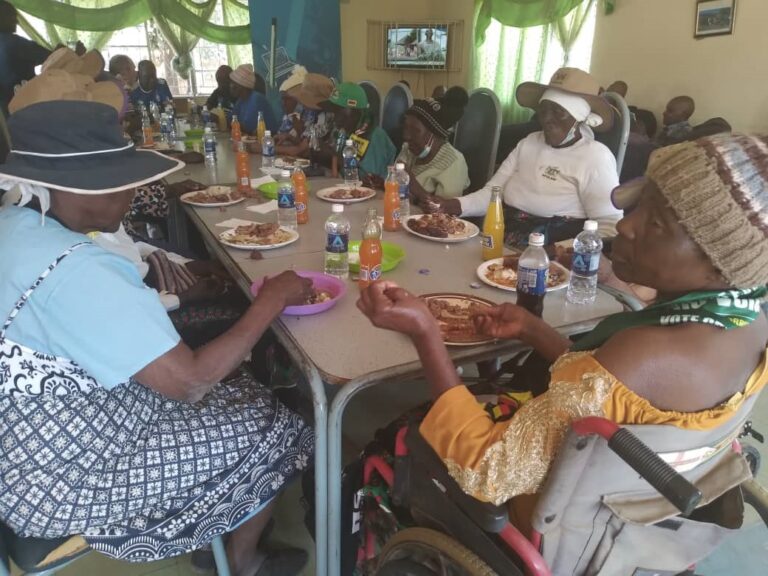
Zhirahuru complex directors hosted a lunch at Mucheke Old People’s Home on October 12, 2022 before donating 20 kgs beef to the institution.
Speaking during the event, former Masvingo City Town Clerk Adolf Gusha, one of the directors of the complex said as a business entity, they have come to Mucheke Old People’s Home to cheer up the elderly by having lunch with them.
He also added that they decided to support the elderly since they need support from the younger generation.
“We have come here to cheer up with our grandparents by having lunch with them. Old people need support from the young because they can’t do anything to sustain themselves.
“We have heard that there are 19 elderly people here so decided to give each elderly person 1 kg of meat to make 19 kgs .The other 1 kg we decided to give it to the maids and other personnel here,” said Gusha.
He thanked government, council, private sector and individuals for helping Mucheke Old People’s Home.
Gusha said he hope that other business entities are going to chip in to solve the problems the elderly are facing.

Zhirahuru complex director Adolf Gusha

“I want to thank the government, council, private entities and individuals for helping these elderly. I hope other business entities are going to help this institution to solve the problems they are facing here,” Gusha added.
Pastor Matopos Chaka of Mucheke Old People’s Home thanked Gusha and co-directors for the lunch and meat.
Chaka said that the institution does not have money to take six elderly people who have eye sight problems to Morgenster for them to be attended to by an Optician after being referred to that institution.
“I want to thank Zhirahuru for the lunch they decided to host here and also for the meat they donated to us. However, we have monetary problems here at Mucheke Old People’s Home. Sometimes we go to the council and social welfare to seek assistance but things will be hard for them and we get nothing. Right now we have six people who need to go and see an Optician at Morgenster Hospital because they have eye sight problems. But because we do not have the funds, we cannot be able to transport them,” said Chaka.
He also added that shortage of food and transport to use in case of emergency are also some of the challenges they are facing.
“We are also having shortage of food. Once the food that people donate is over, our elderly here start to eat chunks and cabbages. In addition, we are also having transport challenges such that when one of them gets sick, we can’t afford to take them to a hospital or clinic. If we call an ambulance, sometimes it takes a long time to come. We also need computers for easy communication since the world is now globalized,” Chaka added
Sekuru Gono who is the oldest inmate at Mucheke Old People’s Home was very happy with the kind gestures and he thanked them.
He said that his relatives abandoned him and that is the reason he is at the institution.
“I am happy with what you have done to us. My relatives abandoned me and that is the reason why l am here today. People who are not even our relatives are coming here to help us. May the Lord bless you and your families,” said Sekuru Gono.