Home Blog Page 430

Media freedom under severe strain in Southern Africa

0


…as Zimbabwe uses
spyware to monitor telecoms


Moses
Ziyambi

There seem to be
consensus among countries in Southern Africa to stifle free speech and media
freedom, making the need for vigilance all the more critical, the Media
Institute of Southern Africa (Misa) Zimbabwe director Tabani Moyo has said.

Speaking at a virtual
meeting with members of the African Commission on Human and People’s Rights
(ACHPR) recently, Moyo said there was a move towards repression of the media in
the region.

“There is a regional
consensus to throttle online expression as per the Maputo Resolution of Sadc
Heads of State which saw the proliferation of fake news regulation in Zimbabwe,
Zambia, Malawi, South Africa, Eswatini and Namibia.

He said there were
several instances of violation of free expression and media freedom in many
members of the Southern Africa Development Community (Sadc).

“As we commemorate 30
years of the enactment of the Windhoek Declaration on a free press, we note an
increased attack on journalists while they are doing their job. I bring to your
attention the situation in Mozambique is quite fragile, and journalists that
went to cover a certain province having been flown by government were attacked
by insurgents, firing live ammunition thereby exposing them to great danger.

“Secondly, the
Mozambique as a government must be brought to account for a journalist who has
gone missing for more than a year now; Ibrahim Braco. The last text message he
sent was that he had been surrounded by soldiers. As we speak, he is yet to
return,” Moyo said.

He said in the year
2020, a total of 52 cases attacks and imprisonment of journalists had been
recorded in Zimbabwe.

“Journalists like
Hopewell Chin’ono have been arrested twice for investigative work while Mduduzi
Mathuthu is undercover after having exposed the challenges pertaining to
corruption including (by) the members of the first family,” Moyo said.

He also said privacy
rights were getting increasingly under attack as governments increased their
attempts to control what people do and say on the cyberspace.

 “The right to privacy is under attack in
Southern Africa specifically Zambia has enacted the Cyber Security and Cyber
Crimes Act which ha chilling effects of expression, media and access to
information. Zimbabwe is in the process of doing the same; the bill is
currently in parliament and both the bill (in Zimbabwe) and the act in Zambia
fall below the bar defined by the principles of the declaration as per revisions
of freedom of expression and access to information of the ACHPR.

“Recently, Zimbabwe
also enacted an executive order SI 95 of 2021 called Telecommunication Traffic
Monitoring Systems Regulations that intensifies monitoring of voice calls
without judicial oversight, without any mechanism of ensuring that the right to
privacy by all means is upheld as defined by the ACHPR frameworks,” he said.

On the use of software
to monitor people’s telecommunications, Moyo said this was being done in a
manner which largely ignored fundamental rights.

“The other issue is the
procurement and use of spyware by governments in Southern Africa. A recent
study by the University of Toronto Lab, dictated that there are three Southern
African countries namely Zimbabwe, Botswana and Zambia that are applying the
Circles spyware that compromises the right to privacy of mobile phones and
telecommunications without any frameworks being in place. And these by the way,
also violate the framework as defined by the declaration as per its revision.

“There is a rise in the
number of laws that are emerging in Southern Africa that violate the framework
of the commission namely Zimbabwe revising broadcasting regulations, Zambia
enacting media practitioners laws; the same with Botswana all these fall far
short of the standards set by the framework,” said Moyo.

He urged the commission
to do more to hold to account member states that trampled rights to free speech
and privacy through unmitigated deployment of spyware and attacks on the media.

“The Commission brings
to account members of the Sadc community that are attacking journalists to
ensure that the safety and security of journalists is paramount at any given
moment.

“The regulation of
cyber security and data protection is in sync with the framework of the
Commission. The media should be considered as a strategic partner in the
development agenda of the Southern Africa region. Take a stand against member states
that are promulgating laws that are in violation of the right to privacy and
rights to expression as defined in the regulations.

“There are five members
states of Sadc that are going for elections; the media will be under attack,
will be under siege in Angola, South Africa, Zambaia, Madagascar and
Mauritius,” Moyo said,


Water crisis: Provincial Hospital suspends theatre operations

File Picture: Masvingo Provincial Hospital main gate

 Brighton
Chiseva

MASVINGO
Theatre
operations at Masvingo Provincial Hospital are being intermittently suspended
due to water problems which have plunged the whole city into a crisis with
boreholes and water bowsers being the alternatives.

The situation has worsened in recent days such that patients
often need to bring their own water to the hospital, a situation that is
delaying some clinical processes that require water and putting lives at risk.

Patients who spoke to TellZim News said the situation was so
dire that being at home was better than being admitted at the province’s
biggest referral institution.

“The water situation at the hospital is not good, I have a
patient who is there whose wound has not been cleaned for a number of days
because there is no water. I had to bring water from home where we struggle
again to get it,” said a source

Another source said they have been bringing water to the
hospital for a patient who has been admitted there for the past two weeks.

“I have been going with water to the hospital for the past
two weeks for bathing and other needs.

“Sometimes, the water is found at the Jojo tank which is at
the hospital entrance but how do seriously ill patients travel from the wards
to the gate to get water?

“Patients who cannot bring their water often find it hard to
even take their tablets and have wait for relatives to bring them water. They
end up not taking their medication at prescribed time,” said another source

Masvingo Provincial Medical Doctor (PMD) Dr Amadeus Shamhu
said the hospital has two boreholes which had a capacity to supply the
hospital.

“The hospital has two boreholes which have the capacity to
serve the hospital, however, if there are any complaints, they have not reached
my office but I will look into the matter,” said Shamhu.

The permanent secretary in the Ministry of Health and Child
Care Dr Jasper Chimedza said he was in a meeting and referred questions to the
ministry’s public relations manager Donald Mujiri who said the supply of water
at public health institutions fell under the purview of local authorities and
Zinwa.

“As a ministry, we rely on other ministries and responsible
authorities, sometimes our institutions are supplied by ZINWA and the local
councils through their responsible ministries. They get a budget for that and
if there are any water challenges we refer to them,” said Mujiri.

Masvingo City Council has attributed the water problems to
Zimbabwe Electricity Supply Authority’s (ZESA) faulty transformer which powers
the Bushmead Water Works.

IcodZim pledges to donate textbooks to 4 varsities

0

Veeslee Mhepo

The Institution of Community Development in Zimbabwe (IcodZim)
has pledged to donate textbooks to the country’s four universities which
participated in the organisation’s Moot Court Competition for Disability Rights
hosted at Great Zimbabwe University’s (GZU) Hebert Chitepo Law School last
week.

The text books will be donated to GZU, Midlands State
University (MSU), University of Zimbabwe (UZ) and the Zimbabwe Ezekiel Guti
University (ZEGU).

IcodZim director Talent Maposa said the textbooks will provide
literature and enhance the culture of research on the rights of People with
Disability (PWDs).

“We want to enhance the culture of research and provide
as much literature as possible on the rights of PWDs and Women with Disability
(WWDs) and we are going to donate books to the four universities that
participated in the Moot Court Competition for Disability Rights,” said
Maposa.

Maposa said they will continue to advocate for the rights of
PWDs and WWDs in every way possible up until there is a notable change in
Zimbabwe.

“We will not stop empowering and advocating for the
rights of PWDs and WWDs until there is a change on the treatment of the
disabled people in Zimbabwe,” said Maposa.

IcodZim aims to empower, promote and protect the rights of
women including young women with disabilities through creating platforms for engagement,
dialogue, advocacy, lobby, networking and capacity building.

Masvingo rocks in Arts industry


The Story of Nehanda cast and crew with President Mnangagwa

Terrence
Ndowora

Masvingo Arts Club well known for productions
like Gonarezhou, Poor Cousins and Operation Restore Legacy among many others
continues to rock the airwaves with their latest production, The Story of
Nehanda, premiering on the national broadcaster ZBC-TV.

The Story of Nehanda film, which has
been on the cards since last year, was launched on ZBC-TV during Independence
Day (April 18).

The movie’s producer and script writer Charles
Munganasa said the film was a story about the people’s struggle, identity and
past.

“The Story of Nehanda film was produced
after the realization that Zimbabweans needed to be integrated with their
history.

 “The
movie came after the government wanted to put a statue of Mbuya Nehanda at the
intersection of Samora Machel and Julius Nyerere, there were mixed feelings
among the citizens of Zimbabwe whether it was worth establishing the statue in
recognition of Mbuya Nehanda.

“As young film makers, we thought it
was important for us to tell Zimbabweans the story through a medium which is
understood with a lot of people,” said Munganasa. 

The story of Zimbabwe started back from
the time of Mbuya Nehanda who was one of the pioneers of the First Chimurenga.

The film, which was produced by 3 different
film companies— Nelned pictures, Ngano Studios and Township pictures— was
written by Sydney Taivavashe and Rtd Major Special Matarirano.

Munganasa said that there was thorough research
which was done before the film was produced.

“We got information of Mbuya Nehanda
from National Museums and Monuments of Zimbabwe, Zimbabwean Archives and from
Chief Seke who is in charge of the land in which Mbuya Nehanda originated,”
said Munganasa.

He further elaborated on the challenges
which the crew faced during the pre-production of The Story of Nehanda.

“Our major challenges was the setting
of the film which was supposed to be set around the 1890s, casting of white
people, challenges to get costumes and among others,” said Munganasa.

The film was shot in Harare, Masvingo,
Domboshava, Nyanga and Mazowe, and was featured by Eunice Ratidzo Tava being
Mbuya Nehanda, Nobert Sakarombe and Anton Tongai among others.

4 family members, 2 dogs found dead in Gutu

Ass Comm Paul Nyathi

 Kimberly Kusauka

GUTU— In a
suspected case of food poisoning, four members of a family including a their
two dogs were found dead last Saturday with the police having already started
investigations.

 National police spokesperson Assistant Commissioner Paul
Nyathi confirmed the incident saying the four family members were found foaming
on the mouth with all signs pointing to poisoning.

“The police is investigating a case of suspected food
poisoning which occurred on April 17, at village 3A Mushaviri, Gutu, where four
family members and two dogs were found dead with vomits coming out of their
mouths and nostrils.

“The deceased bodies
were taken to Gutu Hospital for post mortem and we urge the members of public
to come forward with any information regarding to this matter,” said Nyati.

The deceased Gamuchirai Guta (90), Tawanda Murova (34),
Eunice Gochore (69) and Jacob Ziracha (18) were found dead at their homestead
by their neighbor Salimu Kadanda who immediately reported the matter to the
police.

It has not
been clear as to what the family ate which led to the tragedy.

Masvingo’s 146 inmates released under presidential amnesty

 Blessed Chauke

A total
of 146 inmates were released in Masvingo province under presidential amnesty aimed
at reducing congestion at the county’s prisons in the face of the deadly
Covid-19 pandemic.

The
presidential amnesty will see about 3 000 prisoners who have been caged for
non-violent crimes being released from the country’s prisons which have been
accommodating over 22 000 inmates against a maximum carrying capacity of 17
000.

Zimbabwe
Prisons and Correctional Services (ZPCS) Masvingo provincial spokesperson Assistant
Principal Correctional Officer Stanslous Sanike said they have started
releasing prisoners in line with the presidential amnesty.

“In
Masvingo province, we have 146 inmates who were realised from prison. We have
inmates who were realised from Mutimurefu prison, Masvingo remand prison,
Chiredzi prison and other satellite prisons dotted around the province,” said
Sanike.

Sanike
said the release of the inmates will help to stop the spread of Covid-19 in
prisons.

“This
move will certainly help stop the spread of Covid-19 in prisons since they will
be decongested. I am happy to proclaim that even before their release, efforts
to contain the spread of the virus were in place and proved to be effective,” said
Sanike. 

Those to be released had been convicted of non-violent crimes
and those convicted of crimes such as murder, treason, human trafficking, and
sexual offenses will not benefit from the presidential amnesty.

The presidential amnesty will include a full remission of the
remaining period of imprisonment to be granted to all juveniles under the age
of 18, save for those convicted of specified offences. The prisoners should
have served at least one third of their sentences.

Remission of sentence for all females prisoners is also under
this presidential amnesty where a full remission of the remaining period of
imprisonment to be granted to all female prisoners and remission of sentence on
medical grounds to all prisoners who have been terminally ill for a prolonged
period without recovery.

Self-service pre-paid parking for Gweru

0


Tinaani
Nyabereka

Gweru City Parking (GCP),
a private parking entity which was mandated by the City of Gweru to run the
parking division, has started collecting revenue from motorists within the
Central Business District.

Briefing the media at a press conference, City
Parking Public Relations (PRO) manager Francis Mandaza said collection of
revenue began on Thursday April, 15.

He urged motorists to comply with the parking marshals
who are deployed to ensure smooth operations.

“We were mandated by City of Gweru to manage
the traffic and parking division of the local authority and enforce the by-laws
in the parking department with effect from April 01, 2021. We started with road
and bay markings in the Central Business District and we are now doing the
final touches.

“Our parking fees are pegged at U$S1 or RTGS$80.
We call upon motorists to cooperate and comply with our parking marshals. We
also urge motorists not to park at undesignated areas or road islands so that they
don’t destroy road infrastructure,” said Mandaza.

He said the company was brining an ICT-driven system
by which fees payment details are quickly send to severs for accountability and
security purposes.

“We have a system which allows motorists to pay
on their own. It’s a parking (Gweru Park Assist) self-service mobile
application which can be downloaded on one’s phone, but in the absence of a
smartphone, one can still use the *192# option to pay,” he said.


Masvingo City Council donates $170 000 to Auxillia’s cooking competition

0
Collen Maboke

 Upenyu Chaota

Faced
with crippling water problems and a host of other service delivery challenges,
the cash-strapped City of Masvingo recently paid $169 260 towards First Lady Auxillia
Mnangagwa’s traditional food cooking competition which was held at Masvingo
Polytechnic College.

The
amount translates to US$2 015 on the official interbank rate.

The
traditional food cooking competition was held on March 24 and the city council
was requested to foot the total cost of the competition to the tune of $338 520
equivalent to US$4 030.

The
Finance and General Purposes Committee minutes dated March 22, 2021 show that council
was asked to donate towards the cost of hosting the traditional cooking
competition held by the First Lady.

“It was
reported that the council was requested to donate towards the cost of hosting
the cooking competition to be held at Masvingo Polytechnic College at a date to
be advised. The competition would be hosted by the First Lady Amai Auxillia
Mnangagwa.

“The
total cost of the competition was US$4 030 which was translated to RGTGS 338
520. The committee noted that council could not pay the full cost of the event
but agreed to pay half of the cost which was US$2 015,” reads the minutes.

Mayor
Collen Maboke told TellZim that he was not aware of the developments and said
he would confirm with the Finance director.

Acting
Town Clerk engineer Edward Mukaratirwa said he had no comment on the issue.

However,
a councilor who requested anonymity said council simply
responded to a genuine request for help.

“The
request came in from the minister of State for Masvingo Provincial Affairs and
Devolution Ezra Chadzamira. He wrote to all local authorities looking for
donations and the city council responded.

“It is
our responsibility to help when need be. It was the city council’s donation
which made the event successful. This is the First Lady we are talking about
and we know in future we may need something from her as a local authority,”
said the councilor.

Masvingo
United Residents and Ratepayers Alliance (Murra) spokesperson Godfrey Mtimba
lashed out at the city council saying the decision was diabolic, inconsiderate
and counterproductive.

“We are
so much infuriated as residents to learn that our council donated over US$2 000
to a cooking competition at a time residents are confronted with the worst
service delivery ever. Residents in Rhodene and other suburbs have spent over
two months without tap water but the council finds it sensible to donate that
money to a traditional food cooking competition.

“We
feel that that this is a case of misplaced priorities. How could they do such a
thing when they could have sunk a borehole for residents to access water? We do
not know how these decisions are made and they should consult us,” said Mtimba.

He said
the council must bring back the money and put it to good use for the benefit of
the ratepayers.

“The Finance
committee should be brought to account. This is diabolic, senseless and
inconsiderate. They want to bootlick the First Lady by sponsoring her and
donating money when we are not getting the services we are paying money for.

“Our
roads are in a terrible shape and are infested with pfumvudza-like pot holes
and garbage is not collected yet you see a whole city council sitting and agreeing
to donate to a traditional food cooking competition.

“We
want our money back. We will not tolerate that as residents,” said Mtimba.

Four universities clash in ICOD Zim moot competitions

0


Veeslee
Mhepo

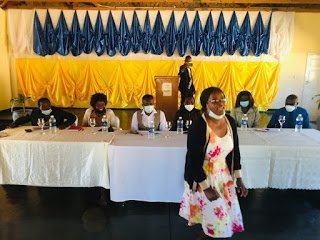
Four
universities participated in a moot competition which was organised by the
Institute for Community Development in Zimbabwe (ICOD Zim) and the Great Zimbabwe
University (GZU) at the Herbert Chitepo Law School to raise awareness on the
rights of People With Disabilities (PWDs) especially women and girls.

Participants
at the competition were GZU, University of Zimbabwe (UZ), Midlands State
University (MSU) and the Zimbabwe Ezekiel Guti University (ZEGU).

The
competitions ended on a high note with the hosts coming out first, followed by
MSU at second position, UZ at third and ZEGU last.

ICOD
Zim director Talent Maposa said the moot court competition was a platform to
promote the uptake and access of Sexual Reproductive Health Right (SRHR)
knowledge since women with disabilities suffer from sexual violence and abuses.

She
said most of the victims’ cases go unreported and they do not receive justice
because law officers often stigmatize and stereotype them.

“We
realized that women with disabilities still face numerous barriers such as communication
barriers. Moreover, most if not all health facilities in Zimbabwe do not have
Sign Language interpreters and materials written in Braille.

“Some
health facilities have stairs but do not have elevators and ramps that are
friendly to PWDs who want to access such health services. This moot competition
is therefore a platform for advocacy,” said Maphosa.

She
said ICOD Zim remained committed to lobbying, advocating and championing the
rights and fair opportunities for PWDs and WWDs.

Herbert
Chitepo Law School dean, Victor Nkiwane said he was excited by a chance for his
institution to compete in such a noble initiative.

“I
am excited to be part of the success of the moot court competition and I am
impressed by efforts being made to ensure that issues of PWDs are mainstreamed
by raising awareness through platforms as this,” said Nkiwane.


New District Information Officers for Masvingo

0
Thembinkosi Ncube

 Wayne Ncube

The Ministry of Information Media
and Broadcasting Services has deployed four new District Information Officers
(DIOs) in Mwenenzi, Chiredzi, Zaka and Chivi in place of retired and promoted ex
officers.

Thembinkosi Ncube has replaced
Samson Matsilele who retired from Mwenezi last year while in Chiredzi,
Rangarirai Mashamba has replaced Itai Dhliwayo who has been promoted as
Mashonaland East Provincial Information Officer.

Zaka and Chivi have opened new
posts which were taken over by Shingirirai Hwande and Tinofara Hove respectively.

In an interview with TellZim
News, Masvingo Provincial Information Officer Rogers Irimayi said the new dispensation
intended to enhance information dissemination and the officers will play a
vital role in their district in accomplishing their duties as they have the
link between government and the citizens.

“The new dispensation intends to
enhance information dissemination. Officers will play a vital role in their
districts as they provide dissemination link between central government and
citizens,” said Irimayi.

He went on to say that the
development project areas covered by the new officers will be put in the
limelight through enhanced media reportage.

He said he hoped the communities
will embrace the new officers as they provide information and clarification on
government policies.

“The development projects in the
areas that the new officers cover will also be put in the limelight as they
will help facilitate enhanced media coverage. It is our hope that communities
will embrace the officers as they have come not to spy on them but to provide
them with information and clarification on government policies,” he said.

Irimayi said to
ensure that the service delivery continues and information is disseminated to
the people, the ministry has made sure the deployments are with immediate
effect.