Home Blog Page 116

Politicians, promoters exploited me: Mauchi

By Virginia Njovo

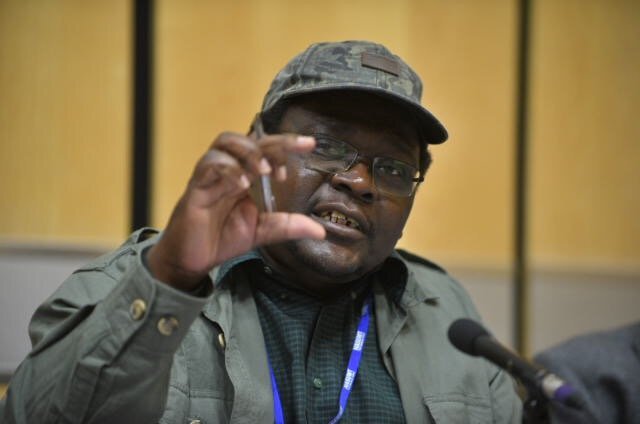
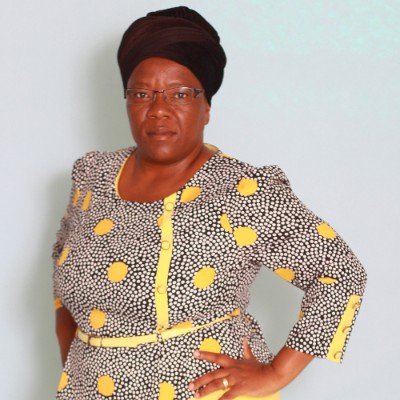
Talented Shona poet Abel Mauchi (49) is a bitter man, saying politicians, promoters and online content creators have been exploiting his talent for nothing, using him only to promote their work while he remains struggling.
Speaking to TellZim News, Mauchi, who is known for performing at political rallies, said in most cases he only got a plate of sadza as payment for his performances despite him leaving people craving for more due to his word-smithing.
“Back home my family would be expecting something tangible from all these activities, but I will go back with empty pockets after being given a plate of sadza, and it is not like they would not have promised to pay. They would always give me a run-around when it is time to pay,” said Mauchi.
The poet said apart from being called for interviews by podcasters and online content creators for nothing in return, politicians who sought his services during campaign periods would still not pay a dime.
“I am treated like I do not exist by politicians when it is not campaign time, and when another campaign period comes, they reach out, use me to make their supporters happy then dump me after,” Mauchi said.
Mauchi has performed at both ruling party and opposition rallies, something he said should not be cause for concern in a country that recognizes art as it is, not attaching partisan titles to what a poet like him does.
“Towards the SADC Summit, I penned a poem titled Karekare, endorsing President Emmerson Mnangagwa’s chairmanship but it didn’t go anywhere despite sending it to relevant people whom we trusted to publish it, but in our industry which is full of saboteurs, it did not go anywhere,” said Mauchi.
Mauchi added that artists from Masvingo were being neglected by promoters on events that take place in the province, while they bring in artists from Harare whom they pay easily and expect those from the province to perform for free.
“When artists from Harare come to perform at events organized locally, they are paid handsomely, while local artists like me are considered as last option, with nothing to show for it,” he said.
Mauchi, who calls himself ‘Shefu Mudhesve’ started poetry in 1992 while he was staying in Chitungwiza Seke Unit N, and says he has written over four thousand poems, claiming he can recite over a thousand of them.

Unclear roles, politics behind clashes between SDCs, School administration

By Rangarirai Shanyurai

The lack of clearly defined roles of the School Development Committees (SDC) has been referred as one of the major reasons behind the ever increasing clashes with school administration, a situation which stifles development at many learning institutions in the country.
A survey by TellZimm publication recently showed that about five schools in Masvingo Province had conflicts over SDC elections since January this year mainly due to misunderstandings over mandate and responsibilities.
Ministry of Primary and Secondary Education (MoPSE) Director of Communications Taungana Ndoro said the conflicts had become a common feature in Zimbabwean schools, citing overlapping of roles between the two parties and overlapping of political interests into school business as the major cause.
“These types of tensions and challenges around SDC elections and operations are deeply concerning and seem to be symptomatic of deeper problems within the education system. Some of the key factors that may be contributing to these heightened conflicts include lack of clear roles and responsibilities. There may be ambiguity or overlap in the defined roles and decision-making powers between the two leading to power struggles.
“Politicization of school governance, in some cases, SDC elections and processes may be influenced by partisan political interests, rather than focusing on the best interests of the school community. Inadequate training and support of SDC members, who are often volunteers might also be another challenge as they may not have the necessary skills,” said Ndoro.
Ndoro also highlighted mistrust and resource constraints as other reasons behind the continued conflicts.
“Breakdowns in communication and transparency between school leadership and SDCs can foster an environment of suspicion and confrontation. Disagreements over allocation and utilization of limited school funds and resources may be a source of tension,” said Ndoro.
He said it was important for government to have clear legal and policy frameworks that govern roles of both parties to avoid role overlapping while training remains crucial for SDC members.
“To address these issues, a multi-pronged approach may be necessary including reviewing and clarifying the legal and policy frameworks governing roles and responsibilities of school authorities and SDCs, ensuring a clear delineation of powers and accountability mechanisms.
“There is need to provide comprehensive training and capacity-building programmes for SDC members to equip them with the necessary skills and knowledge to effectively participate in school governance.
“Promote greater transparency and open communication between school leadership and SDCs, fostering a culture of collaboration and mutual respect and strengthen mechanisms for resolving disputes and conflicts, such as establishing impartial mediation or grievance redressed processes,” said Ndoro.
“There is need to consider ways to depoliticize school governance and ensure that decisions are driven by the educational needs and wellbeing of leaners, rather than narrow political interests.
“Ultimately, the goal should be to create an environment where school administrators, SDCs, and the broader community can work together constructively to improve the quality of education and address challenges facing Zimbabwe’s schools. This will require a sustained effort and a commitment to putting the interests of learners first,” he added.
Progressive Teachers Union of Zimbabwe (PTUZ) Dr Takavafira Zhou said the conflicts were due to conniving between either parties often to benefit from school finances.
“Indeed there are many conflicts in schools such as Ndarama High School, Victoria Primary, Victoria High School, Gokomere High, just to mention a few. In some instances we have the same people being retained in the SDC/SDA over protracted periods because they connive with administration to fleece the schools of the money for personal benefits. In other instances administrators who ordinarily are ex officials in SDA/SDC enter into tenders without parents’ representatives and when parents raise objections, the administrators’ nichodemously work for a shortened term of office or boot them out of office.
“In other instances, parents representatives use political power to prolong their stay in office and school administrators are petrified to legitimise their illegitimacy. Responsible authorities also flout the Statutory Instruments in the appointment of SDC/SDA with the consequent friction with parents. Some Ministry officials at district and Provincial offices also support administrators that are flouting regulations because of kickbacks from school administrators,” said Dr Zhou.
Dr Zhou said the best way to address the challenge in schools was through observing the laws guiding conducting of elections and ensuring each department knows its roles for checks and balances.
“The best way forward is to respect the legislation in place and create harmonious relations in schools. It is sad we have officials sleeping on duty when nasty happenings are ensuing in schools. Fundamentally, an SDA/SDC committee must be in office for a year. An AGM must have a chairperson’s report and treasurer’s report that must be audited, and ratified by parents. Selection of a new committee must be independent from any interference by the administration at any school.
“Administrators must never interfere with the selection of parents’ representatives, except on the following laid down regulations such as Statutory Instrument 379 of 1998 or Ministry of Primary and Secondary Education handbook. Ministry officials must educate administrators on proper observance of regulations guiding the appointment and operations of SDC/SDA. School administrators must not usurp powers of SDC/SDA chairpersons and treasurers.
“Ultimately, it must be realized that being an administrator or being in SDA/SDC must not be a licence to loot resources that must be channeled to the improvement of learning and teaching in a school,” said Dr Zhou.
One school head who spoke on condition of anonymity said the conflicts were centered on various characters of the major stakeholders.
“Situations in some schools need to be sanitized. Many schools are beset with problems of a varied nature but they centre mostly on the character of major stakeholders parents or communities and school heads or administrations. In some cases teachers too have a hidden hand in some of these conflicts. Some communities are so obsessed with what goes on in schools for different reasons, some parents are concerned with their fees that they are keen to follow up, more so if they have suspicions about the way the school administration handles the fees,” said the head.
At Victoria Primary School, clashes between the two parties resulted in the SDC filing their case at the courts of the law against the school while at Duma Primary School elections were totally abandoned and moved to a later date with allegations of political interferences in the elections.
Victoria High School once had a similar case of parents demanding an audit at the school against the then head John Muzamani after pass rates deteriorated at the former elite school.
At Ndarama High School there was high tension and parents were required to bring identity cards for verification before gaining access to the annual general meeting.
At St Joseph High in Zaka, the elections were postponed indefinitely and no date has been set for the election to take place.
Parents at Shakashe Primary School have also been on record having clashes with the school admin and SDC over allegations of misplaced priorities.

Neshuro learner wins ZPCS marathon race

0

By Tatiana Mhararira

Mwenezi District’s Neshuro High School learner, Rudo Moyo recently won a gold medal at the Zimbabwe Prisons and Correctional Services Commissioner General’s Goodwill Trust Fund half marathon race held at Chikurubi Dam View on August 24, 2024.
Moyo, also won a prize of US$75 as the first runner-up in the 10km race for juniors aged 16 to 19.
Speaking to TellZim News, Moyo said her win did not come as a surprise, it was hard work and commitment that paid off.
“I won the tournament because I worked tirelessly with the assistance of my coach and some community members who persuaded me and gave me much-needed moral support.
“It was an exciting experience participating in such a big tournament and I was determined to win and put my area on the map,” said Moyo.
Moyo’s coach, Stephen Mpofu said he was excited by the courage and confidence shown by the athlete which ultimately resulted in her win.
“The athlete showed maximum effort which resembled enough preparation and determination that gave her the results.
“The courage and level of confidence that Moyo showed to participate at this tournament considering that it was her first time participating at a big tournament considering her background was amaizing.
“She was not shy to showcase her talent despite coming from a marginalized area of Neshuro, is my hope that she will continue to shine in all the tournaments she will participate in,” said Mpofu.
He appealed for sponsorship for the talented athlete to travel to other tournaments saying financial constraints usually affect them and they end up missing some tournaments.
“I am also appealing to well-wishers who want to assist the athlete in the forthcoming events the Kasambezi tournament in Binga and these events helps in grooming Moyo and also exposing her to more stiffer contests,” said Mpofu.

Electricity shortages affecting winter wheat production

By Meditation Mposi

Farmers at Rufaro Irrigation Scheme in Masvingo North have raised concern over continuous electricity shortages hitting the province which they said was adding to water shortages farmers were already facing due to the El Nino-induced drought.
Speaking during a winter wheat field day at Rufaro Irrigation Scheme on August 28, Minister of State for Masvingo Provincial Affairs and Devolution Ezra Chadzamira said most irrigation schemes were being affected by power outages which made it difficult for farmers to get enough water for the crops.
“There is an outcry in irrigation schemes over power cuts which has left us doubting whether it is load shedding, electricity faults or sabotage. Farmers spend the whole day without electricity only to have electricity at around 2200hours then it is switched off at 0400hours, which shows farmers are not being prioritized in electricity distribution.
“We have agreed with Zimbabwe Electricity Supply Authority (ZESA) to give farmers priority on the little electricity available for sustenance of agricultural projects. In as much as there are faults and load shedding, the agricultural sector should be prioritised,” said Chadzamira.
Chadzamira further urged Zimbabwe National Water Authority (ZINWA) and its partners to drill more boreholes to complement the existing presidential borehole scheme to assist farmers with water for their projects.
“The Presidential Borehole Scheme is there to provide boreholes to each ward across the country. Water is a necessity to farmers and agriculture is now the greatest business. These projects must be taken seriously for they give us food and money to survive. The next time l come here I want to see progress from ZINWA,” said Chadzamira.
Masvingo North Constituency Member of Parliament (MP) Brian Mudhumi said the ongoing load shedding and poor response from ZESA was affecting the pumping of water for irrigation.
“When we report to ZESA officials about electricity faults, they give us low voltage power to operate the pump, even when we report problems they do not respond in time, sometimes they say they have no fuel and I give them only to respond after three or four days. If the province is to achieve its target for wheat then ZESA needs to take irrigation schemes seriously,” said Mudhumi.
ZESA representative at the field day, Alpha Mataga promised to do better and to hand over the plea to his bosses for better services.
“For the past weeks there was load shedding due to some technical issues. The other unit which supplies electricity was down. Farmers must report faults so that they can be fixed on time,” said Mataga.
ZINWA officials present at the tour also promised to drill another borehole to add to the six available at the scheme since the other one was not working.
“We are going to drill another borehole for farmers, we promise to put this on our borehole projects list, to help with the supply of water on this project,” said the ZINWA representative.
Farmers were further urged to consider using solar systems as an alternative when there is no electricity as the water table is now very low.
Four villages are in the Rufaro Irrigation scheme and each has 50 hectares of wheat and the whole irrigation is expected to produce 45 metric tonnes of wheat after harvesting.
Inputs for the winter wheat crop were received through the presidential input scheme and government has sent experts from different departments including ZESA, Agritex, ZINWA, AFC Bank, Grain Marketing Board (GMB) to monitor the projects.

Chiredzi communities unite to fight water challenges

By Beatific Gumbwanda

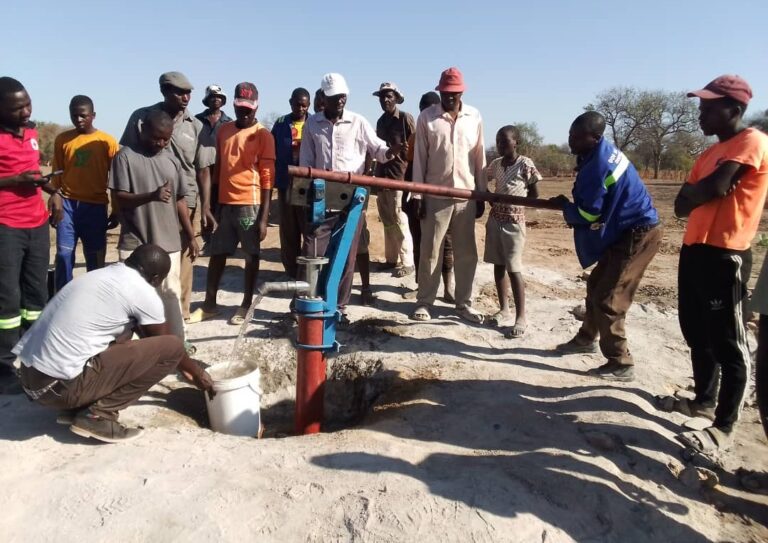
CHIREDZI- Communities in Chiredzi recently launched an initiative to contribute funds towards drilling boreholes at village level amidst the El Nino-induced drought.
The villagers mobilized themselves to contribute funds towards the purchase of borehole casings and fuel for the drilling rig, with Chiredzi Rural District Council (CRDC) coming in with expertise and the drilling rig for the exercise.
Chiredzi RDC Chairperson, Aspect Mashingaidze, applauded the communities for mobilizing their funds and partnering with CRDC to ease water challenges.
“Council is working with the communities on a Community Initiative Program where the communities mobilize financial resources towards the procurement of borehole casings and fuel and we provide the drilling rig,” said Mashingaidze.
He said they were drilling 60 meters but can go beyond depending on the contributions made for a particular hole.
“On average, we are drilling around 60 meters per borehole. So far we have started with ward 24, where we have 14 boreholes for 154 villages. Ward 1 has seven borehole sites for seven villages. Ward 3 has one village borehole site while ward 20 and 23 got two boreholes each.
“We have two schools and 24 village sites. We applaud the communities for coming up with the idea for the provisions of clean water to the communities,” said Mashingaidze.
Communities mobilized a total of US$ 31 000.00 while the provisional budget for the council in drilling and maintenance of the drilling rig amounts to US$17 000.00 for the projects.
Ward 24 councilor Tinashe Matanhuse said the idea came following persistent water challenges in his ward as well as the outbreak of cholera where villagers were walking five to six kilometers to fetch water from Mukazi River.
“We did not have access to clean water as villagers would walk five or six kilometers to fetch water from Mukazi River. The other thing that motivated the villagers to come up with such an initiative was the recent cholera outbreak. So far we have drilled seven boreholes though two of them were dry holes,” said Matanhuse.
Ward 20 councilor Tawanda Boora, said the communities were pressured to this initiative by the distances they have been walking to water points to get fresh water.
“Due to persistent water shortages the communities have been facing, they came up with such an initiative where we engaged our local authority to provide us with the drilling rig while we contribute money towards the purchase of fuel and drilling casings,” said Boora.
Ward 1 councilor, Learnmore Muvengi also highlighted the same water challenges and added that the communities were even planning on solarizing the boreholes for easy access.
“The fewer boreholes we have were overwhelmed so we decided, as communities to contribute money towards drilling boreholes as four villages were drinking from the same borehole. So far two villages got their shares and they are planning on solarizing their boreholes,” said Muvengi.

CHIRRA continues to hound FLOAAI

By Beatific Gumbwanda

Chiredzi Residents and Ratepayers Association (CHIRRA) is haunting Full Life Open Arms Africa Investments (FLOAAI) which they blocked from deducting money from civil servants who were supposed to get residential stands from Buffalo Range’s 750 hectares meant for Chiredzi town expansion.
In July 2024, CHIRRA sought a court order barring FLOAAI Director Pastor Nelson Godfrey Madanyaya from selling unserviced residential stands, which was granted by Masvingo High Court Judge Justice Zisengwe.
“The first respondent and all those acting through him should stop selling any stands on the 750 hectares Remainder of Buffalo Range, Chiredzi until after servicing of the stands and being issued with a compliance certificate by the second and third respondents,” read the order.
Chiredzi Town Council and Chiredzi Rural District Council were the second and third respondents in the application.
In response, FLOAAI, through its Facebook page, Buffalo Sweets Chiredzi assured stakeholders that they will stop selling stands until they have been issued with a compliance certificate.
“On the second of July 2024, the High Court sitting in Masvingo granted an order to stop selling of stands until compliance on the Remainder of Buffalo Range which is currently being developed to meet compliance requirements with Chiredzi councils.
“Full Life Open Arms Africa Housing Trust will comply with the High Court Order without fail. Please note that the High Court did not order any cancellation of existing arrangements,” read part of the statement.
Efforts to get a comment from Madanyaya were futile, as usual as it has become a habit that he does not answer calls from this reporter.
FLOAAI however continued to deduct money from civil servants salaries registered with them, which CHIRRA said was akin to them still selling the stands.
CHIRRA, through the Messenger of Court served FLOAAI with an urgent notice, urging them to cease the deduction of any money from promised home seekers.
“CHIRRA is reminding you and FLOAAI to abide by the Masvingo High Court Case Number HSMSVCAPP72/23 Judgment and order between CHIRRA and FLOAAI which was handed down on the 2nd of July 2024 by Justice Zisengwe J.
“Please stop the deduction from teachers’ salaries, who are paying for unserviced stands through stop order by SSB, and workers who are paying each month.
“FLOAAI is not allowed to sell stands at 750ha Remainder of Buffalo Range,” read part of the urgent notice.
FLOAAI had been selling unserviced residential stands at the cost of US$20.61 per m2 , with one supposed to deposit US$1500 and pay the balance in installments over a period of four years.
A non-refundable fee of US$50 was requested in order to open a file with FLOAAI.
The company did a feasibility study for the 750 hectares and to develop 350ha phase one and handed it over to Chiredzi Town and Rural District Councils.
FLOAAI Directors, Madanyaya and Dr Andrew Chigudu have a pending case of fraud for allegedly using 1 700 residential stands as collateral for a US$1.2 million loan they got from NMB bank which was intended to pay for the feasibility studies.
They are being accused of misleading both councils by presenting 1 700 residential stands as security in order to secure a loan from NMB Bank for the purposes of developing the Buffalo Range Project and allegedly diverted the funds for personal use.
.

Theological Understanding of Witchcraft and Sorcery

0

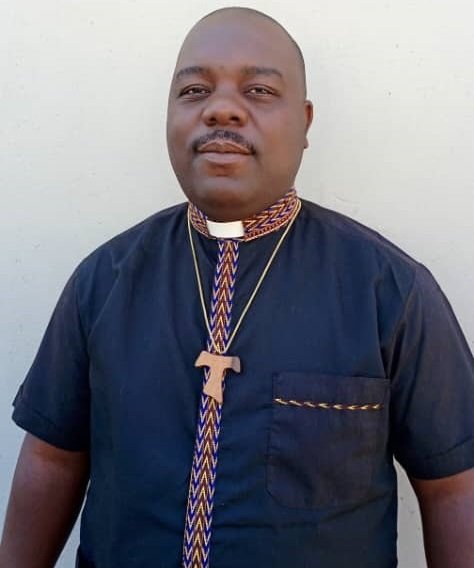
By Rev Dr Isiah Dhliwayo

The theological understanding of witchcraft and sorcery in Africa is a complex and multifaceted issue that varies across different regions and cultures on the continent.
Western sociological and anthropological presuppositions view witchcraft as a myth and therefore contend that belief in witchcraft are based upon an essentially mistaken view of the world .Accordingly ,witches do not exist except in the minds of certain people (Chavunduka,1994:90).
Witchcraft, sorcery, and magic are related to encounters of humans attempting to control the supernatural and are usually described as ways to account for experiences and conditions that are beyond simple explanation.
In many African societies, social disruptions of a serious magnitude are normally attributed to witchcraft.,and belief in witchcraft is not particularly African but a global phenomenon (Bourdillon,1990:187).
Witchcraft and Sorcery appear as themes when humans are concerned with misfortune and harm, accusation and blame, risk and responsibility, and therefore are often analyzed as forms of social control and leveling, as well as ways of perceiving reality.In Shona thought worldview,there are no clear distinctions between witchcraft and sorcery, the allusion to muroyi wehusiku, muroyi wemasikati can be used to infer the degrees of evil intent.
On the other hand ,the reality of witchcraft has been seriously questioned by academics particularly from Europe mainly because of the ideas they inherited from 18th century Europe due to the inhuman treatment inflicted upon persons accused of witchcraft.Infact the Church declared witchcraft as a heresy which came to be seen as vein superstition (Lagerwerf,1987:14).
Chavunduka (1994:88) underscores that Sorcery is a technique or a tool employed by an individual under certain circumstances in order to harm other people.Recourse to sorcery is always on a deliberate, conscious , voluntary basis.
There are however numerous spirits that populate the universe and these include alien spirits,mashavi,and angry or vengeful spirits ,(ngozi)(zvitupwani)(zvidhoma) ghosts (magoritoto),spooks (zvipoko)and tokolotches.
Traditional African religions often incorporate beliefs in the supernatural, spirits, and the influence of magic on human affairs.
Africa is a vast and diverse continent with a multitude of indigenous belief systems. The concepts of witchcraft and sorcery are “responsible ” for misfortunes, illnesses, or other inexplicable occurrences.
Many African societies, strongly believe that witchcraft and sorcery are the real forces that can be used for both good and evil purposes. Those accused of practicing witchcraft may be feared, ostracized, or even harmed.
African traditional religions often view the world as interconnected with the spiritual realm. Witchcraft is sometimes seen as a means of tapping into this realm to influence events in the physical world.
Commonly spoken and mostly dreaded in Zimbabwean communities are some spirits associated with witchcraft called zvidhoma,with some calling them Zvitupwani.Some are believed to appear in the form of animals (zvivanda)like a cat or birds (zvishiri).Worrisome is that,” they can enter a kitchen ,eat too much sadza, defecate and break pots and plates(Shoko,2007:42)”
In Zimbabwe ,The Witchcraft Suppression Act was passed in 1889 and was amended in 2006.In 1889,the legislature made it clear that although some people may genuinely believe in witchcraft,the whole practice of witchcraft was pretence and a sham,something in actual fact had no real existence at all.Witchraft Suppresion Act was stalling the genuine development of African culture in the country (The Herald ,May 10:2006).
In conclusion, the theological understanding of witchcraft and sorcery in Africa is deeply rooted in cultural, religious, and spiritual beliefs.

Digital literacy in Zimbabwe worrisome

0

By Aribino Nicholas (Writing in my own capacity)

Writing in the Standard of August 25 to 31 2024, Professor Ken Mufuka who is based in the US, intimates that Zimbabwe is still top of the list in education, beating Australia, New Zealand and the UK when measured by standardized examinations set by Cambridge and London universities. Despite this colossal feat, this writer is of the opinion that Zimbabweans are not faring well in the province of digital literacy. It is the intention of this writer to problematize digital literacy and in the process share experiences and perspectives that rally behind the assertion that digital literacy for Zimbabweans is painstakingly low.
Digital literacy which can also be circumscribed or understood as digital diplomacy is not just about one’s ability to use a computer or a smart phone. Digital literacy in its broadest sense, encompasses one’s capacity to understand and appreciate how to utilize technology with a sense of positive reciprocity with other online community members and also having a tooth-pick analysis of information being shared between and among groups with an eye towards establishing its credibility or authenticity and taking full responsibility for one’s online conduct. Just as human beings need a sense of decorum as they interact physically, that sense of decorum should also be demonstrated when online communications take place. Digital literacy also comes with a consciousness of the need to observe ethical implications of one’s conduct online and having an awareness of legal frameworks that regulate online behaviour in one’s country.
Most Zimbabweans are not aware of digital literacy as seen by their online conduct. Despite having the Cyber and Data Protection Act Chapter 12.07 which regulates online conduct, most users of the social media continue to share emotionally distressing pictures of accidents on Tik Tok, WhatsApp and Facebook. For example, when some Zimbabweans witness road accidents, instead of saving lives, they become photo journalists (they want to be the first with the news), they take pictures and share them across different social media platforms before the relatives of those people involved in an accident are informed. Relatives get to know about the passing on of their loved ones via social media platforms, a thing that may even trigger mental health problems for them. Rather than taking pictures of a road accident that has just happened where people are injured or have died, the ubuntu diplomacy should instruct the conscience to ferry the injured to the nearest health facility, to do first aid, call the police or an ambulance. The act of sharing pictures of road accidents and people writhing in pain with different digital spaces shows disregard for the feelings of the relatives of the people involved in the accident and also shows the dearth of both digital and emotional literacy in Zimbabwe.
Across social media platforms, there is so much cyber bullying, hate speeches, barbed comments that come without any inkling of the philosophy of consciencism. As human beings relate digitally, there ought to be an appreciation of the fact that smart phones can be either weapons of unifying or destroying their communities. For example, hate speeches or messages shared digitally can create polarization leading to conflict or violence. Some Zimbabweans receive and forward messages to various groups without even verifying if those messages are authentic, others receive pictures and videos of people in acts of love making and circulate them widely within their online communities without giving any second thoughts to the Cyber and Data Protection Act, or the impact of such messages, pictures and videos on the significant others of the people involved. Some Zimbabweans are not even aware that pictures of people cannot just be shared like confetti at a wedding, without having sought their assent (children) and consent (adults). According to the Cyber and Data Protection Act any person who unlawfully and intentionally, by means of a computer or information system, generates and sends any information or data (message(s)) to another person, or posts any material whatsoever on any electronic medium accessible by any person, with the intent to coerce, intimidate , harass, threaten, bully or cause substantial emotional distress or to degrade, humiliate or demean another person or to encourage a person to harm himself or herself shall be guilty of a criminal offence. If you are a Zimbabwean and you are not aware of the above piece of legislation then your digital literacy is pathetically low because you may not moderate your behaviour as a user of digital platforms.
With the invasion of Artificial Intelligence (AI) into our spaces, it is critical that governments and organisations responsible for several different digital platforms combine their efforts in content moderation and regulatory frameworks. The need for mutually constitutive and reinforcing efforts between the former and the latter in the monitoring and regulation of digital content is as critical as water is to fish. The law has no bowels of humanity, so if one commits a crime that is related to the violation of the Cyber and Data Protection Act, the law would still take its course without looking through the window to appreciate any other material circumstances like ignorance of the law at the time of committing a crime. The onus is on every Zimbabwean to be guided by principles of ubuntu when interacting digitally with the online community. This writer is persuaded to submit that laws that guide online conduct are just coming as a bonus to us Zimbabweans because we already have the moral economy or the communal-self into which we are socialized from our formative years. Our digital literacy can only improve if, as Zimbabweans we appreciate that citizenship is not only about status, but also about duty. We all have a duty of care towards one another and this duty of care begins with emotional and digital literacy for both onsite and online social intercourse.


Zaka RDC’s US$200k rig yet to drill single borehole in 5 years

By Richard Mukwenya

In a classic case of serious incompetence and maladministration, Zaka Rural Disctrict Council (RDC) spent over US200 000 to procure a water drilling rig about five years ago, but the rig has never drilled even a single borehole since then despite the fact that the district is facing acute shortage of clean and safe water.
To make matters worse, Zaka district was hard hit by cholera last year with a number of villagers losing their lives because they were using contaminated water from rivers and unprotected wells. The councilors led by chairperson Fungai Maregedze revealed, in a leaked letter to the Minister of Local Government and Public Works, which TellZim is in possession of that the local authority bought a drilling rig sometime in 2018 but did not sink even a single borehole since then.
The letter was signed by Maregedze dated June 7, and was a follow up to another letter written on May 20 where the councilors were seeking the minister to intervene following an impasse between the management and the councilors.
Contacted for comment, Zaka RDC Chief Executive Officer David Majaura gave a different version and said procurement of the rig started in 2021 not 2019 as been alleged and said they drilled five boreholes with it.
“The procurement started in 2021 and it took time to be delivered. It was said to be at a port in South Africa and was finally delivered in 2023 end of year.
“On testing, it was noted that it had parts vandalised while at the port, so the supplier took it for fixing. We were handed over the rig back in February this year and we have since drilled five boreholes. One is in Jerera, one in Charuka, another one at Charingeno Secondary and two at Charingeno Primary School,” said Majaura.
However, the council chairperson claimed in the letter that each time the councilors sought the CEO and his management to account thats when they claimed the councilors were interfering with their work.
Chairperson Maregere said council bought a water drilling rig in 2018/2019 but has never used it.
“The council bought a rig in 2018/19 and paid over or around US$200 000 but never drilled a single borehole up to today as they cite problems with the rig. When we tried to get clarification on that the CEO then wrote to you saying we are interfering yet we are playing our oversight role.
“Is this interference Honourabe Minister? How do we achieve our call to action if Government invests in equipment and we take five years with a non-functional rig listening to stories and fearing to be labeled interfering? Who is supposed to ask the management why it’s not functioning from the day of purchase to five years then…,” reads part of the letter to the minister.
Maregedze also raisedcorruption suspicions in the manner council properties such as halls were being leased but the management could not account for the rentals being paid.
“We have Gain Wholesale renting our community hall. The resolution is that council was to improve the vendor market and since 2019 Gain was paying US$ 2000 per month but there is nothing to show for it. If you ask it’s labeled. Why are we in council Honourable Minister if we are not allowed to understand this serious mismanagement of resources,” questioned Maregedze in the letter.
“We have a worst budget performance of 11 percent in June. What miracles are we going to perform Honourable Minister if we are at 11 percent while 2024 is at 50 percent going to December? When the finance committee requests for strategies to cover the gap it’s called usurping powers and interference and our good CEO secretly writes letters to you without copying me on the same issues which I copied him which clearly shows he is getting sympathy somewhere,” Maregedze further alleged in the letter.
Minister Daniel Garwe has since dispatched a five member team to investigate a number of issues at Zaka RDC.

Council fails to deliver on new landfill

By Perpetua Murungweni

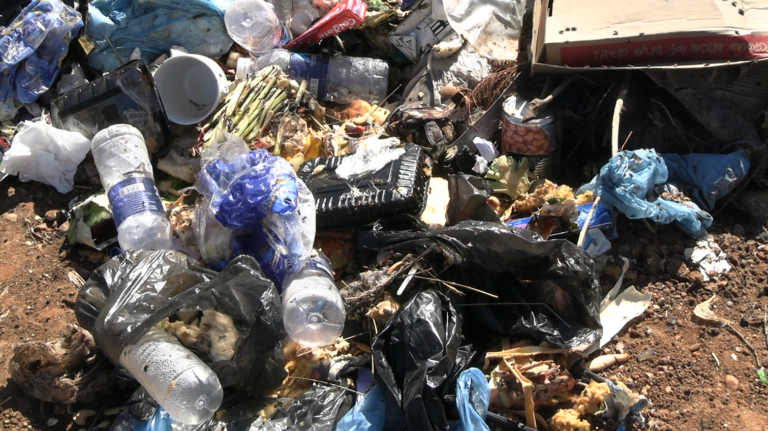
Masvingo City Council has failed to deliver on its promises to decommission the Runyararo West dumpsite and move to the new Cambria Farm Landfill despite the health and environmental risks that the old dumpsite is posing to residents who live close to the dumpsite.
Residents in Runyararo West and Victoria Ranch might have to endure another three or four months of air pollution as the local authority is still unsure of when the dumpsite will be decommissioned, citing lack of funding to procure equipment for the new dumpsite.

Residents raised concern over the dumpsite in an engagement meeting between residents and councillors organised by the Zimbabwe Union of Journalists (ZUJ) recently.
Masvingo City Mayor Alec Tabe told TellZim News that plans to improve the new dumpsite and relocate were underway and they were expecting to start using the landfill by the end of this year.
“Council has already completed the drafting of a decommissioning plan, a document that elaborates on the current situation of the Runyararo West dumpsite and relocation to the new landfill is earmarked for any month in the fourth quarter.
“The relocation is necessary because we have heard the plea of residents in Runyararo West and Victoria Ranch who have undergone immense suffering due to uncontrolled fires that occur at the dumpsite.
“Council is working frantically to move to the landfill as soon as possible. The plans are that we will be using the sanitary landfill by latest end of December 2024,” said Tabe.
Tabe said council was waiting for funding to complete the project and had since applied for borrowing powers from the Ministry.
“The landfill has been completed and related structural works have been completed, the major outstanding items include the sanitary landfill compactor. Council has not yet secured funding from Steward Bank to facilitate procurement of the landfill compactor; financing of the landfill shall be through a local bank.
“Council has also applied for borrowing powers from the Ministry and we are waiting for the borrowing certificate,” said Tabe.
According to a recent ZHRC report, council was violating environmental human rights and the right to administrative justice, years after the old dumpsite became cause for concern.
In the ZHRC report, Masvingo City Council Public Relations Officer Ashley Jinjika highlighted that council was still using Runyararo dumpsite because the construction process of the new landfill was hindered by lack of funding.
“The first cell of the landfill was completed and was supposed to be commissioned in February last year. However the whole construction process was hindered by lack of funding hence council was still using the Runyararo West dumpsite awaiting the construction of the landfill to be finalized,” Jinjika was quoted in the report.
Masvingo City Council secured 10 hectares of land on Cambria Farm which is on the western outskirts of the city for the establishment of the new landfill in 2019 and was set to move there by the end of October the same year.
In October 2022, Acting City Engineer Kudzaishe Mbetu, said council was only left with construction of the site offices which was already underway. He was quoted saying council was going to start using the landfill at the end of the same month, adding that three boreholes had been drilled but only the control borehole had been equipped.
Masvingo City Council in June 2023 invited Vice President Kembo Mohadi to officially open the landfill despite it not being functional until now.
A research conducted by this publication indicated that Masvingo City has approximately 16 655 housing units that pay monthly rates. From the 16 655 housing units Masvingo City Council charges US $8.72 for refuse collection per housing unit per month and is getting about US $ 145 231.00 every month which translates to about US$1 742 779.2 million.
This year’s refuse collection tariffs increased with 50 cents from US $ 8.25 last year to US $ 8.75 this year, all this in light of council’s failure to complete the landfill project due to lack of funding.