The wait for Masvingo residents on Rujeko D suburb waiting list will soon be over as council will start preparations to service the stands before issuing them out to beneficiaries.
Masvingo City Council is set to embark on a programme to service the stands so that the local authority can begin clearing the long waiting list.
Town Clerk Engineer Edward Mukaratirwa confirmed the development and said council is expecting house servicing as soon as they get the funding.
“The Rujeko D house servicing is still in progress but we are expecting to start as soon as November,” said Eng Mukaratirwa.
Lack of funding has been cited as one of the major hindrances to infrastructure development.
Council applied to the Ministry of Local Government and Public Works in May this year for borrowing powers to raise more than US$ 7 Million to cater for housing and procurement of equipment, and part of the funds would go to the servicing of Rujeko D housing schemes.
“Negotiations with the Ministry of Local Government and Public works are still underway. As soon as funding comes in we will start the proper servicing of houses as we start issuing out stands to residents,” added Eng Mukaratirwa.
Stands surveyed in Rujeko D by Council are awaiting approval of layout by the Department of Physical Planning.
Council is hoping to have as many high density suburb stands as possible.
“The stands we are expecting are slightly above 700, as we wait for provision of offsite sewer reticulation infrastructure,” he said.
Masvingo United Residents and Ratepayers Alliance (MURRA) spokesperson Godfrey Mutimba confirmed that residents are expecting the servicing of stands at Rujeko D to be complete so that they get their own properties.
“The servicing of stands at Rujeko D comes at a time when many residents are facing housing challenges, so this will allow residents their right to shelter,” said Mutimba.
Council suspended selling residential stands and the city’s housing backlog would be reduced through opening up more land for housing at Rujeko D.
“After servicing the housing backlog in the city will be reduced and residents will enjoy their right to shelter,” Mutimba said.
The Rujeko D project will also help in controlling the clustering of residents in the high density suburbs considering the growing population in the city.
“The population is getting larger by the day. A lot of people have been on the housing backlog list for over 10 years, so it is a right move for people who are renting houses which is becoming very expensive, so buying own stands will be helpful economically,” remarked Mutimba.
The Ministry of Higher and Tertiary Education has ordered students at colleges to either be vaccinated for Covid-19 or have a valid polymerase chain reaction (PCR) test, failure to which they will be barred from entering school premises.
Students from Masvingo Polytechnic who are not yet vaccinated for Covid-19 were last week barred from attending lectures and entering the school premises.
Security guards manning entry points at the institution were demanding vaccination cards, even from students in exam classes, turning away those who did not have them.
Masvingo Polytechnic Principal, Engineer Callisto Muzongondi said they are encouraging students to get vaccinated or provide Covid-19 PCR test to gain entry at the school premises.
“We are saying if one is not vaccinated, they should have a valid Covid-19 PCR test. One has to be either vaccinated or tested in the last 48 hours to access school premises.
“We have set aside a hostel to quarantine those who have tested positive because we have to be careful,” said Eng Muzongondi.
Contacted for comment, Permanent Secretary in the Ministry of Higher and Tertiary Education, Innovation, Science and Technology Development Professor Fanuel Tagwira said the ministry was strict on Covid-19 in students unless one had a valid medical reason not to be vaccinated.
“I am not even allowed to access government buildings without a vaccination card. We are saying, unless someone has a valid reason given by a doctor, they have to be vaccinated in order to access school premises.
“Remember in the third wave we lost a number of lecturers because they are normally older and vulnerable, so we have to protect everyone. At Bondolfi, when there was an outbreak, only one case had symptoms, the rest were asymptomatic. That puts lecturers who are older at risk.
“Lecturers themselves are vaccinated, so what would be the reason for students to not want to get vaccinated,” said Prof Murwira.
He went on to say that if one does not want to get vaccinated, he or she should then produce a Covid-19 test valid for 24 hours.
Meanwhile, Masvingo Teachers College Principal, Benson Mutambudzi said that they did not have a circular yet that bars unvaccinated students from attending lectures but almost 95 percent of all staff members were vaccinated.
“We do not have a circular that yet bars unvaccinated students from entering the school premises, but we do have one for the staff, and I can safely say that almost all staff members here are vaccinated.
“We are however strongly encouraging the students to get vaccinated and we have engaged the Provincial Medical Director’s office to give us the vaccines at our school clinic so that the students get easy access to the vaccine,” Mutambudzi said.
ZAKA– Member of Parliament (MP) for Zaka West constituency, Ophias Murambiwa last week commissioned Bvumbura dip tank in Murembwa village, under chief Nyakunhuwa, coming to the rescue of villagers who had to walk long distances to dip their cattle.
Speaking during the commissioning ceremony, Murambiwa said the dip tank would go a long way in reducing cattle deaths in the district.
“Murembwa villagers were walking for over eight kilometers to the nearest dip tank and when they lodged their plea, we saw it necessary to swiftly construct this dip tank because cattle were dying and it was becoming unbearable”, said Murambiwa.
Masvingo Provincial Veterinary Officer, Dr Ernest Dzimwasha who also graced the event encouraged villagers to take their cattle to their nearest dip tanks once a week, to reduce the spread of diseases.
“We are encouraging people to take their cattle to dip tanks near them, so that the spread of the diseases will be controlled,” said Dr Dzimwasha.
John Muchadenyika a villager applauded the development that he said came at the right time and had put an end to their burden of walking long distances.
“We used to wake up very early and walk to nearby villages but now we have our own Bvumbura dip tank that has saved us from walking long distances to have our cattle dipped,” said Muchadenyika.
Since January, over 4000 cattle succumbed to foot and mouth and theileriosis popularly known as January disease in Masvingo.
Also present at the event was ward 17 Councillor Chrispen Watadza and Chief Nyakunhuwa born name Courage Mashavave.
The dip tank project completed in three months was constructed using Constituency Development Funds (CDF) 2021 allocation and named after Bvumbura Mountain.
Murembwa villagers were some of the most affected with the deadly theileriosis that left villagers counting loses this year when the disease killed many cattle in the district.
Villagers had to walk for hours to Cherechere and Zenguvo villages in order to get to the nearest dip tanks.
Old infrastructure that dates back to the early 1980s is affecting operations of the District Development Fund (DDF) in the province, with only a few machines functional while the rest are broken down.
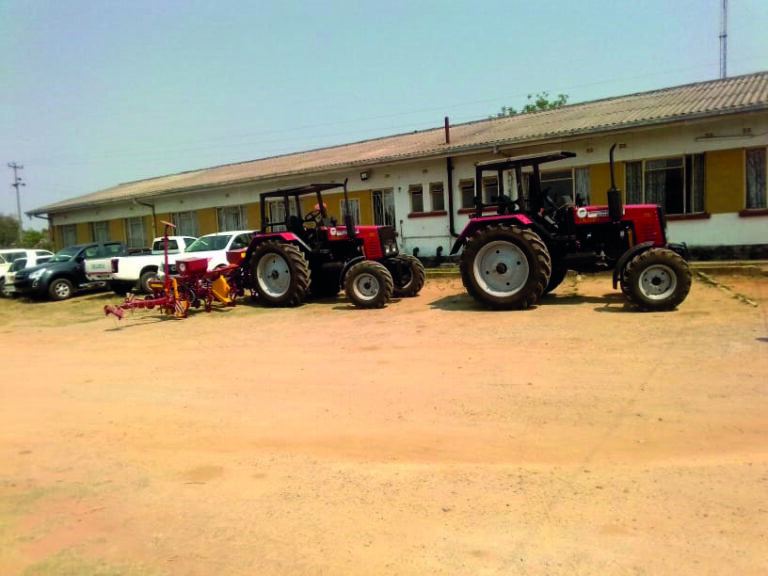
Speaking to guests at the commissioning of two tractors by the Masvingo Minister of State for Provincial Affairs and Devolution Ezra Chadzamira at DDF premises in Mucheke on September 21, 2021, DDF provincial coordinator Marasa Gutukunhuwa said of the 72 tractors in the province only seven are working while others are on minor to major breakdowns.
“We have 72 tractors and out of those only seven are working. 24 are on minor breakdown while 41 are on major breakdown.
“We also have 48 ploughs and out of those four are working, 15 on minor breakdown and 29 on major. Of the 20 disc harrows, four are working, 10 on minor breakdown and six on major breakdown. Of the 19 planters only one is working while the rest are on major breakdown,” said Gutukunhuwa.
He bemoaned the deteriorating situation facing the department to which he attributed the decrease in effectiveness of operations in the province with a decline being noticed since 2015.
“Because of the deteriorating situation, this is what I may say; in 2015 we disced 492 hectares and reaped 100 hectares. In 2016-17 season, we did 4037 and last year we only did 307 hectares.
“Honorable minister, we are looking forward to receiving more of this equipment given that as a province we have more dams and the fact that most cattle the communities used to rely on as draught power succumbed to thelioriosis which we termed January disease hence the need for more chunk from the mechanisation programme,” he added.
Minister Chadzamira attributed the state of the equipment to economic sanctions that were imposed on Zimbabwe by the Westrn countries as he said they are no longer capable of buying spares to repair the equipment most of which were procured from European countries due to the restrictions.
“We call for unconditional removal of unilateral illegal sanctions on Zimbabwe which have hindered the procurement of spare parts for broken down equipment which we previously purchased from the Western countries.
“We are however using our local resources and expertise, brick by brick to build our economy by providing local solutions to our challenges. These tractors and equipment will take us to the next level as we endeavour to grow our economy. So many tractors are on breakdown and it is the wish of government that we get the spares so we can be able to repair them. However, we have since turned to friendly nations like Belarus who have made this kindly gesture by providing the equipment,” said Chadzamira.
The equipment received under the recapitalization programme include a new drilling rip, motorised grader, four supervisors’ vehicles, planter and two tractors
The poor state of the equipment is at odds with the achievement of food security provision by the province that is home to the nation’s 50 percent water hence being tasked with national food provision.
The rushed opening of schools on September 6 has exposed pupils and teachers to Covid-19 as many schools have since recorded positive cases since the re-opening of schools.
Last week TellZim News published a story that exposed how government rushed to open schools without putting in place all the materials needed to combat the spread of Covid-19 and the incapacitation of teachers to travel back to their workstations.
Recently, a number of schools from Masvingo, Midlands, Manicaland, Mashonaland East and Matabeleland South provinces recorded positive cases of pupils and in some cases teachers.
In Midlands positive cases were recorded at Chegato with 60 out of the 115 pupils tested, Masase with 40, Msume 7 out of 12 tests done, in Mashonaland East Daramombe, Chemanza and Neshangwe recorded positive cases while in Matabeleland South Bulu and Tongwe recorded positive cases.
Progressive Teachers’ Union of Zimbabwe (PTUZ) President Dr Takavasha Zhou said they have said it before that it was a danger to open schools without all the materials needed to curb the coronavirus.
“We said it before and would say it now that it is suicidal to open schools without concrete plans to combat Covid-19.
“We now cannot ignore designing an intervention plan for affected schools in particular and any other schools in general,” said Dr Zhou.
He said those schools that have recorded low positive cases, it is because they were lacking test kits because almost every boarding school has an infection.
“Those schools with low figures are simply reflective of the shortage of testing kits than low infection. Opening schools without testing teachers and pupils was a great mistake committed by the Ministry of Primary and Secondary Education,” said Dr Zhou.
Amalgamated Rural Teachers Union in Zimbabwe (ARTUZ) President Obert Masaraure said the situation in schools is deteriorating every day since government has not put in place measures to combat and contain the disease.
“The situation in schools is deteriorating by each day passing, government has failed dismally. We expected that by now they would have disbursed funds towards capacitating our schools to operate under Covid-19 World Health Organization (WHO) regulations.
“There are no sanitizers, thermometers and social distancing is not maintained hence schools are becoming super spreaders of Covid-19 and very soon we will be forced to close since we are not capacitated. Some schools have since closed after they recorded positive cases,” said Masaraure.
He however urged government to work towards disbursing the funds they received to curb Covid-19.
“The government received US$463 million from United Nations Educational, Scientific and Cultural Organization (UNESCO) which is specifically for education meant to deal with the Covid-19 crisis and they should distribute that money.
“We urge government to quickly play their role before the situation gets out of control,” said Masaraure.
Masvingo Provincial Medical Director (PMD) Dr Amadeus Shamhu acknowledged receiving information that pupils had tested positive to Covid-19 at Gutu high school and said the infected learners will be placed on quarantine at the institution.
“We received the information that pupils tested positive at Gutu high school and like the case of Bondolfi Teachers college, the positive pupils will be isolated at the institution.
“We are still waiting for the report from the District and we urge all schools to abide
by Covid-19 regulations at all times,” said Dr Shamhu.
Gutu District Information Officer (DIO) Miriam Dube said four high schools namely Gutu, Alheit, Mutambwi and Mushayavanhu recorded Covid-19 cases of pupils and teachers as well.
“The schools which include Alheit, Gutu, Mushayavanhu and Mutambwi have recorded positive cases and some parents have withdrawn their children from Gutu high school. However the Ministry of Primary and Secondary Education does not encourage parents to take their children,” said Dube.
She said that most cases emanated from form one classes and the schools are only testing pupils from form four to six as schools have limited test kits.
“Most recorded cases emanated from form one pupils. However, the schools are also testing pupils from form four to six but the test kits are not enough for all learners to be tested.
“The Ministry should acquire more test kits and distribute them in clinics near schools so that the pupils can easily access the clinics and get tested,” said Dube.
Gutu District Medical Officer (DMO) Dr Brian Takaidza said they are testing all pupils starting with the most affected schools and organizing vaccination programme for unvaccinated teachers.
“We are testing students starting with Gutu high school which recorded most cases and some dormitories were turned into isolation centers for positive pupils.
“We are organizing the vaccination programme for the teachers who have not yet been vaccinated as a precaution against Corona virus,” said Takaidza.
Plans to include pupils from 14 to 17 years on the vaccination programme are underway while government has ordered all civil servants to either be vaccinated or resign from service.
…Masvingo schools overwhelmed
Masvingo PMD Dr Amadeus Shamhu
Masvingo province this week recorded a spike in Covid-19 cases, with schools recording high numbers only two weeks after reopening, amidst calls to have pupils vaccinated as a matter of urgency.
On September 22, 2021, Masvingo recorded 89 positive cases, with 50 from schools in Bikita (50), Chiredzi (5), Chivi (1) and Gutu (7).
Bikita District Information Officer (DIO) James Makuvaro said the cases are from Mashoko Mission and Chirumba High schools where they are currently testing pupils.
“We received positive cases from schools here in Bikita and most cases were from Mashoko Mission and Chirumba High Schools,” said Makuvaro.
He said he is not yet in a position to state causes of the spread in those schools since he did not visit them yesterday.
“I am not in a position to establish causes of spike in those schools with positive cases because I did not visit schools with my team yesterday. I will update you as soon as I get the information,” Makuvaro said.
Bikita District Medical Officer (DMO) Dr Thalia Mungwari referred questions to Masvingo Provincial Medical Director (PMD) Dr Amadeus Shamhu.
“I cannot give you details about the positive cases in schools. You can contact the PMD,” said Mungwari.
As at September 22, Gutu district recorded one positive case at Gutu high with cumulative cases at 105, two positive cases at Perseverance College which had three cumulative cases and one positive case at Gutu Central Primary School (CPS).
Gutu DMO Dr Brian Takaidza said they are testing all learners in Gutu starting with those schools with pupils or staff members with symptoms.
“We are moving around in schools testing both teachers and pupils for Covid-19. However we are prioritizing schools with pupils or staff showing symptoms and 12 pupils completed their 10 day isolation period at Gutu High,” said Dr Takaidza.
Masvingo PMD Dr Amadeus Shamhu confirmed the rise in positive cases in the province and most of them are emanating from schools through contact tracing.
“We have seen an increase in Covid-19 cases in the province and most cases are emanating from schools through contact tracing,” said Dr Shamhu.
He said district health personnel are visiting affected schools and implementing measures to contain the virus.
“The districts are busy visiting affected schools and implementing all necessary measures needed to contain the virus,” said Dr Shamhu.
Dr Shamhu encouraged the people to abide by the Covid-19 regulations and those who have not been vaccinated to do so.
… those campaigning for positions to face disciplinary action
Brighton Chiseva
Masvingo–The battle to take control of Zanu PF party at provincial level took another twist over the weekend after indefinite suspension of provincial elections , a move seen as a way to block aspiring candidates from taking up top positions as the party gears for 2023 harmonized elections.
Masvingo province being the political hot bed for factional fights in both Zanu PF and MDC, the warring factions one allegedly led by former police boss and provincial vice chairperson Robson Mavhenyengwa and the other one by incumbent provincial chair Ezra Chadzamira.
The elections are believed to have been rescheduled to a later date most likely to be in 2022.
The guest-of-honor at the Provincial Coordinating Committee (PCC) held in Masvingo recently, Secretary for Gender in the politburo and Bindura North MP Kenneth Musanhi reiterated that no one was supposed to campaign for any position as provincial elections had been shelved.
“Provincial elections are not due so no one should be seen campaigning for any positions. Even MPs or councilors are still there and no one should campaign for those positions as well. If anyone is seen campaigning they will face disciplinary action,” said Musanhi.
He went on to say Masvingo should lead in terms of abiding by the party constitution as party secretary for legal affairs Paul Mangwana hails from the province.
“Masvingo should lead in terms of knowing the constitution; you have Cde Mangwana who is a law guru. He is leading in amending the party constitution so you should be ahead, therefore we do not except you to break the law,” said Musanhi.
As if acknowledging the factional fights, he went on to say the meeting was meant to unite people, after which he endorsed party provincial chairperson Ezra Chadzamira’s leadership, saying he was voted several times and won despite rigging by purported G40 members.
“You had several elections here and Cde Chadzamira won on all those. If God wants you to lead no one can stop you that is why he is still here. Please avoid power struggles; they are not healthy at all. I was once in the same situation so hear from me,” said Musanhi.
On his part Mangwana also warned people against breaking the party laws saying sitting in a disciplinary hearing involving people from Masvingo was the most difficult task for him.
“The most difficult situation for me is sitting in a disciplinary meeting involving people from here. You are expected to be well disciplined and follow party regulations. People should stop campaigning for posts because it is against party regulations, let us wait until the time comes to avoid disciplinary action,” said Mangwana
The meeting however almost ended in chaos after Chivi North MP Mathias Tongofa stood up, just after he had asked someone to give the closing prayer, and told Chadzamira that there were previous issues which had to be ironed out before the party could move forward.
“We were talking a lot about discipline in this meeting but people are not practicing it. There are many issues which need to be addressed and they emanate from the chaotic District Coordinating Committee (DCC) elections.
Chadzamira however chose to be diplomatic and said other issues were going to be discussed some other time saying they should stick to the agenda of the meeting amid shouts from the attendants with some telling Tongofa to sit down while others were saying he should be allowed to speak.
Other people who are allegedly eyeing the provincial chairperson post are Mavhenyengwa’s Zaka counterpart Clemence Chiduwa who chairs Zaka DCC and Rtd Major General Gibson Mashingaidze who hails from Bikita.
The suspension of the elections come during a period in which alleged intra-party fighting and factional warring has taken centre stage in the revolutionary party.
Gokwe – A 41-year-old man was recently robbed of his cash by three unknown men at his home.
The incident occurred at Ringo Village in Chief Njelele area on September 12 2021, around midnight.
It was reported that on September 12 2021, the complainant Samuel Samu was asleep in his bedroom with his wife when three unknown men armed with logs broke in.
The three demanded US $700-00 cash which the complainant had obtained after selling his two cattle the previous day.
They went on to assault him with logs advising him to submit to their demands.
Fearing for his life, the complainant handed over the cash to them before they disappeared.
Midlands Police spokesperson Inspector Emmanuel Mahoko appealed to members of the public who might have information on the whereabouts of the three to contact police.
“We are appealing to anyone with information that can help in identification and arrest of the culprits behind this case to report at the nearest police station.
“Apparently, the robbers had full knowledge of the cattle sell transaction and that the money was home hence the attack.
“Farmers are encouraged to keep all their cash transactions a closely guarded secret whenever possible and once they receive large sums of money; they should not keep it in their homes, but deposit it in banks,” said Mahoko.
Masvingo’s Garikai fruit and vegetable market vendors who ply their trade at the popular Chitima Market came to the rescue of Masvingo Pirates (Depotivo Pirates) Netball Club which almost failed to participate in Premier Netball League (PNL) in Bulawayo set for September 25 and 26 due to financial constraints.
The vendors mobilized funds for transport, food and allowances for the players after TellZim News published a story in which they were seeking for financial assistance to go to the big girl’s league.
Garikai fruit and vege market Chairperson Tamisai Katini who also plays for the netball team said she was happy with the support they got from fellow vendors rescuing the team which currently have no sponsorship.
“I am glad that our netball team is finally going to participate in the PNL after hard work of fund raising by vendors from Garikai. The team was at the verge of failing to go and all the hard work in training and commitment from players could have been a wasted effort,” said Katini.
The team manager Mercy Kanyemba thanked the vendors for their support and encouragement saying the team almost gave up due to lack of finance.
“We thank the vendors from Chitima who worked very hard to make our dream come true, we almost lost hope of playing in this crucial game but they made it possible for us,” said Kanyemba.
She went on to say the team was ready and confident of winning since they were trained by a professional coach with an outstanding record.
“The team is ready now and we are going to shine in Bulawayo, we got professional training from a coach who once took Pamushana netball team to Botswana,” said Kanyemba.
Masvingo pirates is still looking for sponsorship so that they participate in other games.
For the first time the biggest opposition party in Zimbabwe led by the young man has come up with a good catch phrase or maybe it’s the new slogan hameno. NGAAPINDE HAKE MUKOMANA. Today I am not going to beat about the bush, I will go straight to the point. Kana neni I want kuti mukomana apinde and NGAAPINDE HAKE MUKOMANA is a good slogan but let me tell you this guys, Mukomana hapinzwe nekutaura paSocial media but through voting. Trending on tweeter haipinze mukomna, chinopinza munhu iVote. I see a lot of tweets and retweets of ngaapinde ngaapinde, Social media is good but not kana iriyo strategy yega because kwedu kwaChimudombo hakuna izvi. The rural folk haizvizive izvi and I hope Dr Chidzarikire vari kupabatisisa apa. Kana muchiti ndonyepa Go to Chiredzi North and see kana vachiiziva new slogan. Mukagumira kungoti NGAAPINDE NGAAPINDE on social media musingapinde pamaregistration centres nekuzopinda muballot box naiye haapinde, hezvino ndiri pano ini. We need action; words alone cannot do it kkkk. But akafunga ichi is a genius not zvimwe zvamaiita paya, Zanu yoti bhora Mugedhi imi moti bhora musango, Iteam ipi yakambohwina nekuisa bhora musango kkkk. That is why makarowhwa clean sheet 2013 hapana kana rigging paya. Last time maiti Chamisa Chete Chete haa whats that, sometimes you need to learn even from your enemy. Zanu Yakamboti vaMugabe Chete Chete paya kuma 08 but it went on to ban that slogan before elections vaona hachiite imi ndoyomotora and expect to win kkkk. Hanzi na Jonso its all froth hapana kana doro kkkk, usaiita iyoyo Jonso plz kkkk.
This time pakaipa ladies and gentlemen, maHashtags ungapedza here kkkk, #EDTGameChanger and #NgaapindeHakeMukomana kkkk ini zvangu ini. Lets wait and see zvedu isu vana Mapombi. I hope these ones will not fade away soon. Kwaimbova nana#thisflag yakamboita mbiri but its nowhere to be found kkk. These Politicians of ours are clowns regai ndikuudzei kkk, ED tongombeya is moving around officially opening useless things while Nero is busy buying mabhisvo on the road side kkk. Tosvikep with this kind of leaders’ nhai. We need action from both, less talk and action, less drama and action. If there is no action then one party will be buried in 2023, I am not sure which but will tell you soon. But chikomana chakamakwa guys. Zanu PF nedivi, MDC-T paside, then CCC ndokuuya nekupedzera kkk. Kubvutira Chamisa Zita pamuromo kkkk.
But Nero kana une strategy, please keep it close to your chete because mmm, what is happening sure is extreme. But I mean kana unayo because surely handisati ndaiona. Maybe it’s there but your fear is as good as mine. The comrades are heartless. But I once told you need to change the name of the party before it’s too late but people thought I am mad, I am not mad and ndoonera and you don’t listen. People were happy about CCC, tikati since Dhagi is eyeing the MDC alliance name that’s the best way to go, manje what are you going to do wakakomberanwa kudaro. What are you going to do nhai Nero. If you and your boys have plans of changing the party name do it now before it’s too late because 2023 paseri apo. But don’t disclose it before the renaming is ready. You can only share it with me you sister, after all kwaChirimudombo pedo nekwaGutu. I can be your advisor wena, why not, ED had hobo wani though most of them were useless. You need a strong advisor who tells you what is right not those who tell you what you want to hear kkkk. Ini ndri gentrumen handikuvanziri Nero. Be serious guys and mind you Malaba is back in office, you don’t want to go the ConCourt way.
What is it with this guy called Malaba, I used to hear people saying beauty without brains but mmmm pana Malaba, zvese hapana. Sure you can’t be so ugly and be so arrogant, who in his right mind would go to Supreme Court only to stay at work nezerea riya. Why can’t you just retire and go home to play with grandchildren iwe Malaba. No wonder why vana vemazuvano vaakungoita zvemutoriro, they have no time with their grandparents to teach them about life because they are busy in courts kuda kuchemberera pabasa. This shows one thing, they do corruption and eat the money without investing. Mari yese yavakaita sure if they had invested it properly handii dai vaakunogara kumusha vakazorora vachiita mudya ndiegre. That old man kuda kufa munhu amire sechibhorani, hee. Chete that the kind of system we have in Zimbabwe, everyone needs kutanga ambogarisa pachigaro, why not retire in time and allow others to take over and bring new ideas. This is why takasara senyika, we do not allow new and young leaders tongoda edu madara with the 1970 mind-set kkkk. Zvitori nani Kuvaraidza Musungo zvedu tichivavarira kuti Mukomana apinde kkkk.
Before I go zvangu kunokanga maputi angu for lunch, let me warn anyone who I hear saying elections are rigged. Sure ndikanzwa anodaro kwedu kuchitima uku I will bite you nemuromo chaiwo. Spreading the gospel of rigging won’t help. It only makes things worse; yes things will be worse because that gospel discourage new voters. Who do you think want to go and vote for rigged elections. Tell me ndiani anoda kuvhotera mahara sure. If elections are rigged let’s not vote, let’s allow Dougie and ED to form another GNU and suspend elections till 2045 kkkkk. Don’t misquote me zvenyu handina kumboti vanoda kuita GNU ini.
Ko Simon Khaya Moyo aripi maCdes, ndochimwe chisingadi kusiya chigaro chibababa chiya, sure Zanu kungoramba ngori nana Acting Spokesperson because Khaya doesn’t want to leave office. We know you are sick short man, take your time and rest. But Zanu so, it continues to recycle the dead wood, vana Bimha vange vachiko sure, I heard kuti he is now the acting spokesperson kkk. Recycling iri muZanu tikaiita with the waste we will make money and live in a clean environment.
But Guys Tokwe Mukosi atiuraya neChando, mmmm kungopisa 2 days, the following kotonaya, I feel pity for some guys who sleep in the pavements medu mutown umu who were happy that winter is gone todziirwa. Izvi zvaakutoda CDE Mphoko with his incubtors maybe tingadzirwa. If anyone sees Mphoko please tell him to bring a few incubators paMasvingo chando charurara, mboko Imboko.
CHIVI – The feud between Sese Community and Murowa Diamond Mining Company over the latter’s occupation of Danhamombe School premises continues to rage on with the former engaging in a flash demo over the weekend.
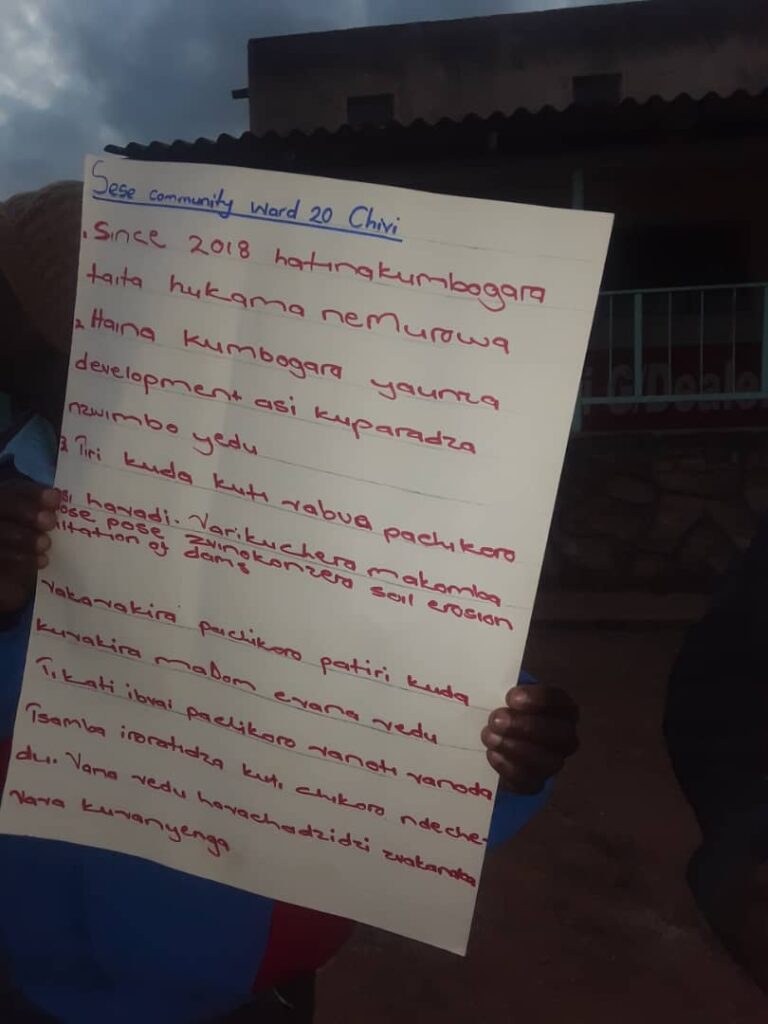
Community members of Sese Community Trust had a flash demonstration at Sese Business Centre and Danhamombe school turnoff where they held placards demanding the mining company moves out of the school area as well as stopping the mining activities which they said were not benefitting the community.
Murowa Diamond Mining Company started exploration in 2018 and since then they have camped in the school yard, a development which the community is saying affects the learning of their children.
They are also saying the company vehicles are degrading the area and the football pitch is no longer usable as vehicles pass through the pitch.
They also accuse the company of occupying the area earmarked for the school expansion and they have cannot develop to the area they are currently occupying.
The community Trust Chairperson Musiiwa Musiiwa said plans to construct hostels for a boarding facility at the school cannot go on as the company is camped in the school yard.
“We want to make this school a boarding and the area they are camped is where we want to start constructing girls’ hostels, “said Musiiwa.
The demonstrators held placards written that the mine was failing to engage the local community but bribing a few traditional leaders.
The mine is also accused of causing siltation in local weirs while male workers are reportedly engaging in illicit affairs with young girls and married women.
Sese community also accuse the mine of not doing any social responsibility as they are not financing developmental projects beneficial to the community.